To reduce wet waste weight, do four things in order: measure what you throw away, stop producing the avoidable part, keep food waste out of general waste bins, and take the water out of what is left. Water is usually the heaviest part of wet waste, and since Irish commercial collections are now charged by weight, every kilo of liquid you remove or divert comes off your bill.
This guide is written for facility managers, business owners and procurement officers on Irish sites: kitchens, food producers, retailers, offices and warehouses. It covers what counts as wet waste, how to weigh it, what the rules require, and where equipment makes sense.
TL;DR
- Wet waste is mostly water, so weight falls fastest when you prevent food waste, segregate it into its own bin and drain or press out liquids before collection.
- Since July 2023, commercial collectors must weigh individual bins and offer price plans where recycling or bio-waste costs less than residual disposal, so a lighter general-waste bin is a direct saving.
- Food waste segregation is a legal duty for Irish commercial premises that prepare, consume or supply food, and failure can lead to notices, fixed payment notices or prosecution.
- Start with a short audit: weigh bins for two weeks, find the biggest wet stream, then decide between prevention, dewatering or on-site treatment.
Table of Contents
- What counts as wet waste in a business
- Why weight matters more than ever on Irish bills
- Step 1: measure what you actually produce
- Step 2: prevent the waste in the first place
- Step 3: segregate, label and drain
- Step 4: take the water out
- Where the waste goes afterwards
- A worked example: a 60-seat restaurant
- Our perspective on wet waste
- Work with Compact
- A checklist to take back to site
- FAQ
- Sources
What counts as wet waste in a business
Wet waste is any waste carrying a lot of moisture: food scraps and trimmings, spoiled produce, coffee grounds, fats and gravies, process residues, washdown sludge and anything that leaks. In a hospitality kitchen it is plate waste and prep waste. In a food factory it can be pressings, paunch contents or filter cake. In an office it is the canteen caddy and the cups half full of coffee tipped into the bin.
Many businesses assume they are not food waste producers. The national information note for commercial premises says otherwise: commercial premises that produce food waste include food retailers, food producers, offices, warehouses, logistics centres and other institutional or commercial facilities, regardless of whether there is a canteen. If staff eat lunch on site, you are probably in scope.
The weight problem comes from the water. A bin of wet food waste weighs far more than the same volume of cardboard or film, and when it ends up in a residual bin, it drags the whole collection into a heavier, dearer category. That is why wet waste is the first stream to attack when you want to cut weight-based charges.
Why weight matters more than ever on Irish bills
Until recently many commercial customers paid per lift or on a flat rate. That has changed. Regulations effective from July 2023 require commercial collectors to provide residual, mixed dry recyclable and bio-waste bins, to weigh individual bins, and to offer price plans where recycling or bio-waste costs less than municipal waste disposal.
In practice that means two levers on your invoice:
- Move wet waste out of the residual bin. The same kilo of food waste is billed at a lower rate in the bio-waste bin than in general waste, under the price plans collectors must now offer.
- Make what remains lighter. Less liquid in every bin means fewer kilos billed, whichever stream it sits in.
The savings can be real. A Tipperary County Council publication reports that a pub saved around €4,000 a year on waste collection charges by segregating at source and reducing food waste. Your figure will depend on your volumes and your collector’s rates, which is why you measure first.
Step 1: measure what you actually produce
You cannot reduce what you have not weighed. The EPA’s guidance for the hospitality sector says businesses can estimate annual food waste through an internal assessment, periodic visual checks of bins, or default factors from national studies. Visual checks are a start; scales are better.
A simple two-week method:
- Put a platform scale next to the bins in the kitchen, loading bay or canteen.
- Weigh each wet stream separately at the end of every shift: prep waste, plate waste, spoilage, liquids, process residues.
- Record the weight, the date and the reason (overproduction, trim, expired stock, returns).
- Compare your totals with the weights on your collector’s dockets.
- Rank the streams by weight. The top one or two get your attention first.
Two weeks is enough to show patterns. Weekday against weekend, event days against quiet days, and one supplier’s produce against another’s often reveal the cause on their own.
If you want a structured version, our waste audit checklist for managers walks through weighing and recording. Larger sites, or those without time, can ask for a free waste audit and have the measurement done with you.
Check the cleaning side too
Wet waste is not only food. Washdown water, sludge and cleaning residues add weight and often end up in the same bins. Methods such as food-grade cleaning without water can reduce how much liquid your cleaning routine puts into the waste stream on production sites, so include cleaning in your weighing exercise.
Step 2: prevent the waste in the first place
The cheapest kilo to collect is the one that never existed. The US EPA lists source reduction steps that apply in any commercial kitchen or food plant: compare purchasing inventory with customer orders, adjust menus, improve production and handling, store food properly, and use surplus or trimmings in new dishes.
Your weighing data tells you which of these to try. Typical matches:
| What the weights show | Likely cause | First fix |
|---|---|---|
| Heavy plate waste on one dish | Portion too large or an unpopular side | Resize the portion, offer a half portion |
| Full trays of expired stock | Over-ordering, poor rotation | Order against actual covers, label dates, first in first out |
| Large prep trim weights | Cutting method or product spec | Review specs, reuse trimmings in stocks and soups |
| Heavy Monday and Friday bins | Weekend forecasting | Adjust ordering to the day |
| Wet waste from returns or spoiled goods | Storage temperature or handling | Fix storage, tighten receiving checks |
The Tipperary publication frames this as a waste hierarchy: prevention first, then reuse or redistribution, then recycling, supported by audits, staff training and swapping single-use packaging for reusable alternatives. Treat dewatering and treatment equipment as the step after prevention, never a substitute for it.
Step 3: segregate, label and drain
Segregation does two jobs. It keeps you legal, and it stops wet food waste from inflating the weight and cost of your residual bin.
The legal baseline
In Ireland, commercial premises where food is prepared, consumed or supplied must segregate food waste and have it collected by an authorised collector, treated on site by authorised treatment, or delivered to an authorised facility. The same note says that failure to segregate can lead to local authority enforcement, including formal notices, fixed payment notices or prosecution. For a fuller walkthrough, see our guide to food waste regulations in Ireland.
Practical set-up
Singapore’s National Environment Agency publishes a clear handling guide. Its advice translates well to Irish kitchens: use dedicated, clearly labelled food-waste bins, put a general-waste bin beside them, train staff in segregation, and drain gravy or water from food waste with a basket before treatment.
On your site that means:
- Bins at the point of waste. A food-waste bin at every prep station and the dish return, with a general-waste bin beside it so staff never have to choose between walking or guessing.
- Clear labels and colours. Match your collector’s bin colours and use pictures of what goes in.
- A draining step. Tip liquids down the appropriate drain, strain soups and sauces, and use a perforated basket or colander over the bin for plate scrapings.
- Short training. Ten minutes at induction and a reminder at a team meeting. Most contamination comes from new or agency staff.
- Compostable liners only if accepted. Check with your collector before using them. Certified compostable packaging follows the EN 13432 standard, and the Seedling logo is a common mark, as the national My Waste guidance explains.
Audit the bins weekly for the first month. Photograph contamination and show the team. Visible feedback works better than a memo.
Step 4: take the water out
Once the avoidable waste is gone and the rest is in the right bin, the remaining lever is physical: remove liquid from what you generate.
Simple measures
Draining baskets, strainers and a short drip time before bins are closed all help in small kitchens. They cost almost nothing and make a measurable difference to the weight of the food bin.
Dewatering presses and shredders
For sites that produce wet organic waste in volume, a dewatering press or shredder is the next step. It separates the liquid from the solids, so the solids are lighter and drier and the liquid goes to the appropriate route. The principle is long established in Irish industry. At one licensed meat plant, paunch contents are dewatered on a press, the liquid goes to the treatment plant, and the organic solids are land spread.
Food producers, processors, large catering operations and packaging-heavy sites are the usual candidates. The point is not the machine itself, but what it does to your weight: less water in the bin means fewer billed kilos and fewer collections. Our range of industrial dewatering shredders is built for this job, and our page on leachate management explains how liquid runoff is handled on Irish sites.
Liquid left over after dewatering still needs a lawful route, whether that is your site’s trade effluent arrangements or a licensed collector. Agree this with your environmental adviser or the relevant authority before installing equipment.
On-site treatment
Some sites prefer to treat food waste where it is produced. The Irish rules allow authorised on-site treatment as one of the compliant routes. Commercial composting machines reduce volume and weight of food waste on site and can be worth considering for a canteen, hotel or food retailer with steady volumes. See our organic waste composting machines and the commercial food composter cost guide for what to budget and what to ask.
Where the waste goes afterwards
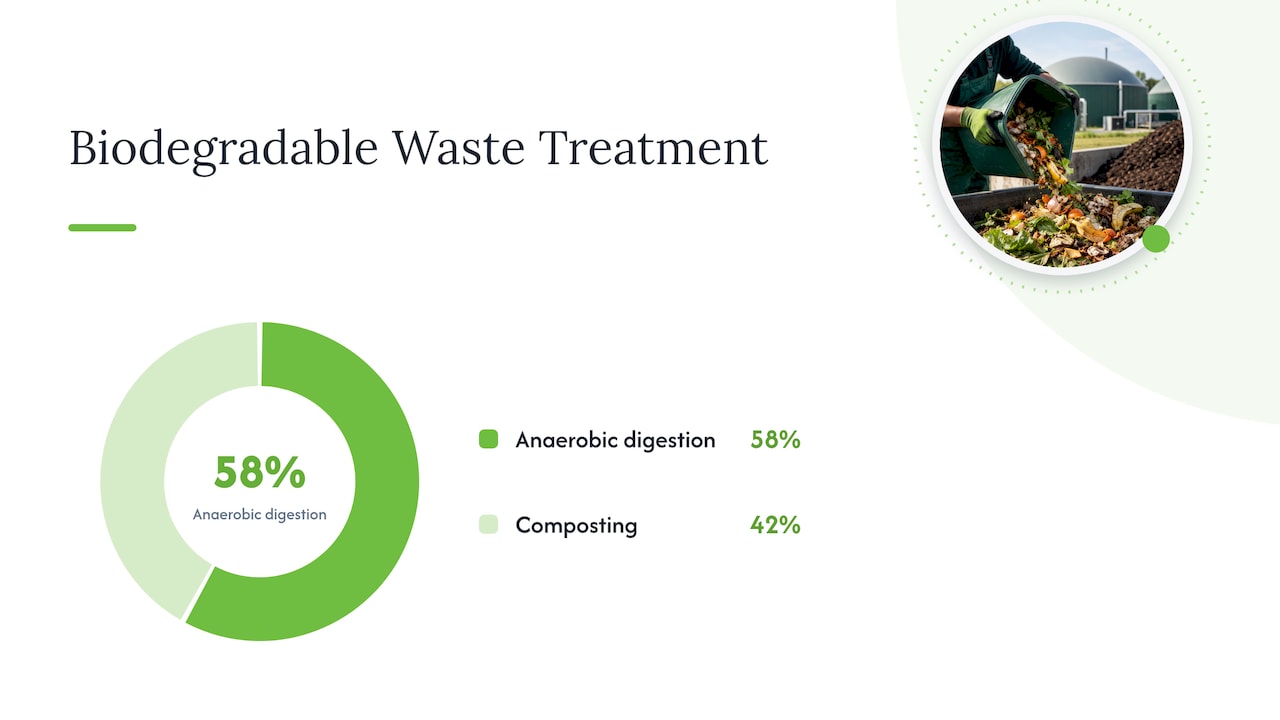
It helps to know what happens downstream, because it explains why collectors price bio-waste lower than residual. According to EPA statistics, around 548,000 tonnes of biodegradable waste were collected in Ireland for treatment in 2024, with 58% going to anaerobic digestion and 42% to composting. Residual waste is different: the same EPA page notes that biostabilisation is used to break down biodegradable material in residual waste to limit gas and leachate before landfilling. Food waste in its own bin has a cleaner, cheaper route to a useful end.
A worked example: a 60-seat restaurant
The figures below are illustrative, not client data. They show how the steps combine.
- Measure. Two weeks of weighing show the general-waste bin is mostly wet: plate scrapings and prep trim sit in it with the packaging.
- Prevent. Portion sizes on two dishes are reduced and ordering is matched to booked covers. Prep trim is reused in stocks.
- Segregate. Food-waste bins go to every station, with a general-waste bin beside each.
- Drain. Staff strain liquids and use a basket over the bin for plate scrapings.
- Review. After a month, the residual bin is lighter and collected less often, and the weight moves to the lower-rate bio-waste stream.
No equipment was needed. For a food plant the same sequence applies, with step four replaced by a dewatering press.
Our perspective on wet waste
In our experience, the businesses that save most are the ones that treat waste as a measurement problem before they treat it as a disposal problem. Most sites know their bin lift count but not their kilos, and almost none know how much of those kilos is water. Once they do, the decisions become obvious.
We would put the order as: weigh, prevent, segregate, drain, then invest. Equipment earns its place only when the audit shows a steady wet stream that the basic steps cannot shrink. We would rather tell a customer a free fix is enough than sell them a machine they do not need.
The other half of the picture is dry waste. Cardboard and plastic are the part of your waste that has value, and while you are already weighing, you can see what a bale of it would earn. That is why we offer audits, equipment and a buyback scheme as one service: the audit finds the saving, the equipment delivers it and the buyback turns your dry recyclables into income that offsets what you spend on wet waste.
— Graham
Work with Compact
If you would like the numbers rather than the theory, ask for our free waste audit. We look at what your site produces, separate wet and dry streams, and tell you where the weight and cost sit. From there we can supply dewatering equipment, balers or compactors where they pay back, and buy back your cardboard and plastic bales through our bale buyback scheme. One team covers audit, equipment and collection.
A checklist to take back to site
- Weigh each wet stream for two weeks and rank them.
- Check your collector’s invoice for residual, recycling and bio-waste rates per kilo.
- Fix the top cause of avoidable waste first.
- Put labelled food-waste bins beside general-waste bins at every point of use.
- Add a draining step for liquids and scrapings.
- Train new and agency staff at induction.
- Re-weigh after four weeks and compare.
- Consider dewatering or on-site treatment only if a large wet stream remains.
Office sites can use the same approach at smaller scale; our office waste audit guide lists costed fixes for facilities teams, and our guide to cutting waste disposal costs covers the billing side.
FAQ
How can I reduce wet waste weight without buying equipment?
Prevent and segregate first. Match ordering to demand, resize portions, put labelled food-waste bins beside general-waste bins and drain liquids before they reach the bin. Weigh before and after so you can see what each change delivered.
Does moving food waste to a brown bin really lower my bill?
Usually it does. Since July 2023, commercial collectors must weigh bins and offer price plans where bio-waste costs less than residual disposal. Check your own contract and per-kilo rates, because plans differ between collectors.
Do offices need to segregate food waste?
Possibly. The national information note lists offices among commercial premises that produce food waste, regardless of whether there is a canteen. If food is consumed or supplied on your premises, segregation applies, and you should confirm the details with your collector or local authority.
When is a dewatering machine worth it?
When your audit shows a large, steady wet stream that prevention and draining cannot shrink, such as process residues or high-volume food preparation. The saving comes from lighter solids and fewer collections. We can assess this on a free waste audit before you commit.
Sources
- Information Note: Commercial Premises Regulatory Obligations, My Waste
- Introduction of incentivised waste collection charges, gov.ie
- Calling Time on Waste, Tipperary County Council
- Pathway to less food waste and better margins, EPA
- Prevent Wasted Food Through Source Reduction, US EPA
- Food Waste Segregation and Treatment, NEA Singapore
- Brown bin collection service, My Waste
- Dawn Meats licence document, EPA
- Composting and Anaerobic Digestion Statistics for Ireland, EPA
- Food-grade cleaning without water