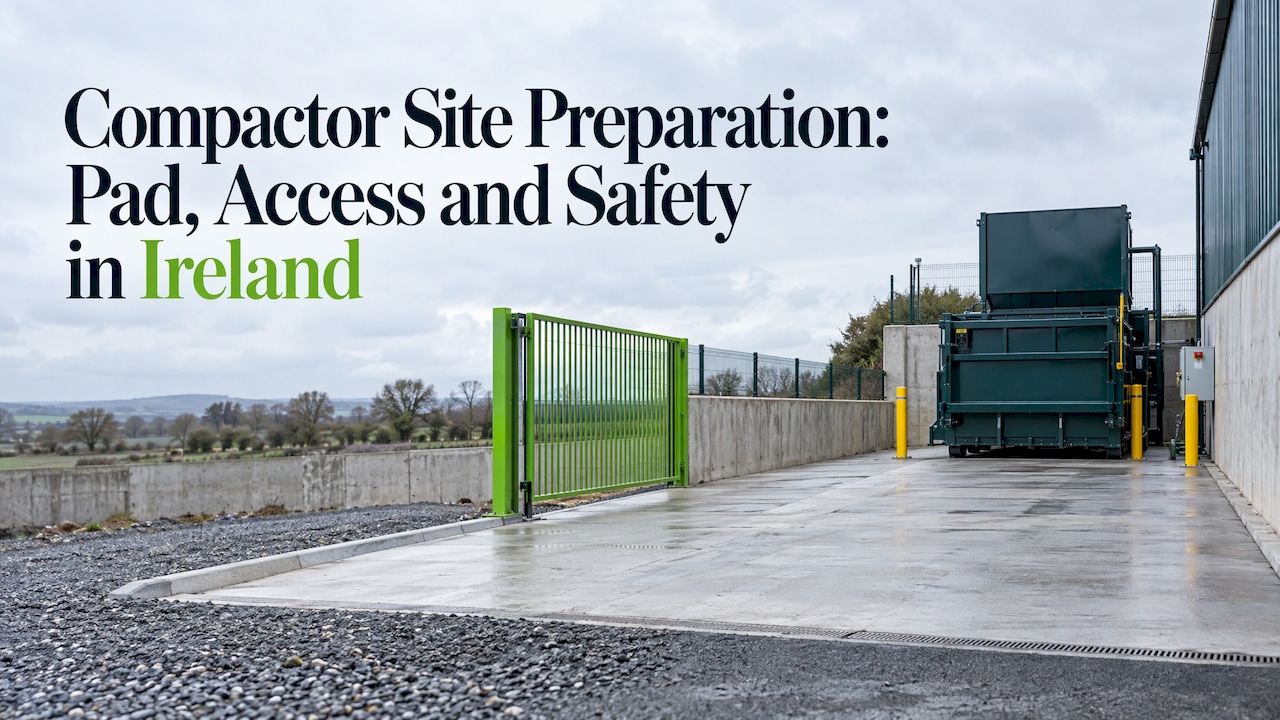
A waste compactor is only as good as the ground it stands on and the space around it. Before delivery you need a level, reinforced concrete pad sized to the unit, a compacted base under it, drainage, clear access for the collection vehicle, and a safe working area around it. Most of the cost and delay in a compactor project comes from getting one of these wrong, so settle them first. Our free waste audit looks at your specific requirements before any equipment is chosen, which is the right moment to fix the pad and access plan.
This guide is for facility managers, property managers and business owners installing a static or hydraulic compactor on a commercial site. It does not cover the handheld plate compactors that builders use on soil, apart from the one place they matter: preparing the ground under your pad.
TL;DR
- Plan a level, reinforced concrete pad about 6 in (150 mm) thick, built on compacted earth with a stone base, and sloped slightly so rainwater drains away.
- Size the pad from the unit’s own drawings: published specifications run from about 10 ft x 36 ft for one manufacturer to 12 ft x 40 ft for a large horizontal unit, plus clearance for the haulage vehicle.
- The ground must take the weight of plant and equipment, including delivery and lifting vehicles, before anything heavy arrives.
- Irish law requires employers to choose work equipment to suit the working conditions, including the nature of the ground, and to risk-assess its use.
- Settle unit size, pad, access and operator training together, not one after the other.
Table of Contents
- Start with the unit, not the slab
- What a compactor pad needs
- Preparing the ground under the pad
- Access, clearances and position
- Irish safety duties during preparation and use
- A pre-delivery checklist
- How long a compactor lasts
- Our view: plan the pad as part of the system
- Next step: match the machine to your site
- FAQ
- Sources
Start with the unit, not the slab
Pad dimensions follow from the machine. A compactor that feeds a bin through a hopper, a self-contained unit that is lifted onto a vehicle, a hydraulic compactor and a bin press all have different footprints and different handling needs. Pouring a slab before you have chosen the unit is the most common way to end up with a pad that is too short, too narrow or in the wrong place.
Three inputs decide the size of a commercial compactor: how much waste you produce, what it is, and how often it is collected. Our guide to commercial compactor size and capacity walks through them. If you are not sure which of your waste streams justifies a compactor, a baler or neither, start with the free waste audit, because the answer changes the pad, the power supply and the route the vehicle takes.
Once you have a model, ask for its installation drawing. It states the footprint, the weight, the anchor points, the electrical load and the clearances the manufacturer requires. Everything below is a general picture of what those drawings usually contain. Where the drawing and a general figure differ, the drawing wins.
What a compactor pad needs
Irish standards for commercial compactor pads are not published as a single rule you can quote. The most detailed published specifications come from US manufacturers and university facilities standards. They agree closely with each other, which makes them a reliable guide to what a sound pad looks like. Treat them as ranges to discuss with your engineer and supplier, not as Irish regulation.
Concrete, thickness and reinforcement
One manufacturer’s pad requirements call for reinforced concrete of at least 3,000 PSI, 6 in thick. That is roughly 150 mm and a strength of about 20 MPa. A US university’s facilities standard asks for the same strength and thickness, with #4 reinforcing bars at 12 in centres each way, poured on compacted earth over a base of at least 4 in of crushed stone. Another university standard also specifies 6 in of reinforced concrete on a prepared subgrade.
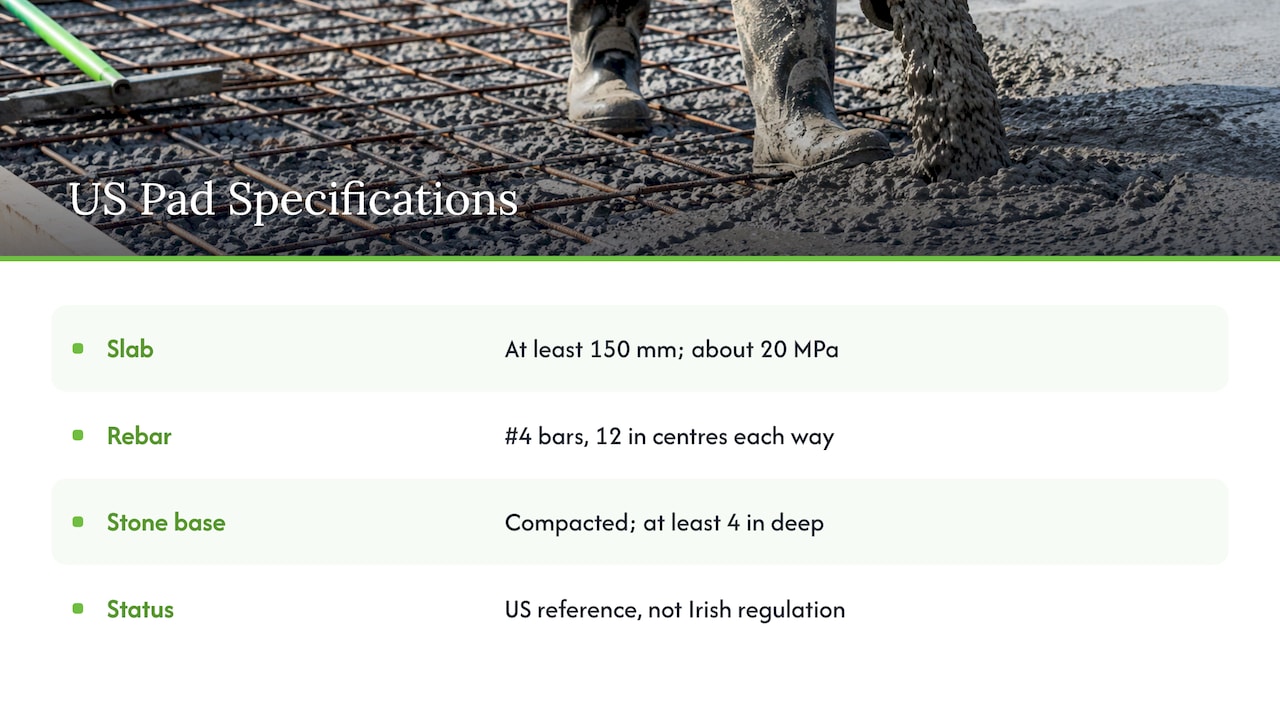
The common thread is a reinforced slab, not a thin screed, resting on a stone base that sits on properly compacted ground. A compactor concentrates weight and vibration in a small area, and a collection vehicle drags a full container on and off it. A slab without a good base cracks and settles at the edges, and then the unit no longer sits level.
Size of the pad
Published pad sizes vary with the unit:
| Specification | Pad size | Notes |
|---|---|---|
| One manufacturer’s manual | 10 ft x 36 ft (about 3 m x 11 m) | Level, preferably flush with the ground, 2 ft clearance to a building wall, 45 ft clear space from the pad end for the container-handling vehicle |
| US university standard, self-contained compactors | At least 12 ft x 28 ft (about 3.7 m x 8.5 m) | Bollards at the edges |
| US university standard, 20 to 30 cubic yard horizontal compactors | At least 12 ft x 40 ft (about 3.7 m x 12.2 m) | 4 in stone base under the slab |
Sources: the manufacturer’s pad requirements, the self-contained compactor standard and the horizontal compactor standard.
Notice the clear space beyond the end of the pad. The vehicle that lifts or pulls the container needs a straight run to do it, and that space is easy to forget when you are only looking at a site plan of the slab itself.
Level, slope and drainage
The pad should be level for the machine but not flat for water. The same university standards slope the pad by 1/8 in per foot so rainwater drains without puddling. A hauler-focused guide gives a range of 0.5 to 1.0 per cent. Use the slope to carry runoff away from the compactor and from doors, and check with the unit’s drawing that a slope is acceptable for that model. Compactors that hold liquids, such as wet food waste, also need a plan for where leachate goes, which is a good question to raise at audit stage.
Anchoring and protection
A stationary compactor is usually bolted down. Manufacturer manuals specify minimum anchor bolts, for example 3/4 in x 5 in bolts, and one guide cites four 3/4 in x 6 in anchor bolts as a minimum. Bollards protect the unit and any adjoining wall from vehicle strikes. One standard asks for 4 in concrete-filled steel pipe on 30 in centres, embedded at least 2 ft. Because anchor positions come from the unit itself, they should be set out from the installation drawing, not from a generic figure.
Preparing the ground under the pad
This is where the plate compactor in the search results does belong. The subgrade, the natural ground or fill under the stone base, must be stripped and compacted before the slab goes on.
- Strip the site. Official earthworks guidance says a foundation must be prepared by removing vegetation, topsoil, loose and organic material and standing water, and that frozen material must not be placed on or over it.
- Build up in thin layers. Fill is placed in specified lifts, at the right moisture content, with added water mixed uniformly through the full lift. Thick lifts do not compact through.
- Control moisture. A plate compactor manual warns that too much moisture stops particles compacting properly; very wet soil should dry first, and very dusty soil needs water.
- Fill dips and recompact. Equipment hire guidance notes that material will not level itself out: fill any dips that appear, then compact the area again.
- Check the density. Pavement engineers generally specify not less than 95 per cent of maximum laboratory density for the top 150 mm of subgrade, with the soil at or near its optimum moisture content. In plain terms, 95 per cent means the soil has been squeezed to 95 per cent of the densest state it can reach in a lab test. Ground below that figure keeps compressing after construction, which is how pads crack and tilt.
- Lay the stone base and pour. Only then does the reinforced slab go on.
Your groundworker or engineer will carry out and certify this work. What you control as the site manager is asking for the density result before the slab is poured, because nobody can correct a poorly compacted base once it is under 150 mm of concrete.
Access, clearances and position
Walk the route the delivery vehicle and the collection vehicle will take, not just the spot where the machine goes.
- Turning and approach. Check gate widths, overhead obstructions, kerb heights and the turning circle for the longest vehicle that will visit.
- Straight run at the pad end. Allow the clear space beyond the pad that the manufacturer specifies for container handling.
- Wall clearance. One manual asks for 2 ft clearance to a building wall and no less than 24 in from any structure. This keeps the unit serviceable and reduces fire spread risk.
- Combustibles. Keep other stored material away. Equipment hire guidance for plate compactors suggests keeping combustibles at least 5 m away, and it is sensible to apply the same discipline around any machine with a motor.
- Walking route. Staff should reach the hopper or loading door without crossing the haulage route.
- Lighting and CCTV. Staff often use the area early or late. Light the pad and the approach.
- Power. Electric compactors and balers need a suitably rated supply and isolator close by. The installation drawing gives the load, and your electrician sizes the supply to it.
For balers, which have their own positioning and commissioning steps, see our baler installation guide.
Irish safety duties during preparation and use
If you are an employer in Ireland, site preparation is part of your safety management, not just a building task.
The Safety, Health and Welfare at Work (General Application) Regulations 2007 require employers to make sure work equipment complies with relevant safety law, that selection takes account of the specific working conditions and hazards, and that mobile lifting equipment is used so it stays stable in all foreseeable conditions, taking account of the nature of the ground. That last point matters for the crane or lorry that sets your container in place.
The Health and Safety Authority’s guide to those regulations explains that conditions of use can include operating limits, supervision, weather and ground conditions, and that when in doubt you should contact the equipment manufacturer. Its groundworks guidance says the area around an excavation should be inspected to confirm it can take the weight of plant and equipment before compaction plant is brought on site. Apply the same thinking to the pad area and its approach.
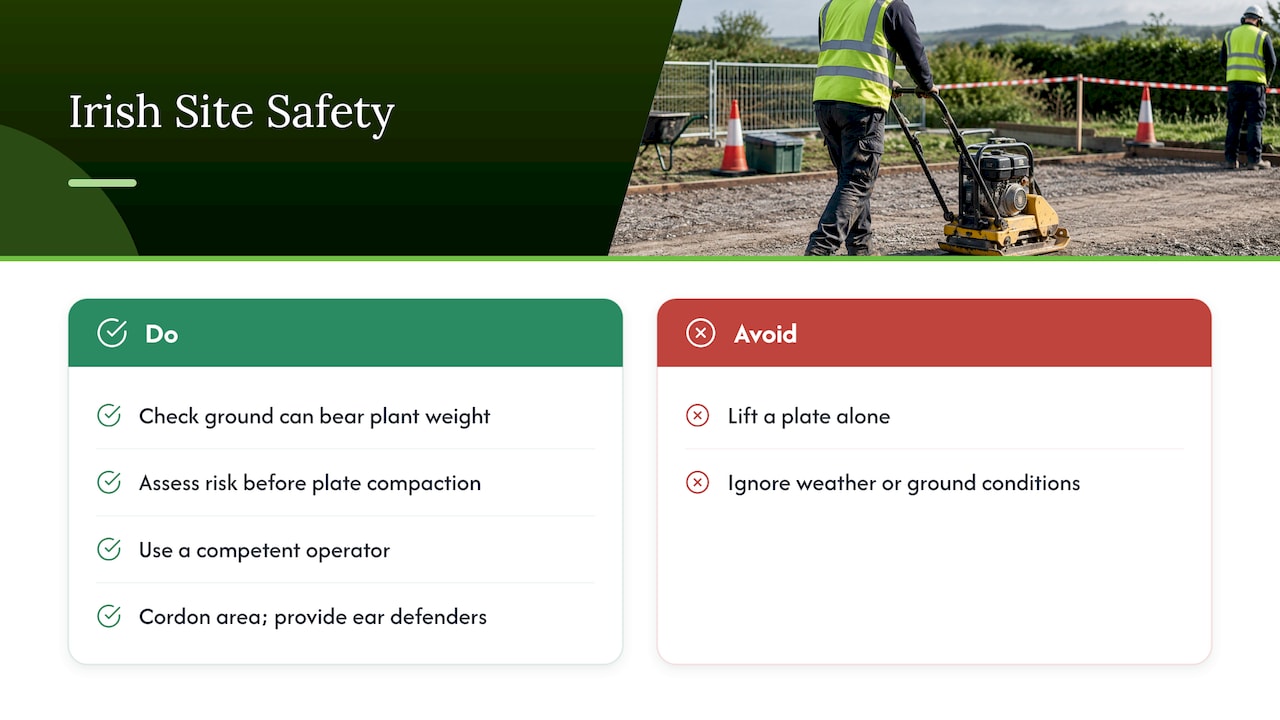
During any ground compaction with a plate, equipment hire guidance asks for a risk assessment before use, a competent operator, a cordoned no-go area, and ear defenders for everyone nearby. The same guide notes the plate can weigh up to 84 kg and should never be lifted alone.
Once the unit is running, your obligations move to safe operation. Our compactor safety guide for Irish employers covers what to put in place, and the operator training guide covers what staff should learn before they load or empty the machine.
A pre-delivery checklist
Work through this with your supplier and contractor about two weeks before delivery:
- Installation drawing received and the pad dimensions match it.
- Subgrade stripped, compacted and density confirmed.
- Stone base laid, reinforced slab poured, cured and sloped to drain.
- Anchor positions set out from the drawing.
- Bollards or barriers in place where vehicles pass.
- Access route and turning checked for delivery and collection vehicles.
- Power supply and isolator installed and rated for the unit.
- Clear space at the pad end and clearance to walls confirmed.
- Risk assessment done and operators trained.
If a used unit is on your shortlist, the same pad and access questions apply, and our used compactor inspection guide covers what to check before buying.
How long a compactor lasts
Buyers ask this because it affects whether to pay for a proper pad. Service life depends on the duty it sees, how often it is serviced, and whether operators load it as intended. A level, well-drained, firmly anchored pad protects the frame and the ram alignment, so the groundwork is part of the lifespan, not a separate cost. We do not publish a single lifespan figure for compactors because it depends on the model and the waste it handles, and your supplier’s documentation for the model is the right reference.
Our view: plan the pad as part of the system
Most compactor problems we see start on paper, not on site. A business decides it wants a compactor, the pad gets poured to a rough size, and only later does anyone ask what the collection vehicle needs, where the power comes from, or whether the waste would be better baled.
That is why our service starts with the audit. The free waste audit analyses your specific requirements, so the machine, the position and the route are chosen from your own waste, not from a catalogue. From there we supply the equipment, whether a cardboard compactor, a hydraulic compactor or a baler, and, where your waste is cardboard or plastic, we buy back the bales so the material earns a rebate rather than a disposal cost.
A pad built to the right drawing, with good ground under it and clear access around it, is what lets all of that run smoothly for years. Settle the groundwork first and everything after it gets simpler.
Graham
Next step: match the machine to your site
If you are planning a compactor or baler and want the pad, access and equipment decided together, start with our free waste audit. We work from audit through equipment to recycling and payment, so one team keeps the whole plan consistent.

If you already know what you need, look at our cardboard compactors, hydraulic compactor or cardboard balers. Where you generate baled cardboard or plastic, our bale buyback scheme turns it into revenue.
FAQ
What does 95% soil compaction mean?
It means the soil has been compacted to 95 per cent of the maximum density it can reach in a laboratory test. Engineers commonly specify this for the top 150 mm of subgrade, with the soil at or near its optimum moisture content. It is the reading to ask for before a pad is poured.
How thick should a compactor pad be?
Published manufacturer and university specifications use 6 in (about 150 mm) of reinforced concrete of at least 3,000 PSI, for example in a US university facilities standard. Your unit’s installation drawing gives the figure that applies to your model.
Does a compactor pad need to slope?
Yes, slightly. A gentle fall lets rainwater drain instead of pooling around the unit. Published standards use 1/8 in per foot, while the machine itself should still sit level, so check the slope against the unit’s drawing.
Do I need to train staff before the compactor arrives?
Operators should be trained and the risk assessment done before first use. Irish regulations require employers to account for working conditions and hazards when selecting and using work equipment, as set out in the General Application Regulations. Our operator training guide lists what to cover.
Sources
- Part 645 Construction Inspection, Earthfill and Rockfill (NRCS)
- Compactors guide (HSS)
- CCR-02 Concrete Pad Requirements
- 11 82 26 Waste Compactors and Destructors (Duke University)
- Waste Handling and Recycling standards (University of Florida)
- Compactor Enclosure Sizing, Gates and Clearances
- Vibratory Plate Compactor manual
- Subgrade Preparation for New Pavements (Pavement Interactive)
- Safety, Health and Welfare at Work (General Application) Regulations 2007
- Safe System of Work Plan for groundworks (HSA)
- Guide to the General Application Regulations, work equipment (HSA)