A baler installation goes well when the work is done before the truck arrives: a measured space, a sound floor, the right power supply, a clear delivery route and a safe-isolation plan. This guide covers each stage in order, from site survey to first bale, with the Irish rules that apply to the electrical and safety side. It also covers where to put a baler or compactor so it stays useful once the site is busy.
TL;DR
- Start planning the moment you choose the model and location. Delivery lead times are long enough to get the site ready, and electrical upgrades are the usual cause of delay.
- Measure the operating footprint, not just the machine: operator space, loading, bale ejection and maintenance access all need room.
- In Ireland, a new electrical installation must be inspected and tested by a competent person before it is made live, and the paperwork must be kept.
- Check the three-phase rotation direction on first start-up. A wrong rotation can damage the hydraulic pump within minutes.
- Treat guarding, interlocks and lock-out procedures as part of the installation, not as extras for later.
Table of Contents
- Start with the site, not the machine
- Choosing the position
- Floor and foundation
- Delivery access
- Electrical supply and testing in Ireland
- Guarding, interlocks and isolation
- Commissioning step by step
- Training before the first shift
- Our view: what we see go wrong
- Choosing equipment that suits the space
- Pre-delivery checklist
- FAQ
- Sources
Start with the site, not the machine
Most installation problems come from decisions made weeks earlier. Industry guidance on baler and compactor installation says planning should begin as soon as the model and location are chosen. It should list the trades you need, such as electricians and mechanical contractors, and coordinate their diaries so production downtime stays short. Power supply upgrades are where downtime tends to grow.
You have time to use. One equipment dealer notes that baler delivery times can range from six weeks to six months or more, which is long enough to finish groundwork, book the electrician and clear the space. That article dates from 2013, so treat the range as a guide and ask your supplier for the current lead time on your model.
Before anything is ordered, write down five things:
- The model and its dimensions, weight and power rating, taken from the manufacturer’s data sheet.
- The exact spot where it will stand.
- The route from the public road to that spot.
- Who will supply and test the electrics.
- Who will be trained to operate it.
If you are still deciding between a baler and a compactor, our guide to what you need to know about cardboard balers and our commercial compactor size guide will help you settle that first.
Choosing the position
The machine’s footprint on the brochure is the smallest space it will ever need. Facility managers often underestimate that a baler needs an operating footprint: room for the operator, space to load, and clearance for maintenance and bale ejection. Where this is ignored, the machine ends up blocked by other site activity and loses efficiency.
If you want a method for turning a data sheet into a realistic allowance, this piece on floor space planning for equipment argues for budgeting more than the vendor’s stated footprint. It is written about machining equipment, but the principle carries over to a baler.
A placement checklist
| Question | Why it matters |
|---|---|
| Where does the cardboard come from, and how far does it travel? | A baler tucked at the far end of the building gets used less, and loose cardboard builds up elsewhere. |
| Can a pallet truck or forklift reach the front and the bale exit? | Bales are heavy and must be moved out without crossing pedestrian routes. |
| Is there space to stack finished bales and store them dry? | Wet or scattered bales lose value and create a trip hazard. |
| Is the loading door clear of fire exits and escape routes? | Blocked exits are a separate safety failure, whatever the machine. |
| Can unauthorised people reach it? | Guidance on compaction equipment says to locate it to avoid or minimise access by unauthorised people, especially in a public area. |
| Is there lighting and ceiling height for the full ram or door travel? | Operators need to see inside the chamber and the controls. |
The same logic applies to compactors. A compactor is usually fed from a hopper or chute and emptied by a collection vehicle, so the vehicle’s turning space and overhead clearance decide the position as much as the machine does. For a compactor, add a lorry’s access route and a safe standing area for the driver to your checklist.
Indoors or outdoors
Vertical balers usually go inside, near the point where cardboard is generated: a stockroom, a loading bay or a goods-in area. Larger horizontal and auto-load machines often need a dedicated bay or a yard position. Whichever you choose, keep the controls and power equipment dry and keep the area drained so water does not sit around the base. Our pages on autoload balers, jumbo load balers and the baletainer show how much the layout differs by machine type.
Floor and foundation
A baler concentrates heavy loads and vibration on a small area. Manufacturer guidance for industrial balers points to a level, reinforced concrete floor that can carry both the machine’s weight and its dynamic load, often with anchors fixed into the concrete so vibration does not move the unit. That guide is for one vertical model, so the figures for your machine, including anchor size, come from your own manual.
In practice:
- Check the slab for cracks, settlement, slope and thickness before delivery, not on the day.
- Ask the supplier for the weight, the footprint load and any anchor or base-plate requirements in writing.
- If the floor is suspended, such as a mezzanine or a first-floor loading area, get a structural engineer’s opinion before you commit.
- Allow for the forklift or pallet truck that will move the machine in. Some vertical balers have fork sleeves at the front or side for exactly this, so the handling method is built into the design.
Delivery access
A machine that cannot get through the door is a very expensive problem. Measure the whole route: gate width, door openings, turning circle for the delivery vehicle, headroom under canopies and cables, and ground that will bear the vehicle. Confirm who is unloading, with what equipment, and that the lifting gear is rated for the machine’s weight. Keep pedestrians and other vehicles out of the unloading zone while it happens.
Some balers ship with parts packed inside the chamber or bound for fitting afterwards. One owner’s manual describes parts shipped inside the machine that require installation, and another lists steel transit brackets to be removed from the chamber and kept. Read the unpacking section of your manual before the machine is lifted, so nothing is left in place that should come out.
Electrical supply and testing in Ireland
This is the stage that most often delays an installation, so settle it first. Find out from the data sheet whether your baler needs a single-phase or a three-phase supply, what its rated current is and what isolator it needs. If your building does not have the right supply, the upgrade involves an electrician and, for a larger connection, the network operator, and that can take time. Raise it on day one.
The legal point is clear. Under the Safety, Health and Welfare at Work (General Application) Regulations 2007, new electrical installations and major alterations must be inspected and tested by a competent person before they are made live, and the record of that testing must be available for verification. In plain terms, a registered electrician should connect the machine and certify the work. Do not let anyone from the delivery crew improvise a connection.
For a wider view of what a competent inspection looks at across a site, from earthing to documentation, this factory electrical safety checklist is a useful companion to the baler-specific steps here.
Practical electrical points
- Ask for the isolator to be positioned where the operator can reach it without entering the danger zone, and where it can be locked off.
- If the electrician drills the control enclosure, ask them to clear filings with a vacuum. One manufacturer’s manual warns against using compressed air, because it can push conductive chips onto internal components and cause early contactor failure.
- Keep the test certificate with the machine file. If an inspector, insurer or auditor asks, you will need it.
Guarding, interlocks and isolation
Guarding is part of the installation. Guidance on compaction equipment stresses that guards, particularly around the baler chamber, must be properly interlocked, and experts caution against relying on a single-channel interlock for high-risk equipment, preferring a secondary, robust safety system. That source is UK guidance, so check the equivalent Irish requirements with your safety adviser, but the engineering principle holds.
The Health and Safety Authority names poor maintenance, missing guards and inadequate isolation during cleaning or servicing as leading causes of machinery accidents. Installation is when you can set up the answer: a locked isolator, a lock-out procedure written for this machine, and a named person who holds the keys.
Before handover, test the following with the supplier or engineer present:
- The loading door cannot be opened while the ram is moving.
- The ram cannot start with the door open.
- The emergency stop works and needs a deliberate reset.
- The key or lock system is fitted and the keys are controlled.
- Warning labels are fitted and legible.
Commissioning step by step
Once the machine is positioned, anchored, wired and certified, commissioning follows a consistent order. Your manual takes precedence over this list.
- Remove transit fixings. Take out brackets, ties and packing, and keep any parts the manual says to retain.
- Check the oil and fittings. Look at hydraulic oil level, hoses and connections for leaks or damage.
- Confirm the electrical certificate is in place before the supply is switched on.
- Check the motor rotation. On a three-phase machine, direction matters. A pump run backwards can be damaged within minutes, so compare the rotation with the arrow on the unit. If it is wrong, the electrician swaps any two of the three phases.
- Run empty cycles. Cycle the ram a few times with nothing in it, watching for noise, leaks and any hesitation.
- Test the safety devices listed above.
- Make the first bale. Load clean, flat cardboard, tie the bale with the correct wire or tape and eject it, checking the clearance as you go.
- Record everything: date, who attended, readings and the certificate reference.
Wire and tape matter for the first bale. Using the wrong gauge or strapping leads to burst bales, so have the right consumables on site. We stock baling wire and tape for this reason.
Training before the first shift
An installed baler is not ready until the people using it are. Every operator should know the loading limits, the stop procedure, how to clear a jam safely and why the isolator is locked off before any hands go near the chamber. Our baler training programme sets out six safety skills operators need before working alone. Put the training date in the same plan as the delivery date.
Our view: what we see go wrong
We sell balers and compactors to Irish businesses, and we begin every conversation with the waste, not the machine. That is why we offer a free waste audit: the volume and type of material you produce decide which baler fits, and therefore how much space and power you need.
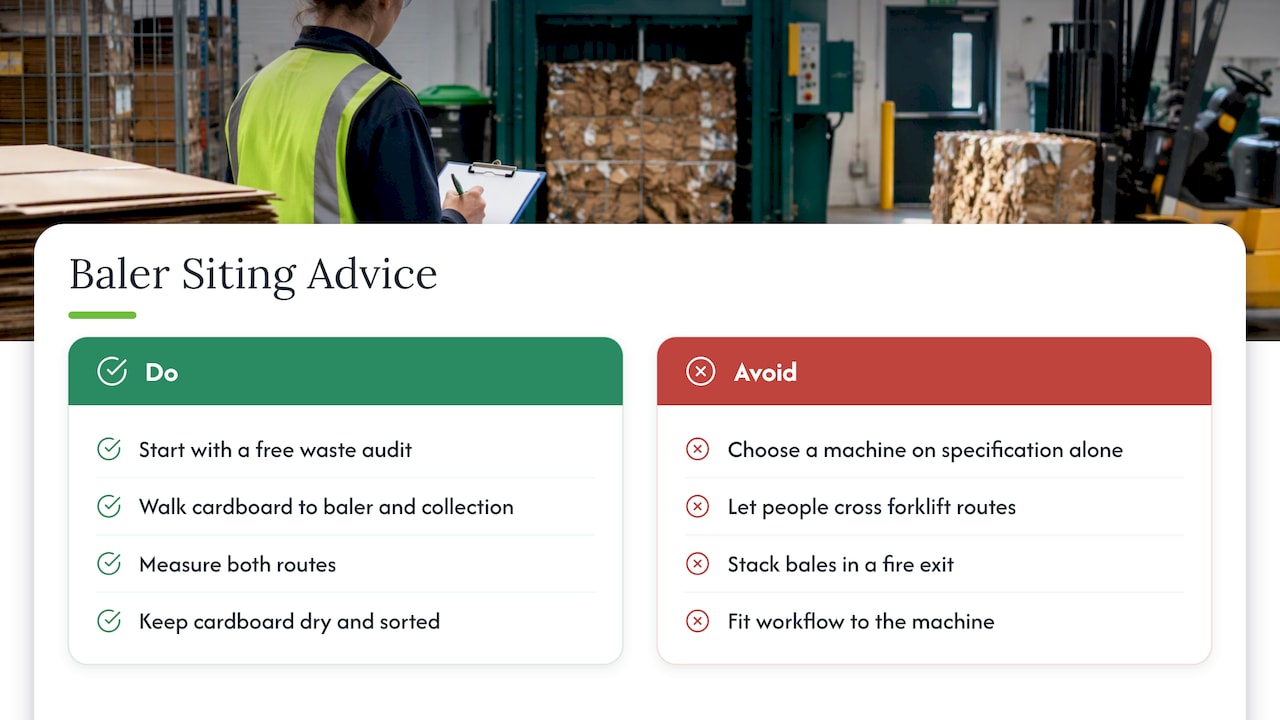
The pattern is consistent. A site picks a machine on specification, then discovers the electrical supply, the door or the position is wrong. The cheapest fix is always the one made on paper. Our advice is to walk the route the cardboard takes from the shop floor to the baler, then from the baler to the collection point, and to measure both. If that walk shows people crossing a forklift route or stacking bales in a fire exit, move the position before you order.
We also think of the baler as an income source rather than a cost. Clean, well-tied bales are what buyers want, so a position that makes it easy to keep cardboard dry and sorted pays back over years. Fit the machine to the workflow, not the workflow to the machine.
— Graham
Choosing equipment that suits the space
If the survey shows your space is tight, you have options. Vertical cardboard balers suit smaller footprints, auto-load and jumbo machines suit high volumes, and compactors suit mixed or wet waste. Refurbished machines can also be a sensible route where budgets are tight, and our refurbished compactors and balers page shows what we can supply. Browse our cardboard balers and cardboard compactors, or look at new and refurbished balers for Irish businesses to compare. Once you are baling, our bale buyback scheme turns the output into revenue.
Pre-delivery checklist
Print this and tick it off with your electrician and supplier.
- Model, weight, dimensions and power requirement confirmed in writing.
- Operating footprint measured, including loading, ejection and maintenance clearance.
- Floor checked, and anchoring requirements known.
- Delivery route measured, with lifting equipment and unloading zone agreed.
- Electrician booked, supply adequate, isolator position agreed.
- Test certificate arranged before the machine goes live.
- Guarding, interlock and lock-out procedure agreed.
- Bale storage area and collection route set.
- Wire or tape on site.
- Operators booked for training.
FAQ
Can I install a baler myself?
Moving and positioning the machine is a job for qualified riggers or the supplier’s crew, and the electrical connection must be made and tested by a competent person under Irish regulations. Your own staff can prepare the site, clear the route and arrange the bale storage. Do not connect power or bypass any guard yourself.
How much space does a baler need?
More than its dimensions. Allow for the operator, loading, bale ejection and maintenance access, and check the figures for your model in the manufacturer’s manual. Measure the route in and out as well as the final position.
Does a baler need to be bolted to the floor?
Often, yes. Manufacturers commonly call for a level reinforced concrete floor and anchoring to stop vibration moving the unit. The exact anchor type and spacing come from your model’s manual, so ask your supplier before delivery.
What happens if the baler motor runs the wrong way?
On a three-phase machine, wrong rotation can damage the hydraulic pump within minutes. Compare the rotation with the directional arrow on first start-up and, if it is reversed, have the electrician swap two of the three phases.
Sources
- Baler & Compactor Installation FAQs, Harmony
- Baling Equipment Installation Made Simple with AES
- Vertical baler user’s guide, MDA Compaction
- Excel EX62 owner’s manual, ManualsLib
- Mill Size Baler Installation & Operation Guide, SINOBALER
- Facilities Management Handbook on Critical Legislation, SCSI
- Safe Hospitality Part 6: Machinery and Equipment, HSA
- Compaction equipment: Managing user and public safety