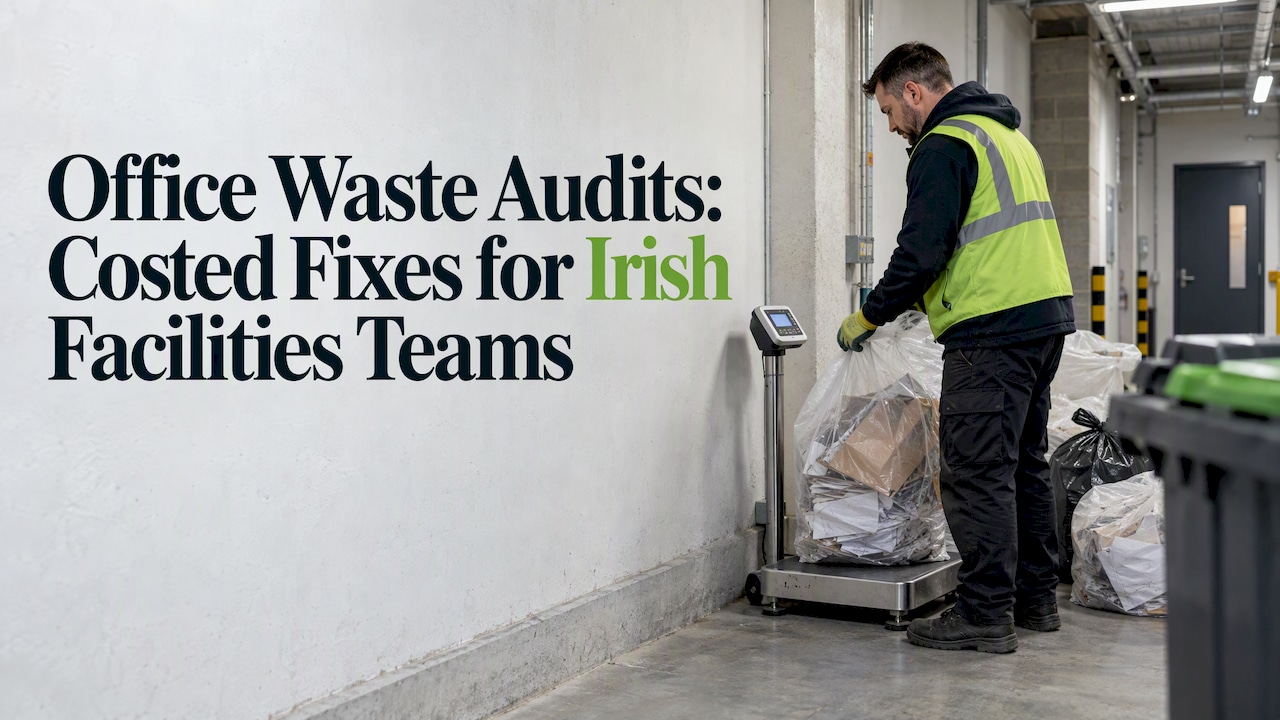
An office waste audit is a measured inventory of what your workplace throws away, and it shows which streams to target and where the savings sit. The EPA’s commercial municipal waste characterisation shows how much recyclable material still ends up in general waste, and at Compact we turn that gap into costed actions.
TL;DR:
- Sample a typical week, complete a risk assessment before sorting, and repeat the audit within a week, averaging results to limit distortion from unusual days.
- EPA sampling found 37% of material in general waste was recyclable, 32% could go to organics, and only 26% was correctly sorted.
- Calculate diversion as recyclables divided by total waste, annualize weekly weights by multiplying by 52, and keep general waste near or below 20%.
- Food waste from office kitchens must be separated for proper treatment; confirm local rules with authorities and collectors, since contamination can trigger extra fees.
- Start with signage, centralized bins, managed print, and staff training; price a baler or compactor only when cardboard or plastic volumes justify it.
Table of Contents
- Why should you run a waste audit before changing anything?
- How do you plan and prepare the audit?
- What happens on the day of the audit?
- How do you analyse the results?
- How do you turn findings into a costed action plan?
- What do the food waste and segregation rules mean for offices?
- How do you communicate the results so people act on them?
- How do you connect audit findings to your existing waste services?
- Why does a baseline matter more than any single initiative?
- Ready for a free professional audit?
- FAQ
- Sources
Why should you run a waste audit before changing anything?
An audit gives you a baseline. Without one, every bin initiative is a guess, and nobody can prove whether disposal costs fell because of your efforts or because of a quiet month. A baseline lets you quantify each stream, spot contamination and set targets you can defend to finance.
The benefits stack up quickly: lower disposal fees as recyclables leave the general waste bin, a higher diversion rate, easier compliance, and hard evidence for ESG reporting. Reports built on audit data can help inform that reporting, as this guide to audit reports and ESG explains.
The scale of the gap: Municipal waste recycled in 2021 was 41%, and total municipal waste generated grew by 11% since 2016. Plenty of room remains to improve segregation.
Two benchmarks are worth keeping in view. General, non-recyclable waste should not exceed about 20% of total waste, and a good-practice paper target is around 7 reams per employee per year, against an estimated average of 20.
How do you plan and prepare the audit?
Preparation decides whether your numbers are representative. A rushed audit on an unusual day tells you very little, so settle the basics first.
- Scope: decide whether you are auditing the whole building, one floor or a single department, and how often you will measure.
- Team and roles: name people for weighing, recording and health and safety, and brief your cleaning staff so bins are not emptied before you collect them.
- Timing: choose a typical week, avoiding events, holidays and office moves. Repeating the audit within a week and averaging the totals improves accuracy.
- Risk assessment: complete one before anyone sorts a single bag, covering manual handling, sharps, broken glass and any hazardous materials.
- Paperwork: print your audit template so every weight lands in the same format. Our own waste audit checklist is built for exactly this.
Involving staff in the audit also pays off. People who see the weights themselves tend to take segregation more seriously afterwards, a point the Northern Illinois University office audit guide makes about buy-in and insight.
What happens on the day of the audit?
On the day, the goal is to turn bags of mixed waste into clean, comparable weights. Work through the steps in order.
- Collect every bag and container, labelling each by the location it came from.
- Lay out tarpaulins in a ventilated, out-of-the-way space and put on your PPE.
- Tip one bag at a time and sort items into labelled containers.
- Weigh each category, then subtract the container weight to get the net figure.
- Photograph notable contamination, such as a coffee cup in the paper bin.
- Record every figure on the template before moving to the next bag.
Use these categories: paper, cardboard, plastics, cans, food, WEEE, confidential paper and general waste.
Your equipment list is short:
- Tarpaulins and labelled boxes
- Bathroom or industrial scales
- Gloves, safety glasses and other PPE
- Pens, a camera and the printed audit template
Pro Tip: Weigh an empty container first and write its weight on the lid, so net weights take seconds rather than a calculator session.
Keep the cleaning team in the loop throughout. If bins are emptied early, the sample is incomplete and the whole exercise loses value. For the underlying methods, the US EPA’s waste assessment instructions describe records examination, walk-throughs and waste sorts, with worksheets you can adapt.
How do you analyse the results?
Raw weights become useful once you convert them into a few key figures. The first is your diversion rate: recyclables divided by total waste, multiplied by 100. It tells you at a glance how much of your waste avoids general disposal.
Next, annualise. Multiply your average week by 52 to estimate yearly tonnage per stream, which is the number finance cares about. The more sample weeks you average, the less a freak week distorts the picture.
Then look at contamination. Count what sits in the wrong bin and how much of it there is. A table makes the picture clear:
| Measure | How to calculate | What to compare against |
|---|---|---|
| Diversion rate | Recyclables ÷ total waste × 100 | Your own baseline, re-audited later |
| General waste share | General waste ÷ total waste × 100 | About 20% maximum |
| Paper use per employee | Annual reams ÷ headcount | 7 reams good practice, 20 typical |
What sampling revealed: in the EPA’s 2022 sampling, 37% of material in general waste could have been recycled and 32% could have gone to organics, while only 26% of materials sat in the correct stream.
Use those findings to set targets stream by stream, not one vague overall number.
How do you turn findings into a costed action plan?
Rank every possible action by cost and impact, then start with the cheap, effective ones. Signage, removing desk bins, switching to managed print and clearer colour coding cost little and often shift behaviour within weeks.
- Centralise bins: use bin stations with consistent colours and labels, as the MyWaste business guidance recommends, and monitor contamination.
- Train staff: a short briefing with your own audit photographs lands better than generic posters.
- Engage suppliers: ask them to reduce or decant packaging.
- Consider equipment: when cardboard or plastic volumes are high, a baler or compactor cuts collection frequency and creates a saleable product. We offer cardboard balers and cardboard compactors.
Pro Tip: Build the ROI case on two lines only: disposal fees avoided and bale revenue earned, set against the machine’s annual cost.
Finish by fixing a re-audit date. For more on costed measures, see how Irish businesses can reduce waste costs.
What do the food waste and segregation rules mean for offices?
If your office has a kitchen, canteen or vending area, food waste is the stream most likely to cause trouble. Irish commercial premises that generate food waste are expected to segregate it and send it for appropriate treatment rather than binning it with general waste. Check the exact obligations that apply to your premises with the EPA and your local authority, and confirm the detail with your waste collector.
Contamination is the practical risk. A brown bin with plastic wrap, or a recycling bin with food residue, can be rejected at the facility. Collectors may then charge a contamination fee or downgrade the load to general waste pricing, so the effort of segregating is wasted.
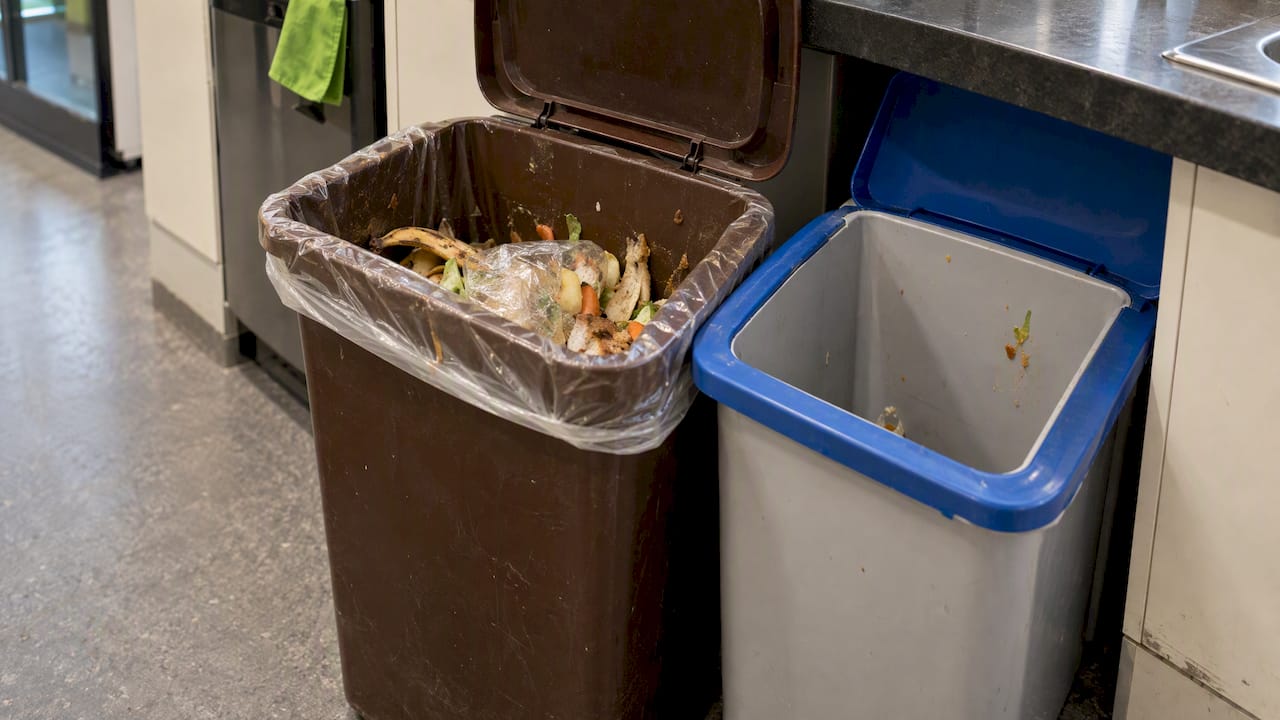
Your audit is the best evidence tool here. Photographs of mis-sorted items show exactly what is going wrong, and your sorting weights show how much food waste you really produce. That tells you whether a separate food bin is enough or whether on-site treatment is worth pricing.
Offices without catering still have a legal angle through confidential paper and WEEE, both of which need proper handling and records. Keep your audit sheets and collection dockets together so you can show how each stream leaves the building.
How do you communicate the results so people act on them?
Numbers alone rarely change behaviour, so shape the message for each audience. Facilities and finance want annualised costs and savings. Staff want something visual and personal, and senior leaders want a short summary with a target and a date.
Try these approaches:
- Show, do not tell: a photo of the contents of one bin, laid out on the tarpaulin, does more than a paragraph of statistics.
- Keep it simple: present three or four numbers, such as diversion rate, general waste share and projected annual saving.
- Name the ask: tell people exactly what changes, such as which bin goes where and when desk bins disappear.
- Share progress: a monthly note showing movement against the baseline keeps momentum going.
- Use champions: one person per floor who answers questions and spots contamination early.
Send the full report to management, a one-page version to staff and the sorting guide to cleaning teams. Invite feedback, because the people emptying the bins often know about problems your audit missed. Repeat the message at induction so new starters inherit the system rather than undo it.
How do you connect audit findings to your existing waste services?
Take your audit report to your current collector and ask them to match service levels to what you really produce. If cardboard is a large share, collections may be too frequent, or you may be paying general waste rates for material that has market value.
Start with a short list of questions for every vendor:
- Are collection frequencies and bin sizes right for the measured volumes?
- Is contamination being charged, and can you see the evidence?
- What are the rates per stream, and can cardboard and plastics be collected separately?
- Is there a market for baled material?
That last question is where our Bale Buyback scheme fits. Once cardboard and plastics are baled, we buy back the bales, turning a disposal cost into a revenue stream. Current market ranges are covered in our cardboard bale prices guide.
For offices that are not ready for a machine, our article on turning this month’s audit into recycling revenue walks through logistics options. Keep your audit data to hand at every contract renewal: evidence-based negotiation beats a guess every time.
Why does a baseline matter more than any single initiative?
Most waste projects fail for one reason: nobody measured the starting point. Posters go up, a bin changes colour, and later no one can say whether anything improved. A baseline fixes that, and in my view it is the cheapest, most underused tool in facilities management.
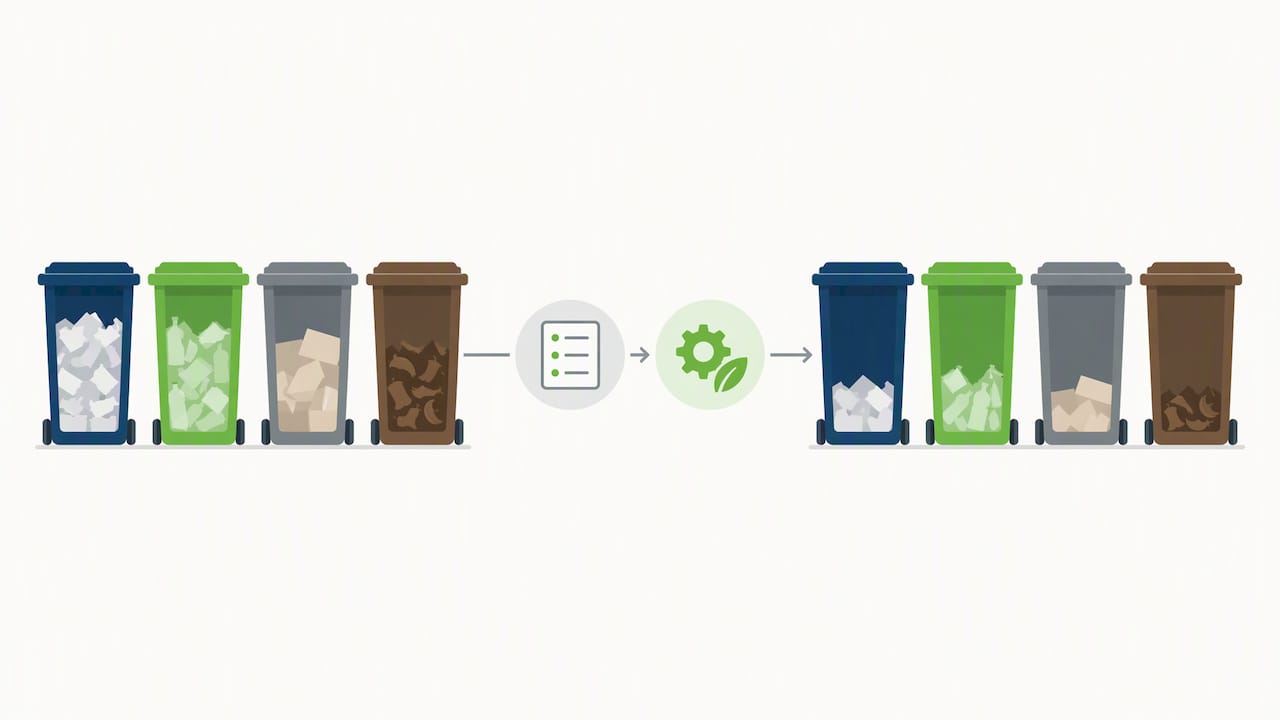
The second lesson is repetition. A single audit shows a snapshot, while repeat audits show direction and expose backsliding. Treat your first audit as the start of a cycle, then re-measure after each major change.
If you want a head start, use our waste audit checklist to run the first one yourself.
— Graham
Ready for a free professional audit?
We run a free waste audit to analyze your business’s waste management requirements. If it uncovers cardboard or plastic worth baling, our bale buyback turns it into income. Request your audit, or download the checklist and start this week.
FAQ
What is meant by a waste audit?
A waste audit is a structured exercise that identifies and weighs the types of waste a site produces. It shows what is recycled, what is binned and how much contamination exists. The results become the basis for targets and an action plan.
How can you reduce waste in an office?
Start by measuring, then fix the biggest streams first. Centralised, clearly labelled bins, staff briefings, managed print and supplier packaging requests are the usual low-cost wins. Aim to keep general waste at or below about 20% of the total.
How do you conduct an audit step by step?
Plan the scope and team, complete a risk assessment, collect the waste, sort it onto tarpaulins, weigh each category and record the net weights. Repeat within a week and average the results, as the WRAP guidance advises. Then calculate your diversion rate and set targets.
What are the five steps of waste management?
Common frameworks run from prevention through reuse and recycling to recovery and disposal. In an office, that means reducing what you buy first, reusing what you can, recycling and composting the rest, and sending only the remainder to landfill or incineration.
Sources
- How to conduct a waste audit in the Office sector
- Conducting an Office Waste Audit | Sustainability at NIU | Northern Illinois University