If your business handles packaging in Ireland, you have legal duties. Which ones depend on how much packaging you place on the market. Every business must separate and manage packaging waste properly. Larger producers must also join an approved body, which in practice means Repak. Since 12 August 2026 the EU Packaging and Packaging Waste Regulation (PPWR) has applied on top of that, bringing new rules on recyclability, labelling and design. This guide sets out who is covered, what you have to do, what the penalties look like and how to get your own waste handling in order.
TL;DR
- A “major producer” places 10 tonnes or more of packaging on the Irish market a year and has turnover above €1 million. Major producers must be members of an approved body, and Repak is the only one.
- All producers, whatever their size, must separate packaging waste by material, collect and treat it, and supply data for national statistics.
- Regulation (EU) 2025/40 (the PPWR) has applied since 12 August 2026. Its recyclability duty covers all packaging placed on the market.
- Failing to meet your obligations is an offence that can lead to prosecution. The EPA and local authorities enforce.
- A packaging audit is the quickest way to find out where you stand, and a waste audit shows what your own site produces.
Table of Contents
- Who has to comply with packaging waste rules in Ireland?
- What major producers must do: Repak membership
- The targets behind the rules
- What the PPWR changed from 12 August 2026
- Who enforces, and what failure can cost
- Compliance on your own site: the waste side
- A practical compliance checklist
- Our perspective: compliance and cost are the same project
- Where Compact can help
- Common mistakes to avoid
- FAQ
- Sources
Who has to comply with packaging waste rules in Ireland?
Irish packaging law works on a simple idea: whoever puts packaging into the supply chain carries responsibility for what happens to it afterwards. That is not limited to manufacturers of packaging. It reaches businesses that fill, import, sell or supply packaged goods.
The rules split businesses into two groups.
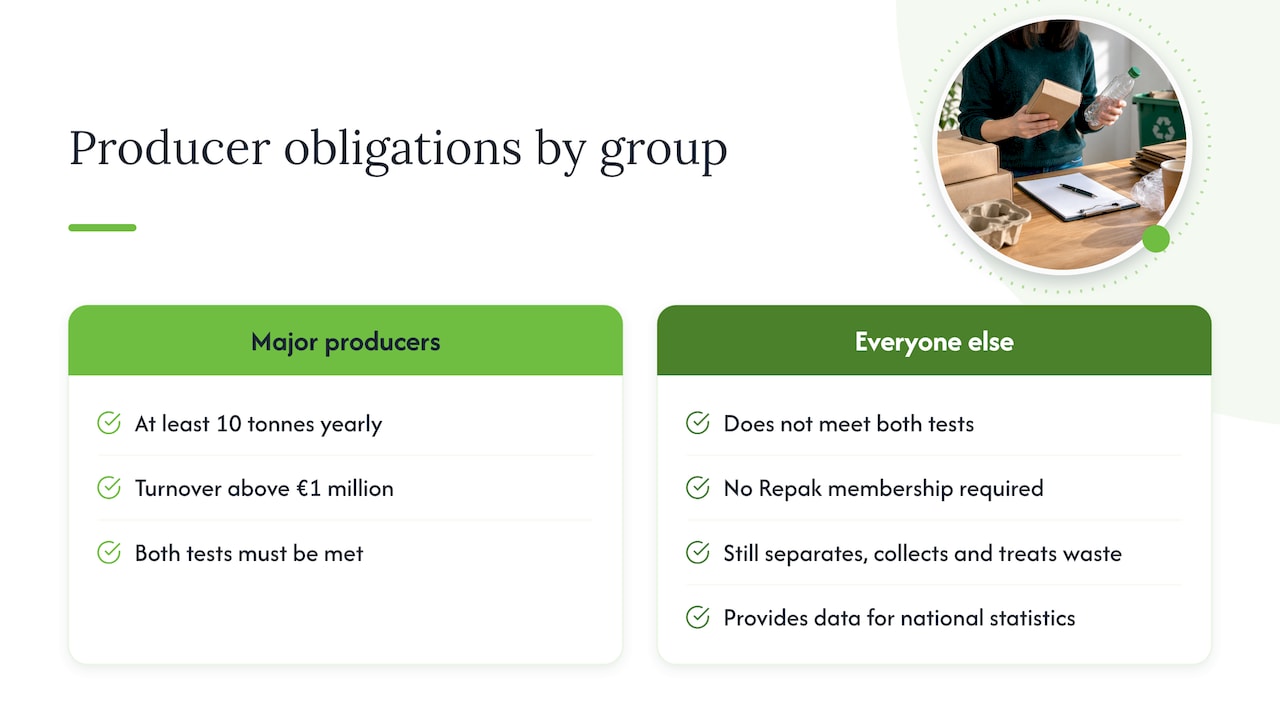
Major producers. The Department of Climate, Energy and the Environment defines a major producer as a business that places 10 tonnes or more of packaging on the market each year and has an annual turnover above €1 million. Both tests must be met.
Everyone else. Smaller producers are not required to join Repak, but they are not exempt. The same Department notice confirms that all producers of packaging, regardless of size carry primary obligations under the European Union (Packaging) Regulations 2014. These include separating packaging waste by material type, collecting and treating it, and providing data for national statistics.
A retailer, a distributor, a food manufacturer, a wholesaler and an online seller can all fall on either side of the line. A business that thinks of itself as “small” can still cross 10 tonnes quickly if it moves pallets of boxed goods, shrink-wrapped stock or bulky protective packaging.
Do you cross the 10-tonne line?
South Dublin County Council’s guidance tells businesses to check whether they supply more than 10 tonnes of packaging in a calendar year and have turnover above €1 million. If you are not sure of the tonnage, it says a packaging audit may be needed.
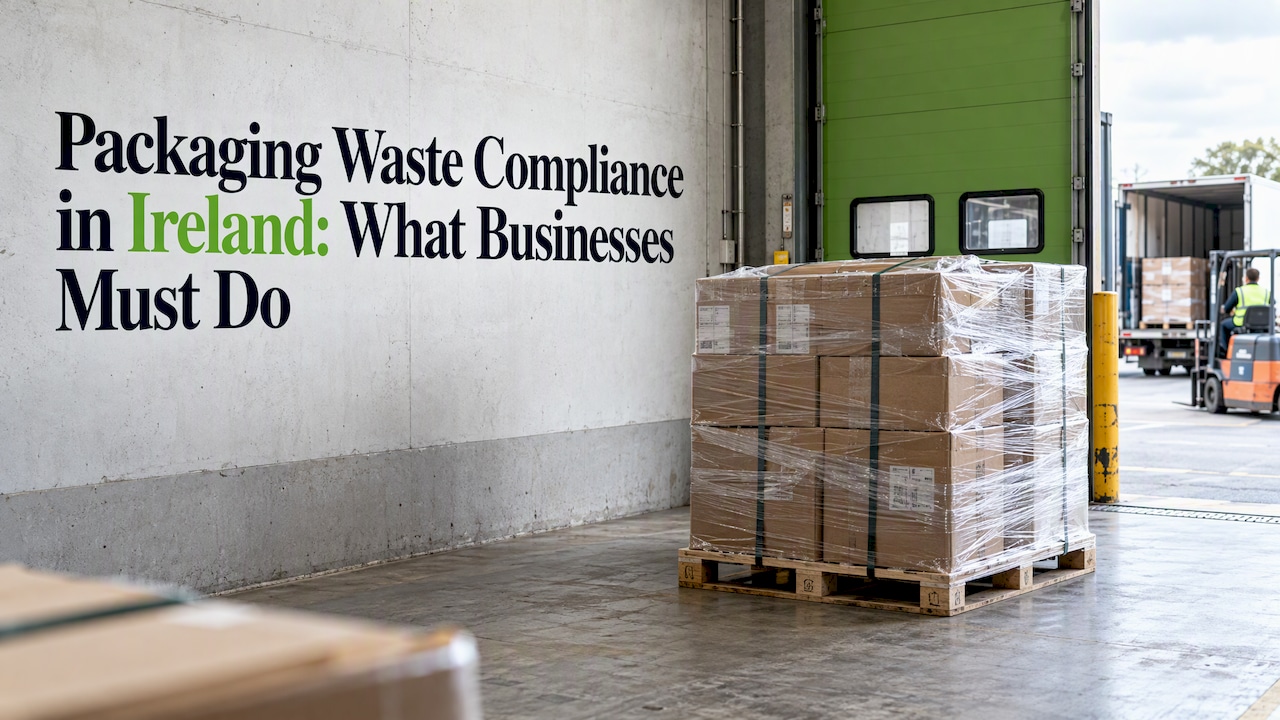
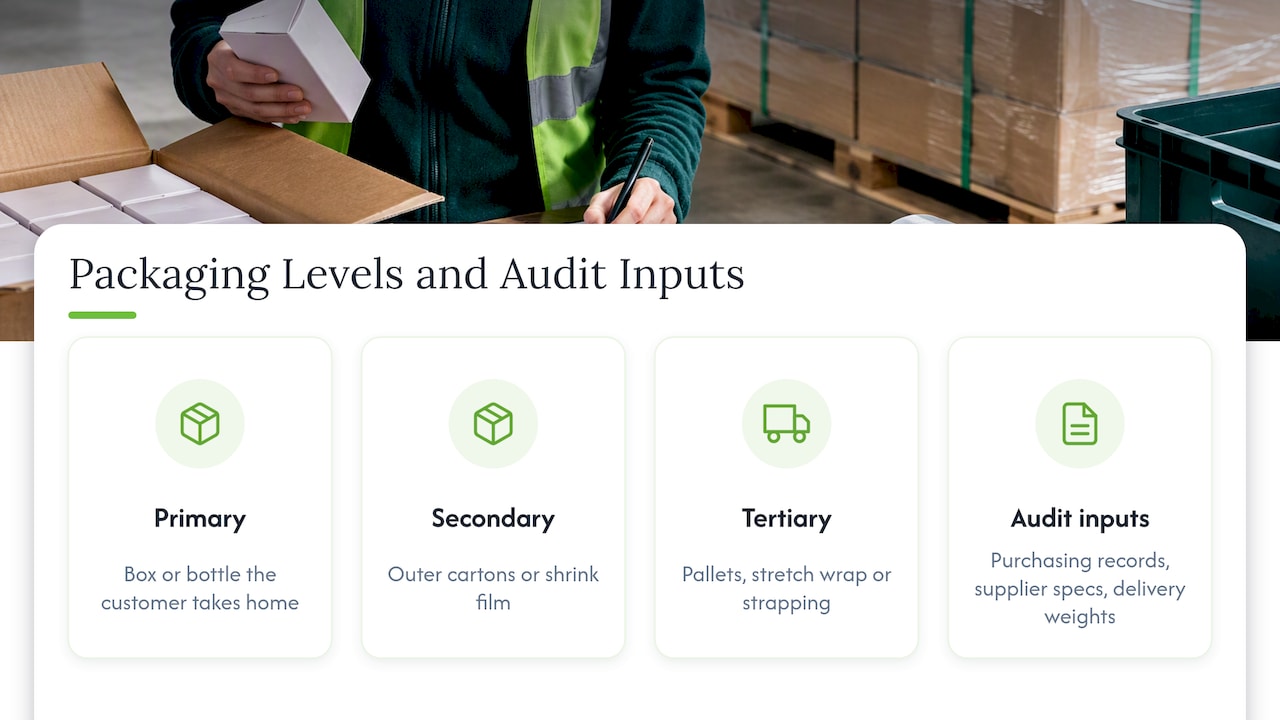
Count all the packaging you place on the market, not only what arrives at your door. That covers primary packaging (the box or bottle the customer takes home), secondary packaging (outer cartons, shrink film) and tertiary packaging (pallets, stretch wrap, strapping). Your purchasing records, supplier specifications and delivery weights are the starting point. If those are patchy, an audit fills the gaps.
What major producers must do: Repak membership
Major producers must become members of an approved body, and Repak runs the only existing approved body for packaging in Ireland. The option for major producers to self-comply under local authority oversight was removed from 1 January 2023. If you were relying on self-compliance before that date, it is no longer available.
How the scheme is funded
Repak’s scheme is funded by fees from packaging producers, with higher fees for materials that are harder to recycle. The money is used to subsidise waste collectors for collecting, sorting, recovering and recycling packaging waste. Repak must report annually to the Minister on the scheme’s performance and must achieve its members’ share of EU recycling and recovery targets, under a licence the Minister has approved for ten years.
For your finances, this has one practical consequence. The packaging you choose affects the fee you pay. A material that is hard to recycle costs more to place on the market than one that is easy to recycle. Packaging decisions are now cost decisions, not only environmental ones.
The targets behind the rules
The obligations exist because Ireland has to hit recycling targets. According to the Department’s EPR page, Ireland must meet EU recycling targets for glass, plastic, paper and board, metals and wood packaging. The same page notes that the EPA publishes a summary of Ireland’s performance against those targets.
Looking further ahead, Ireland’s Waste Action Plan for a Circular Economy commits to all packaging on the Irish market being reusable or recyclable in an economically viable way by 2030. Paper and board is the largest material stream for most businesses, which is why clean, well-baled cardboard matters so much to compliance and to cost.
What the PPWR changed from 12 August 2026
Regulation (EU) 2025/40 on packaging and packaging waste entered into force on 11 February 2025 and applies from 12 August 2026. As a regulation, it applies directly in Ireland without needing to be copied into national law. The Irish Government has also put in place S.I. No. 541/2025 to designate who enforces it.
The PPWR moves packaging compliance beyond waste handling. It reaches how packaging is designed, labelled and made. The points most relevant to Irish businesses:
- Recyclability. Article 6(1) requires that all packaging placed on the market must be recyclable, applying from the date of application, 12 August 2026.
- Reuse criteria. Article 11 sets reuse criteria from the date of entry into force, but because the Regulation generally applies from August 2026, packaging placed on the market before 11 February 2025 does not need retroactive compliance.
- Guidance. The European Commission has published a guidance document (C/2026/3084) to help member states and businesses apply the PPWR uniformly across the EU.
Minister Alan Dillon has said the PPWR will reshape how packaging is designed, used and recycled. If you buy packaging rather than make it, the practical step is to ask your suppliers how their products meet the new recyclability and labelling requirements, and to keep their answers on file. We cover the wider picture on our own page about packaging regulations in Ireland and the PPWR start date.
Who enforces, and what failure can cost
Failing to meet obligations under the packaging regulations is an offence. S.I. No. 282/2014 provides for prosecution and penalties, and empowers the EPA and local authorities to enforce the rules and require information from producers.
For the PPWR, enforcement is split between two bodies under S.I. No. 541/2025:
| Competent authority | PPWR articles it enforces |
|---|---|
| Environmental Protection Agency (EPA) | Articles 53, 54, 56 and 57 |
| Minister for Climate, Energy and the Environment | Articles 29, 30, 31, 34 and 44 |
Read the instrument itself for the detail of each article. The point for a business owner is that there is a named regulator for each part, and that regulators can request your data. If a request arrives, you want records ready: packaging tonnages by material, supplier declarations, waste collection dockets and evidence of where your material went.
Compliance on your own site: the waste side
Placing packaging on the market is one half of compliance. The other half is what happens to the packaging waste your own premises produce: delivery cartons, pallet wrap, strapping, polystyrene and plastic film. The duty to separate by material, collect and treat applies to you whatever your size.
In practice, most sites fail in the same few places:
- Mixed skips. Cardboard, film and general waste thrown together. The material is contaminated, costs more to dispose of and cannot be shown as recycled.
- No weights. Without weighed data you cannot report accurately or check what your collector is charging you.
- Loose cardboard. Uncompacted boxes fill bins fast, which means more lifts and higher costs.
- Wrong waste coding. Cardboard paperwork that does not match the right European Waste Catalogue code creates audit problems. Our guide to cardboard, code 15 01 01 and audit-proof records explains how to avoid that.
Separating cardboard and film at source is the single most effective fix. A baler turns loose cardboard into dense, tied bales that are easy to store, easy to weigh and easy to sell. See our overview of cardboard balers and waste compactors in Ireland for how the options differ, or our cardboard recycling solutions page for the wider process. Sites with a lot of stretch wrap should also look at plastic film recycling, because film is the second stream most businesses handle badly.
A practical compliance checklist
Use this order. It takes you from “do we need to do anything?” to a documented position.
- Work out your packaging tonnage. Add up the packaging you place on the market in a calendar year, by material. Check it against the 10-tonne and €1 million tests.
- Join Repak if you are a major producer. Self-compliance is no longer an option for major producers.
- Check your supply chain for the PPWR. Ask suppliers about recyclability and labelling. Keep written confirmations.
- Separate waste at source. Give cardboard, plastic film, polystyrene and general waste their own streams.
- Weigh and record. Keep collection dockets and weights. Match cardboard records to the right waste code.
- Review your contracts. Check what you are paying per lift and per tonne, and whether you are being paid for any material.
- Revisit each year. Volumes, materials and rules change. Rerun the tonnage check annually.
If your records on any of these are weak, start with a site-level review. Our waste audit checklist shows what to weigh and record, and our guide on how Irish businesses can reduce waste costs covers the savings that usually come with getting organised.
Our perspective: compliance and cost are the same project
We spend our working days on the waste side of packaging: auditing sites, supplying balers and compactors, and buying back baled cardboard and plastic. That gives us a particular view of compliance.
Most businesses we meet treat packaging rules as a paperwork burden handled by whoever has time. The sites that do best treat it as an operations question. They separate cardboard and film properly, bale it, weigh it and keep clean records. The result is that the compliance evidence is a by-product of running the site well, and the same discipline cuts the number of collections and creates a saleable material instead of a disposal charge.
The PPWR will push more attention onto packaging design and supplier data, and that is largely for manufacturers, importers and brand owners. For most of our customers, the practical effect is closer scrutiny of what leaves their premises and how it is recorded. Our advice is simple: measure first. You cannot comply with, or save money on, a stream you have never weighed.
— Graham
Where Compact can help
We handle the waste-handling side of compliance as one service. We start with a free audit of what your site actually produces, recommend the equipment that fits (balers, compactors, shredders for wet waste, or composting machines for food waste), and then buy back your cardboard and plastic bales so that material that used to cost you money can earn a rebate.
To get started, book a free waste audit and we will look at your volumes, your collections and your records. If you already bale or want to, see our bale buyback scheme and our cardboard balers. If you are measuring what your cardboard is worth, our page on cardboard bale prices gives the current picture.
We do not replace Repak membership or advice on your design obligations under the PPWR. Those sit with the approved body and your own legal or compliance adviser. What we do is make sure the waste on your premises is separated, weighed, documented and handled at the lowest sensible cost.
Common mistakes to avoid
- Assuming you are too small. The Repak membership tests apply to major producers, but the separation, collection and data duties apply to everyone.
- Relying on old self-compliance arrangements. That route for major producers ended on 1 January 2023.
- Treating the PPWR as a future issue. It has applied since 12 August 2026.
- Not weighing waste. Without weights, you cannot prove performance or challenge charges.
- Mixing streams. Contaminated cardboard and film lose their value and weaken your recycling record.
FAQ
Do small businesses have to comply with packaging waste rules in Ireland?
Yes, in part. Only major producers (10 tonnes or more of packaging a year and turnover above €1 million) must join Repak. But all producers of packaging, whatever their size, must separate packaging waste by material, collect and treat it, and provide data for national statistics under the 2014 Regulations.
Is Repak membership compulsory?
For major producers, yes. Self-compliance under local authority oversight was removed from 1 January 2023, and Repak runs the only approved body for packaging. Businesses below the thresholds are not required to join.
When did the EU packaging regulation start to apply?
Regulation (EU) 2025/40 entered into force on 11 February 2025 and has applied since 12 August 2026. Its recyclability requirement for all packaging placed on the market applies from that date. Packaging placed on the market before 11 February 2025 does not need retroactive compliance with the reuse criteria.
Who enforces packaging rules in Ireland?
The EPA and local authorities enforce the 2014 Regulations. For the PPWR, S.I. No. 541/2025 names the EPA as competent authority for some articles and the Minister for Climate, Energy and the Environment for others. Failure to meet obligations is an offence that can lead to prosecution.
How can I find out whether I am over the 10-tonne threshold?
Add up the packaging you place on the market in a calendar year, by material and weight, using purchase records and supplier specifications. If that data is incomplete, a packaging audit is the recommended route. A separate waste audit then shows what your own site produces and how it is handled.
Sources
- Minister Ryan signs new packaging and packaging waste rules into law
- Minister Dillon approves 10-year licence for Repak
- Extended Producer Responsibility (EPR), Department of the Environment, Climate and Communications
- Extended Producer Responsibility (EPR), Department of Climate, Energy and the Environment
- EUR-Lex: Commission document C(2026)3702
- EUR-Lex: Commission guidance C/2026/3084
- S.I. No. 282/2014, European Union (Packaging) Regulations 2014
- S.I. No. 541/2025, European Union (Packaging and Packaging Waste) Regulations 2025
- Packaging, South Dublin County Council