On-site composting turns food and organic waste into a stable, soil-like product where it is produced, so less material leaves your premises. For an Irish business, that means less to collect, transport and dispose of, lower emissions, and compost you can use on your own grounds. The benefits are real, but they depend on how well the system is chosen, fed and managed. This guide covers what you gain, where the money comes from and how to get it right.
TL;DR
- On-site composting reduces the volume of organic waste and produces a safe, stabilised product for gardening and growing.
- It avoids collection, transport and landfill, which cuts emissions and can cost significantly less than centralised treatment where it is practical.
- Ireland’s commercial bin rules since 1 July 2023 price bio-waste below general waste, so separating food waste pays either way.
- Results depend on space, staff time, the right mix of materials and a system sized to your waste. A waste audit is the place to start.
Table of Contents
- What on-site composting actually does
- The environmental benefits
- The financial benefits
- Benefits of using the finished compost
- Operational benefits for facilities teams
- Getting the benefits: what to plan for
- Is on-site composting right for your site?
- Our perspective
- See what your waste could do for you
- FAQ
- Sources
What on-site composting actually does
Composting breaks down biodegradable material into a humus-like product. According to Wicklow County Council’s food waste guide, composting reduces the quantity of organic waste and gives a safe, stabilised product suitable for gardening and for growing later crops. The same guide notes that on-site composting is possible wherever suitable space is available.
For a business, “on site” can mean very different things:
- a set of bays or bins in a yard for garden and canteen waste;
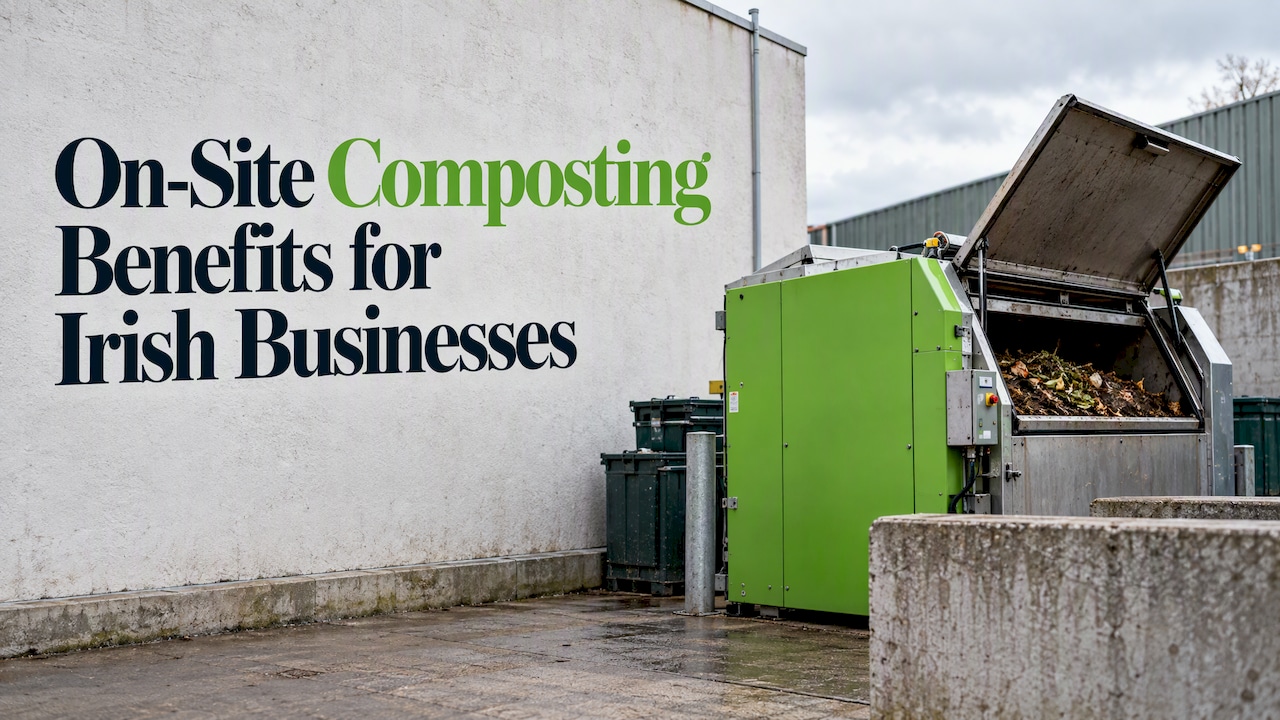
- an enclosed in-vessel unit beside a kitchen or loading bay;
- a machine that processes food waste in a controlled, enclosed cycle.
The benefits below apply across all three, but they grow stronger as the system becomes more controlled and easier for staff to run.
The environmental benefits
Less waste leaving the building
The most direct benefit is volume. The EPA’s composting booklet says composting biodegradable material avoids the need to collect, process, treat and dispose of some waste. It also conserves landfill space and the fuel used to transport waste.
The scale of the problem in Ireland is large. The Government reports that the EPA estimated 753,000 tonnes of food waste were generated in Ireland in 2021, with restaurants and food service accounting for 25%. Any business handling food is part of that figure, and any business that treats its own organics is taking itself out of the collection chain.
Lower methane and carbon emissions
Food waste in landfill breaks down without oxygen and produces methane. The EPA says keeping food and garden material out of landfill avoids methane generated under landfill conditions and helps address climate change. Its hospitality guidance adds that reducing food waste reduces carbon emissions as well.
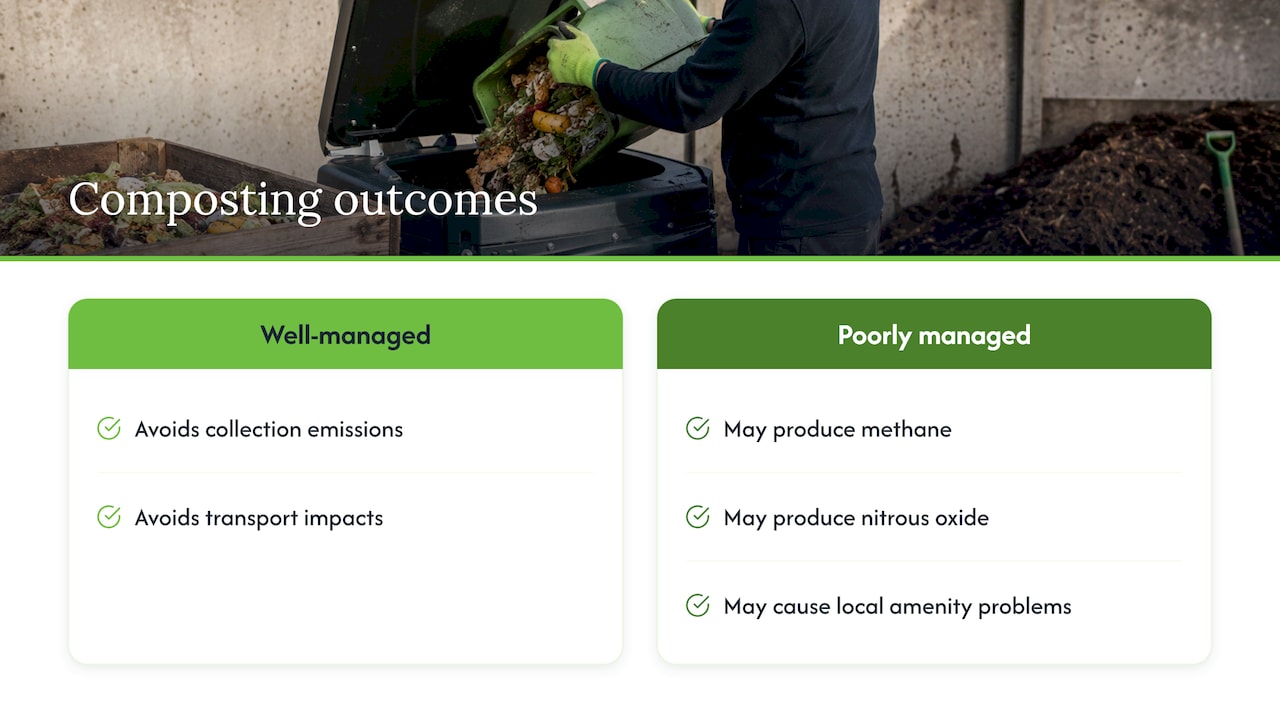
Transport matters too. Australia’s NSW EPA reports that well-managed on-site composting avoids the emissions and other impacts of collection and transport. The same report warns that poorly managed systems can produce methane, nitrous oxide and local amenity problems. In short, the climate benefit is earned through good operation, not just by owning the equipment.
Safe, hygienic output
There is a common worry that composting food waste is unhygienic. Wicklow County Council’s guide says that when properly managed, composting generates heat sufficient to destroy human, animal and plant pathogens. Control of temperature, aeration and the mix of inputs is what delivers that result, which is why enclosed, monitored systems appeal to larger sites.
The financial benefits
Avoiding collection and treatment costs
A paper from Cré, the Composting & Anaerobic Digestion Association of Ireland, discussing EPA work on biodegradable waste, says treating waste at source can avoid collection, treatment, product marketing and distribution, and disposal. Where feasible, it may cost significantly less than centralised management. The paper concludes that source composting may be the lowest-cost and most environmentally sustainable option for organic waste where practical.
That paper dates from 2008, so treat it as a statement of principle rather than a current price comparison. The principle still holds: every tonne you treat yourself is a tonne you do not pay to move.
Ireland’s commercial charging rules reward separation
Since 1 July 2023, Irish commercial waste collectors must provide residual, mixed dry recyclable and bio-waste bins. The Department’s announcement on incentivised charges says collectors must also weigh collected waste, report bin weights and price recyclable and bio-waste collection below municipal-waste disposal.
This changes the arithmetic. Food waste in the general bin is the most expensive place for it. If you separate it, you pay less per kilo for collection. If you compost it on site, you remove it from the weighed bins altogether.
Prevention still comes first
Be realistic about where the biggest savings lie. The EPA’s 2022 hospitality guidance says the largest financial gains generally come from preventing raw materials from becoming food waste. Lower waste-management costs are an additional saving. The strongest approach is to cut avoidable waste first, then treat what remains on site. Composting handles the unavoidable part: peelings, trimmings, coffee grounds and plate waste.
Benefits of using the finished compost
Good compost is a product, not just a disposal route. The same Wicklow guide describes it as useful for gardening and growing subsequent crops. Businesses with grounds, planters, landscaping or a kitchen garden can use it directly and avoid buying in soil improvers.
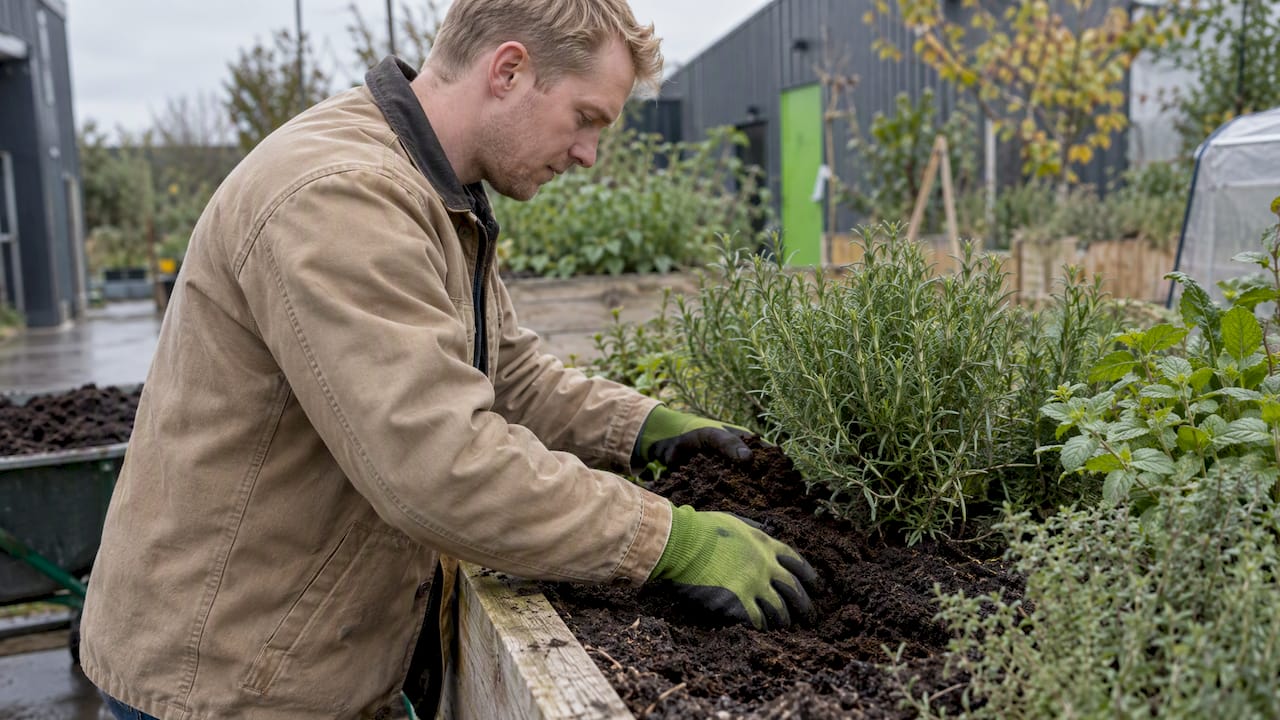
There is also a peatland benefit. The EPA says using self-produced compost reduces reliance on peat-based potting compost. That helps protect the biodiversity of Irish bogs and peatlands. For companies reporting on sustainability, that is a concrete, local story. It is better than a generic claim about being green.
Output that comes straight out of an in-vessel system may not be finished. CalRecycle, California’s recycling agency, notes that discharged material may need curing, cooling or stabilisation before use, to avoid odour and nuisance. Plan a simple maturing area, and the compost will be ready for use on your site.
Operational benefits for facilities teams
Beyond cost and carbon, there are day-to-day advantages.
- Fewer bin lifts and cleaner bin areas. Less wet waste in the general bin means less smell, fewer pests and lighter lifts.
- Simpler staff routines. Wicklow County Council identifies enclosed systems such as in-vessel composters as cleaner in daily operation and easier to use than traditional compost units, for larger institutions.
- Visible sustainability. Staff and customers can see waste being turned into something useful. That supports internal engagement and external reporting.
- Less dependence on collection schedules. Treating on site means a missed or delayed lift matters less.
Hygiene around the kitchen supports all of this. The products you use for cleaning bins and surfaces, and the packaging that ends up in the food waste stream, affect how a system behaves. Manufacturers face similar choices, as shown in this overview of sustainable liquid packaging requirements. Choosing compatible products and keeping contamination out is part of running a clean system.
Getting the benefits: what to plan for
The benefits above are conditional on a well-run system. These are the points to settle before you buy or build.
Space, staff and neighbours
Wicklow County Council advises businesses to assess space, staff resources, neighbour relations and local-authority registration where applicable. Think about where the unit sits, who loads it, who checks it and how close the nearest neighbour is. A system that has a named owner on each shift works far better than one that is everyone’s job.
What goes in
Traditional compost units cannot treat meat or animal waste, oils, grease or fatty foods, according to the same guide. Kitchens produce plenty of both, so decide early how those materials will be handled. Animal by-products are strictly controlled in Ireland to protect human and animal health. The Department of Agriculture’s conditions for animal by-product processing set out the approval requirements, including the Irish conditions for composting plants that transform them. If your waste includes catering by-products, check these conditions first, and ask your equipment supplier how their system fits.
Balance and aeration
Wicklow County Council advises blending food waste with paper and landscaping waste, and turning material frequently to provide aeration and reduce the risk of smell. Food scraps are wet and rich in nitrogen. Cardboard, paper and shredded garden material add the dry, carbon-rich bulk that keeps the process aerobic. Many businesses already have plenty of cardboard.
Count the full cost honestly
CalRecycle says a business comparing on-site processing with collection should include shipping and installation, electricity or water connections, maintenance, repairs, staff time, and bulking agents or additives. Build those into the comparison from day one. Then the saving you project is the one you actually get.
Start with real numbers
The EPA recommends an internal waste assessment, or visual bin checks over several weeks, to understand where waste comes from, how well it is segregated and how the system is working. That is the basis for sizing any composter. Our guides on running a waste audit with a checklist and on office waste audits show how to weigh and record your streams. Manufacturers can use the manufacturing waste audit guide. Restaurants and cafés will find practical options in four ways restaurants can compost food waste.
Is on-site composting right for your site?
| Your situation | What it suggests |
|---|---|
| Steady daily food waste from a kitchen or canteen | A good candidate for an enclosed, in-vessel type system |
| Grounds or landscaping on site | You can use the compost directly and add garden waste as bulking material |
| Very little space or no outdoor area | Look at compact enclosed machines, or separated bio-waste collection |
| Lots of meat, fat or oil in the waste | Check animal by-product conditions and system suitability first |
| Unknown waste volumes | Run an audit before choosing anything |
None of these is a reason to wait. Each one shapes the right answer.
Our perspective
We see the same pattern on site after site: businesses pay to move waste they have never properly measured. The first step is always to weigh it. Once you know what you produce, the question of what to do with the organic share becomes simple to answer.
Our approach is to treat waste as something with a value, and organics are part of that. A well-chosen on-site composting machine takes wet, heavy food waste out of the bins you pay for by weight. It also gives you a material you can put to use. Cardboard, which you probably have in abundance, can be baled and sold, and it can also serve as the dry bulking material that balances the compost. One audit can look at both streams together.
That is why we offer a single point of service, from the audit through to the equipment and the recycling. You should not need three suppliers to deal with one set of bins. Our organic waste composting machines are sourced to suit different volumes and layouts, and we help you size them against what the audit shows. The aim is simple: lower costs, cleaner operations and a result you can report with confidence.
Graham
See what your waste could do for you
If you are weighing up on-site composting, start by finding out what you generate. We carry out a free waste audit tailored to your site. It looks at your organic, cardboard and plastic streams and at the legal and corporate standards you need to meet. If composting suits you, you can browse our organic waste composting machines, including the COMPACT-OC-50 and the COMPACT-OC-2000, and talk to us about the right fit.
Alongside composting, we buy back baled cardboard and plastic through our bale buyback scheme, so your dry recyclables can earn a return while your food waste stays on site.
FAQ
What are the main benefits of on-site composting for a business?
The main benefits are less waste to collect and dispose of, lower emissions from transport and landfill, and usable compost. The EPA links composting to avoided collection, conserved landfill space and avoided landfill methane. Savings come mainly from the waste you no longer pay to move.
Does composting on site save money?
It can, where it is practical. An EPA-related discussion paper from Cré says source treatment may cost significantly less than centralised management. You should count equipment, installation, utilities, maintenance and staff time against your current collection costs. An audit gives you the baseline for that comparison.
Can I compost meat, oil and fatty food on site?
Not in a traditional compost unit. Wicklow County Council states that these units cannot treat meat or animal waste, oils, grease or fatty foods. Animal by-products are also controlled by the Department of Agriculture, so check its approval conditions and ask your supplier what your chosen system can accept.
Will on-site composting smell?
A well-run system should not. Mixing food waste with dry material such as paper and turning it often supplies the oxygen that limits smell. Enclosed systems make this easier to manage. Poorly managed composting is what causes odour and nuisance problems.
Sources
- Less Food Waste More Profit, Wicklow County Council
- Composting, EPA Ireland (3rd edition, 2017)
- Pathway to less food waste and better margins, EPA Ireland (2022)
- Waste Policy and the Circular Economy, gov.ie
- Introduction of incentivised waste collection charges, gov.ie
- Hitting the Targets for Biodegradable Municipal Waste, Cré (2008)
- Emissions impacts of composting food waste, NSW EPA (2024)
- Conditions for Animal By Product Processing Operations, DAFM
- Commercial-Scale Technologies: Food Scraps Management, CalRecycle
- 5 Manufacturer Requirements for Sustainable Liquid Packaging