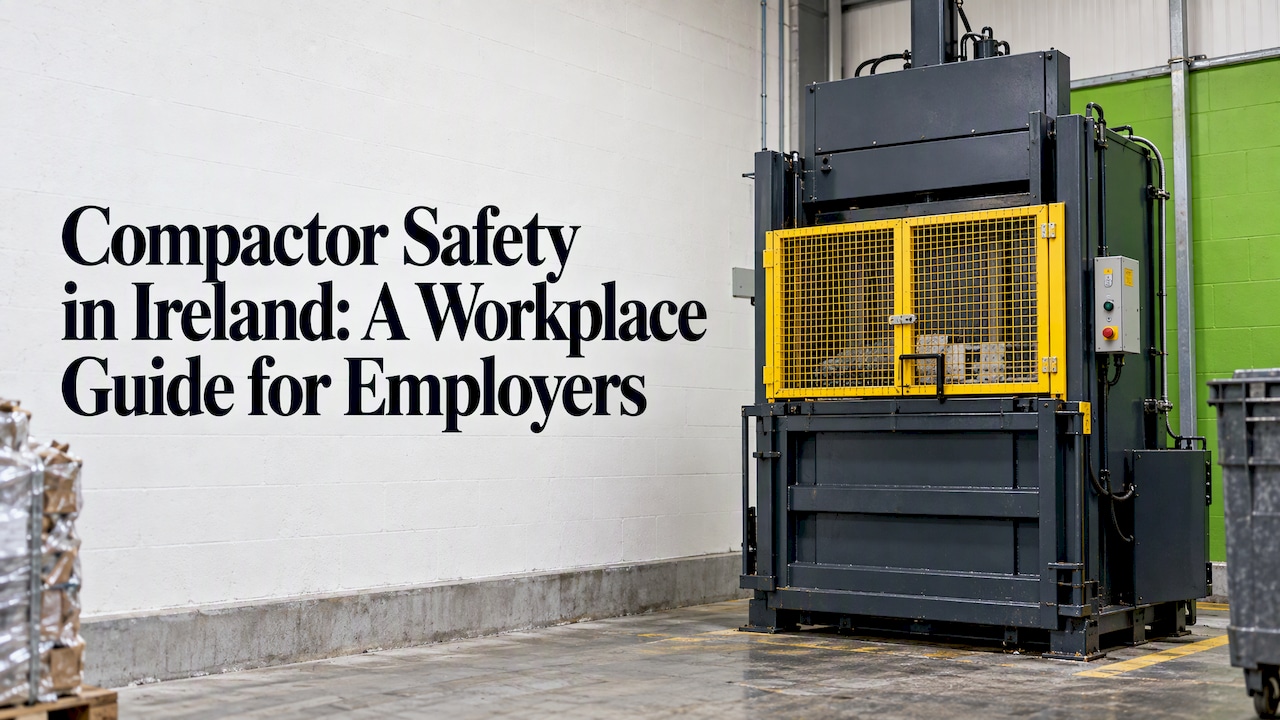
A waste compactor is safe when four things hold: the guards and safety switches work, only trained people use it, it is isolated from power before anyone cleans or services it, and a competent person inspects it and writes the result down. Irish law puts those duties on the employer. This guide turns the Health and Safety Authority (HSA) guidance and the 2007 General Application Regulations into a practical routine for facility managers, business owners and property managers.
TL;DR
- The main injuries are crushed fingers and hands at the moving plate, crushed toes and feet under the descending chamber, and cuts from glass in bags after compaction (HSA, Safe Hospitality Part 6).
- Never use a compactor with a broken or missing guard, or with safety switches that do not work. Report the fault and take it out of use.
- Isolate the power before any cleaning, blockage clearing or maintenance. Maintenance carries more risk than normal operation.
- Keep a maintenance log and inspection records. The regulations set five years for inspection records.
- Wrap sharp items before they go in, keep liquids out, and restrict access to trained staff.
Table of Contents
- Where compactor injuries happen
- What the law requires of the employer
- Machine design: what to expect from a compactor you buy
- A safe-use routine for operators
- What you must not put in a compactor
- Isolation, blockages and maintenance
- Inspection, logs and records
- Siting and surroundings
- Training and supervision
- Our perspective: safety is a design choice, not just a procedure
- Choosing equipment that suits the job
- Start with a free waste audit
- FAQ
- Sources
Where compactor injuries happen
Most compactor incidents are not dramatic failures of the machine. They happen at ordinary moments: someone reaches in to push a bag down, steps under a descending chamber, or lifts a bag that has been compressed and finds broken glass inside.
The HSA’s guidance for larger hospitality premises names the main risks plainly. These are finger and hand injuries from the moving compactor plate, toe and foot injuries between the descending chamber and the base plate, and cuts from glass in bags after compaction (HSA, Safe Hospitality Part 6). The guidance is written for hospitality, but the mechanics are the same in a warehouse, a retail unit, an office block or a hotel back yard.
It helps to sort the hazards by the moment they occur:
| Moment | Typical hazard | First control |
|---|---|---|
| Loading | Hand caught at the plate or feed opening | Working guard, interlock, no reaching in |
| Compacting | Foot or toe trapped under the descending chamber | Keep clear, interlocked access |
| Unloading | Cuts from glass or sharp items in compressed bags | Gloves, wrapped sharps, correct handling |
| Clearing a jam | Unexpected movement of the plate | Isolate power first |
| Servicing | Guards removed, safeguards inoperative | Competent person, isolation, permit if needed |
Why the quiet moments are the dangerous ones
The HSA’s own work-equipment guide makes an important point: maintenance operations inherently carry higher risks than normal operation, because workers often have to approach or reach dangerous parts that are normally guarded, while safeguards may be temporarily inoperative (HSA, Guide to the General Application Regulations: Work Equipment). A jammed compactor is exactly this situation. The temptation is to reach in and free it quickly. That is the habit to design out.
What the law requires of the employer
The core duties sit in the Safety, Health and Welfare at Work (General Application) Regulations 2007 (S.I. No. 299/2007). Applied to a compactor, they mean the employer must:
- Select equipment suitable for the workplace and the work.
- Make sure it is installed and inspected by a competent person, initially and periodically.
- Maintain it throughout its working life.
- Restrict use to trained employees, and restrict access where the equipment involves specific risks.
- Keep a maintenance log.
- Make sure repairs, modifications and servicing are done by competent people, particularly when safeguards are inoperative.
Regulation 28(f) is the one that matters most for access: where using work equipment involves specific risks, access must be limited to the employees who need it, and anyone repairing, modifying or servicing it must be competent to do so (S.I. No. 299/2007).
The duty to maintain is spelled out in Regulation 31. Where possible, equipment is shut down for maintenance. Where that is impossible, appropriate protection must be put in place or the work done outside the danger area, and an up-to-date maintenance log must be kept (S.I. No. 299/2007).
This is general legal guidance, not advice on your particular site. If you are unsure whether your compactor, your arrangements or your records meet the regulations, ask a competent safety adviser or contact the HSA.
Machine design: what to expect from a compactor you buy
Safety starts with the machine. European standard EN 16486 sets safety requirements for the design, manufacture and information for safe use of compactors that compact waste or recyclable fractions such as paper, plastics, cardboard and mixed waste. It covers static and transportable compactors that are fed by hand or mechanically, including feed hoppers and openings (SIS, EN 16486 summary).
When you buy or lease, ask the supplier practical questions:
- Is the machine supplied with a CE marking and a declaration of conformity?
- Which guards and interlocks protect the feed opening, and how do you test them?
- Where is the isolator, and can it be padlocked?
- What instructions and training does the supplier provide?
- Who services it, how often, and who keeps the service record?
A refurbished machine deserves the same questions, plus a clear record of what was checked and replaced during refurbishment.
A safe-use routine for operators
The HSA guidance is short and concrete. Turn it into a laminated card at the compactor.
Before you use it
- Look at the guard. Do not use the compactor if it is broken or missing.
- Check the safety switches. Do not use it if they do not work.
- Report any malfunctioning control or safety device straight away, and tag the machine out of use.
- Wear protective gloves when handling bagged waste.
- Do not wear loose clothing that could catch in moving parts.
The points above come directly from the HSA’s guidance (HSA, Safe Hospitality Part 6).
While you use it
- Keep hands, feet and head out of the loading area while the plate or chamber can move.
- Load by tipping or placing, never by leaning in.
- Do not let anyone stand under or beside a descending chamber.
- Stop and isolate if something jams. Do not clear it with the machine live.
When you unload
- Handle compressed bags with gloves, from the side, and at a pace that does not tempt you to grab.
- Expect glass to have broken inside. A bag that feels heavy and uneven may have sharp edges pressing through.
What you must not put in a compactor
The HSA advice is clear that sharp or pointed objects should not go in unless suitably wrapped (HSA, Safe Hospitality Part 6). Wrapping protects the person who empties the bag, and it protects hoses, seals and bag liners from punctures.
Beyond that, set a written site rule. A sensible list for most commercial settings:
- Sharps and broken glass, unless wrapped or boxed.
- Liquids and wet food waste. Fully drain cartons before you compact them; a general waste compactor is not suited to liquids and some food wastes.
- Anything the manufacturer’s manual excludes, such as aerosols, pressurised containers or batteries.
- Hazardous waste of any kind, including solvents, oils and chemicals.
- Loose waste that can wedge between the plate and the chamber wall.
If food waste is a large part of your waste stream, a general compactor is the wrong tool. Our guide to food waste regulations in Ireland explains what businesses must do instead.
Cardboard and paper are cleaner, but they are not free of hazard. Dry, dusty material in an enclosed space is a fire load, and fine dust can be an ignition risk in its own right. The principles in this piece on combustible dust risks apply to any workplace where fine dust builds up: keep it from accumulating, keep ignition sources away and clean regularly.
Isolation, blockages and maintenance
This is where the serious injuries are.
The rule from the HSA is to isolate compactors from power, especially before cleaning or maintenance, and not to use them if guards are broken or missing or safety switches do not work (HSA, Safe Hospitality Part 6). The same guidance suggests considering restricting use to people over 18.
Isolation is often called lockout/tagout. The HSA describes it as the process of isolating machinery and equipment from its energy source, and notes that permits to work are used where a significant risk needs precise preparation and clear communication (HSA, Work Permits and Isolation of Equipment). That page is written for quarrying, but the principle carries over to any machine with stored or moving energy.
A workable procedure for clearing a blockage:
- Stop the machine using the normal controls.
- Switch off at the isolator and lock it with your own padlock.
- Attach a tag with your name and the time.
- Test that the controls no longer start the machine.
- Check for stored energy, such as a raised plate or hydraulic pressure, and make it safe.
- Clear the blockage with a tool, not your hands, where possible.
- Refit guards, remove your lock, and tell colleagues before restarting.
Only the person who fitted the lock removes it. If the job is beyond a trained operator, such as a hydraulic fault or a bypassed interlock, call a competent service engineer. Never bypass a safety switch to keep the machine running.
Inspection, logs and records
The regulations expect equipment to be kept at a safe level through adequate maintenance throughout its working life, with inspection and maintenance results recorded in an up-to-date log. Periodic and special inspections by a competent person are needed, especially where conditions cause deterioration or exceptional circumstances might make the equipment unsafe (HSA, Work Equipment guide). Inspection records must be kept for five years (S.I. No. 299/2007).
A simple log has these columns: date, who did the work, what was checked, what was found, what was fixed, and when the next inspection is due. Keep three kinds of entry:
- Daily or weekly operator checks: guard, switches, leaks, damage.
- Scheduled service by a competent person: as the manufacturer’s manual specifies.
- Special inspections: after a breakdown, an incident, a relocation or a repair to a safety device.
Siting and surroundings
A compactor can be perfectly guarded and still be dangerous if it is in the wrong place. Think about:
- Access control. A locked cage or enclosure physically restricts who can reach the machine, and the HSA lists it as a practical measure (HSA, Safe Hospitality Part 6). Key or fob control tied to trained staff makes the training rule enforceable.
- Space to work. Leave room to load, unload and service without squeezing between the machine and a wall.
- Lighting. Night-time loading in a dark yard leads to missed steps and unseen sharps.
- Traffic. Keep collection vehicles and forklifts away from the people loading.
- Ground and drainage. A level, clean, dry floor reduces slips, especially near wet waste.
- Fire. Keep the compactor clear of ignition sources and away from escape routes.
- Isolator position. Put it where an operator can reach it quickly and where it cannot be flicked back on by someone else unseen.
These are our practical suggestions rather than a statutory list. Your safety statement and risk assessment should record what you decide for your own premises.
Training and supervision
Restricting use to trained employees is a legal duty (S.I. No. 299/2007), so train before you give anyone the key. Cover the following, and record who attended:
- What the machine does and where it can hurt you.
- The pre-use checks and what to do if one fails.
- What can and cannot go in.
- How to isolate, and who may clear a jam.
- Manual handling of compressed bags and the right gloves.
- Who to tell when something is wrong.
Repeat the training when staff change, when the machine is replaced and after any near miss. Contractors and cleaners who work near the machine need the same briefing on the limits of what they may touch.
Our perspective: safety is a design choice, not just a procedure
We supply balers, compactors and related waste equipment to Irish businesses, and we begin with a waste audit before we recommend any machine. The audit matters for safety as well as cost. It shows what material you generate, how much, and how it is currently handled. A machine that matches the waste stream gets fewer jams, fewer bypassed guards and fewer moments where someone reaches in.
Three things we would tell any facility manager:
- Match the machine to the material. Cardboard goes in a cardboard baler or compactor, polystyrene in an EPS compactor, wet organics in a different solution altogether. Most unsafe improvisation starts when a machine is used for something it was not meant for.
- Reduce handling. Every time a person lifts, pushes or reaches, there is a chance of injury. Equipment that bales or compacts at the point of generation shortens the route the waste takes through your building.
- Treat the log as part of the machine. A compactor without a service record is a compactor nobody is responsible for.
We would rather you ask hard questions of any supplier, including us, about guards, interlocks and service support than be surprised later.
— Graham
Choosing equipment that suits the job
If your current machine is worn, undersized or poorly guarded, replacement may be the safest and cheapest route. Our cardboard balers and waste compactors in Ireland page sets out the main types. For a closer look:
- Cardboard compactors, and our guide to choosing a cardboard compactor.
- Cardboard balers for businesses that want to bale material and sell it.
- Hydraulic compactors for heavier compaction duties.
- EPS compactors for polystyrene packaging.
Baling has a financial side too. Clean, well-baled cardboard has a market, and our cardboard bale prices page shows what buyers pay.
Start with a free waste audit
If you are not sure whether your compactor is the right machine, or whether your set-up would stand up to an inspection, we can look at it with you. Our free waste audit reviews what you produce and how you handle it, and recommends equipment and collection arrangements that fit. Where you generate clean cardboard or plastic, our bale buyback scheme can turn it into income instead of a disposal cost.
FAQ
What can you not put in a waste compactor?
Do not put sharp or pointed objects in unless they are suitably wrapped. Keep out liquids, wet food waste, hazardous materials and anything the manufacturer’s manual excludes. Drain cartons fully before compacting them.
Do I have to keep records for a compactor in Ireland?
Yes. The 2007 General Application Regulations require an up-to-date maintenance log, and inspection records must be kept for five years. Periodic inspection by a competent person is also required. Keep operator checks, service visits and repairs in the same log.
Who is allowed to clear a jam?
Only a trained, competent person, and only after the machine has been isolated from power and locked off. Where safeguards must be inoperative, the work needs a competent person and a controlled system of work. If the cause is mechanical or hydraulic, call a service engineer.
Can young workers use a compactor?
The HSA guidance suggests considering restricting use to people over 18. Whatever you decide, record it in your risk assessment and make sure anyone who does use the machine has been trained.
Sources
- HSA, Safe Hospitality Part 6: Machinery and Equipment in Larger Premises
- HSA, Guide to the Safety, Health and Welfare at Work (General Application) Regulations 2007: Work Equipment
- S.I. No. 299/2007, Safety, Health and Welfare at Work (General Application) Regulations 2007
- HSA, Work Permits and Isolation of Equipment
- SIS, Compactors: Safety requirements, EN 16486
- Combustible dust risks and source extraction