For most Irish businesses, segregated cardboard packaging waste falls under EWC code 15 01 01 (paper and cardboard packaging). Mixed municipal or commercial paper and cardboard can instead sit under 19 12 01 or 20 01 01, and the right choice depends on whether your cardboard is exclusively packaging, contaminated, or blended with other materials. Always confirm the final code against the official list and with your collector.
TL;DR:
- Irish businesses should carefully verify their waste streams to ensure correct EWC codes, especially distinguishing between pure packaging waste and mixed or contaminated materials.
- Segregated cardboard packaging typically falls under code 15 01 01, but mixed or municipal cardboard may be classified under 19 12 01 or 20 01 01 depending on its source and composition.
- Contamination and composite materials like plastic linings or heavy lamination can alter the correct waste code and require separate classification guidance to avoid regulatory issues.
- Properly identifying the waste origin and purpose, along with documenting reasoning, helps prevent classification disputes and ensures compliance with Irish waste transfer regulations.
- Baling and segregating cardboard on-site can improve handling, reduce costs, and enable revenue through buyback schemes, provided accurate documentation and codes are maintained.
Table of Contents
- Which EWC codes cover cardboard: the specific entries and when each applies
- How to decide ‘packaging’ versus ‘non-packaging’ and handle contamination or composites
- Duty of care and transfer notes for cardboard: legal obligations for Irish businesses
- Practical example: how a waste audit or baling programme changes classification and costs
- A compliance officer’s practical take
- How we can help with cardboard classification, baling and buyback
- FAQ
- Sources
Which EWC codes cover cardboard: the specific entries and when each applies
The European Waste Catalogue is the six-digit list every Irish business should check before assigning a code to its waste. It remains the definitive reference for matching a waste description to the correct entry, and it sits behind every other piece of guidance referenced in this article.
15 01 01, paper and cardboard packaging, is the entry most Irish offices, retailers and warehouses will use for segregated cardboard. EPA guidance ties this entry specifically to packaging waste and explains that it applies where the material is exclusively packaging rather than mixed with non-packaging paper or contaminants. If your bins or bales contain delivery boxes, retail packaging and similar material with nothing else mixed in, 15 01 01 is almost always correct.
The wider 15 01 family covers related packaging streams that sometimes get mixed in with cardboard by mistake:
- 15 01 02: plastic packaging, relevant where film or wrap ends up in a cardboard stream.
- 15 01 03: wooden packaging, occasionally found with pallets or crates.
- 15 01 04: metal packaging, including strapping or staples.
- 15 01 05: composite packaging, the entry for materials that combine cardboard with another substance in a way that matters for processing.
- 15 01 06: mixed packaging, used where several packaging materials are genuinely combined and not practically separable.
- 15 01 07: glass packaging.
Spotting these entries helps compliance officers recognise when a skip or baler feed has drifted from pure cardboard into a mixed stream that needs a different code.
Where cardboard arrives as part of general municipal or commercial waste rather than as segregated packaging, two other entries come into play. 19 12 01 covers paper and cardboard recovered during the mechanical treatment of waste, such as material sorted out at a transfer station. 20 01 01 is the municipal waste entry for paper and cardboard collected as part of household-type commercial waste, relevant for offices or smaller premises whose cardboard is collected alongside general recycling rather than as a dedicated packaging stream.
In practice, the form the cardboard takes when it leaves your site also matters for how it is recorded. LEAP and EPA schedule data shows separate line items for baled cardboard and loose cardboard, both typically filed under 15 01 01 but recorded with different weight entries and handling notes. A business that bales its cardboard before collection should expect its transfer documentation to reflect that form specifically, since baled and loose material are treated as distinct line items in commercial reporting even when the underlying EWC code is identical.
How to decide ‘packaging’ versus ‘non-packaging’ and handle contamination or composites
The test for whether cardboard counts as packaging under 15 01 01 comes down to three questions: what was its original purpose, where did it come from, and is it exclusively packaging material with nothing else mixed in. Delivery boxes, retail packaging and similar items that served a packaging function and remain uncontaminated by other materials fit cleanly under 15 01 01. Office paper, shredded documents, or cardboard that arrived as part of general mixed waste collection sit outside that definition and usually belong under 19 12 01 or 20 01 01 instead.
Composite materials complicate this further. EPA guidance notes that composite packaging, such as beverage cartons combining cardboard with a plastic lining, may need a separate entry rather than being coded as pure cardboard, because the composite nature of the material affects how it can be processed. The same logic applies to cardboard with plastic viewing windows or heavy lamination: if the plastic content is more than incidental, it changes the classification.
Contamination is the other major variable. Food residue, oil, chemical spillage or similar contamination can push cardboard out of a standard packaging code entirely, and in some cases towards a hazardous waste classification depending on the nature and extent of the contaminant. A short decision tree, moving from waste source to material composition to a contamination check before settling on a LoW entry, produces documentation that holds up to scrutiny and reduces disputes with collectors or regulators, a structure reflected in EPA’s own classification guidance.
A practical four-step checklist for on-site classification:
- Identify the source and original purpose of the material before it became waste.
- Check for composite elements such as plastic linings, windows or heavy lamination.
- Inspect for contamination from food, oil or chemical residue.
- Match the resulting description against the EWC entry it most precisely fits, recording the reasoning.
Pro Tip: Keep a one-line note against each bale or bin describing why a code was chosen. It takes seconds and saves hours if a collector or inspector later questions the classification.
Duty of care and transfer notes for cardboard: legal obligations for Irish businesses
Irish businesses carry a duty of care to verify that their waste collector holds a valid permit for the specific EWC code being collected, and to ensure that waste is accurately described at every transfer. Gov sets out that inaccurate waste descriptions on transfer documentation can lead to enforcement action under the Waste Management Act, so getting the code right is not a paperwork formality.
A transfer note for cardboard should record:
- The EWC code assigned and the rationale behind it.
- Weight or quantity, and whether the material was baled or loose.
- The date of collection, and the generator and collector’s registration details.
The Waste Management (Collection Permit) (Amendment) (No. 2) Regulations 2023 require commercial collectors to provide segregated bins for residual, mixed dry recyclable and bio-waste, weigh what they collect, and price recyclable streams below municipal waste, with the measure effective from 1 July 2023. This means correctly segregating and coding cardboard carries a direct commercial incentive alongside the compliance requirement.
The most common enforcement pitfall is treating cardboard as general waste out of convenience rather than segregating it, which both misses the cost benefit of incentivised pricing and risks an inaccurate transfer note. A close second is failing to check that a collector’s permit actually covers the EWC code being handed over, something worth confirming in writing rather than assuming.
Practical example: how a waste audit or baling programme changes classification and costs
A structured waste audit typically starts by walking the site to see what is actually going into each bin, which is where cardboard misclassified as general waste usually gets caught. Once segregated cardboard is confirmed as exclusively packaging, assigning 15 01 01 and documenting that decision removes most of the ambiguity that leads to disputes with collectors later.
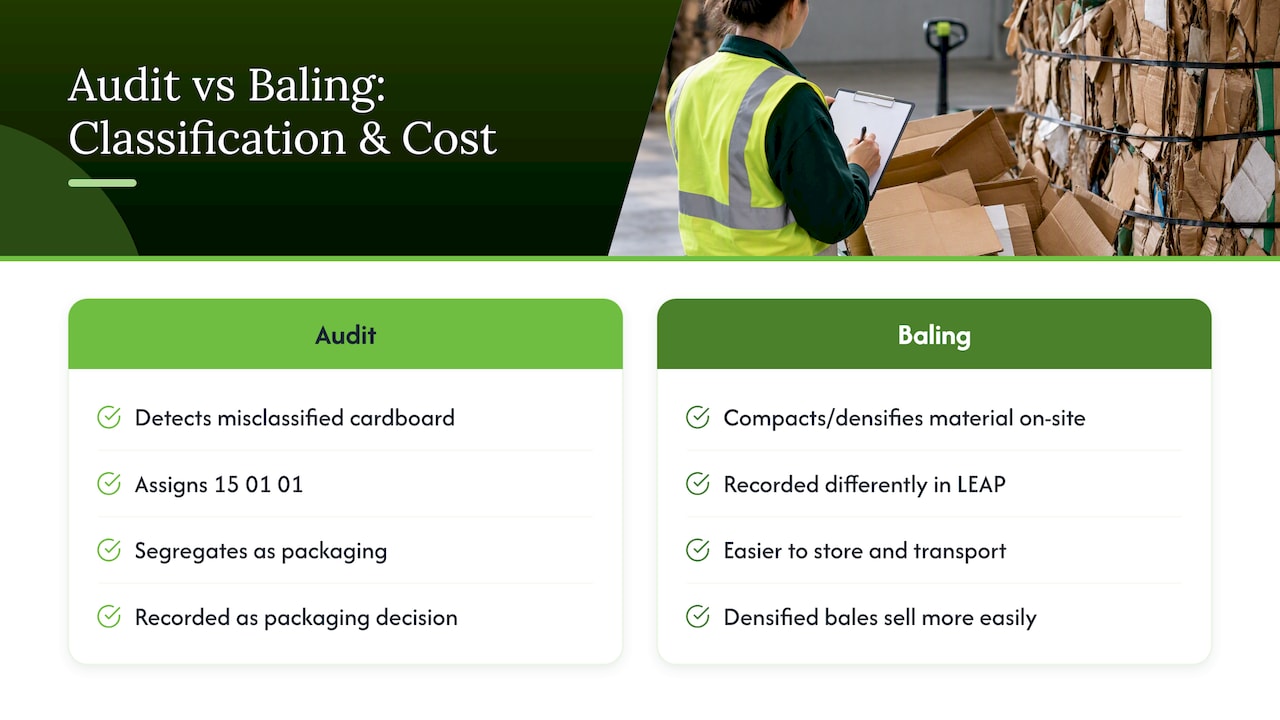
Baling or compacting cardboard on-site changes both the handling and the commercial picture. Baled material is recorded differently from loose cardboard in LEAP schedule data, and in practice it is also easier to store, transport and sell, since densified bales attract better rebates than loose material collected in bins. Where cardboard is properly segregated and baled, a buyback arrangement can turn what was previously a disposal cost into a revenue line, converting a compliance task into a commercial decision rather than a pure expense.
A compliance officer’s practical take
Classify correctly, segregate at source, write down why, and check your collector’s permit covers the code you have assigned. Those four habits remove most of the risk around cardboard waste.
Getting the EWC code right is not bureaucratic box ticking. It determines whether your business pays general waste rates or recyclable rates, and whether a transfer note holds up if challenged. My suggestion for anyone reviewing this now: run a short audit of your current bins and transfer notes this quarter, and update anything that still describes cardboard generically as “waste” rather than by its specific code.
— Graham
How we can help with cardboard classification, baling and buyback
Getting cardboard correctly classified is easier when someone has already looked at what is actually in your bins. Our free waste audit reviews what your business is currently generating, identifies where cardboard should be segregated under 15 01 01, and documents the rationale so your transfer notes hold up if questioned.
Where cardboard is already segregated, our We Buyback Bales scheme pays for baled material rather than leaving it as a pure disposal cost, and we can also supply cardboard balers or compactors suited to the volumes a site produces, with maximum market rebates factored into how collection is arranged. If your cardboard shares space with other packaging materials such as plastic film, our cardboard recycling solutions cover how mixed streams get separated properly before baling. Where contamination from specialised materials is part of the picture, such as protective films used in manufacturing settings, it is worth checking disposal routes for those materials separately, as outlined in this booth film disposal guidance. Get in touch to book an audit and see what your current cardboard stream could be worth.
FAQ
What is the EWC code for cardboard?
Segregated cardboard packaging waste in Ireland is typically coded 15 01 01, paper and cardboard packaging, under the European Waste Catalogue. Mixed or municipal cardboard may instead fall under 19 12 01 or 20 01 01 depending on its source and composition.
How can I check my EWC codes?
Check your assigned codes against the official European Waste Catalogue, EPA interpretation guidance, and your collector’s authorisation, which must cover the specific code being collected. LEAP schedule data is also useful for seeing how codes are applied in practice across commercial waste categories.
What does EWC code 12 01 21 represent?
Code 12 01 relates to spent grinding bodies and materials from metal and plastic shaping and physical and mechanical surface treatment processes, not cardboard or paper waste. For cardboard, the relevant family of codes sits under 15 01 for packaging and 19 12 or 20 01 for mixed or municipal paper streams, as set out in the EWC code book.
What are EWC codes?
EWC codes are the six-digit entries in the European Waste Catalogue used across the EU, including Ireland, to classify waste by source and composition. Every waste transfer note and collection permit references these codes, which is why assigning the correct one matters for compliance and for cost.
Sources
Verification should always start with primary sources rather than general guides. The core references are the European Waste Catalogue itself, EPA’s interpretation guidance, LEAP’s published schedule datasets, and mywaste.ie for general public-facing explanations. EPA licence documentation also lists the phrasing regulators expect to see against common paper and cardboard entries, which is useful when drafting your own waste descriptions.
A repeatable verification workflow looks like this:
- Guidance on the interpretation and application of list of waste entries and sub-entries (EPA)
- EWC Code Material Weight Waste Types (LEAP / EPA)
When reviewing LEAP or EPA schedule data, note how entries differ by form (baled vs loose) and commercial category, as these distinctions can affect reported weights and data lines, even under the same code.
Keep all documentation including rationale, LoW entries, and collector confirmations on file per your waste record retention policy. This ensures readiness if an inspector questions a code assignment.