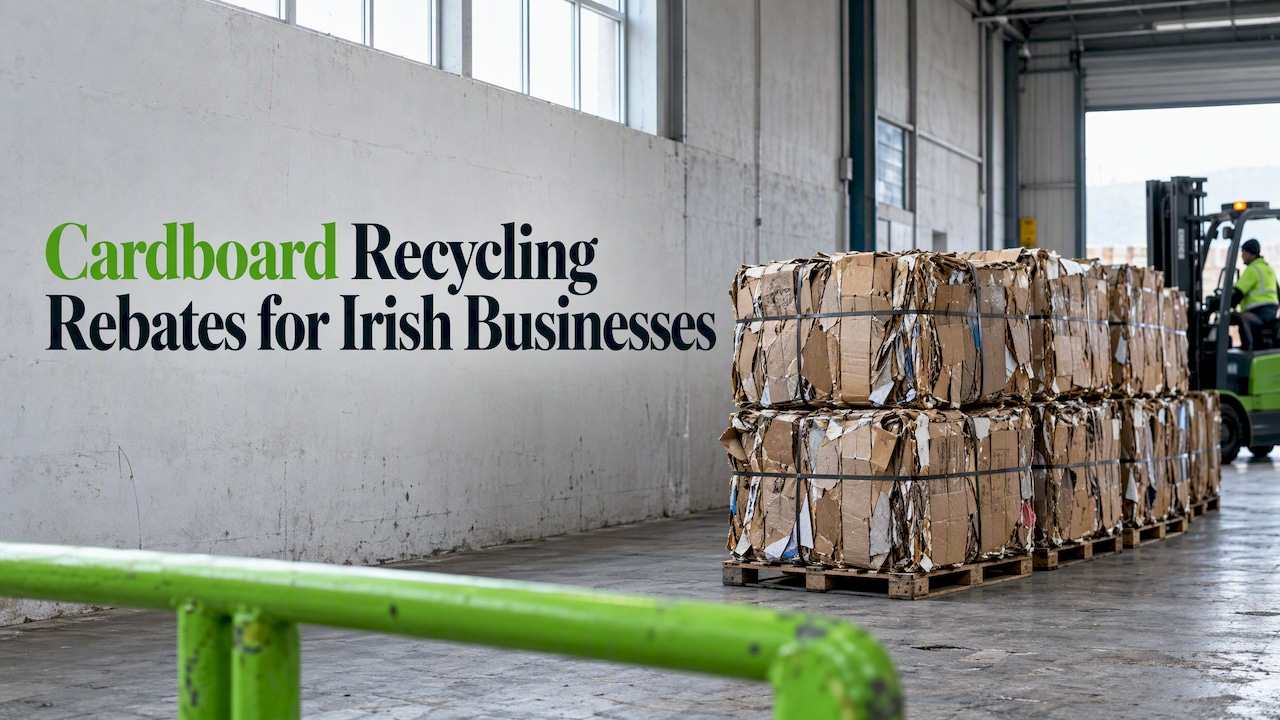
A cardboard rebate is money, or a discount on your collection charges, that you receive for handing over clean, dry, segregated cardboard. For most Irish businesses the real saving comes first from keeping cardboard out of the general waste bin. A cash payment comes second, and only if your volumes and bale quality justify it. This guide explains how rebates work, what drives the price, and how to decide whether baling is worth it for your site.
TL;DR
- A rebate is usually cash, a credit against services or a lower collection fee. In weak markets it may only offset the cost of haulage.
- Rebate value moves with the market, the tonnage you produce and how dense and clean your bales are.
- Low-volume sites rarely make a profit. The saving for them is avoiding residual waste charges.
- Segregation is a legal requirement in Ireland, so clean cardboard streams protect you as well as paying you.
- Baling cuts collections and lifts the value of every tonne. A free waste audit shows whether the numbers work for you.
Table of Contents
- What a cardboard recycling rebate actually is
- What decides how much you receive
- Be honest about your volume
- Segregation is now the baseline, not a bonus
- Why the producer fee is not your rebate
- Where baling changes the economics
- How to work out whether a rebate pays for you
- Our perspective
- Turning your cardboard into income with Compact
- FAQ
- Sources
What a cardboard recycling rebate actually is
Industry guidance describes a rebate as a payment or discount for supplying clean, dry, segregated cardboard in bulk, typically from packaging, deliveries, warehouses and retail. It can arrive in three forms:
- Direct cash per tonne, paid against a weighed load or bale count.
- A credit against other waste services on your account.
- A reduced service fee, where the cardboard value offsets what you pay for collection.
The word “rebate” can mislead. When paper markets are soft, buyers may charge a hauling fee that exceeds the commodity value, so your “rebate” is only a smaller bill. Ask any provider to state in writing which of the three forms you are being offered and how it is calculated.
What decides how much you receive
Three things matter most.
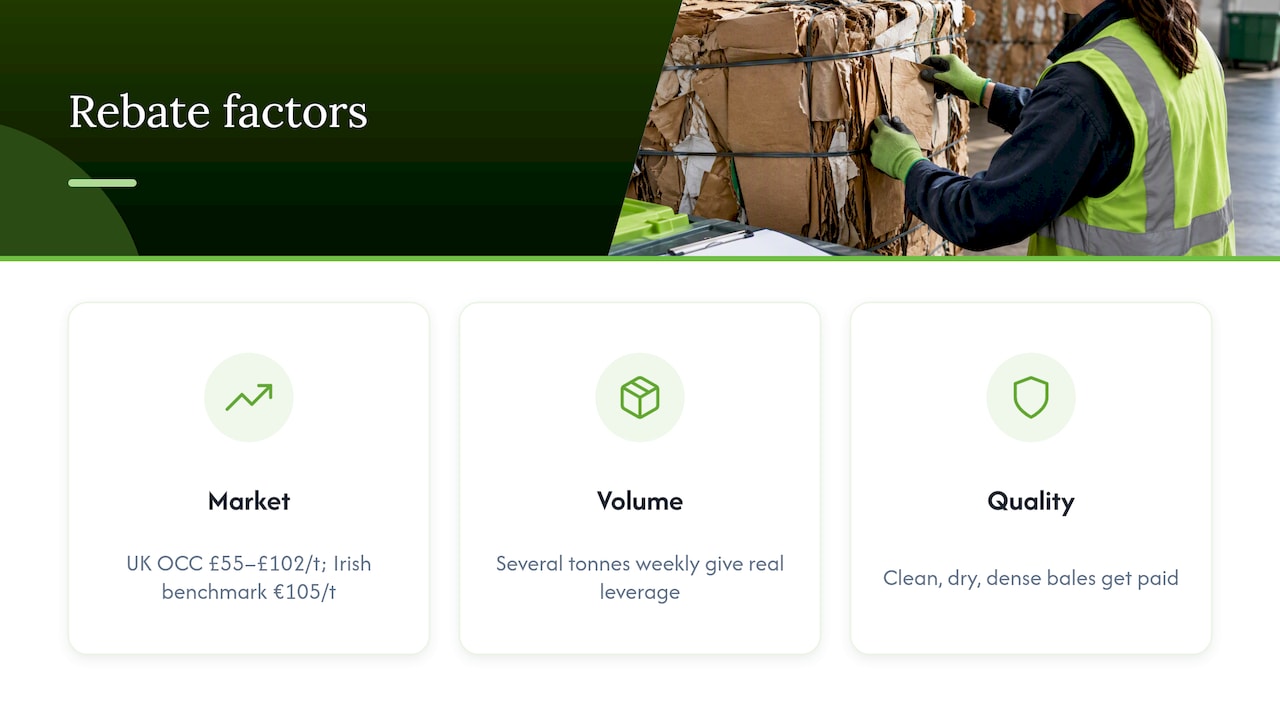
The market. Old corrugated containers (OCC) are priced against recovered paper indices. UK indicators for baled OCC in early 2026 fluctuated roughly between £55 and £102 per tonne, and the UK market peaked at around £150 per tonne after a sharp price rise in 2021. These are UK figures, useful as a direction of travel rather than an Irish quote. For what Irish buyers have been paying, see our page on cardboard bale prices in euro per tonne and the €105 per tonne benchmark we use to protect returns.
Volume. Buyers want full loads. A shop generating a few bags of flattened boxes a week has nothing to sell. A distribution centre or large retailer producing several tonnes a week has real leverage.
Quality. Wet, greasy or mixed cardboard is downgraded or rejected. Clean, dry, densely baled cardboard is what gets paid for. Foil and similar items are not typically accepted in cardboard and paper streams because of contamination risk, so keep them out.
Be honest about your volume
Consultants who work on this repeatedly find that small businesses misjudge eligibility. Rebates are rarely profitable for low-volume generators. For most SMEs the benefit is cost avoidance: cardboard that stays out of the general bin does not attract residual waste charges.
That is still a real saving. The EPA found that recyclables such as plastics, paper, cardboard and metal make up around 37 per cent of the commercial general waste bin. If a third of what you pay to dispose of as general waste is recyclable, the first win is moving it.
A rough guide to where you sit:
| Your situation | Likely outcome |
|---|---|
| Small shop, café or office, a few bags a week | No cash rebate. Saving comes from lower general waste charges |
| Mid-sized retailer or manufacturer, a compactor or baler’s worth of cardboard each week | Reduced collection fees, possibly a modest credit |
| Warehouse, distribution or large retail site, regular tonnage | Per-tonne payment on baled loads, plus fewer collections |
Segregation is now the baseline, not a bonus
Irish businesses no longer have a choice about separating waste. The Circular Economy Act introduces mandatory segregation and incentivised charging, which means mixed or residual waste costs more over time. Rebate schemes therefore sit on top of a compliance requirement. You separate cardboard anyway, so the question is whether you capture value from it.
Three practical habits make the difference:
- Flatten and keep it dry. Store cardboard under cover, away from food waste and wet areas.
- Keep contaminants out. Polystyrene, food-soiled boxes, tape in bulk and foil all lower grade. Keep plastic film in its own stream: our page on plastic film recycling equipment covers that.
- Label and train. Clear bin signage and a short briefing for staff beats any later sorting.
If you need the paperwork side, such as the waste code for cardboard and what an auditor expects to see, read our guide on EWC code 15 01 01, baling and audit-proof records. The wider packaging rules are covered in our note on packaging regulations in Ireland.
Why the producer fee is not your rebate
A common confusion in Ireland: Repak fees are paid by packaging producers, not to cardboard generators. For 2026 the total fee for recycled paper and cardboard is €45.60 per tonne, of which the brandholder or importer pays €41.60. That money funds the collection and recycling system that makes commercial recycling workable. It does not arrive in your account.
If you want to see how similar producer responsibility costs are being handled elsewhere, this explainer on how Canadian packaging buyers are cutting EPR fees is a useful comparison, though Canadian rules and rates differ from Irish ones.
Where baling changes the economics
Loose cardboard is bulky. You pay to move air. A baler compresses it into dense bales that can be stacked, stored and sold by weight. That does two things for your rebate.
- Fewer collections. In an Irish case study at a large logistics facility, the biggest gain came from automating waste handling to reduce the number of collections, which cut operating costs even when market prices were low. The same logic applies to a baler.
- A product buyers want. A uniform, dry, tied bale is easier to weigh, price and trade than a skip of loose boxes.
Compactors suit sites that produce a lot of mixed dry waste and want a sealed unit; balers suit sites producing clean cardboard they intend to sell. Our guides on choosing a cardboard baler and choosing a cardboard compactor set out the differences, and the overview of balers and compactors in Ireland puts them side by side. Do not forget consumables: baling wire and tape are a running cost to include in your calculation.
How to work out whether a rebate pays for you
Do this before signing anything.
- Weigh it. Record cardboard tonnage for four to eight weeks. Estimates are almost always wrong.
- List current costs. Collection fees, lift charges, bin rental and the proportion of general waste that is really cardboard.
- Price the options. Compare staying loose, a compactor and a baler, including wire, power and floor space.
- Ask what the rebate really is. Cash, credit or fee reduction? Fixed or index-linked? What happens if the market drops or a load is rejected?
- Check for hauling charges. A rebate that is net of haulage can fall to zero in a weak market.
- Review every quarter. Prices move, so a good deal in spring may not be one by autumn.
Our checklist for weighing waste to prove savings walks through steps 1 and 2, and how Irish businesses can reduce waste costs covers the wider picture. If your priority is speed, see how to cut waste disposal costs within one or two billing cycles.
Our perspective
We see the same pattern on site after site. Businesses come to us asking about a rebate, and the audit shows that the first money sits somewhere else: cardboard hiding in general waste, collections that are too frequent, and bins that are half air. Fix those and the rebate becomes a bonus rather than the business case.
We also think the market should be treated with respect. Cardboard prices move, and anyone promising a fixed windfall is ignoring that. What you can control is quality, density and consistency, because a clean, well-tied bale is the one thing that holds its value when the market is soft.
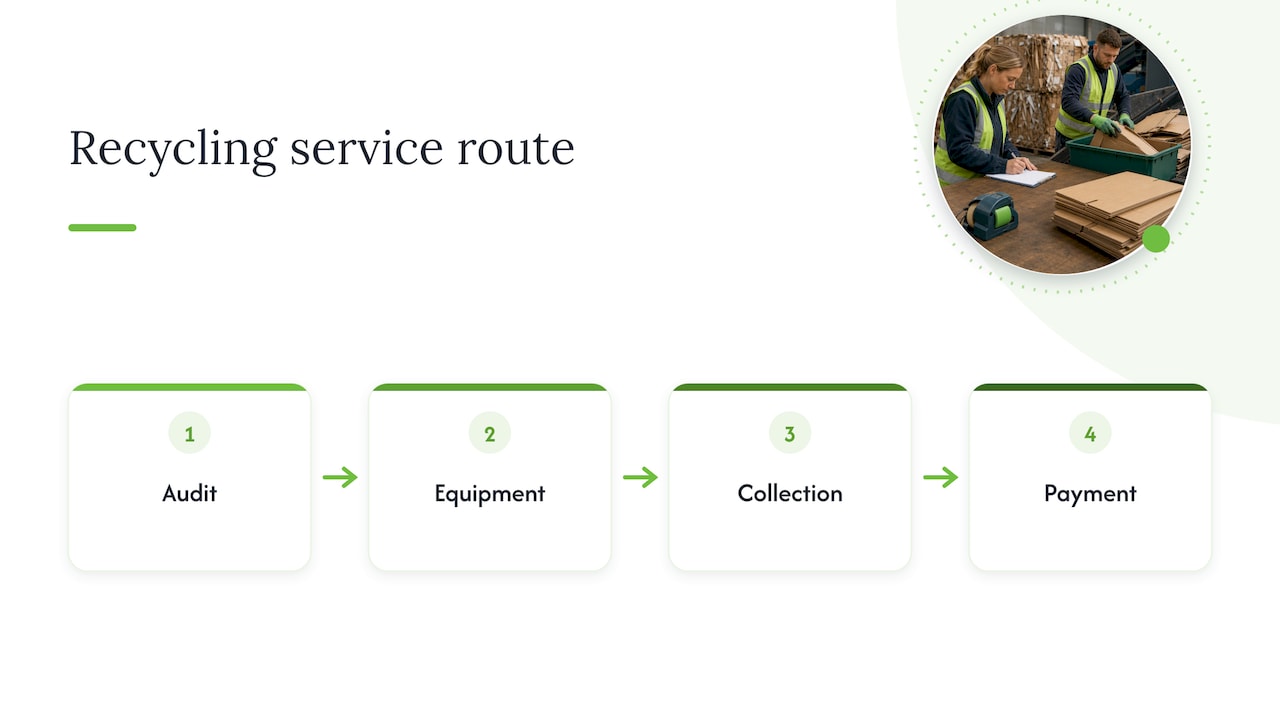
That is why we offer one route from audit, through equipment, to collection and payment. You do not have to work with one party to measure, another to supply a baler and a third to buy the bales, each with its own view of what the cardboard is worth. And if the audit shows your volume does not justify a baler, we will say so.
— Graham
Turning your cardboard into income with Compact
Our free waste audit looks at what you produce, how it is collected and what it costs, then shows where cardboard and plastic can be diverted or sold. If the numbers support it, our bale buyback scheme pays you for the bales you produce, and we supply cardboard balers, cardboard compactors and refurbished equipment to produce them. Start with the audit, then decide.
FAQ
Can any business get a cardboard rebate in Ireland?
In principle yes, but in practice it depends on volume and quality. Buyers need regular, clean, dry cardboard in quantity, so small producers usually benefit through lower waste costs rather than a payment. A weighed audit tells you which group you are in.
Is a rebate paid in cash?
Not always. It can be a cash payment per tonne, a credit on your account or a reduced collection fee. Ask for the form in writing, and check whether haulage is deducted.
Why did my rebate fall?
Because it follows the recovered paper market. UK indicators for baled OCC have ranged widely, from about £55 to £102 per tonne in early 2026, and a softer market can also bring hauling charges that eat into the value. Poor bale quality or contamination can lower it further.
Do I have to segregate cardboard by law?
Yes. Mandatory segregation is part of the Circular Economy Act. Keeping cardboard separate also avoids the higher charges applied to residual waste.
Does a baler guarantee a rebate?
No. A baler reduces collections and gives you a saleable product, but the payment depends on your tonnage, bale quality and the market on the day. Run the numbers on your own weights first.
Sources
- Commercial Cardboard Recycling Rebates, Business Waste
- Baled Cardboard Prices UK: Grades and Value Explained, Kenburn
- Rebates for Large Volumes of Cardboard, Waster
- Repak 2026 fees sheet
- Landmark Circular Economy Act signed into law, gov.ie
- EPA on commercial waste segregation and recycling performance
- wheel.me and LSM automated waste management case study
- MyWaste: soft plastics and recycling bins