The fastest route to payment is to prepare clean OCC (old corrugated cardboard), document each consignment properly, and get written offers from more than one buyer before committing. Verify that the buyer is authorised to take the material, and either arrange your own collection or use a buyback service. Two things to do today: build a buyer pack for your current stock, and request written quotes that spell out haulage, weighing and payment terms so you can compare like for like.
TL;DR:
- Confirm that offers include haulage, weighbridge locations, and payment schedules to ensure the net value matches the quote and avoid surprises.
- Keep bales dry, well-labeled, and free from contamination, as moisture and mixed materials significantly reduce bale prices and risk rejection.
- Obtain written agreements with clear specifications for grade, pricing basis, volume minimums, and rejection rules to prevent disputes and ensure steady cash flow.
- Use a documented buyer pack with photos, bale counts, and contamination notes to leverage negotiation power and maintain consistent supply quality.
- Conduct a free waste audit and supply detailed bale data to secure direct buyback offers, reducing disposal costs and increasing revenue potential.
Table of Contents
- How cardboard bale prices are set
- Preparing and grading bales: what buyers expect
- Where to find buyers and how to compare offers
- Logistics, contracts and compliance to avoid operational surprises
- Estimating revenue: a brief worked example and realistic ranges
- Why source separation and documentation improve price
- Making baled cardboard a reliable revenue stream
- How Compact can help with audits and buyback
- Sources
- FAQ
How cardboard bale prices are set
Buyers price bales on a handful of levers, not a single headline figure. Grade matters most: clean OCC commands more than mixed or contaminated loads, and moisture or food residue can trigger deductions before the material is even weighed.
- Grade: sorted OCC outperforms mixed paper and board on almost every quote.
- Moisture and contamination: wet or soiled bales lose weight-adjusted value and risk rejection.
- Bale density: tightly baled loads transport more efficiently and are easier to price.
- Market benchmark: European recovered paper indices set the ceiling most Irish quotes work from.
- Export dynamics: demand from paper mills and overseas buyers shifts benchmark pricing week to week.
European OCC benchmark prices moved toward roughly €105 per tonne in late 2025 and early 2026, according to BIR market commentary on the European recovered paper trade. That figure is a market indicator, not a guaranteed payout: your actual return depends on whether the quote is delivered, ex-yard or net of haulage, and whether it is fixed or index-linked.
Contract terms often move net value more than the headline rate does. Who pays for haulage, where the load is weighed, how contamination deductions are calculated, and when payment lands all change what actually reaches your account. A buyer offering slightly less per tonne but collecting reliably on a fixed schedule frequently beats a higher quote that comes with unpredictable deductions.
Preparing and grading bales: what buyers expect
Preparation starts before the baler runs. Source-separate OCC from food packaging, plastics, and coated or waxed board, since baling compresses material for transport but cannot remove contamination that is already mixed in.
- Keep OCC in its own stream, away from general waste and other recyclables.
- Store bales dry and under cover; damp cardboard loses weight-adjusted value fast.
- Photograph each batch and note bale count, dimensions and estimated weight.
- Label bales by date and grade so buyers can verify consistency across a consignment.
- Confirm loading access (dock height, forklift or loader availability) before requesting a quote.
Most buyers will ask for a buyer pack: bale count, estimated or actual weight, photographs, contamination notes, dimensions, storage conditions, pickup address and preferred loading method. Assembling this once and updating it per consignment saves repeated back-and-forth with each prospective buyer.
Pro Tip: Keep a simple spreadsheet log of bale weights and grades over time; it turns into your negotiating leverage once you can show a buyer a consistent, well-documented supply.
Where to find buyers and how to compare offers
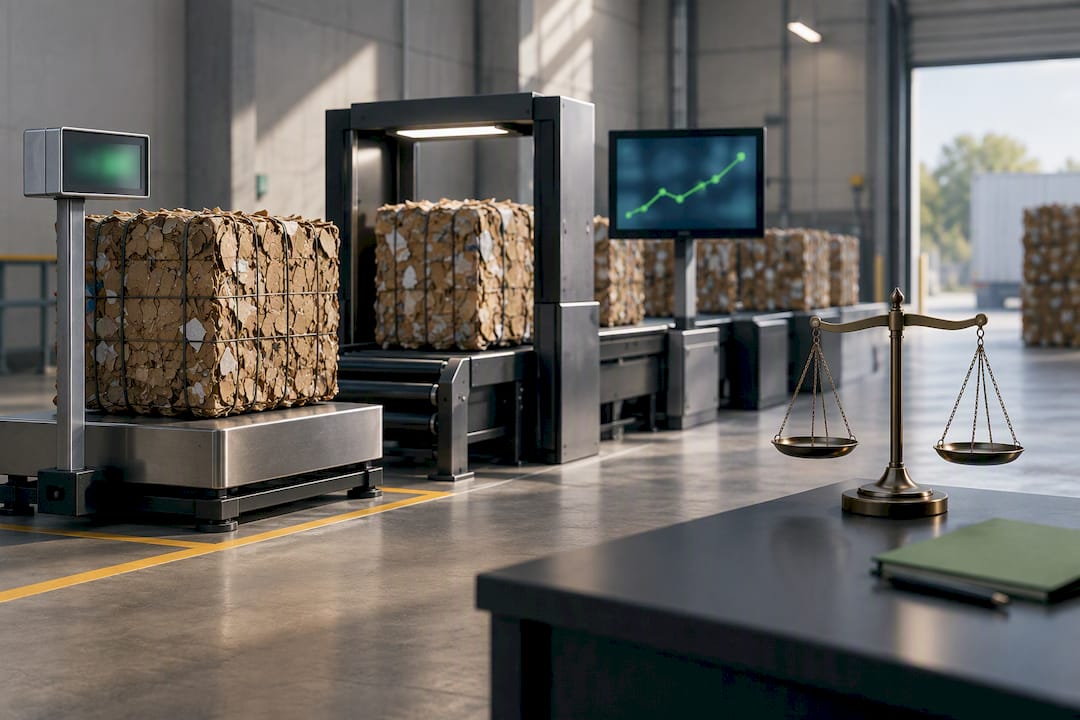
Cardboard bale buyers fall into a few categories: recycling processors who take material directly, brokers who aggregate volume from several sites, regional collectors who service a defined area, and buyback services that combine collection with a standing purchase agreement, Compact among them.
Comparing offers only works when the specification is identical across quotes. Before signing anything, check:
- Price basis: is it fixed per tonne, or linked to a published index.
- Grade definition: does the buyer’s OCC specification match what you are actually baling.
- Haulage responsibility: who arranges and pays for collection.
- Weighing point: on your site, at the buyer’s yard, or somewhere in between.
- Minimum volumes: does the offer require a certain tonnage per collection.
- Rejection rules and payment terms: how disputes are handled and when you get paid.
Ask for a written acceptance and inspection checklist as part of the agreement. It reduces the risk of a load being downgraded or rejected after collection, when you have far less leverage to negotiate.
Logistics, contracts and compliance to avoid operational surprises
Getting paid for baled cardboard involves more than agreeing a price. A few checks protect you from delays, deductions or legal exposure.
- Confirm the buyer’s authorisation and intended recovery route before the first load leaves your site; if the material will be handled as waste rather than a direct recyclate sale, it needs to move through an authorised waste-management route with transfer documentation and weighbridge records kept on file.
- Expect inspection on arrival: BAT guidance for waste transfer and materials recovery describes reception checking, sampling, storage and onward movement as standard steps that influence both acceptance and any deductions applied.
- Sort out site logistics in advance: loading method, vehicle access, whether you weigh on-site, and dry, secure storage that keeps contamination out until collection.
None of this is complicated, but skipping it is where most disputes originate. A load that gets rejected on arrival costs you handling time and, often, a return journey.
Estimating revenue: a brief worked example and realistic ranges
Say a site produces 40 bales a month, each averaging 350 kilograms, giving 14 tonnes of OCC. At a benchmark price near €105 per tonne, that is a gross value of roughly €1,470 before any deductions.
- Haulage: if the buyer charges collection back to you, subtract that cost from the gross figure.
- Contamination deduction: a load with moisture or mixed material can be discounted by the buyer’s stated percentage, which varies by contract.
- Net result: after haulage and a modest contamination deduction, the same 14 tonnes might realise noticeably less than the headline gross figure.
These numbers are illustrative only. Benchmark prices move quickly, so always confirm the current rate and full deduction schedule in a written quote before you rely on any projection.
Why source separation and documentation improve price
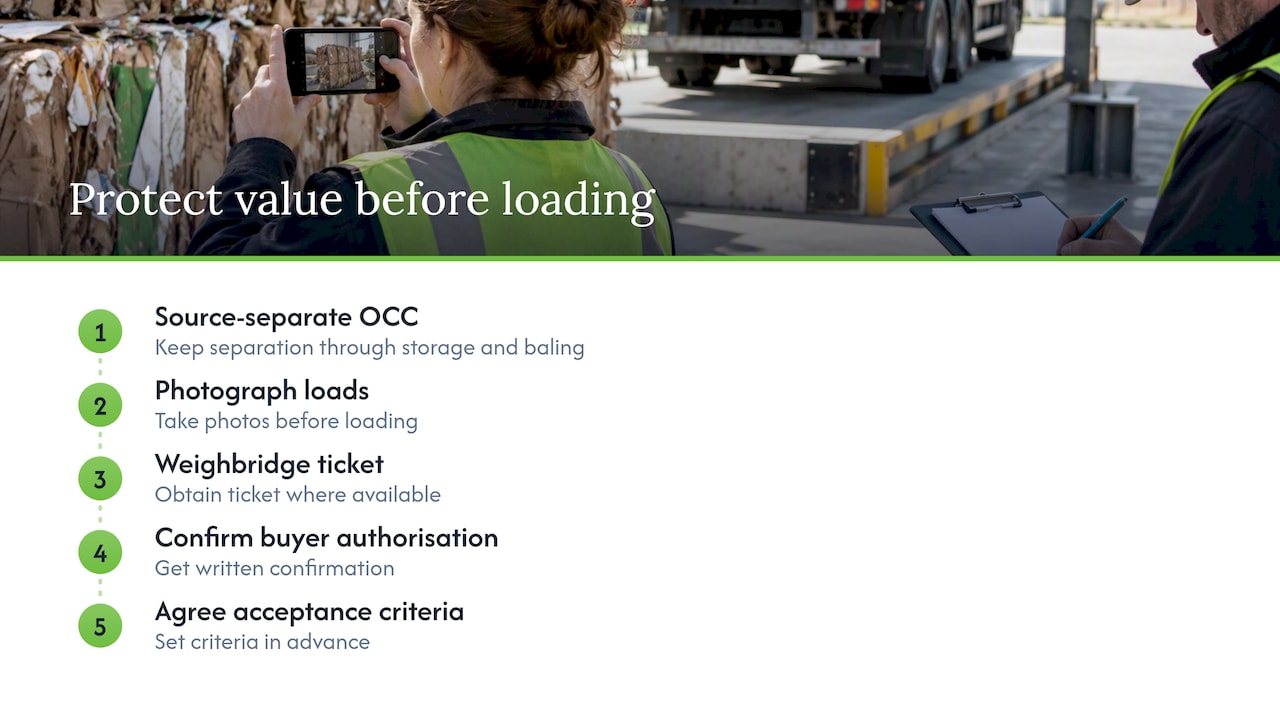
Separating OCC at source and keeping it that way through storage and baling is the single change most likely to protect value. The EPA’s pre-treatment and residuals management guidance identifies source separation as central to maximising recovery options for paper and cardboard streams, and buyers price accordingly.
Market commentary reinforces the same point from the demand side.
Quality consistency and logistics reliability are decisive for realised value in the recovered paper trade.
BIR recovered paper market commentary
Before loading, take photographs, get a weighbridge ticket where available, confirm the buyer’s authorisation in writing, and agree the acceptance criteria in advance. These small steps consistently reduce disputes and unplanned deductions.
Making baled cardboard a reliable revenue stream
The businesses that do well out of this treat cardboard as a commodity with a paper trail, not a bin that happens to get emptied. A proper audit, tighter source separation, and a written buyback arrangement usually turn what was a disposal cost into a small but repeatable income line. If you have not had your waste stream audited, it is worth asking Compact for a free assessment or a conversation about a buyback arrangement.
— Graham
How Compact can help with audits and buyback
Compact’s Free Waste Audit looks at your current cardboard stream, baling setup and collection pattern, then sets out where value is being left on the table. The We Buyback Bales service builds on that by offering direct payment for baled cardboard and plastics, with collection arranged as part of the agreement, aiming to maximise the rebate you get for material you would otherwise pay to have removed.
- Request a free audit to get a site-specific view of your cardboard stream.
- Supply your buyer pack (bale count, weight, photos, contamination notes) once your audit is complete.
- Get a written offer covering price basis, haulage and payment terms before agreeing collection.
| Step | What happens |
|---|---|
| Free Waste Audit | Compact reviews your current cardboard and waste handling |
| Buyer pack | You supply bale count, weight, photos and contamination notes |
| We Buyback Bales | Compact offers direct payment and arranges collection |
If you are also weighing up whether on-site baling would improve your transport efficiency, Compact’s cardboard baler range is worth a look before you commit to a new buyer relationship. Start with the audit, then decide.
Sources
- Municipal solid waste – pre-treatment & residuals management (EPA)
- BIR – Europe recovered paper market commentary
FAQ
How much are bales of cardboard worth?
Value depends on grade, moisture, contamination and the terms of the deal, not just the headline market rate. Benchmark European OCC prices moved toward roughly €105 per tonne in late 2025 and early 2026, but your actual return depends on haulage, weighing point and any deductions in the written offer.
Can I make money from selling cardboard?
Yes, businesses that generate enough baled OCC can turn a disposal cost into revenue, provided the material is clean and well documented. A buyback arrangement or a direct sale to a processor both work, as long as you compare written offers on identical terms first.
What is the price per kg for recycling cardboard?
Prices are usually quoted per tonne rather than per kilogram, and the European OCC benchmark sat near €105 per tonne in late 2025 and early 2026. Convert that to a per kilogram figure only as a rough guide, since actual payouts vary with haulage costs and contamination deductions.
What do people do with cardboard bales?
Baled cardboard is typically sold to recycling processors or brokers who move it on to paper mills for reprocessing into new board or packaging. Businesses that generate consistent volumes often use a standing buyback arrangement so collection and payment happen on a set schedule rather than as one-off sales.