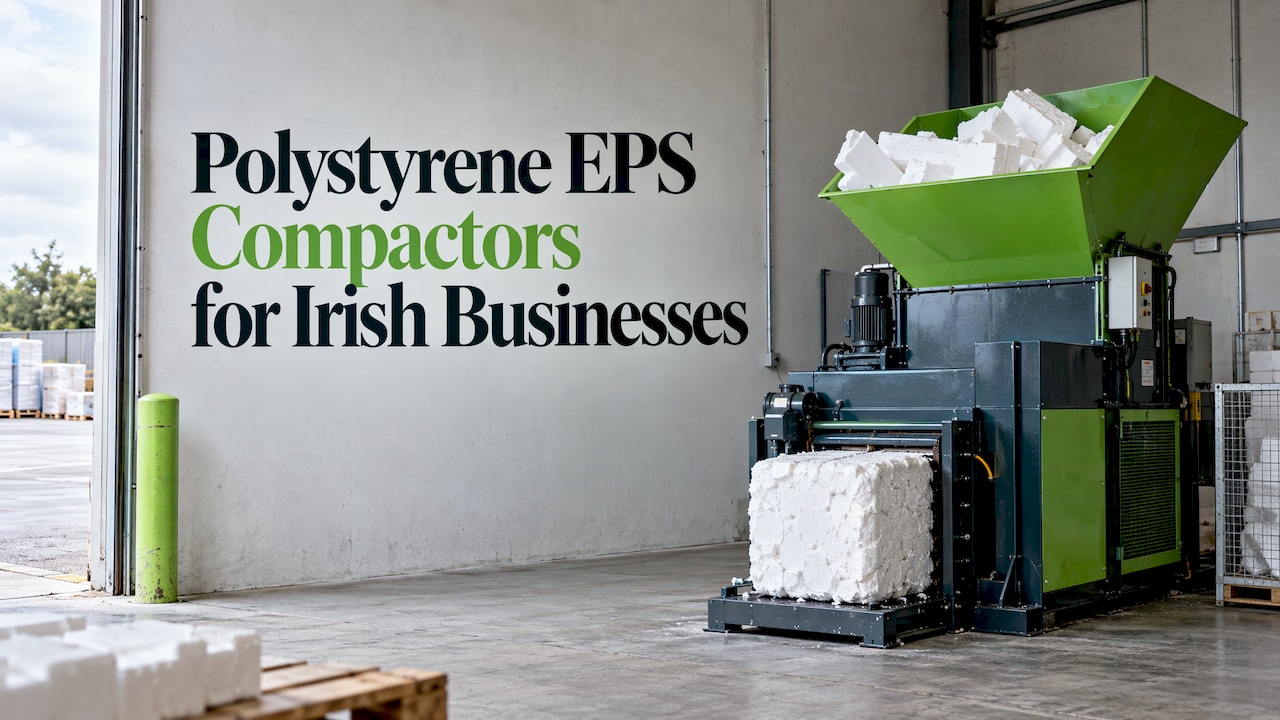
An EPS compactor turns light, bulky polystyrene packaging into dense blocks that are cheap to store, easy to move and ready to sell on for recycling. If your site throws out foam trays, protective packaging or fish boxes every week, a compactor is the machine that stops that foam filling skips and lorries with air. Our range at Compact covers EPS compactors to rent or buy, from SME scale up to industrial volumes, and we start with a free waste audit so the machine matches what your site actually produces.
TL;DR
- Expanded polystyrene (EPS) is about 98% air, so compacting it before transport is what makes collection and recycling workable.
- Our EPS compactors use high-pressure compression to cut foam volume by up to 98%, and the dense blocks can be sold to recyclers.
- Size the machine from your weekly foam volume, the space you have, your power supply and how the blocks leave site.
- Irish workplace guidance expects trained operators, working guards and an emergency stop on any compactor.
- A free waste audit with Compact is the quickest way to work out the right model for your site.
Table of Contents
- What an EPS compactor does
- Compactor, crusher or melting machine
- Which polystyrene can go in
- What happens to the blocks
- How to choose the right size and set-up
- Using an EPS compactor safely
- Irish recycling rules and why EPS segregation matters
- Our view on EPS compaction
- Start with a free waste audit
- FAQ
- Sources
What an EPS compactor does
EPS is the white, rigid foam most people call polystyrene or Styrofoam. It protects appliances, electronics, medical supplies and chilled food in transit, and it arrives in volume at warehouses, retailers, fish processors and manufacturers.
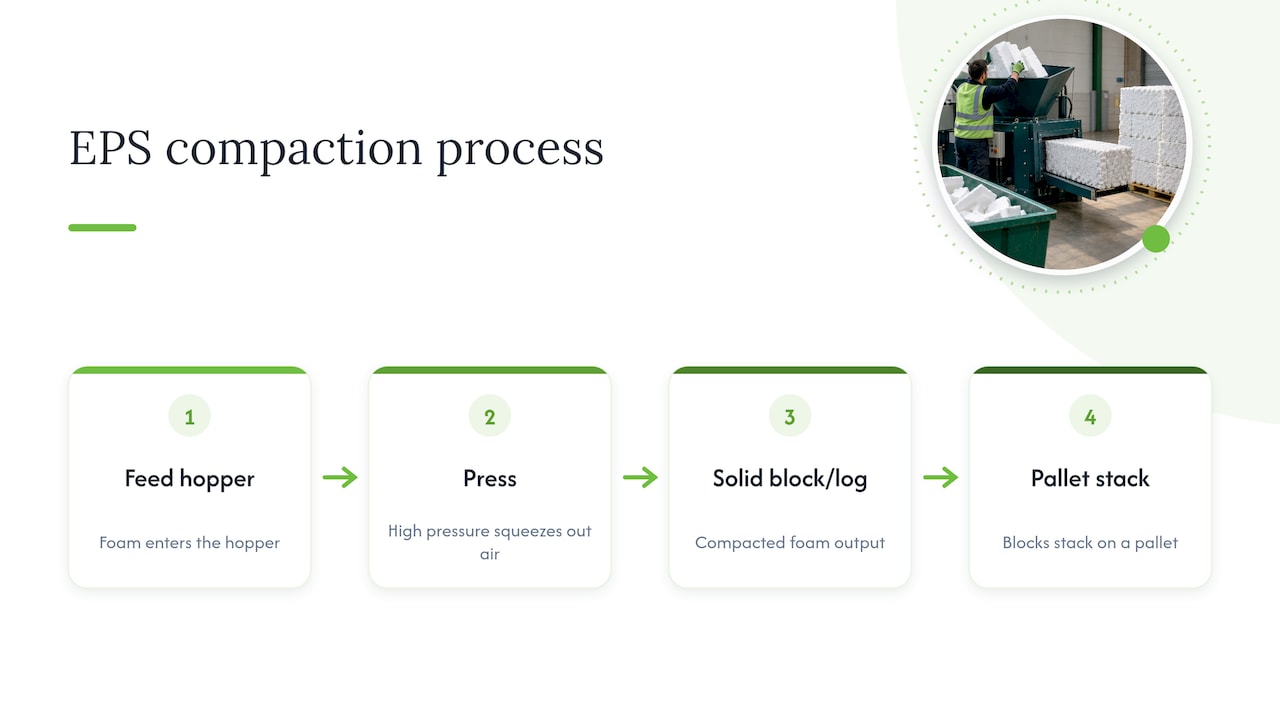
The problem is bulk, not weight. A skip of loose foam is mostly air, so you pay to move and store very little material. A compactor squeezes that air out. The foam is fed into a hopper, pressed under high pressure and delivered as a solid block or log that stacks on a pallet. As our EPS Styrofoam recycling compactors page explains, volume can fall by up to 98%, which means fewer collections, less floor space taken up and a product recyclers will actually take.
A Repak report on EPS and XPS in Ireland notes that most recycling of these materials happens business to business, and that because both are 98% air, compaction before transport is essential. That is the business case in one line: clean, dense foam from commercial sites is the material the recycling chain is built around.
Compactor, crusher or melting machine
There is more than one way to reduce foam, and the right one depends on your volume and what you want to do with the output. We supply each of these:
| Machine | What it does | Best suited to |
|---|---|---|
| EPS cold compactor (A-C100, A-C200, A-C300) | Presses foam into dense blocks without heat | Sites with steady foam streams that want blocks to sell on |
| EPS foam crusher | Breaks foam into small pieces | Sites that want to reduce volume before further processing |
| EPS melting machines (C50 to C300) | Melts foam into compact ingots | Higher-volume sites that want maximum reduction |
| StyroPress | Dedicated foam pressing unit | Sites that want a purpose-built polystyrene press |
If you are unsure which row fits, the EPS recycling system page shows how these machines work as part of a full set-up.
Which polystyrene can go in
The usual commercial feed is clean white packaging foam: moulded protective inserts, sheet foam and boxes. Keep the stream clean. Food residue, tape, plastic film and cardboard lower the value of the block and can cause problems at the recycler.
Two habits keep it clean:
- Put the compactor where the foam is generated, so it does not pick up other waste on its way there.
- Strip labels, tape and film at the point of unpacking, and send film to its own stream. We also cover plastic film recycling, which pairs naturally with an EPS line in a warehouse.
Never feed metal, glass or other unsuitable material into the machine. Irish workplace guidance makes the same point (more on that below).
What happens to the blocks
Compacted EPS is a commodity. Our page notes the blocks can be sold to recycling companies for further processing or used in making products such as picture frames and mouldings. Because most EPS recycling in Ireland is business to business and local in scale, the practical question is who collects your blocks and how often. A dense, stackable block makes that an easy conversation, because the collector is moving material rather than air.
If you already bale cardboard, the same logic applies. Our We Buyback Bales scheme turns cardboard and plastic residues into revenue, and a single audit can look at your foam, cardboard and plastic streams together.
How to choose the right size and set-up
Four checks decide the model. Work through them before you ask for any quote.
1. Weekly volume
Estimate how many cubic metres of loose foam you clear each week, or how many skips or bags you fill. Include peak weeks such as pre-Christmas for retail or product launches for electronics. The machine should cope with your busiest period, not the average. The A-C100, A-C200 and A-C300 cold compactors give you three steps in capacity.
2. Space and layout
Measure the footprint plus the room needed to load the hopper and to move a pallet of finished blocks. Position the machine close to the packing or goods-in area so staff are not carrying foam across the yard. Check door widths and floor strength on the route in.
3. Power and loading
Check what supply is available at the siting point and confirm it with the machine’s specification before delivery. Think about how foam arrives: by hand from packing benches, by trolley, or in bulk. Where foam is bulky and arrives in large loads, a crusher feeding a compactor can speed things up.
4. Collection and storage of blocks
Decide where blocks are stacked, how they are kept dry and clean, and how a collector gets access. Blocks that sit in the rain or beside general waste are harder to sell.
Rent or buy
We offer EPS compactors to rent or buy. Renting suits a site testing a new waste stream or with seasonal peaks; buying suits steady, high-volume sites. For more budget-friendly options, we also supply refurbished compactors and balers. Prices depend on the model and your site, so we quote after looking at your volumes.
Using an EPS compactor safely
A compactor is safe when it is used as designed. The HSE’s risk assessment prompt sheet for warehouses and stores, issued under Section 19 of the Safety, Health and Welfare at Work Act 2005, sets out what to have in place:
- Use and maintain the compactor according to the manufacturer’s instructions.
- Keep guards and interlocks fitted, with the machine stopping automatically if the door opens.
- Fit an emergency stop, and make sure the machine does not restart on its own after a power interruption.
- Never feed in unsuitable materials such as metal or glass.
- Isolate the power before clearing a blockage.
- Allow only trained employees to operate it, with no loose clothing, dangling jewellery or unsecured long hair.
Build this into a short site routine: name one or two trained operators, put a laminated do and don’t list beside the machine, and book regular servicing. If a guard or safety switch ever fails, take the machine out of use until it is repaired.
Irish recycling rules and why EPS segregation matters
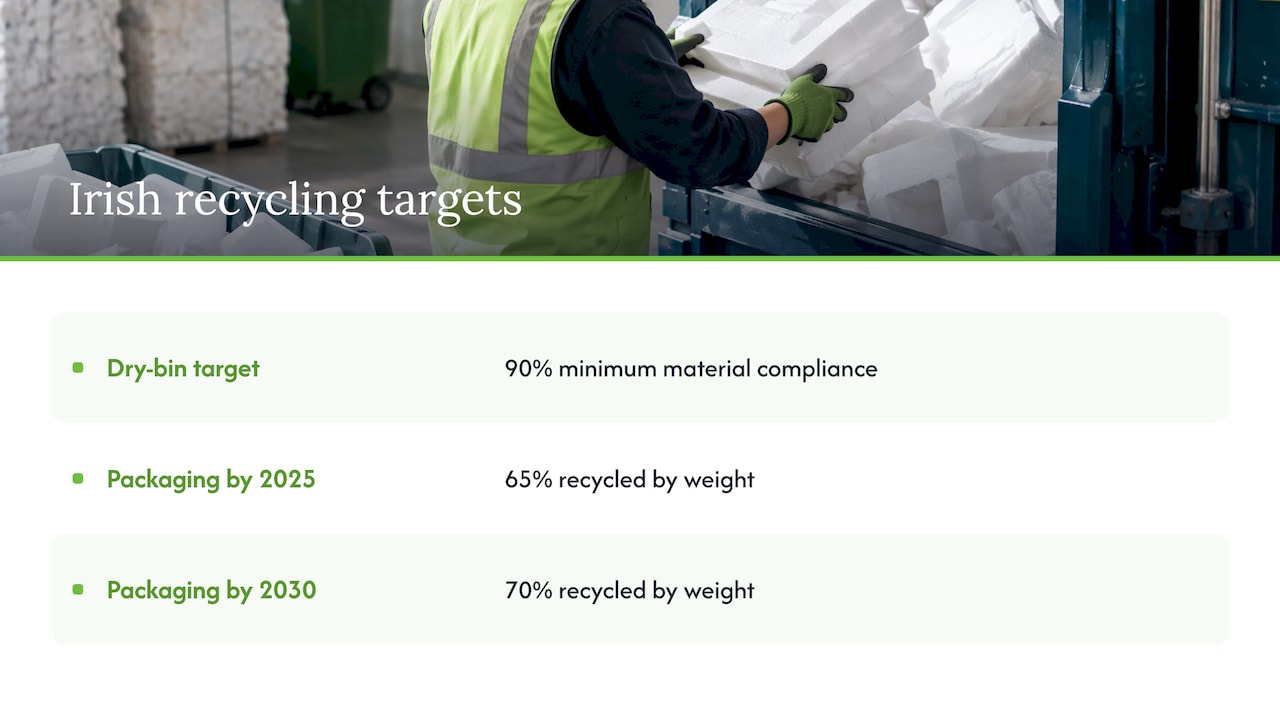
Commercial waste in Ireland is moving towards cleaner segregation. The National Waste Management Plan for a Circular Economy sets a 90% minimum material compliance target for the dry recycling bin and commits Ireland to recycling 65% of packaging waste by weight by the end of 2025 and 70% by 2030. It also asks local authorities to promote commercial waste segregation and apply bye-laws on storage and presentation.
For a business, that points one way: foam packaging that is separated at source, compacted and sent for recycling supports your compliance and your sustainability reporting. Wider efforts to turn waste into useful resources, such as converting waste into green energy, show where the sector is heading, and clean, well-sorted material is what every one of those routes needs.
The EU Packaging and Packaging Waste Regulation is also reshaping obligations for packaging on the Irish market, and Repak has published guidance for its members on it. Check your own obligations with Repak if you place packaging on the market.
Our view on EPS compaction
Most of the foam we see leaving Irish sites is paid for twice: once to buy the packaging, and again to haul away something that is mostly air.
Our approach starts with a waste audit, because the right machine depends on how much foam you produce, where, and how it leaves the building. Our aim is to give you a single point of service, from audit to equipment to recycling and payment, so that waste stops being a cost line and starts to earn.
Compact the foam at source, keep it clean, stack it dry and sell it on. That is the routine we build around, and it is why we pair EPS compactors with our bale buyback scheme.
Graham
Start with a free waste audit
We begin every project with a free waste audit. We analyse your waste streams, recommend the EPS compactor, crusher or melting machine that fits, and show how recyclable material can bring money back through our bale buyback scheme. If your foam sits alongside heavy cardboard, our cardboard balers and hydraulic compactor can sit in the same plan.
To see the full EPS range, visit our EPS compactors page or call 01 503 8241.
FAQ
How much can an EPS compactor reduce polystyrene volume?
Our EPS compactors use high-pressure compression to reduce the volume of polystyrene by up to 98%. That matches the nature of the material, which is around 98% air. The result is dense blocks that take far less space to store and transport.
Can I rent an EPS compactor instead of buying?
Yes. We supply EPS compactors to rent or buy, and we also have refurbished equipment. Pricing depends on the model and your volumes, so the starting point is a free waste audit.
Who should operate the machine?
Only trained employees. The HSE prompt sheet asks for operation by trained staff, guards and interlocks in place, and power isolated before any blockage is cleared. Naming a trained lead operator for each shift keeps this simple.
What can I do with the compacted blocks?
They can be sold to recycling companies for further processing. Because most Irish EPS recycling happens between businesses, a clean, dry, dense block is the form that recyclers and collectors want.
Sources
- Repak: Expanding the Knowledge Base of Expanded and Extruded Polystyrene
- HSE: Risk assessment prompt sheet for warehouse and stores
- National Waste Management Plan for a Circular Economy, Volume II