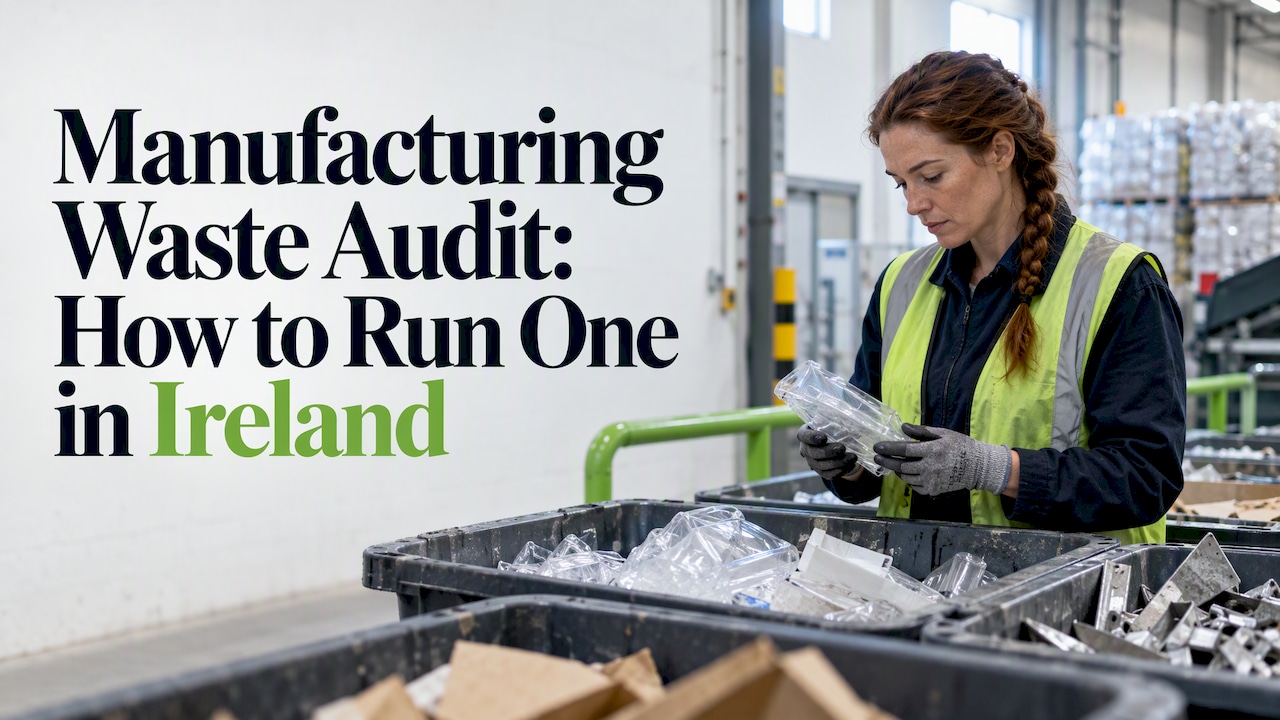
A manufacturing waste audit is a hands-on review of what your site throws away: which materials, how much of each, where on the floor they come from and who produces them. Done properly, it gives you a weighed baseline per waste stream, a list of savings ranked by value, and the records an Irish regulator or customer expects to see. This guide walks through preparation, the sort itself, the Irish paperwork, and what to do with the numbers.
TL;DR
- A manufacturing waste audit identifies the types, quantities and sources of waste at site, department or process level, so you can cut disposal costs and prove compliance.
- Plan it first: risk assessment, a briefed team, the right kit, and a day that does not distort results, such as the day before a scheduled collection.
- Weigh by stream, deduct container weight, and repeat the exercise three times so your annual estimate rests on an average, not a single odd day.
- Hazardous waste, licence conditions and food waste have their own Irish records and protocols. Check these before you start sorting.
- The money is in the findings: cleaner segregation, fewer collections, and baled cardboard and plastic sold rather than paid for.
Table of Contents
- What a manufacturing waste audit actually covers
- Before you start: scope, people and safety
- The equipment and records to bring
- How to carry out the sort and weigh
- Irish rules and records to check first
- Turning findings into savings
- Where equipment and bale income fit
- Perspective: what we see after the audit
- Get a free audit from us
- How often to repeat the audit and track progress
- Common mistakes to avoid
- FAQ
- Sources
What a manufacturing waste audit actually covers
The WRAP guidance for food and drink manufacturers describes a waste audit as a hands-on review that identifies what types of waste a business produces, where it is generated and who generates it. In a factory that means going beyond the skip outside. You are looking at goods-in packaging, offcuts and scrap, rejected product, process residues, maintenance waste, canteen waste and the office block attached to the plant.
The same guidance notes that an audit can help a business comply with waste legislation and set targets for reuse, recycling and recovery. That second part matters. An audit that ends in a report and no targets is a cost. One that ends in a ranked list of actions pays for itself.
It helps to separate three things people often blur together:
| Activity | What it answers | Typical output |
|---|---|---|
| Desk review of records | What are we paying for, and what do our consignment and collection records say? | Cost and tonnage by contractor and stream |
| Walk-through of the facility | Where does waste arise, and where does it get mixed? | Map of waste points and bin locations |
| Physical sort and weigh | What is really in each bin, and how much? | Net weight and composition by stream |
A good audit uses all three. Records show what you think you generate. The sort shows what you actually generate, and the gap between the two is usually where the savings sit.
If you want a step-by-step working document to carry onto the shop floor, our waste audit checklist for managers covers the six stages from planning to action.
Before you start: scope, people and safety
Decide the scope
A single-site audit of every stream is rarely the right first step in a large plant. Pick a boundary you can finish: one production line, one department, or one building. WRAP’s guidance says an audit can be run at a high level for a whole building or at a more detailed level per department or process area. Start narrow where you suspect the most cost, then widen.
Appoint a lead and involve the floor
An older industrial guide from the Ontario Waste Management Corporation, summarised in a waste audit and reduction manual, argues that audits work best when led by a dedicated supervisor, freed from other administrative duties, with people from every level involved, from management to shop floor. The manual dates from 1993 and is Canadian, but the point holds anywhere: if the person running the audit is also covering a production shift, the sort will be rushed.
Run a risk assessment
WRAP’s general waste audit guide says preparation requires a risk assessment to identify hazards such as manual handling or hazardous waste, and that relevant colleagues, including health and safety officers, should be briefed. In a manufacturing setting, add the things specific to your process: sharp offcuts, solvent-contaminated rags, powders, hot residues, pressurised containers and anything covered by your safety data sheets.
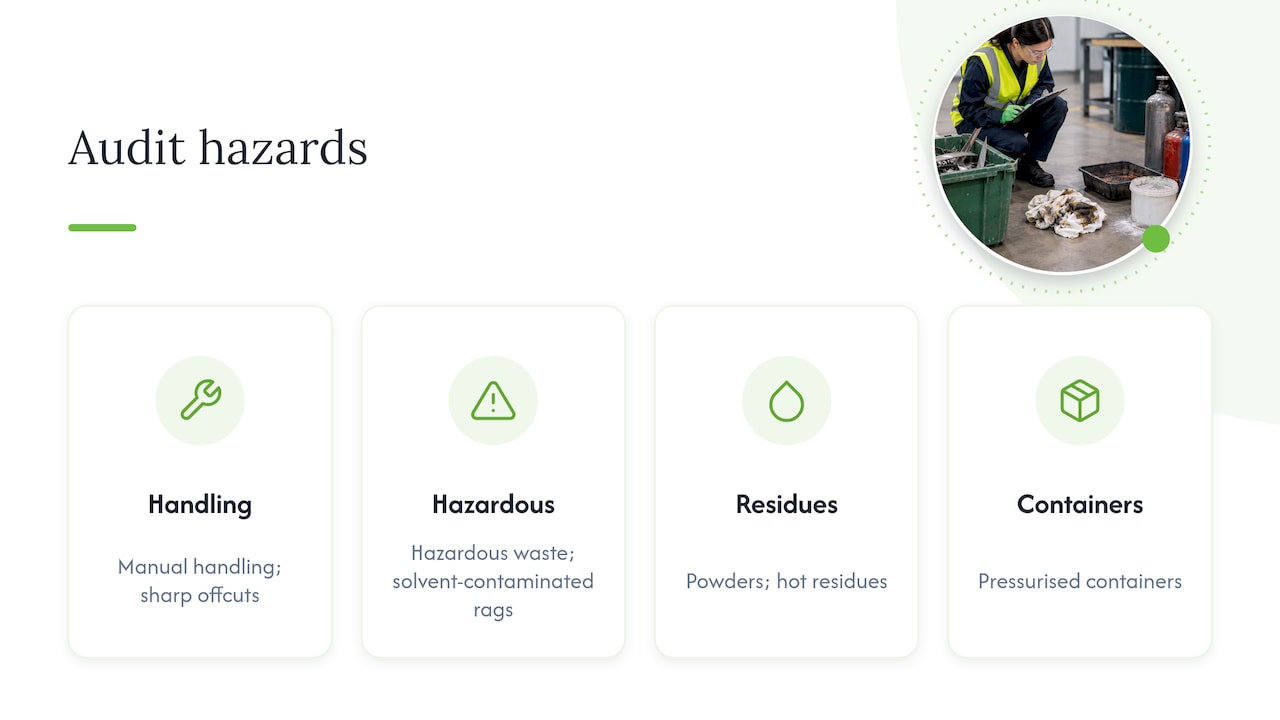
The same WRAP guidance points out that an existing waste or recycling provider may be better placed to carry out the audit, particularly where waste could contain injury-causing items such as broken glass. If your floor produces sharps or mixed residues you cannot easily identify, that is a good reason to bring in outside help.
Choose the day carefully
The audit should happen at a time that does not skew the results. WRAP suggests the day before scheduled waste collection, when bins are as full as they get. It also advises keeping the audit confidential from general staff beforehand, because people who know they are being watched change what they throw where. Avoid shutdown weeks, product changeovers and the days after a big delivery unless you specifically want to measure those.
The equipment and records to bring
According to WRAP, a physical audit needs the following:
- Weighing scales that suit your container sizes
- Containers for sorting by material
- A tarpaulin or plastic sheet to sort on
- Personal protective equipment (PPE) suited to the waste
- A record-keeping template
On a factory floor, add gloves rated for cuts, eye protection, a secure and ventilated sorting area away from forklift routes, a camera for photographing each stream, and a pallet scale if you are weighing whole cages or wheelie bins. WRAP also stresses taking additional care with sharps or hazardous waste and using a secure area for sorting.
For the desk-review part, gather:
- Twelve months of waste contractor invoices and weighbridge tickets
- Collection schedules and bin sizes by stream
- Hazardous waste consignment notes and certificates of destruction
- Your licence or permit conditions, if you hold any
- A site plan marked with bin and skip locations
- Purchasing data for packaging and raw materials, so you can compare what comes in with what goes out
How to carry out the sort and weigh
- Collect by stream. WRAP says waste should be collected separately by stream: general waste, recyclables and any other specific streams you operate. Do not mix bins before sorting.
- Weigh the container empty. Weigh each type of waste and deduct the weight of the container to get the net weight. This is the step most often skipped, and it inflates every figure.
- Sort each stream into its components. Open the general waste bin and split it into cardboard, film, hard plastics, wood, metal, food, residual and anything hazardous. Weigh each fraction.
- Photograph and record. One photo per stream before and after sorting makes the later conversation with production teams far easier.
- Repeat. WRAP recommends running the process three times in total and using the average of those totals to calculate annual waste production. One day can be unrepresentative; three smooths out the oddities.
The average is then scaled to a year. Be honest about seasonality: if your plant has a peak season or a once-a-year product launch, a straight multiplication will mislead you. Adjust using your contractor records, which cover the full twelve months.
Mapping where waste comes from
The sort tells you what is in the bin. It does not tell you why. For the high-value streams, trace each one back to a process step: is the film from goods-in, from a packing line, or from a machine changeover? Structured problem-solving helps here, and root cause analysis methods used in regulated manufacturing translate well to waste: ask why the offcut exists, why it cannot be reused, and why it ends up in general waste instead of a recycling stream.
Irish rules and records to check first
Ireland has no single “waste audit law”. What applies depends on what you make, whether you hold a licence, and whether you produce hazardous or food waste. Use the audit to check your paperwork against these.
Licensed sites
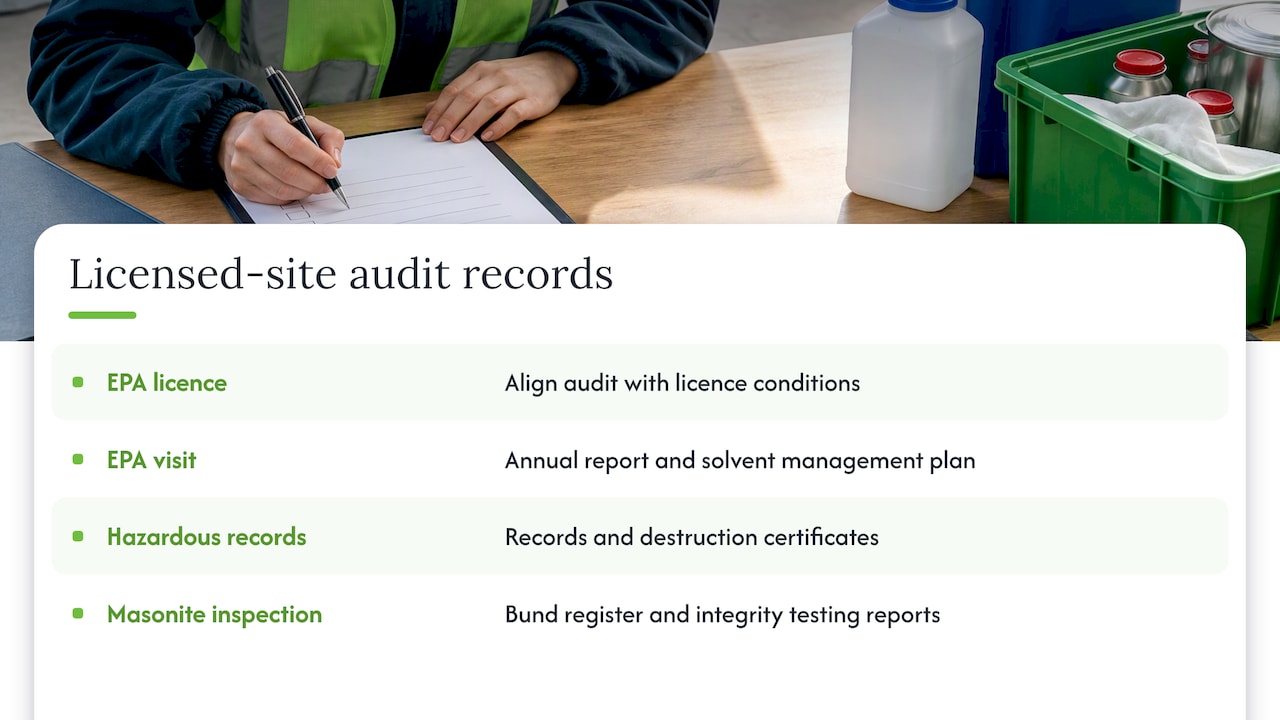
If your site holds an EPA licence, the audit should line up with your licence conditions. An EPA site visit report from 2024 on a licensed Irish manufacturing facility shows the sort of records inspectors look at: the Annual Environmental Report, the solvent management plan, hazardous waste records and certificates of destruction. A separate inspection at Masonite Ireland covered its bund register and integrity testing reports. If an inspector can ask for it, your audit file should know where it is.
A government review of licences across key sectors noted that, at the time of that 2012 review, around 500 manufacturing facilities were subject to IPPC licences. It also noted that non-IPPC manufacturing sites may still need environmental licences, including air-pollution and trade-effluent licences. Treat those figures as a snapshot from that year, and confirm your own obligations with the EPA or your local authority.
Hazardous waste
The EPA’s National Hazardous Waste Management Plan classifies waste as hazardous when it displays one or more hazardous properties, such as being flammable or toxic. During an audit, never open or sort a container you cannot identify. Log it, photograph it, and refer it to whoever manages your hazardous waste contractor and consignment notes.
Food and drink manufacturers
If you make food or drink, the EPA’s Food Waste Measurement Protocol for manufacturing (2025) provides a standard methodology, including a Food Flow Sheet and Data Sheet, to quantify and monitor food waste. The protocol says measurement can show where food flows could move up the waste hierarchy. Use it alongside the general audit rather than inventing your own food waste template. Our guide to food waste regulations in Ireland covers what businesses must do on the compliance side.
Turning findings into savings
The audit is only worth the effort if it changes something. US dairy industry guidance on waste audit findings (2022) says audits reveal waste generation patterns that let manufacturers find reduction and diversion opportunities, lower hauling and disposal costs, and even create revenue by turning waste into valuable material. It also advises focusing on the streams that save the most money or deliver the greatest diversion.
That gives you a simple ranking method. For each stream, note the tonnage, what you currently pay per tonne or per lift, and what it could cost or earn if handled differently. Then work from the top.
| Typical finding | Likely action | Where the saving comes from |
|---|---|---|
| Clean cardboard in general waste | Segregate and bale | Lower residual waste cost, possible income from bales |
| Film and plastic wrap mixed with residual | Separate at source, bale | Diversion from the costliest stream |
| Frequent part-empty collections | Right-size containers or compact | Fewer lifts |
| Wet residues or sludge | Dewater before disposal | Lower weight and volume to haul |
| Polystyrene packaging | Compact on site | Fewer collections for a very bulky material |
| Food or organic residues | Treat or divert on site where suitable | Lower disposal volume |
The national MyWaste business guide (2023) recommends reviewing waste bills regularly, segregating waste, and engaging employees through training and green teams. It stresses that staff are essential, and suggests sharing progress with simple graphs. On a shop floor, a weekly chart by the baler or the bins does more than a policy document.
If your plant also tracks cost and downtime digitally, the same thinking applies. Pairing waste data with production data is one of the cost reduction strategies in MES environments, since scrap and stoppages often show up in both.
On the cost side of compliance, how Irish businesses can reduce waste costs goes deeper on contracts and collections. For emissions reporting, measuring waste emissions for Scope 3 explains how audit data feeds into reporting.
Where equipment and bale income fit
Audits in manufacturing very often end with the same discovery: a lot of clean cardboard and plastic is leaving the site as mixed waste. Once it is separated, it needs to be handled in a way that is cheap to store and collect. A cardboard baler compresses loose material into bales that stack and move easily, while a cardboard compactor suits sites with higher volumes. Bulky foam packaging is a different case, and an EPS compactor deals with that. Where wet process waste is the cost driver, industrial dewatering shredders cut the volume and weight you pay to move.
Once you have bales, you can sell them. Our cardboard bale price guide explains what buyers pay and what affects it, and our bale buyback scheme is built so that cardboard and plastic residues become income rather than a disposal line.
Perspective: what we see after the audit
We audit waste for a living, and the pattern is consistent. Most manufacturers already know their total waste bill. Few know what share of it is clean, saleable material paid for at residual rates. The audit’s real job is to separate those two numbers.
We also see audits fail for dull reasons: no one weighed the empty container, the sort ran on a Monday after a shutdown, the report went to a manager who could not change purchasing, or the findings never reached the people at the bins. If you do only three things, weigh net, repeat the sort, and put the result in front of the people who produce the waste.
And resist the urge to buy equipment before you have the data. A baler sized from a guess is either too big or too small. Sized from three weighed sorts, it is the right machine on the first attempt.
— Graham
Get a free audit from us
If you would rather not run the sort yourselves, we offer a free waste audit for businesses. We look at what you generate, where it arises and how it is currently handled, then set out options that can include equipment and bale buyback. Irish firms can also see the free waste audit for Irish businesses page for the local detail.
How often to repeat the audit and track progress
There is no fixed legal interval for a general manufacturing waste audit, and no source we found sets one, so choose a rhythm that matches how fast your operation changes. A practical pattern is a full audit to set the baseline, a lighter check on your top three streams after you make changes, and a repeat full audit whenever something material shifts: a new product line, a new packaging supplier, a new contractor or a layout change. Sites with licence conditions should also align timing with their reporting cycle.
For progress between audits, track a short list of measures every month, drawn from your contractor invoices and weighbridge tickets:
- Total waste tonnes per unit of output, so growth does not hide improvement
- Percentage sent to general waste versus recycled or reused
- Cost per tonne and total cost by stream
- Contamination: loads rejected or downgraded
- Income from baled material, where applicable
Compare like with like. If production doubled, falling tonnage means little until you divide by output.
Common mistakes to avoid
- Auditing only the visible bins. Skips behind the building, compactors and hazardous stores count too.
- Ignoring the weight of containers. WRAP’s net weight rule exists for a reason.
- Treating one sort as the truth. Repeat it.
- Sorting unknown chemicals. Stop and escalate, as in the hazardous waste section above.
- No owner for actions. Every finding needs a name and a date against it.
- Telling everyone in advance. Briefing the team before the audit changes behaviour, and with it the results.
FAQ
What does “manufacturing waste” mean?
It is the waste generated by making goods: production scrap and offcuts, rejected product, packaging, process residues and by-products, plus the general waste from the site around the line. For audit purposes, it is usually grouped into streams such as cardboard, plastics, metals, wood, organics and hazardous waste.
What is meant by a waste audit?
A waste audit is a hands-on review of the waste a business produces. It establishes what types of waste there are, where they arise and who produces them, usually by collecting, sorting and weighing material by stream. The result is a baseline you can use to cut costs and set recycling targets.
How long does a manufacturing waste audit take?
The sort itself is often done in a day per round, and WRAP recommends three rounds for a reliable annual figure. Add time before for the risk assessment, briefing and record gathering, and after for analysis. A single line or department can be done much faster than a whole site.
Can we run the audit ourselves?
Yes, with a risk assessment, scales, sorting containers, PPE and a template. If your waste may include sharps, broken glass or unidentified chemicals, WRAP notes that your waste or recycling provider may be better placed to do it. We run a free audit for businesses if you want a second pair of eyes.
Sources
- How to conduct a waste audit for the food and drinks manufacturing sector (WRAP)
- How to conduct a waste audit, all workplaces (WRAP)
- Industrial Waste Audit and Reduction Manual
- EPA site visit report, 2024
- A review and audit of licences across key sectors of the Irish economy, 2012
- National Hazardous Waste Management Plan
- EPA Food Waste Measurement Protocol, manufacturing guide, 2025
- Dairy processor waste audit guidance, 2022
- How to manage your business waste (MyWaste.ie, 2023)
- Root cause analysis methods for regulated manufacturers
- Cost reduction strategies in MES for manufacturing