Facility waste streams are the categorised flows of material (organic, recyclable, residual, hazardous and process residue) that a site generates and must account for under its licence. The three immediate priorities are assigning a List of Waste (LoW) code to each stream, producing a defensible tonnage estimate for anything over 5% of intake or any hazardous fraction, and setting up quarantine and storage that matches what your licence reporting demands.
TL;DR:
- Use twelve months of manifests and weighbridge tickets, then estimate annual tonnage from average load weights and collection frequency, cross-checking contractor invoices.
- Give every stream exceeding 5% of intake its own license table row; hazardous streams need separate rows regardless of size, supported by classification evidence.
- Presence-based properties such as HP1, HP2, HP3, HP9, HP12, and HP15 may classify waste as hazardous upon detection, while other properties require concentration testing.
- Route unverified loads to quarantine, verify descriptions, codes, and quantities against consignment notes, and document rejected loads with written reasons and dates before unloading.
- Combine records review, a facility walk-through, and representative waste sorting, using identical categories and sampling methods each audit to compare results reliably.
Table of Contents
- Estimating quantities: records, sampling and converting to tonnes for reporting
- Classification and coding: applying the List of Waste in practice
- Hazardous properties (HP1–HP15): testing, classification and operational consequences
- Storage, waste-acceptance procedures and quarantine area design
- Residues and outputs from facility processes and their onward management
- Waste characterisation and audit methods: from sample design to divertible-opportunity analysis
- Regulatory reporting, licence application tables and how to show waste-hierarchy considerations
- Turning compliance into a commercial advantage
- Start with a free waste audit and bale buyback
- FAQ
- Sources
- Key regulator documents and handbooks to use next
Estimating quantities: records, sampling and converting to tonnes for reporting
Building a tonnage baseline starts with records you already hold. Invoices from waste contractors, weighbridge logs and collection manifests give you actual historical weights, which are far more defensible than visual estimates when an inspector asks how a figure was derived.
- Pull twelve months of collection manifests and weighbridge tickets for every contracted stream.
- Choose a sampling approach: grab samples for a quick snapshot, stratified sampling when composition varies by shift or season, and composite sampling when you need an average across multiple collection points.
- Convert sample weights to an annual estimate by multiplying the average load weight by the recorded number of collections per year, then cross-checking against contractor invoices.
- Flag any stream that crosses 5% of total intake, or any hazardous stream regardless of size, for its own reporting row.
As an illustrative example: say a facility runs two cardboard collections a week averaging 0.8 tonnes each. That is 1.6 tonnes weekly, or roughly eighty tonnes a year once you multiply by 52 weeks, a figure you would then reconcile against the haulier’s own annual total.
Pro Tip: Keep a running spreadsheet that ties every sample back to a specific vehicle and collection date, so a reviewer can trace any figure back to its source load.
Classification and coding: applying the List of Waste in practice
Every waste stream leaving a facility needs a code from the List of Waste (LoW), the system used across EU and Irish regulation to identify waste by origin and composition. The EPA’s waste classification guidance sets out how applicants must use a single row in the licence application’s Table D.2(i) for any individual stream comprising more than 5% of total intake, and for any hazardous stream regardless of its share of the total.
A workable checklist for assigning a code looks like this:
- Describe the waste in plain terms: its source process, physical state and any known contaminants.
- Identify the substances present, using supplier safety data sheets or analytical results where available.
- Search the relevant LoW chapter for the sectoral or process-specific entry before falling back on a generic “other wastes” entry.
- Check whether a mirror entry exists (a hazardous and non-hazardous version of the same waste description) and select based on tested composition.
- Retain the evidence: analytical results, safety data sheets and a short process description, filed against the code you assigned.
Streams that individually fall under the 5% threshold can often be aggregated under a broader code, but anything crossing that line, or anything hazardous, needs its own line and its own paper trail.
Hazardous properties (HP1–HP15): testing, classification and operational consequences
Classifying a waste as hazardous depends on which of the fifteen hazardous properties (HP1 to HP15) apply, and these fall into two distinct groups. Some properties, such as flammability or corrosivity, carry defined concentration limits that determine the threshold at which a waste becomes hazardous. Others are presence-based, meaning the hazard statement attaches as soon as a qualifying substance is detected, regardless of concentration.
- Concentration-limited properties require a tested percentage of a hazardous substance before classification applies.
- Presence-based properties, including HP1, HP2, HP3, HP9, HP12 and HP15, can trigger hazardous status from detection alone where no concentration limit has been set.
- Common test types include flashpoint testing for flammability, pH testing for corrosivity, and laboratory analysis for specific hazardous substances.
- A hazardous designation restricts handling to licensed carriers and permitted facilities, and changes storage requirements to bunded, labelled and segregated areas.
EPA guidance on applying hazardous property assessments confirms that assessors should identify substances present, apply the relevant hazard statements, and use concentration limits where they exist, but treat presence alone as sufficient for classification where no limit has been assigned to a given property, a point set out in guidance on interpreting List of Waste entries. Keep analytical results and classification decisions on file in an audit-ready format, since inspectors will ask for the evidence behind any hazardous or non-hazardous determination.
Storage, waste-acceptance procedures and quarantine area design
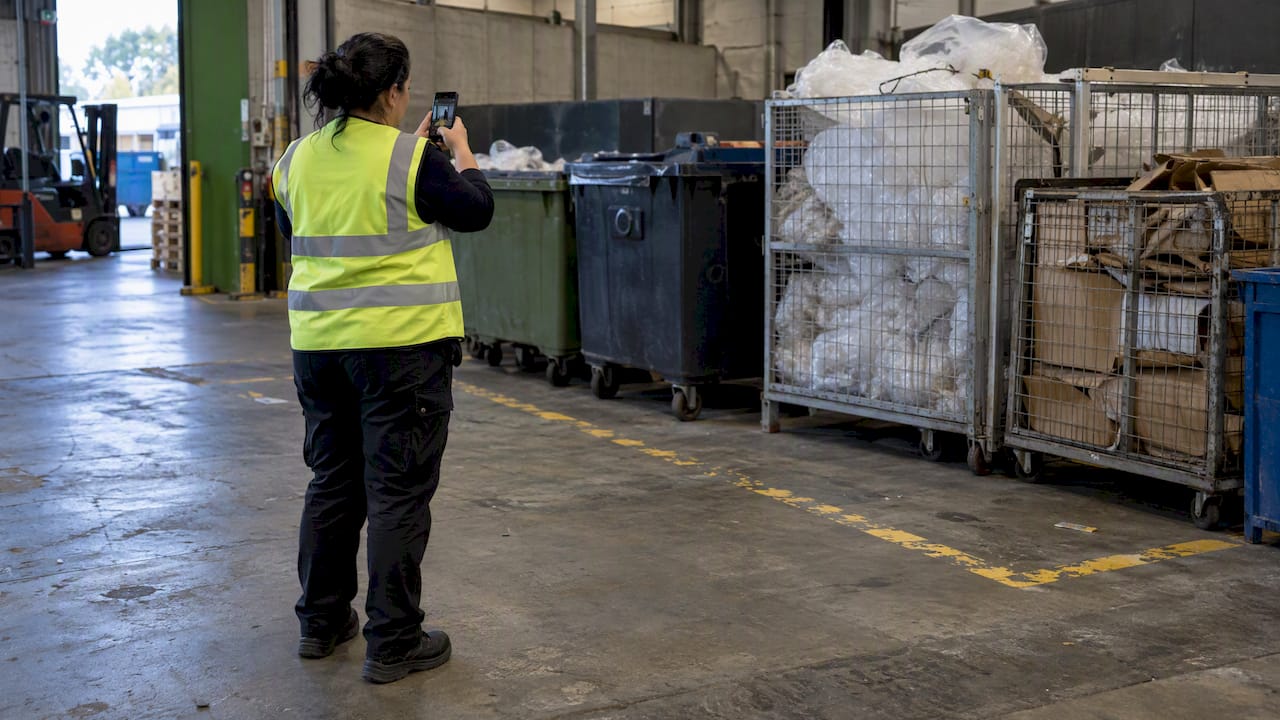
Inspectors and licence reviewers expect storage infrastructure that physically prevents cross-contamination and leaks before they ever check your paperwork. Impermeable slabs, bunded containment for liquids, covered areas for weather-sensitive materials, and clear labelling by waste code are the baseline features auditors look for on a site walk.
- Check documentation on arrival: confirm the waste description, code and quantity against the consignment note before unloading.
- Route unverified loads to quarantine until composition and code are confirmed.
- Sample where composition is uncertain, following the same grab or composite approach used for routine characterisation.
- Reject and record any load that does not match its paperwork, with a written reason and date.
Licence application attachments typically require you to state the maximum annual tonnage to be handled, the storage capacity available on site, and a description of the quarantine area, as set out in standard EPA licence attachment guidance. Build these figures into your site procedures document rather than treating them as a one-off licence exercise.
Pro Tip: Photograph your quarantine and storage areas during a routine audit so you have dated evidence of compliant conditions ready for the next inspection.
Residues and outputs from facility processes and their onward management
Thermal and mechanical processes generate their own secondary waste streams that need separate handling decisions. Bottom ash and fly ash from combustion, flue gas residues, leachate from storage or landfill areas, and landfill gas where relevant each carry their own onward route and their own documentation burden.
- Bottom ash and fly ash typically go to specialist recovery or stabilisation facilities rather than general landfill.
- Leachate needs dedicated collection and storage before off-site transfer to a licensed treatment facility.
- Landfill gas, where a site generates it, requires ongoing monitoring and management under its own licence conditions.
- Recovery outputs such as recovered metals, gypsum, compost or biogas need documentation showing the destination facility and the recovery route used.
Industrial operations remain the largest generators of hazardous waste streams in Ireland, and reported capacity gaps for certain treatment and landfill routes make correct upfront segregation of these residues more important than relying on downstream correction, according to the national hazardous waste management plan. Keep destination facility paperwork on file for every residue stream you send off site, not just the hazardous ones.
Waste characterisation and audit methods: from sample design to divertible-opportunity analysis
A defensible characterisation exercise combines three approaches rather than relying on one. Records review establishes your historical baseline, a facility walk-through identifies where materials actually end up versus where procedures say they should, and a physical waste sort gives you ground-truth composition data you can defend to a regulator or a buyer.
- Design a sampling plan that specifies collection location, sample quantity, the number of samples needed for statistical confidence, and haulier details for cross-checking.
- Run the records review first to flag discrepancies between contracted tonnage and invoiced tonnage.
- Walk the floor during normal operating hours to see where segregation breaks down in practice.
- Sort a representative sample using consistent categories across every audit cycle, so results stay comparable year on year.
- Calculate diversion potential by comparing what ends up in general waste against what could realistically be captured separately, then prioritise the highest-volume, lowest-effort fixes first.
The US EPA’s planning tool offers worksheets and downloadable templates for recording walk-throughs and waste sorts, a useful structure to replicate even where the regulatory references differ. Standardising your categorisation scheme across every audit cycle is what makes the resulting data defensible to both regulators and recycling buyers, a point a recent field-tested characterisation framework makes central to reliable results.
Pro Tip: Use the same category list and sampling method every time you audit, so year-on-year comparisons actually mean something.
Regulatory reporting, licence application tables and how to show waste-hierarchy considerations
Licence applications ask for specific, structured data rather than a narrative description of your waste management. The wastes-to-be-accepted table (commonly referenced as D.2(i) or H.3 depending on the licence type) needs the LoW code, a description, the maximum annual tonnage, and the unit of measurement for every stream you handle.
- Any stream over 5% of total intake, or any hazardous stream, needs its own row rather than being folded into an aggregated entry.
- Supporting evidence for each row should include the basis for the tonnage figure and, where relevant, analytical results justifying the classification.
- Recovery and disposal routes need to be stated per stream, showing how each one is handled relative to the waste hierarchy of prevention, preparing for reuse, recycling, other recovery and disposal.
- Suggested attachments include storage plans, written waste acceptance procedures and destination facility details for anything leaving the site.
| Reporting element | What it must show |
|---|---|
| Waste code (LoW/EWC) | Correct chapter and sub-entry for each stream |
| Maximum annual tonnage | Per stream, with basis for the figure stated |
| Storage capacity | Maximum on-site volume per stream |
| Recovery/disposal route | Destination facility and hierarchy position |
Presenting recovery routes clearly, rather than defaulting everything to disposal, is usually the single clearest signal to a licence reviewer that you have actually thought about the waste hierarchy rather than ticked a box.
Turning compliance into a commercial advantage
Most facilities treat waste profiling as a compliance chore, but the same data that satisfies a licence reviewer also tells you which materials are worth recovering rather than discarding. A clean cardboard or plastic film stream, once separated and baled, stops being a cost line and starts being a material with a market value. The facilities that get the most out of their audits are the ones that read the composition data as a sourcing and packaging signal, not just a reporting obligation.
— Graham
Start with a free waste audit and bale buyback
We provide free waste audits that help with stream identification, tonnage estimation and the documentation needed for licence reporting, based on a thorough characterisation approach. Where audits turn up recoverable cardboard or plastic film, our bale buyback scheme pays for those materials directly rather than leaving them as a disposal cost, and our balers and compactors handle the densification that makes those loads worth collecting.
If your last audit is more than a year old, or you have never had one, start with our Free Waste Audit and get a stream-by-stream breakdown you can use for both compliance and revenue.
FAQ
What counts as a facility waste stream?
A facility waste stream is any distinct flow of waste generated by a specific activity or process on site, categorised by composition (organic, recyclable, residual, hazardous or process residue) and tracked separately for reporting purposes. Each one typically needs its own List of Waste code once it crosses the reporting thresholds set out in licence conditions.
How do I know if a waste stream needs its own reporting row?
Any stream that makes up more than 5% of your total waste intake needs a dedicated row in your licence application’s wastes-to-be-accepted table, and this applies regardless of size to any hazardous stream, as set out in EPA classification guidance. Streams below that threshold can often be aggregated under a broader code.
What is the difference between concentration-limited and presence-based hazardous properties?
Concentration-limited hazardous properties only trigger classification once a substance exceeds a defined percentage in the waste. Presence-based properties, such as HP1, HP2, HP3, HP9, HP12 and HP15, can classify a waste as hazardous from detection alone, since no concentration threshold has been assigned to them.
What methods are used to characterise facility waste?
Best practice combines records review, a physical facility walk-through and a physical waste sort to build defensible, comparable composition data, an approach supported by US EPA planning tools and field-tested characterisation frameworks. Using the same categories and sampling method each time makes year-on-year results meaningful.
Does Compact charge for a waste audit?
No, our Free Waste Audit has no published charge and is offered as a no-cost starting point for facilities wanting a stream-by-stream breakdown. You can request one directly through our Free Waste Audit page.
Sources
Most facilities generate a predictable set of waste categories once you map them against daily activity. Food preparation areas produce organics, packing and receiving generate cardboard and film, maintenance workshops throw off oils, solvents and filters, and process areas can produce sludges, ash or chemical residues depending on the sector.
- EPA — Waste classification guidance report (2019)
- Non-household waste characterisation final report (EPA / CTC)
- US EPA — Managing and transforming waste streams tool (Planning tool)
- Mastering waste characterisation: common practices and field techniques — IOPscience (2026)
Maintenance and cleaning operations are the usual source of hazardous fractions that end up misclassified, because small quantities of solvent-soaked rags or spent oil filters often get placed in general skips rather than segregated. A quick indicator of under-reporting is a residual stream that has grown disproportionately against production volume: that usually means recyclables or organics are being lost into general waste rather than captured separately.
Key regulator documents and handbooks to use next
Before your next audit or licence renewal, these are worth having open alongside your own records.
- EPA waste classification guidance: the primary reference for assigning LoW codes and understanding the 5% reporting rule.
- Non-household waste characterisation report: sectoral composition benchmarks useful for sanity-checking your own sort results.
- US EPA planning tool: downloadable worksheets for structuring records review, walk-throughs and waste sorts.
- Field-tested waste characterisation framework: a methodology-selection guide for choosing between grab, quartering and hybrid sampling approaches.
- Ambient dust control guidance: practical reference for protecting storage and handling areas where dusty or friable residues are present.