
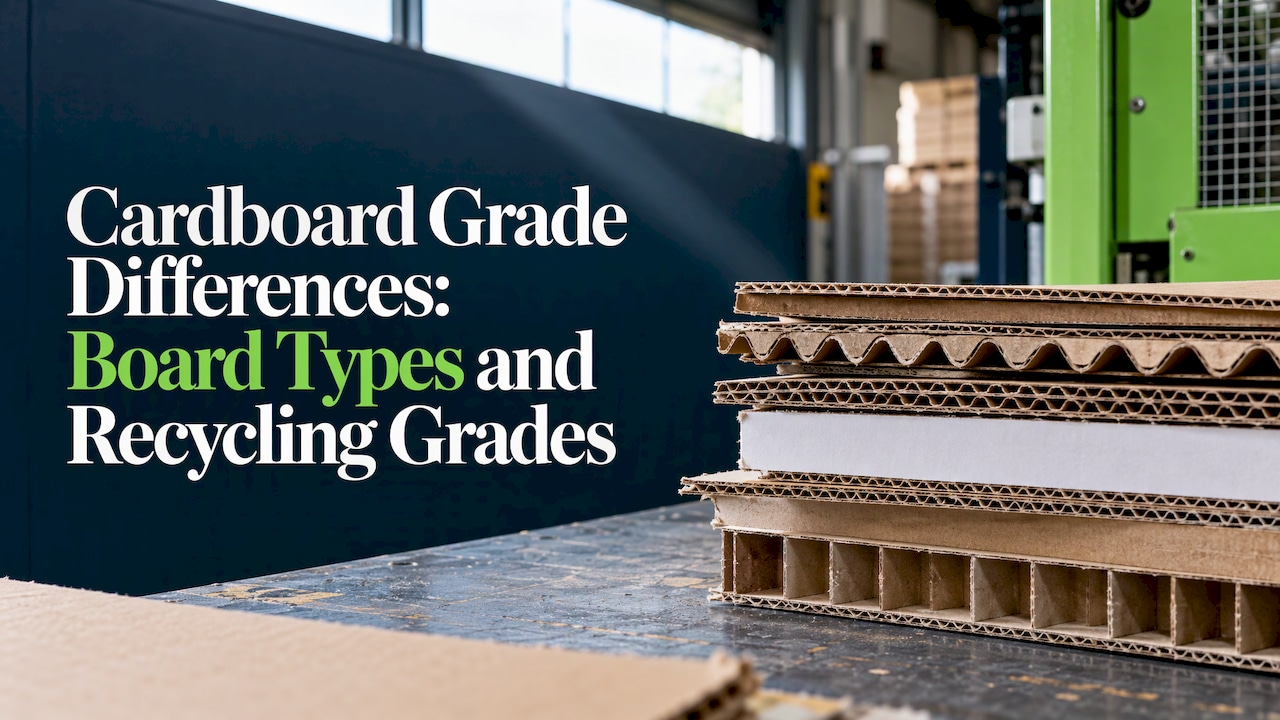
Cardboard grades differ in three ways: how many walls the board has (single, double or triple), which flute profile sits between the liners (A, B, C, E, F or a combination), and what the liners are made of (kraft or recycled test paper) and how heavy they are. A second set of grades applies once the box is empty. Recovered cardboard is sorted into standard paper grades, and that sorting decides how easily you can bale it and sell it.
This guide covers both sides: how to read a packaging specification, and how grade affects what happens to your cardboard waste in Ireland.
TL;DR
- Board grade is a full specification: wall count, flute, liner type and weight. A flute letter on its own is not a strength rating.
- Single wall is roughly 3 mm thick and double wall roughly 7 mm. Thickness alone does not tell you strength, so read it alongside edge crush (ECT) and burst figures.
- Kraft liners are stronger and print better. Testliner is recycled and more economical. Most outer cartons in circulation are built from a mix.
- For waste, the grade that matters is the recovered grade, such as corrugated packaging under EN 643. Clean, separated, well-baled cardboard is easiest to place and rebate.
- RSC is a box style, not a grade.
Table of Contents
- What “cardboard grade” actually means
- Single, double and triple wall
- Flute types compared
- Liners: kraft, testliner and recycled content
- Thickness is not strength
- The strength tests worth knowing
- RSC is a box style, not a grade
- Matching a grade to the job
- The other grades: what happens when the box is empty
- Our perspective
- From grade knowledge to a rebate
- FAQ
- Sources
What “cardboard grade” actually means
“Cardboard” is a loose word. Cereal boxes are a thick, folded paperboard. The brown shipping box is corrugated board: one or more fluted plies glued to flat paper, as defined in ISO 4046. The flat sheets are called liners and the wavy middle layer is the fluting. Both can be made from virgin wood fibre, recovered fibre, or a blend.
When a supplier talks about grade, they usually mean the combination of:
- Walls: single, double or triple.
- Flute: the profile of the wavy layer.
- Liner paper: kraft, test or chip, and its weight in grams per square metre (GSM).
- Performance values: edge crush, burst and sometimes flat crush.
Supplier guidance makes the same point: GSM, thickness, flute type and burst strength should be read together, because GSM alone does not describe how a finished box will perform.
Single, double and triple wall
Wall count is the quickest way to separate grades.
- Single wall (three plies): two liners with one fluted layer between them. It is the everyday carton for parcels, retail deliveries and light to medium goods. An Irish board supplier states it is about 3 mm thick.
- Double wall (five plies): three liners and two flutes. The same Irish supplier puts standard double wall at about 7 mm and roughly twice the strength of single wall.
- Triple wall (seven plies): for heavy, bulky or export loads. One chart gives 12 to 15 mm as a typical thickness.
The number of layers varies with grade and use. Wall-count labels describe the construction, not the complete performance rating, so two double-wall boards can behave differently.
Flute types compared
The letter names the flute profile. It does not rank strength from A to F. Thicknesses below come from a UK guide to corrugated grades.
| Flute | Typical thickness | What it is known for |
|---|---|---|
| A | 5 mm | Cushioning, older style, bulky in storage |
| C | 4 mm | Good compression strength, widely used for shipping cartons |
| B | 3 mm | Robust, compact, good compression strength |
| E | 1.5 mm | Fine profile, crush resistance and printability |
| F | 1 mm | Very fine, retail and display packaging |
| BC double wall | 7 mm | Stacking and compression strength |
| EB double wall | 4.8 mm | Strength with good print and less storage space |
A D.S. Smith technical guide adds useful detail. C flute offers greater compression strength than B but may be crushed more easily. E flute gives excellent crush resistance and printability. BC double wall is normally specified where stacking strength matters, while EB is considered when strength and print quality are both needed, using much less storage space. Finer flutes (R, E, F and N) give the best surface for image-led packaging, and F and N microflutes suit counter-top displays.
If you want the print side of the decision, this overview of board grades and packaging applications shows how construction choices carry through to a finished box.
Liners: kraft, testliner and recycled content
The liner is the second big difference between grades.
- Kraftliner is made from virgin softwood fibre. It gives the most substantial, print-friendly surface and suits outer liners.
- Testliner is made from recycled fibre. It is more affordable, not as strong or as easy to print on, and often used for inner layers.
Manufacturer data shows the gap. A European containerboard range lists kraftliner brown at up to 1300 kPa burst, against up to 480 kPa for Testliner 2. Compression values follow the same pattern, up to 7.00 kN/m for kraft and 3.40 kN/m for that testliner.
Board makers abbreviate all this. A code such as 125K/B/125T means a 125 GSM kraft outer liner, B flute and a 125 GSM test inner liner. A code such as 150T/E/150T means test liner on both sides with an E flute. Once you can read these, a quote stops being a mystery.
One caution on weight: manufacturers now engineer performance boards that match a heavier material at lower weight, so a GSM figure may describe performance quality rather than actual weight.
Thickness is not strength
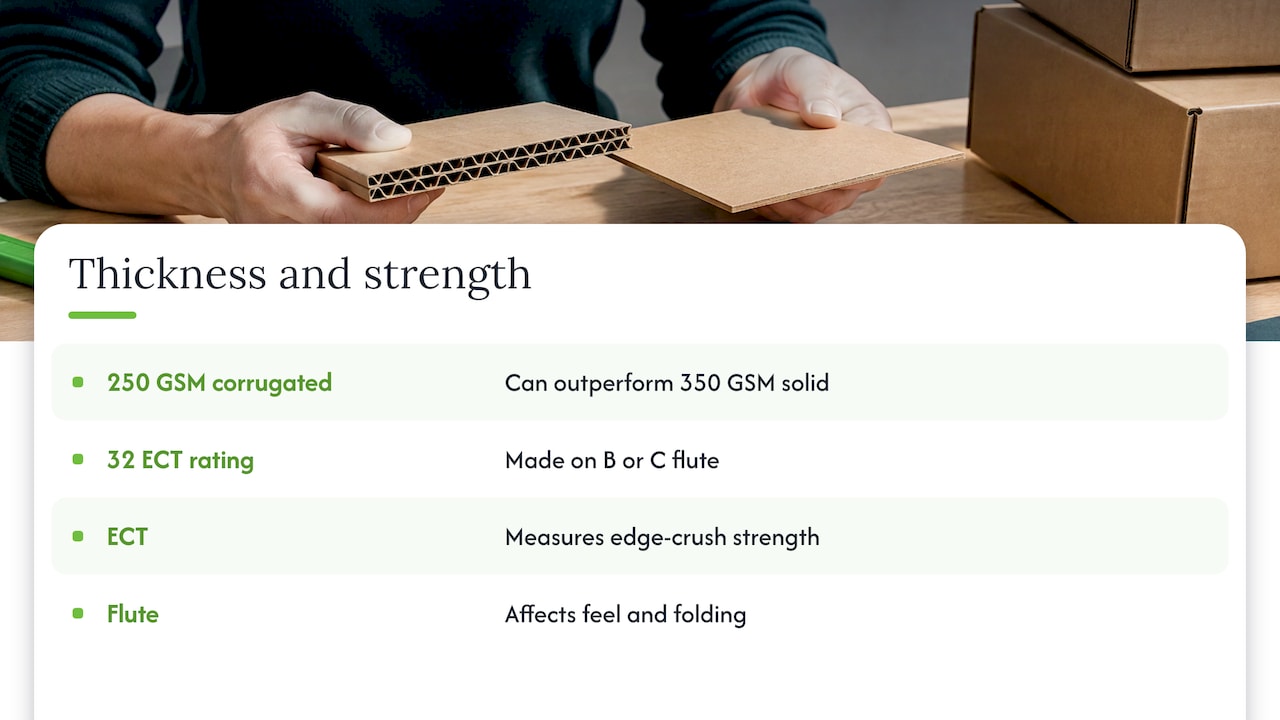
A thicker board is not automatically a stronger one. A buyer’s guide notes that flute structure, material quality and ECT rating matter more than thickness, and that a 250 GSM corrugated board can outperform a 350 GSM solid paperboard because of its flute structure.
Grade and flute are also separate choices. A chart from a US supplier notes that the same 32 ECT rating can be made on B or C flute. The ECT tells you edge-crush strength, while the flute tells you how the box feels and folds.
The strength tests worth knowing
Two measures turn up on most specifications:
- Edge Crush Test (ECT): the stacking load the board edge bears before buckling. It is the one that matters for palletised, stacked goods.
- Burst strength (Mullen): resistance to puncture and bursting, which matters for individual parcels handled many times.
As one US source explains, ECT predicts stacking strength and Mullen predicts puncture resistance. Another notes that modern logistics rely on pallet stacking, which makes ECT more relevant than the older burst test.
US figures are quoted in pounds, and Irish and European specifications use metric values such as kN/m and kPa. Treat US ranges as illustrations only: one source says single-wall boxes start at 23 ECT and go up to 55 ECT, double wall runs 42 to 82. For European standards, FEFCO publishes an overview of national corrugated board standards covering basis weight, burst, ECT, thickness and flat crush.
Before moving up a grade, look at the cause. If stacking is failing, design, handling and raw material issues should be checked before jumping to double wall.
RSC is a box style, not a grade
RSC stands for Regular Slotted Container, also known as FEFCO 0201: a pre-glued blank with four sidewalls and four closure flaps. It describes the shape. You can make an RSC from single wall, double wall, kraft or test liner. When you compare quotes, compare the style and the board specification separately.
Matching a grade to the job
| Situation | What to look at |
|---|---|
| Light parcels, e-commerce | Single wall, C or B flute, with adequate burst strength |
| Palletised, stacked cartons | ECT value first, then flute, BC double wall if stacking is severe |
| Retail-ready or printed packaging | E, F or EB, with kraft or good-quality outer liner |
| Heavy or export loads | Double or triple wall, checked against the carrier’s requirements |
The rule to remember: match the construction to the product and the handling route, not to the thickest option on the list.
The other grades: what happens when the box is empty
For a facility manager, the more costly grade question comes after use. In Europe, recovered paper and board is sorted under EN 643, which defines around 100 grades. The ones most relevant to a business are:
- 1.02: mixed paper and board.
- 1.04: corrugated paper and board packaging.
- 1.05: ordinary corrugated board.
Recycled paper of typical grades 1.02 and 1.04 goes back into new corrugated products. Irish packaging guidance defines Old Corrugated Cardboard (OCC) as large cardboard items separated from other components and then baled for reprocessing.
The practical consequence: a pile of cardboard is not one commodity. Clean corrugated, kept dry and separate from general waste, is the material that supports a rebate. Cardboard contaminated with food, plastic film or other waste is harder to place. Whether you are dealing with single wall, double wall or a kraft and test mix, they all fall into the corrugated stream if they are kept clean and separate. You do not need to sort by flute.
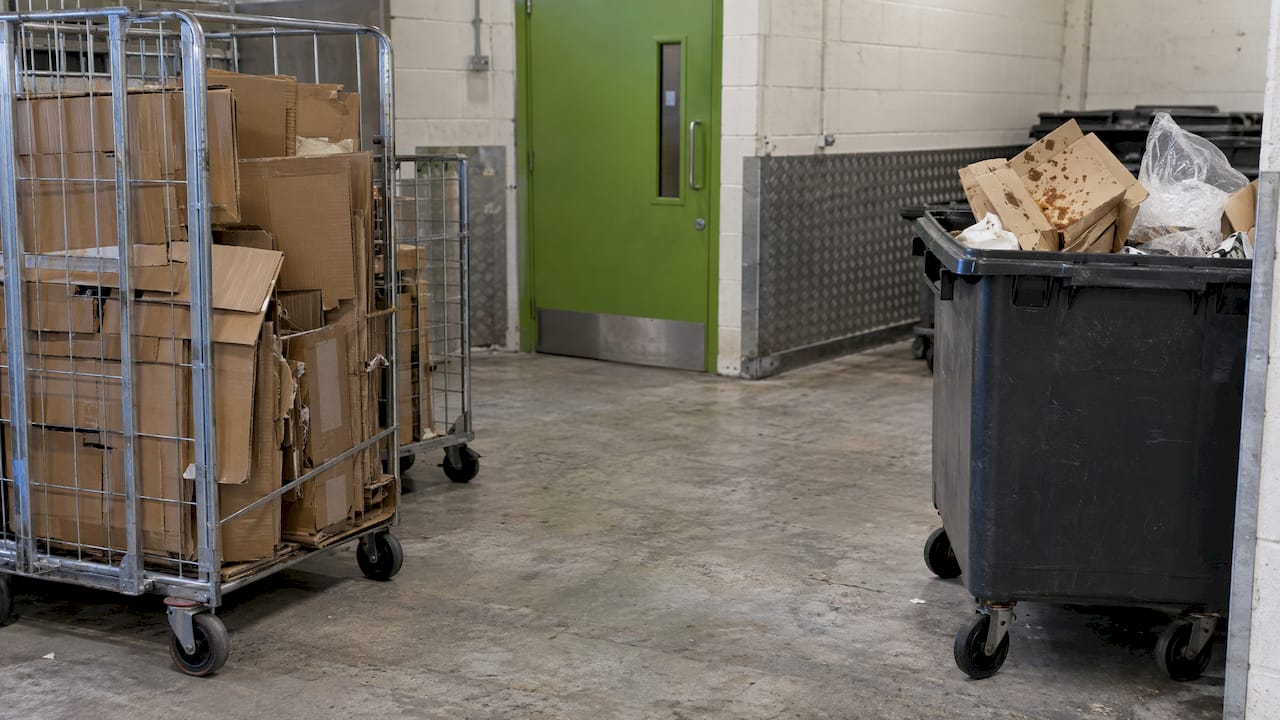
The packaging itself is built for this. Corrugated packaging can be recycled up to 25 times and is often remanufactured into new packaging within 14 days, according to an Irish producer. In Ireland, a licensed materials recovery facility such as the Finglas site in Dublin 11 is permitted to accept commercial mixed dry recyclables including clean paper and cardboard. Packaging responsibilities in Ireland also sit within an EPR scheme that covers paper and cardboard.
To see how buyers assess what you present, read our guide to cardboard bale grading. For the waste code and compliance side, see the 15 01 01 guidance for Irish businesses.
Our perspective
Most of the businesses we speak to have never thought about cardboard grade. They think about cost per lift and how many skips go out each week. Yet the grade of what you generate, and how clean you keep it, decides whether cardboard is a cost or an income.
Our view is simple. Corrugated is a valuable material, so treat it like one. Keep it dry, keep it separate from general waste, and compress it into a dense bale. A baler turns loose, bulky packaging into something a buyer can collect and pay for. A compactor suits sites where volume is high and handling needs to be easy.
That is why we start with a free waste audit rather than a machine. We look at what you actually generate, where it is contaminated, and what format suits your site. Then we can supply the equipment, collect the bales and pay you for them, so you deal with one team from audit to payment.
Graham
From grade knowledge to a rebate
Knowing your grades is useful. Turning your corrugated into income is the next step. Our free waste audit reviews the cardboard and plastic you produce and recommends the right format for your site.

If you already generate steady volumes, look at our cardboard balers or cardboard compactors, and ask about our bale buyback scheme. For the commercial side, see our guide to cardboard recycling rebates.
FAQ
What are the different types of cardboard used for packaging?
The main ones are single-wall, double-wall and triple-wall corrugated board, plus folding paperboard for items such as cereal boxes. Corrugated is stronger and harder to fold by hand. Within corrugated, flute type and liner paper create further grades.
What is the thickness of corrugated board?
It depends on the flute. One UK guide gives A flute 5 mm, C 4 mm, B 3 mm, E 1.5 mm and F 1 mm. Double-wall BC is about 7 mm. Ask your supplier for the exact caliper of the specified board.
Is double wall always stronger than single wall?
Generally double wall is stronger, with one Irish supplier describing it as about twice the strength of standard single wall. Strength still depends on liner weight, paper quality and flute, so compare ECT and burst values rather than wall count alone.
What is RSC cardboard?
RSC means Regular Slotted Container, the standard shipping carton style also known as FEFCO 0201. It describes the box shape, not the board grade. The same style can be made from different grades.
Do I need to separate different cardboard grades for recycling?
Not by flute or wall count. Keep corrugated clean, dry and apart from general waste so it can be baled and sold as one stream. Our cardboard recycling guidance explains the setup for Irish sites.
Sources
- FEFCO Factsheet on Recyclability, October 2025
- Prest Packaging: cardboard grade guide
- Cardboard Box Company: corrugated cardboard
- Packrift: flute types chart
- Suttons: guide to corrugated cardboard grades
- D.S. Smith technical guide via Antalis Ireland
- Smurfit Westrock: European liners
- Network Packaging: introductory guide
- Jeytop: cardboard thickness guide
- Packrift: ECT to Mullen conversion
- Packprinters: corrugated packaging
- Packaura: ECT vs Mullen
- FEFCO national corrugated board standards
- Total Packaging Solutions: types of corrugated
- SOMIC: RSC cartons
- Repak: Packaging and Design for the Circular Economy
- Smurfit Kappa Ireland: corrugated packaging
- EPA licence: Finglas materials recovery facility
- Lappa: Ireland EPR
- Packaging boxes and board grades overview