Good bale collection scheduling comes down to three numbers: how many bales you produce each week, how many your storage area can hold safely, and how often a permitted collector can lift them. Match those three and you collect only when there is a full load to take. You avoid half-empty trips, overflowing yards and rejected bales.
This guide is for facility managers, operations leads and procurement officers in Ireland who already bale cardboard or plastic, or are about to. It covers how to estimate output, set a frequency, coordinate access with your contractor, and keep loads acceptable.
TL;DR
- Schedule around full loads, not the calendar. Work out weekly bale output first, then choose a frequency that keeps storage under capacity.
- Size storage for at least a week of output if you have no collection pattern yet, and keep bales on pallets in a clear, accessible area.
- Confirm the collector holds a valid waste collection permit for the material and that they will accept baled waste before you invest in equipment.
- Keep material clean, dry and segregated, because contamination is the most common reason a load loses value or is turned away.
- Record every lift (date, weight, material) so you can adjust frequency as volumes change.
Table of Contents
- What bale collection scheduling involves
- Step 1: estimate your bale output
- Step 2: choose a collection frequency and storage capacity
- Step 3: plan storage and site access
- Step 4: coordinate with your contractor and your site
- What Irish rules apply to storing and collecting bales
- Keeping loads accepted and costs down
- Track performance and improve over time
- Our perspective on bale scheduling
- Turn your bales into a scheduled revenue stream
- FAQ
- Sources
What bale collection scheduling involves
A bale collection schedule is an agreement on three things: when the collector arrives, what they take, and what has to be ready. For a business that bales cardboard or plastic, it usually means a fixed day or a call-off arrangement, a defined pickup point, and a minimum quantity per lift.
There are two common models:
- Fixed schedule. The same day every week or fortnight. It is simple for staff, but you pay for a visit even when the stack is small.
- Call-off. You request a lift when the storage area is nearly full. It suits seasonal or uneven output, but needs someone to watch stock levels and enough storage to cover the lead time.
Most sites end up with a hybrid: a baseline slot with the option to call an extra lift before peak periods such as the run-up to Christmas, when packaging volumes rise for retail and distribution.
The point of baling in the first place is to cut the number of lifts. Compressed material takes up far less space than loose cardboard, so you can hold more between collections. Schedule design should use that benefit rather than keep the old loose-bin rhythm.
Step 1: estimate your bale output
You cannot choose a frequency until you know your volume. Start from what you actually discard, not from what you think you discard.
- Weigh or count for two to four weeks. Note the number of cages, roll containers or bins of cardboard and plastic leaving your dock each day. A waste audit gives you the same picture with weights attached.
- Convert to bales. Ask your baler supplier for the typical bale weight of the machine you are using or considering. Divide weekly tonnage by bale weight to get bales per week.
- Allow for peaks. Take your busiest week of the year, not the average, as the planning number for storage.
- Separate the streams. Cardboard, film and rigid plastics bale differently and are usually sold or collected separately, so each needs its own estimate.
Guidance on service specifications recommends confirming expected volumes of waste and recycling from a waste audit, a business waste calculator or your existing provider’s data before agreeing service terms (service specification guidance). It is aimed at England and Wales, but the principle of fixing volumes before fixing frequency applies equally here.
If you want an independent baseline, our free waste audit looks at your specific materials and volumes and shows what a realistic collection pattern looks like.
Step 2: choose a collection frequency and storage capacity
Frequency and storage are two sides of the same decision. The more often you are collected, the less you need to hold.
A Northern Ireland building-control storage guide gives a useful rule of thumb for the relationship. Weekly collection needs storage for one week’s waste. Two to five collections a week need four days’ capacity. Six to seven a week need two days’. Where the frequency is not yet established, it advises providing capacity for a weekly collection (Waste Storage Guide). The guide is from Northern Ireland and was written for building design, so treat it as a sound planning benchmark rather than an Irish legal requirement.
For baled material, that translates into a simple worked example:
| Item | Example figure |
|---|---|
| Bales produced per week (peak) | 24 |
| Bales per pallet stack you can store | 4 high on a pallet footprint |
| Pallet spaces needed for one week | 6 |
| Pallet spaces needed for a fortnight | 12 |
| Typical full-load minimum set by collector | Confirm with your collector |
These are illustrative numbers to show the method, not a recommendation for your site. Your own count and your collector’s load requirements replace them.
The same guide notes that baled waste is typically stored on pallets, and that councils and collection contractors may not accept baled waste, so you should check with them before investing in a compactor or baler. In practice that means asking one question early: will my collector lift, buy or take the bales I intend to make?
Pick frequency by the full-load test
A schedule is working when most lifts leave with a full load. If a lorry regularly takes a third of a load, either extend the interval or switch to call-off. If your pallet area is full two days before pickup, shorten the interval or add storage. Review it quarterly for the first year.
Step 3: plan storage and site access
Bales are heavy and the collection vehicle is large, so the layout matters as much as the timetable.
- Pickup point. Choose a hard, level area close to the vehicle route, away from fire exits, customer entrances and pedestrian paths.
- Clear space. An Irish operational waste management plan for a Fingal development requires that collection areas do not obstruct traffic or pedestrians, and keeps a footway of at least 1.8 m (Fingal County Council plan). That is a planning condition for one scheme, but it is a sensible standard for any site.
- Stable stacking. Stack on pallets, keep stacks within the height your handling equipment and risk assessment allow, and keep the wire or tape intact. Consistent baling wire and tape helps bales hold their shape during handling.
- Dry storage. Wet cardboard weighs more, degrades and can be downgraded or refused. Cover or house bales where you can.
- Pest and odour control. Keep food-contaminated material out of the bale stream.
If you are still deciding on the machine, our guides on cardboard balers and what to expect when installing one cover size, bale weight and floor space.
Step 4: coordinate with your contractor and your site
Most missed or delayed collections come from coordination failures, not from the lorry. Four habits prevent them.
Name one person. Large developments use a delivery and servicing management plan with a named controller who schedules deliveries and waste collections and communicates a set space and time to each party (Ireland delivery and servicing management plan). A single owner of the schedule on your site does the same job at a smaller scale.
Avoid your busiest hours. The same plan recommends agreeing collections away from the busiest delivery periods. For a warehouse, that means not booking a bale lift when inbound trucks are queuing at the dock.
Move bales out only when needed. Where bales are kept in a store and brought to a collection point, move them immediately before pickup and return empty equipment promptly.
Put variations in writing. Service specification guidance says the customer must make sure the provider can reach the premises and storage areas on collection days, and must give advance notice of site closures. It also says the provider should change days, times or frequencies only after written approval from the customer (service specification guidance). Tell your collector about bank holidays, stock-takes and shutdowns well ahead.
Staggering also helps multi-tenant sites. The Fingal plan recommends staggering collection days and times to reduce the number of bins emptied at once and the time a waste vehicle spends on site. If you manage a shared yard, giving each tenant a slot achieves the same.

What Irish rules apply to storing and collecting bales
Your schedule has to sit inside the law. These are the points that matter most for commercial bales.
- Permitted collectors. Commercial waste collectors must hold a valid waste collection permit for the waste types they carry, and must deliver waste only to registered, permitted or licensed facilities (Fingal County Council plan). Collection permits have been issued nationally by the National Waste Collection Permit Office in Offaly County Council since 1 February 2012 (Cork County Council). Our contractor due diligence checklist shows what to ask for before you sign.
- Separate collection. Ireland’s 2020 Waste Directive Regulations require separate collection of at least paper, metal, plastic and glass, subject to the exceptions in the Regulations (S.I. 323 of 2020). Mixed bales of different materials cut across that.
- Bin provision and charging. Regulations that took effect on 1 July 2023 require collectors to provide commercial customers with residual, mixed dry recyclable and bio-waste bins (Department of the Environment, Climate and Communications). Baling does not replace those obligations, it complements them.
- Primary law. Sections 32 to 36 of the Waste Management Act 1996 deal with holding, collection, collection permits, presentation and movement of waste (Waste Management Act 1996).
For a wider view of your duties, see our guides to packaging waste compliance and cardboard recycling solutions. Workplace safety around baler operation and manual handling is a matter for your own risk assessment and the Health and Safety Authority’s guidance for your equipment.
Keeping loads accepted and costs down
A schedule only pays off if the load is taken at the expected price. The factors that most often hurt a collection are within your control.
- Contamination. Repak says collection is the first critical stage of recycling, and poor segregation or contaminated packaging reduces material quality and can create odour, pest and worker-safety problems (Repak packaging design guide). Take food, liquids, plastic bags and general waste out before baling.
- Moisture. Repak’s best-practice guide says recyclables should go into recycling bins clean, dry and loose (Repak Best Practice Guide). Dry stock also bales and stacks better.
- Wrong contractor or arrangement. The same guide advises baling cardboard and other valuable materials because payment or free collection may be available, but stresses agreeing the correct contractor and segregation arrangement first.
- Inaccessible pickup point. A blocked loading area, a locked gate or an unavailable forklift operator costs a wasted trip, and often a repeat call-out charge.
- Under-filled lifts. Pay for collection of two bales and the cost per tonne is poor. Use your tracking data to lengthen the interval.
Track performance and improve over time
Treat the schedule as a living document. Keep a simple log with the collection date, material, bale count, weight, and any rejection or delay notes. After three months you can see whether you need more or less frequent lifts.
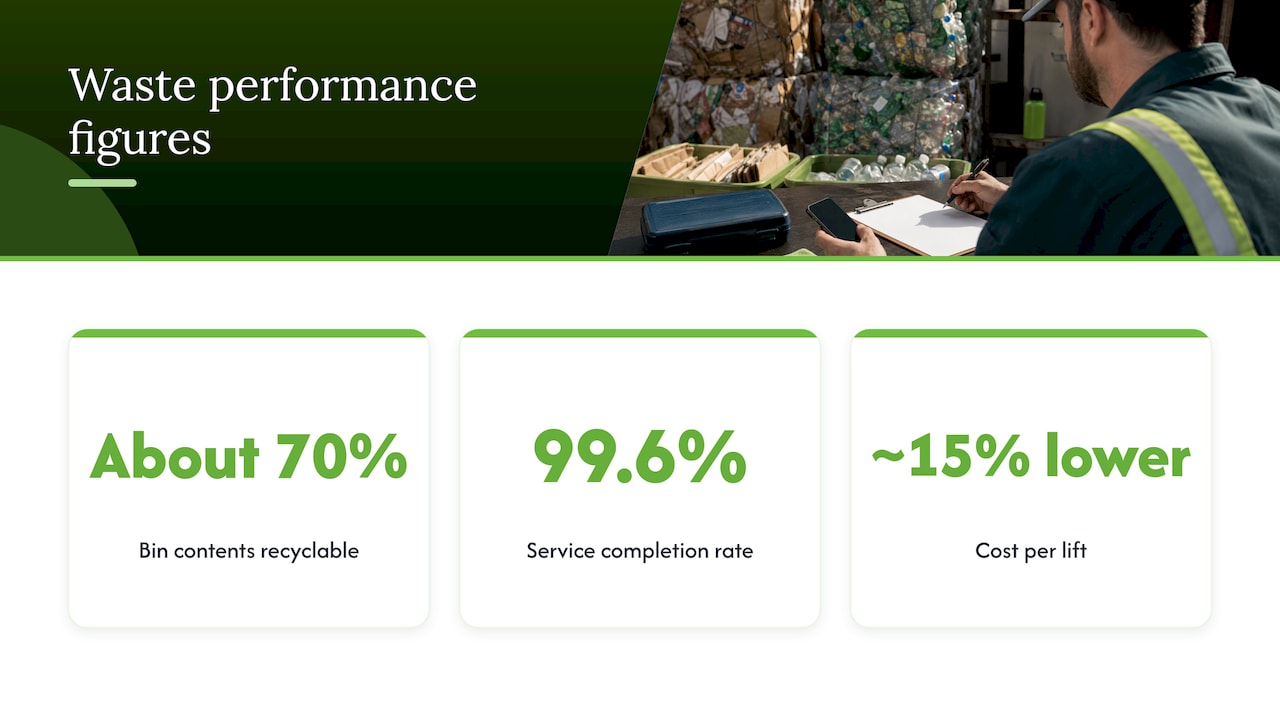
There is room to improve at most sites. MyWaste reports that a 2018 EPA study found about 70% of the contents of an average commercial waste bin could be diverted to recycling (MyWaste). Repak recommends an organised external waste area, clear and consistent signage, and regular staff training and engagement to find improvements (Repak Best Practice Guide).
Scheduling data matters for operators too. One Irish collection company reported a 99.6% service completion rate and roughly 15% lower cost per lift after using route optimisation and weighing data to remove ad hoc missed-bin routes (AMCS case study). Those results belong to that operator and are not a promise for your site, but they show why weights and predictable stops are worth recording.
Where the material ends up also affects how you plan. Repak explains that Irish materials recovery facilities sort and bale paper, cardboard, rigid plastics and metals, and that much recycled material is shipped to other markets, often within Europe (Repak packaging design guide). Clean, consistent bales are what make that onward trade easy.
Our perspective on bale scheduling
We see the same pattern at many Irish sites: the baler goes in, but the collection arrangement stays as it was when material left loose in bins. The result is bales stacking up unsold, or a lorry arriving for a quarter-load.
Our view is that the schedule should be designed with the equipment, not after it. That is why we start with a waste audit, measure what your site really produces, and only then talk about the machine, the storage layout and the pickup rhythm.
Because we handle the audit, the equipment and the buyback of bales, there is one point of contact for volumes, timing and payment. Clean, well-formed bales are what we are set up to take, and a predictable pattern lets us plan lifts around your site rather than around a fixed route.
If your current arrangement turns cardboard into a cost line, it is worth testing whether the same material can instead earn a rebate.
Graham
Turn your bales into a scheduled revenue stream
If you bale cardboard or plastic, we can help you set the right volumes, equipment and pickup pattern, then buy the bales back. Our bale buyback scheme pays for recyclable material rather than charging you to remove it, and our free waste audit is the quickest way to find out how many bales you are likely to produce each week. You can read how it works in our bale buyback programme guide and see what buyers pay in our cardboard bale prices article.
Not yet baling? Our cardboard balers, cardboard compactors and refurbished compactors and balers cover most site sizes, and you can start with Balepress 10 or Balepress 53 pages for the models.
FAQ
How often should a business schedule bale collection?
It depends on bale output and storage space. If you have no collection history, plan storage for a week’s output, then adjust once your log shows how quickly the area fills. Aim for most lifts to leave with a full load.
Is a fixed schedule or call-off collection better?
Fixed slots suit steady volumes and are easy for staff to follow. Call-off suits seasonal or uneven output, provided you have enough storage to cover the lead time. Many sites use a fixed baseline with extra lifts before peaks.
Can any collector take my bales?
No. A commercial collector needs a valid waste collection permit for the material, and some contractors do not accept baled waste at all. Confirm acceptance, bale specification and load minimums before buying equipment.
What causes bales to be rejected or downgraded?
Contamination, moisture and mixed materials are the main causes. Remove food, liquids, plastic bags and general waste before baling, and store bales dry on pallets.
How do I know if my collection frequency is right?
Check your log. If lifts regularly leave part-empty, extend the interval. If storage fills before pickup day, shorten it or add capacity.
Sources
- Waste Storage Guide (Northern Ireland building control)
- Service specification guidance and example clauses
- Operational Waste Management Plan, Fingal County Council
- Outline Delivery and Servicing Management Plan
- Waste permits and certificates of registration, Cork County Council
- European Union (Waste Directive) Regulations 2020
- Incentivised waste collection charges, gov.ie
- Waste Management Act 1996, Law Reform Commission
- Repak Best Practice Guide
- Repak Packaging and Design for the Circular Economy
- MyWaste, workplace legislation
- AMCS case study on route optimisation