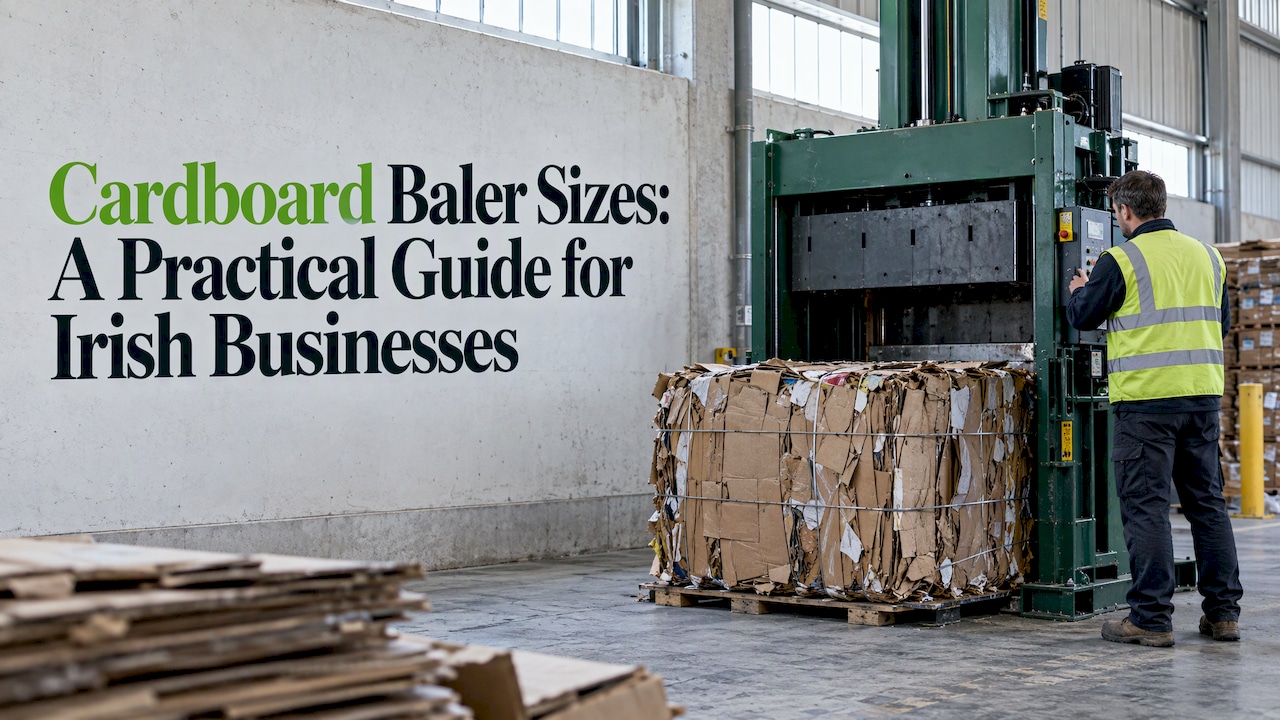
Cardboard balers fall into three broad size bands. Small vertical machines make bales of roughly 30 to 80 kg. Medium machines make 200 to 350 kg bales. Large mill-size machines make bales of 400 kg and up. The right band depends on how much cardboard you generate each day, how much floor space and ceiling height you have, and what size of bale your buyer wants. This guide gives you the numbers, then shows you how to apply them.
TL;DR
- Small balers suit shops and offices, medium balers suit supermarkets and mid-sized stores, and large mill-size balers suit warehouses and distribution sites.
- Machine height is often the limiting factor, not floor area. Measure the ceiling and the loading route before you shortlist anything.
- Match the bale to your buyer. Heavier, denser bales mean fewer lifts, fewer collections and a stronger position when you sell.
- Work from your daily cardboard volume, not your peak day, and leave headroom for growth.
- We offer a free waste audit that sizes the machine to your actual cardboard before you commit.
Table of Contents
- The three size bands at a glance
- What size is a standard cardboard bale?
- Start with your daily volume
- Vertical or horizontal: how the format shapes size
- Check the room before the specification
- Matching size to the type of business
- Is a baler the right machine, or a compactor?
- Our perspective
- Sizing with us: audit, machine, buyback
- A short checklist before you buy
- FAQ
- Sources
The three size bands at a glance
Baler sizes are described in two ways, and readers often mix them up. One is the size of the machine: its height, width, depth and weight. The other is the size of the bale it produces: its dimensions and weight. A small machine makes small bales, so the two move together, but you need both numbers to plan.

Published industry figures for vertical balers give a useful picture. According to Recycling.com’s size guide, small balers measure between about 975 x 715 x 1985 mm and 1360 x 895 x 2370 mm, with bales of 30 to 80 kg. Medium balers run from about 1700 x 1075 x 2500 mm to 1870 x 1294 x 2985 mm, with bales of 200 to 350 kg. Large balers run from about 1785 x 1544 x 2990 mm to 2495 x 1660 x 3590 mm, with bales of 400 to 750 kg.
Those are ranges for typical machines, not a specification for any one model. Individual makes differ, so always confirm the exact dimensions on the datasheet of the machine you are considering.
| Size band | Typical machine height | Typical bale weight | Typical setting |
|---|---|---|---|
| Small vertical | about 2.0 to 2.4 m | 30 to 80 kg | Shops, cafés, offices, small units |
| Medium vertical | about 2.5 to 3.0 m | 200 to 350 kg | Supermarkets, larger retail, hotels |
| Large or mill-size | about 3.0 to 3.6 m | 400 to 750 kg | Warehouses, distribution centres, manufacturers |
Heights and weights above come from the ranges quoted by Recycling.com, rounded for readability.
What size is a standard cardboard bale?
The bale is what your recycler or buyer cares about. A mill-size bale is the heavy, dense, pallet-footprint bale that paper mills prefer. It is commonly described as around 1.2 m x 1.0 m x 0.8 m, with weights from about 400 kg upwards. Small-chamber machines cannot reach that, which is not a fault: they are designed for a different job.
Small bales, in the tens of kilos, are easy to move by hand or on a pallet truck. They suit sites with low volumes, no forklift, and a collection that happens weekly or less. Larger bales need a forklift or pallet truck to move, but the payoff is fewer handling events and fewer trips off site.
There is a practical rule here: ask what your buyer or collector will accept before you pick a machine. Bale size, weight and tying standard all affect what you are paid. If you already sell cardboard, our guide to cardboard bale prices in Ireland explains what buyers look for, and our note on protecting returns on baled cardboard covers the benchmark.
Start with your daily volume
The most reliable way to size a baler is by the cardboard you generate per day. According to IQS Directory, baler selection depends on daily cardboard tonnage. Its guidance runs like this:
- Up to about 2 tonnes a day: a manually fed vertical baler, with bales roughly 0.6 to 1.8 m long and 45 to 680 kg.
- About 1 to 4 tonnes a day: manual or conveyor feeding, and horizontal closed-end balers come into play.
- About 3 to 200 tonnes a day: a high-capacity horizontal baler with automatic feeding and bale tying.
- Above 200 tonnes a day: a horizontal baler with automatic feed and tying, sometimes with two-ram operation for continuous running.
Most Irish retailers, hotels, restaurants and small manufacturers sit in the first band. Large distribution centres and food producers sit in the later ones.
Turning boxes into tonnes
Many sites have no idea what their daily tonnage is. A simple method gets you close:
- Count how many cages, roll containers or loose stacks of flattened cardboard you fill on a normal day.
- Weigh two or three full units on a scale or pallet weigher and take the average.
- Multiply by your daily count, then do the same for your busiest day of the week.
- Add 20 to 30 per cent for growth, seasonal peaks and the fact that cardboard volumes rarely fall.
If you want a more structured way to think about throughput against machine capacity, this capacity calculation worked example shows how to turn hourly or daily output into a requirement you can compare with a machine’s cycle time.
A free waste audit does this properly. We look at what you actually produce, where it is generated and how it leaves your site, then recommend the size that fits.
Vertical or horizontal: how the format shapes size
Vertical balers compress material downward in an upright chamber. They are the usual choice for shops, supermarkets, hotels and light industrial units because the footprint is small, installation is simple and the operator loads by hand through a door.
Horizontal balers press sideways and are fed from the top, by conveyor, or by hopper. They handle higher volumes and continuous feeding, and they make larger bales. They also need more floor length, a feeding arrangement and a bigger power supply.
A rough guide:
| Factor | Vertical | Horizontal |
|---|---|---|
| Footprint | Compact | Long and wider |
| Feeding | By hand through a door | Conveyor, hopper or auto-load |
| Throughput | Light to moderate | Moderate to very high |
| Typical sites | Retail, hotels, small units | Warehouses, distribution, manufacturing |
If you want a gentle introduction to the choice, read what you need to know about cardboard balers. For sites that want to avoid manual loading altogether, an autoload baler feeds material automatically. For heavy volume, a jumbo load baler is designed to take large quantities in one go.
Check the room before the specification
Machine dimensions on a datasheet mean nothing until you hold them against your building. Five checks save the most trouble.
Ceiling height and the loading route
Vertical balers are tall, and the cylinder often sits above the chamber. A machine of 2.5 m or more will not fit a standard store room without checking. Measure to the lowest obstruction, including sprinkler pipes, lights and door headers, and measure the route the machine must take to get in.
Floor area and working space
The footprint is only part of the picture. Allow space in front for loading, room to open the bale door, and a clear area for tied bales to be removed and stored. A baler wedged into a corner is a baler nobody uses properly.
Power supply
Different balers use different motor sizes and electrical arrangements. Small machines may run on a standard single-phase supply, while larger ones usually need three-phase. Have an electrician confirm what is available at the intended location before you order.
Feed opening
The loading aperture decides how much of your cardboard goes in whole. If your boxes are large, a small opening means staff spend time breaking them down further, which cuts into the time you are trying to save.
Bale handling and storage
Think about who moves the bale, with what, and where it waits for collection. A 400 kg bale needs a forklift or a powered pallet truck. A 50 kg bale does not. Bales should be stored dry, on a firm surface and away from fire risk.
Our page on baler space requirements for floor area, height and power goes through these checks in more detail.
Matching size to the type of business
The examples below are typical situations, not a promise about any particular machine.
A small retailer or office. A few cages of flattened boxes a week and limited space. A compact vertical machine making small bales is sensible, and a smaller model such as the Balepress 10 is the sort of unit to look at.
A mid-sized supermarket or hotel. Daily deliveries, a back-of-house store and a weekly or twice-weekly collection. A medium vertical baler fits. The Balepress 53 belongs in this conversation, and our Strautmann balers cover the heavier end of the vertical range.
A warehouse or distribution site. Continuous cardboard flow across the day. Large mill-size bales, conveyor or autoload feeding and a horizontal machine make sense here. The goal is to produce bales dense enough that a collector will lift them without discount.
A site on a tight budget. A good refurbished machine can bring a larger size within reach. See our refurbished compactors and balers and new and refurbished balers for Irish businesses.

Is a baler the right machine, or a compactor?
Balers make tied bales you can sell. Compactors squeeze mixed or loose waste into an enclosed container that is collected and emptied. If your cardboard is clean and separated, a baler normally makes more sense because the bale has resale value. If you need to deal with a large mixed stream, a compactor may be the better fit. Our guide to choosing a cardboard compactor walks through the decision, and the cardboard compactor range shows what we supply.
Our perspective
Most people ask us for a size when they should be asking for a result. The number on the datasheet matters less than whether the machine fits the room, suits the people who will use it and produces a bale someone will pay good money for.
We start with the waste, not the catalogue. A free audit tells us what you produce, how it moves through the site and what it currently costs you. From there, choosing between a small vertical machine, a mill-size baler or an autoload unit becomes a straightforward decision rather than a guess.
We also think about the end of the chain. Because we offer a buyback scheme for bales, we care that your bales come out dense, well tied and consistent. That is how a baler stops being a cost and starts working as a source of revenue.
One point we repeat often: leave room to grow. Cardboard volumes tend to go up, and a baler sized for today’s exact needs can be stretched within a year or two. A single supplier from audit through equipment to collection means you are not coordinating three parties to fix that.
Graham
Sizing with us: audit, machine, buyback
We supply the equipment, and we also buy the bales. That means one point of contact from the first measurement to the payment for your cardboard.
A free waste audit is the starting point. We look at your volumes, your floor space and your collection pattern, then recommend a machine and a bale size to suit. You can browse our cardboard balers, or find out how our bale buyback scheme turns baled cardboard into income.
Don’t forget the consumables. Balers need wire or tape to tie the bales, and the right one depends on your machine. See our baling wire and tape.
A short checklist before you buy
- Weigh your cardboard for a typical week and your busiest week.
- Measure ceiling height, door widths, and the route from the delivery point to the install location.
- Confirm your electrical supply with a qualified electrician.
- Decide who will load the baler and how often.
- Check what bale size and weight your collector or buyer prefers.
- Plan where tied bales will sit and how they will be lifted.
- Add a margin for growth.
If the answers point to different sizes, go with the one that fits the room and the buyer first. A slightly larger machine that you use properly beats a smaller one that is too slow to keep up.
FAQ
How big is a cardboard baler?
It depends on the class. Small vertical balers are around 2 to 2.4 m high and make bales of 30 to 80 kg. Large mill-size machines can reach 3.5 m or more and produce bales of 400 kg and above. Check the exact model’s datasheet and measure your ceiling and access route first.
How big is a standard bale?
The mill-size bale that paper mills prefer is commonly around 1.2 m x 1.0 m x 0.8 m and weighs 400 kg or more. Small-chamber machines produce lighter bales that are easier to handle manually. Ask your buyer or collector which they take before choosing a machine.
How much space does a baler need?
Allow for the machine’s footprint plus room to load it, open the bale door and remove tied bales. Ceiling height matters as much as floor area for vertical machines. Our baler space requirements page lists the checks.
Is a cardboard baler worth it?
For most sites producing a steady flow of cardboard, yes. Baling cuts the volume you store and the number of collections, and clean, dense bales can be sold. A free waste audit will show what it means for your own site.
Sources
- What is the size of a cardboard baler? (Recycling.com)
- Cardboard Balers: Types, Uses & Applications (IQS Directory)