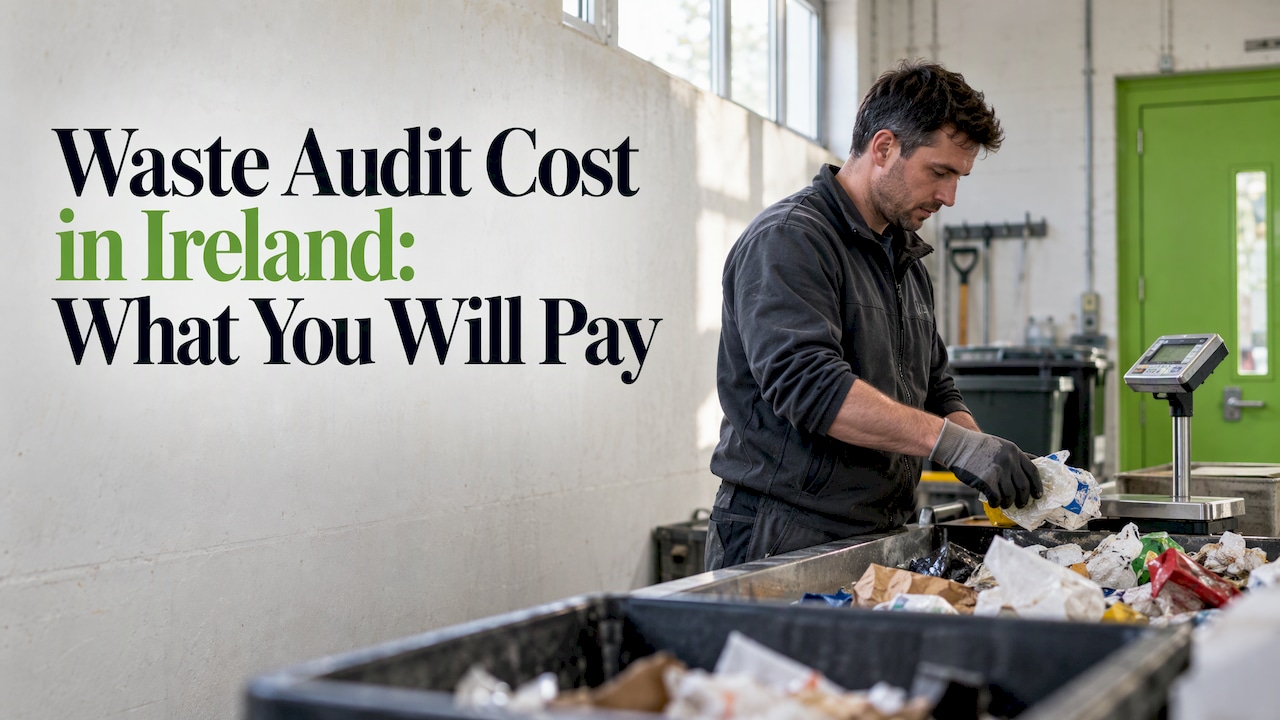
For many Irish businesses a waste audit costs nothing. Free audits exist, including our own Free Waste Audit and the state-backed Green Business programme. Where a fee does apply, it depends on the size of the site, the number of waste streams and how deep the physical sorting goes. This guide covers what drives the price, what a good audit includes and how to judge whether it is worth paying for.
TL;DR
- Free options exist in Ireland: the Green Business programme for qualifying SMEs, and our own no-charge audit tied to equipment and bale buyback.
- Paid audits are priced by site size, streams, sampling method and reporting depth, so ask for a scoped quote rather than a headline rate.
- The audit is the cheap part. Your yearly spend on collection, contamination and lost recyclables is the number that matters.
- Irish guidance says a business could save as much as 10% on waste costs with no-cost and low-cost measures.
- A good audit ends with a costed action plan, owners and timelines, not just a tonnage report.
Table of Contents
- What a waste audit actually is
- How much does a waste audit cost in Ireland?
- What drives the price of a paid audit
- What the fee should include
- Why the audit cost is small next to your waste bill
- Do you have to carry out a waste audit?
- Audit by sector: what to expect
- From audit findings to income
- How to choose an audit provider
- Start with a free audit of your site
- FAQ
- Sources
What a waste audit actually is
A waste audit is a study of how much waste a business produces and of what type. It shows how much is recycled, composted, or sent to landfill or incineration, and how contaminated each stream is. BDC describes it in these terms.
At the physical end, auditors safely sort, divide and weigh a representative sample of bags or recycling bins. They record the types and quantities found, as the Time To Recycle audit manual sets out. The Better Buildings Partnership lists common types: contamination audits, density audits and composition audits. It also notes that an audit should lead to improvement actions, recorded with timeframes and responsibilities.
That last point shapes the price. A cheap audit that stops at a table of tonnages leaves you to work out what to do. A useful one finishes with decisions.
How much does a waste audit cost in Ireland?
There is no standard published rate for a commercial waste audit in Ireland, and we will not invent one. What we can say is what the market looks like, from free to scoped consultancy.
| Route | What you pay | Who it suits |
|---|---|---|
| Green Business resource efficiency assessment | Free to qualifying businesses | SMEs with utility spend over €25,000 |
| Compact Free Waste Audit | No published charge: it is free | Sites weighing up balers, compactors, composters or bale buyback |
| Independent consultant audit | Quoted per project, scoped to site | Larger or multi-site operations needing independent sampling |
| In-house review of invoices and bins | Staff time only | A first pass before any outside help |
The free state-backed route
Green Business is a free and confidential resource-efficiency service for Irish SMEs. Its onsite assessments look at waste production and management, waste prevention, energy bills, water efficiency and staff awareness. According to the programme booklet, they are free to qualifying businesses with utility spend over €25,000 and can be worth up to €5,000 in consultancy time. The programme is managed by the Clean Technology Centre, and many of the opportunities it identifies are no-cost or low-cost with short payback periods. Check the programme’s own site for current eligibility before you apply.
Our free audit
Our Free Waste Audit is a tailored review of your specific requirements. It is designed to help you meet legal and corporate standards while finding cost efficiencies. Because we also supply balers, compactors, dewatering shredders, composters and a bale buyback scheme, the audit can point to the equipment that fits your waste profile. See the free waste audit for Irish businesses page for the sectors it covers.
What drives the price of a paid audit
When a fee does apply, these are the variables that move a quote up or down. They come from how audits are run in practice, so use them as a checklist when comparing proposals.
- Number of sites. Each location needs its own visit and its own sample.
- Site size and complexity. A single office floor is a different job from a plant with production, goods-in, canteen and yard.
- Number of waste streams. General waste, dry mixed recyclables, cardboard, plastic film, food waste, glass and hazardous items each need separate treatment.
- Method. A paper review of invoices and weight tickets is quicker than physically sorting and weighing bags. Sorting takes people and time.
- Duration of sampling. One day shows a snapshot. A week or longer shows the true rhythm of the business.
- Reporting depth. A tonnage summary costs less than a costed action plan with equipment options and payback.
- Follow-up. Re-audits to confirm that changes have worked add to the cost but show the saving.
One practical tip: do not tell staff the sorting day in advance. The Time To Recycle manual advises against it, since people change their disposal habits and the sample stops reflecting normal behaviour.
What the fee should include
Whatever you pay, expect the following in writing before work begins:
- A defined scope: sites, streams, sampling period.
- A review of your waste contractor invoices and collection frequency.
- Physical sampling and weighing, or a stated reason why it is not needed.
- Contamination findings per stream.
- Observation of equipment and working practices, which the Better Buildings Partnership says should complement the waste profile analysis.
- A costed action plan with timeframes and owners.
If you want a ready-made list of what to gather and check, our waste audit checklist for managers walks through it.
Why the audit cost is small next to your waste bill
The fee, if any, is a one-off. Your waste costs recur every month, and they are larger than the invoice suggests. The Lean Business Ireland guide points out that waste costs include contractor disposal charges, purchased raw materials, production costs, staff time to collect and segregate, invoice administration, storage and management time.
Irish official sources put numbers on the opportunity:
- The 2026 MyWaste business brochure says a business could save as much as 10% on waste costs through no-cost and low-cost solutions, and names an audit of waste type and quantity as the first step.
- The EPA’s 2018 study, cited in a government press release, found that 70% of the average commercial waste bin in Ireland could be diverted to recycling.
- For hospitality, the EPA’s Food Waste Pathway reports that every tonne of food waste costs a business €3,000 once purchase, storage, cooking, serving and disposal are counted. One case study cut food waste per person served by almost 37% in two months, worth €15,000 a year with no investment.
- Green Business site visits have identified savings ranging from €2,500 to €295,000 across sectors from food and drink to healthcare and retail.
Those are Irish examples, not promises for your site. They do show why an audit is a sound first move.
A simple worked check
You can estimate the value of an audit before commissioning one:
- Add up twelve months of collection invoices for every stream.
- Divide by total tonnes to get a cost per tonne for each stream.
- Estimate what share of the general waste bin is recyclable. The EPA’s 70% figure is a national average, so use your own sample.
- Work out the saving if that material moved to a cheaper recycling stream.
- Compare that annual saving with any audit fee quoted.
If step 4 is bigger than the fee, the audit pays for itself within the year.
Do you have to carry out a waste audit?
Not as a blanket rule. Section 28(2)(a) of the Waste Management Act 1996 requires anyone carrying on an agricultural, commercial or industrial activity to take reasonable steps to prevent or minimise waste. Section 28(4)(a) allows regulations to require a waste audit and a waste reduction programme. In practice, an audit is the clearest way to show you have taken reasonable steps.
The commercial collection rules also reward good segregation. The Department of Climate, Energy and the Environment announced in March 2023 that all waste collected must be weighed. Collectors must price mixed dry recyclables and bio-waste below municipal waste disposal, and recyclable and bio-waste collections must happen at least fortnightly. Weight-based charging makes it more expensive to leave recyclables in the general bin, which is exactly what an audit uncovers. If you handle food, read our guide to food waste regulations in Ireland.
Audit by sector: what to expect
The scope changes with the type of site, and so does where the savings tend to sit.
- Offices and managed buildings: mostly paper, cardboard, dry mixed recyclables and canteen waste. Our office waste audit guide covers costed fixes for facilities teams.
- Manufacturing: more streams, more contractors, more pallets and packaging. See how to run a manufacturing waste audit in Ireland.
- Food and hospitality: food waste in the wrong bin is the costly item. Composting equipment may come into the plan, and our commercial food composter cost guide explains the options.
- Retail and distribution: cardboard and plastic film dominate, which is where baling and buyback come in.
From audit findings to income
Most audit reports end with recommendations. The question is whether anyone can act on them. The EPA’s food waste guidance notes that much of the early work is organising information a business already has. It also notes that pulling food waste out of general bins cuts costs quickly. The Lean Business Ireland guide advises starting simple: tackle the largest waste types needing the least effort first, then use the savings to fund deeper improvements.
For cardboard and plastic, that usually means turning loose material into tied bales. A cardboard baler or cardboard compactor reduces volume and collections. Bales can then be sold rather than paid for, which is the idea behind our bale buyback scheme. For current market levels, see our note on cardboard bale prices. If you want to reduce your bill within a billing cycle or two, our guide to cutting waste disposal costs sets out the steps.

How to choose an audit provider
Use these questions to compare any offer, free or paid:
- What exactly is the scope, and is physical sampling included?
- Will I get a costed action plan, with owners and dates?
- Does the provider also supply equipment or services, and is that disclosed? Either arrangement can work, as long as you know it.
- What happens after the report: is there support to carry the recommendations out?
- How will savings be measured afterwards?
A provider that can supply equipment, collect and pay for the bales is able to follow through from findings to income. That is the single point of service we offer.
Our view: the audit should earn its keep
We built our approach around one idea: waste is only a cost when nobody has measured it. Most of the businesses we meet pay for collections they have never examined, and cardboard and plastic that could be income leave the building in the general bin.
That is why our audit is tailored to your site and free to start. We look at what you produce, what you pay and what the law and your own corporate standards require. Then we tell you which equipment, if any, makes sense, and how a bale buyback could turn residues into revenue.
An audit that ends in a PDF has not finished its job. Ours is designed to run from audit through equipment to recycling and payment, so the saving you were promised on paper shows up on your accounts.
Graham
Start with a free audit of your site
If you manage a site in Ireland and want to see what your waste is costing, our Free Waste Audit is the quickest way to get a clear picture. We analyse your specific requirements, show where costs can fall and where recyclables can earn, and recommend equipment only where it fits.
You can also browse our refurbished compactors and balers if you want to keep upfront spend down, or visit compact.ie for the full range.
FAQ
Is there a free waste audit in Ireland?
Yes. Green Business offers free onsite resource efficiency assessments to qualifying SMEs with utility spend over €25,000. We also offer a free waste audit for businesses looking at better recycling, equipment or bale buyback. Check each provider’s current eligibility.
How long does a waste audit take?
It depends on scope. A review of invoices and a site walk can be done quickly. Physical sorting needs a sampling period long enough to reflect normal activity, so agree the duration with the auditor before you start.
Do I need a waste audit by law?
There is no general legal duty to commission one. The Waste Management Act 1996 requires commercial and industrial businesses to take reasonable steps to prevent or minimise waste, and it allows regulations to require audits. An audit is a clear way to evidence those steps.
How much can an audit save?
Irish guidance says a business could save as much as 10% on waste costs with no-cost and low-cost measures. Results vary by site, sector and how well waste is segregated today.
Sources
- How to conduct a waste management audit (BDC)
- Waste Audit Manual (Time To Recycle)
- GN 6.2: Undertaking a waste audit (Better Buildings Partnership)
- Green Business promotion booklet
- Green Business case studies
- Green Business Initiative
- Waste Prevention Guide (Lean Business Ireland)
- How to manage your business waste (MyWaste, 2026)
- Food Waste Pathway for the Hospitality Sector (EPA)
- Incentivised waste collection charges (gov.ie)
- Waste Management Act 1996, Section 28