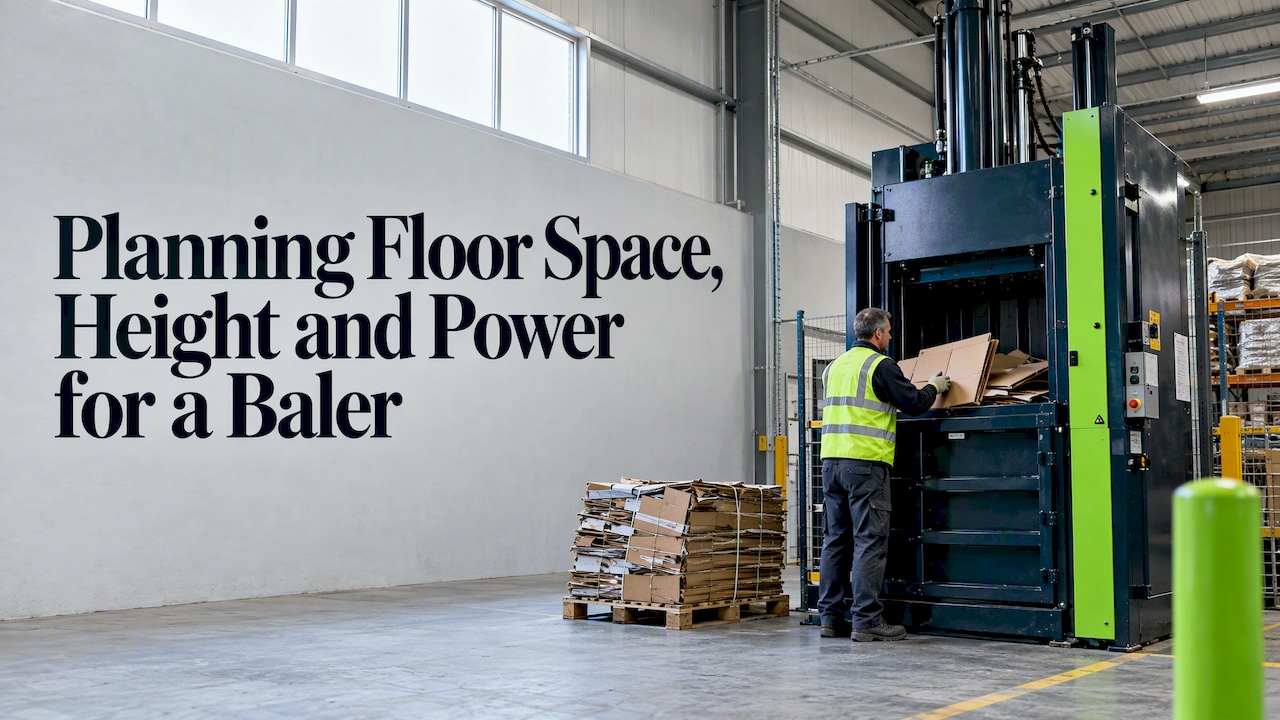
A baler needs more room than its footprint suggests. Plan for the machine, a clear zone to load it, a clear zone to eject and remove the bale, a route for a pallet truck, a level floor and a suitable electrical supply. Get those six things right and the baler pays its way from week one. Miss one and the machine sits half-used in a corner.
This guide is for facility managers, business owners and procurement teams in Ireland who are choosing a spot for a cardboard baler. It also answers the question that usually follows: what power supply does it need?
TL;DR
- Measure the working envelope, not just the machine: loading area, door swing, bale ejection and the path of a pallet truck.
- Check headroom as well as floor area. Vertical balers need height for the ram, the loading opening and any lift-up lid.
- Ask for the exact dimensions and electrical specification of the model from the supplier’s data sheet before you commit to a room.
- Have an electrician confirm the supply at the exact spot where the baler will stand, not just somewhere in the building.
- Plan the bale’s exit route and where finished bales wait for collection.
Table of Contents
- Footprint versus working envelope
- Vertical or horizontal: how the space differs
- Floor area: how to size it
- Headroom and doorways
- Bale size and the pallet
- The floor: level, strong and dry
- Baler power requirements
- Safety and flow around the machine
- Our perspective: plan from the bale backwards
- Choosing a baler for a tight space
- A pre-order checklist
- Talk to us before you buy
- FAQ
- Sources
Footprint versus working envelope
Every data sheet gives width, depth and height. That is the footprint. It is the smallest number you will plan around, and it is rarely the one that decides whether the baler works.
The working envelope is the footprint plus every area that has to stay free while the machine is in use:
- Loading zone: where staff stand and tip or push cardboard in, with room to move flattened boxes without climbing over anything.
- Door swing: a vertical baler’s chamber door opens outwards to release the tied bale. The door arc must be free of racking, bins and walls.
- Ejection and removal zone: the space where the bale is pushed or pulled out and then lifted onto a pallet or collected.
- Service access: room for an engineer to reach the electrical panel, hydraulics and tying area.
- Travel route: a clear path from the baler to the loading bay for a pallet truck or forklift.
A useful habit is to mark all of this on the floor with tape before you order. Walk the route with a pallet truck. If the tape outline cuts across a fire exit, a walkway or a delivery lane, you have found the problem for free.
Vertical or horizontal: how the space differs
The two main types use space in opposite ways.
| Vertical baler | Horizontal baler | |
|---|---|---|
| Floor footprint | Smaller | Larger, long machine with a feed hopper |
| Headroom needed | More, for the ram and the loading opening | Usually less |
| Loading | By hand through a front door or opening | Hopper, conveyor or hand feed |
| Bale removal | Ejected at the front, moved by pallet truck | Ejected at the end, often tied automatically |
| Typical user | Shops, offices, small warehouses, restaurants | High-volume distribution centres and manufacturers |
A vertical baler suits most Irish retail units, hotels and mid-sized warehouses. A horizontal machine only makes sense when you generate cardboard in volume every day and have a dedicated area, because the length of the installation and the space needed to take bales away are much greater.
If your volumes sit between the two, an autoloading option is worth a look. Our autoload baler is built for sites where staff time loading is the real cost, and we can talk through where it would sit in your layout.
Floor area: how to size it
Sizing by floor area alone goes wrong, so work through it in this order.
- Get the model’s dimensions. Ask for the width, depth and height with the door closed and with the door open. Do not rely on a brochure photo.
- Add a loading zone in front. You need room to stand square to the opening and move boxes in. A crowded loading zone is where hand injuries and strained backs happen.
- Add the door arc and the bale exit. On many vertical machines the bale leaves through the same front opening, so the area in front does double duty. It must stay clear when the bale is out and waiting.
- Add a side or rear service gap. Where a model has strapping or wire fed from the back or side, you need to reach it. Some low-profile designs let you reload wire or strapping from the top or front, which saves floor space against a wall. Ask about this if your space is tight.
- Add the pallet area. If bales go straight onto a pallet, the pallet needs somewhere to stand.
For small models in shops and offices, the footprint is modest and the access zones are what take the room. For large industrial models, plan a bay of its own.
Headroom and doorways
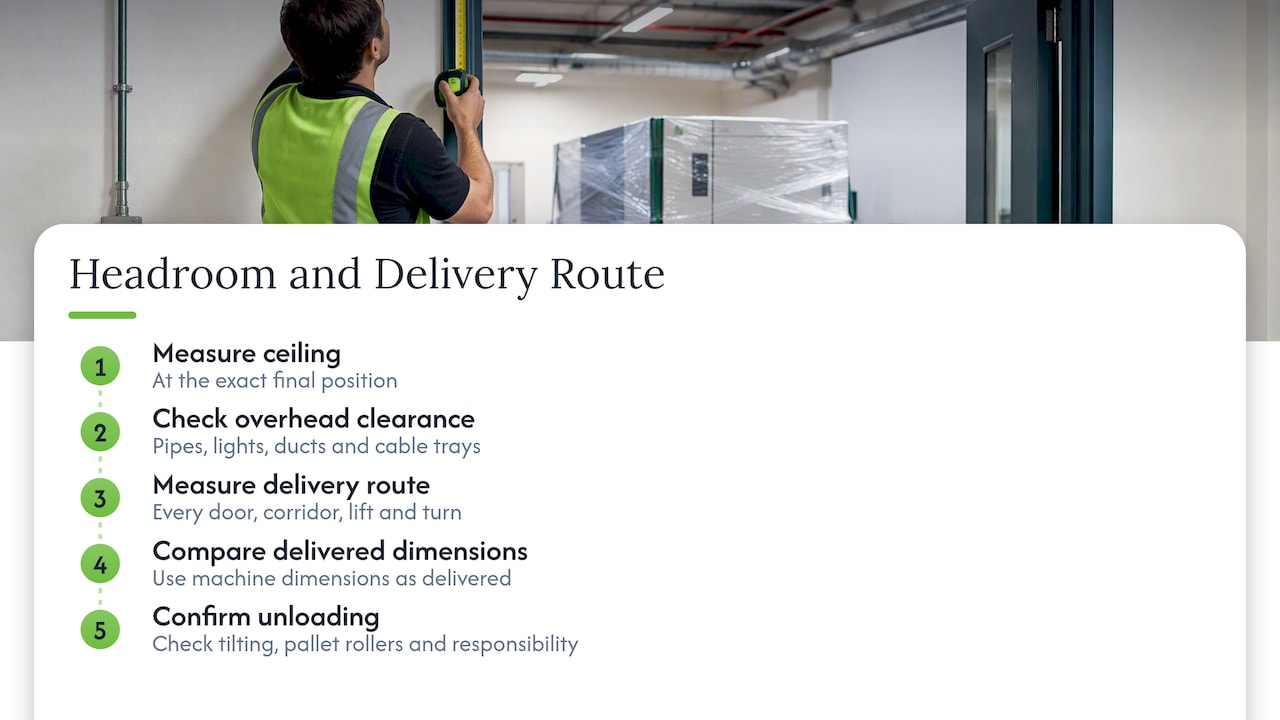
Vertical balers are tall. The ram rises above the chamber, and the machine often needs clearance above it for servicing. Measure the ceiling height at the exact spot, then check for sprinkler pipes, lighting, ducting and cable trays, which often hang lower than the ceiling itself.
Then check the delivery route. A baler that fits the room can still fail to reach it. Measure every door, corridor, lift and turn between the delivery vehicle and the final position, and compare them with the machine’s dimensions as delivered. Ask whether the unit can be tilted or moved on pallet rollers, and who will unload it.
Bale size and the pallet
The bale is part of the space question, because you have to store it until collection. Many balers are designed to make bales around the size of a standard pallet. The standard EUR pallet measures 1200 × 800 mm, and a bale built to that footprint is easier to stack, strap and load onto a collection truck.
Practical points:
- Ask the supplier for the bale dimensions and the typical bale weight for cardboard.
- Work out how many bales you will have between collections and where they will stand. A baler that produces one bale a day needs room for several before the lorry arrives.
- Check how bales are stacked. Stable, low stacks are safer than tall ones. Keep them away from fire exits and electrical panels.
- Make sure the buyer or haulier can reach the bale store with their vehicle and equipment.
If you intend to sell your bales, the buyer’s requirements matter as much as the baler’s. Our page on cardboard bale prices sets out what buyers are paying in Ireland, and our bale buyback scheme is the route to being paid for them.
The floor: level, strong and dry
The floor is the most overlooked part of baler planning. A baler exerts large forces, and an uneven or cracked slab can let the machine twist or sit out of true. That can mean badly formed bales, rough operation and excess wear.
Before delivery:
- Check that the slab is flat and sound in the position and across the whole working zone.
- Look for cracks, spalling, drains and slopes. Many yards and loading areas slope deliberately for drainage, which is the wrong surface for a baler.
- Ask the supplier whether the model should be anchored to the floor, and with what fixings.
- If the machine is going on a mezzanine, upper floor or older building, get its load capacity confirmed by a competent person.
Irish employers also have general duties here. The Safety, Health and Welfare at Work (General Application) Regulations 2007 include a requirement that buildings housing workplaces have a structure and solidity appropriate to their use, and a requirement on ventilation of enclosed workplaces. Neither is a baler-specific rule, but both are relevant when you place heavy equipment indoors. The Health and Safety Authority is the body to consult on your obligations.
Baler power requirements
Space and power belong in the same plan, because the electrical supply decides where the machine can stand.
The general picture is simple:
- Smaller balers commonly run from a standard single-phase supply.
- Larger, heavier-duty balers with bigger motors normally need a three-phase supply.
The exact requirement depends on the model, so take it from the data sheet: motor rating, voltage, phases, current and the type of socket or isolator. Do not treat any figure in a general guide as the answer for your machine.
Questions to put to your electrician:
- Is the right supply available at that spot? A building can have three-phase power and still have none in the back room or loading area where you want the baler.
- Is there a dedicated, correctly rated circuit and isolator? The baler should not share a circuit with other equipment.
- Is the cable run short and protected? Long runs across a working area are a trip hazard and a damage risk.
- What will the upgrade cost and how long will it take? Electrical work can add weeks. Raise it before you order the machine, not after it arrives.
Put the electrician’s visit at the start of the project. If the supply cannot reach your preferred spot, you may find that moving the baler three metres is cheaper than moving the power.
Safety and flow around the machine
A baler is simple to use but is also a heavy machine with a powerful ram. Layout is a safety measure.
- Keep forklifts and pallet trucks out of the operator’s standing area. The bale removal route should not cross the loading position.
- Leave a clear route to emergency exits and keep the machine out of corridors.
- Provide good lighting. A dim corner leads to mistakes with the interlock and door.
- Keep the area free of loose cardboard, which is a slip and fire risk.
- Train staff on the safe operating procedure and the lock-off routine for maintenance.
Check that the model you choose has the safety features that suit your site, such as door interlocks and an emergency stop, and ask the supplier to show them in use at handover.
Our perspective: plan from the bale backwards
Most customers ask us how big the baler is. We would rather start with a different question: where does the bale go next?
In our experience, the best-placed balers sit close to where cardboard is generated and close to where the bales leave the building. That sounds obvious, but many sites do the opposite. They put the baler in the first available gap, then discover that staff walk the length of the building with armfuls of boxes, and that bales must be dragged across a busy loading area.
So we begin with a free waste audit. We look at how much cardboard you produce, where it builds up and how it leaves, and only then do we talk about machines. Sometimes the answer is a compact vertical baler such as our Balepress 10 or Balepress 53. Sometimes a compactor is a better fit, and sometimes a bigger baler in a better spot beats a small one in a bad spot.
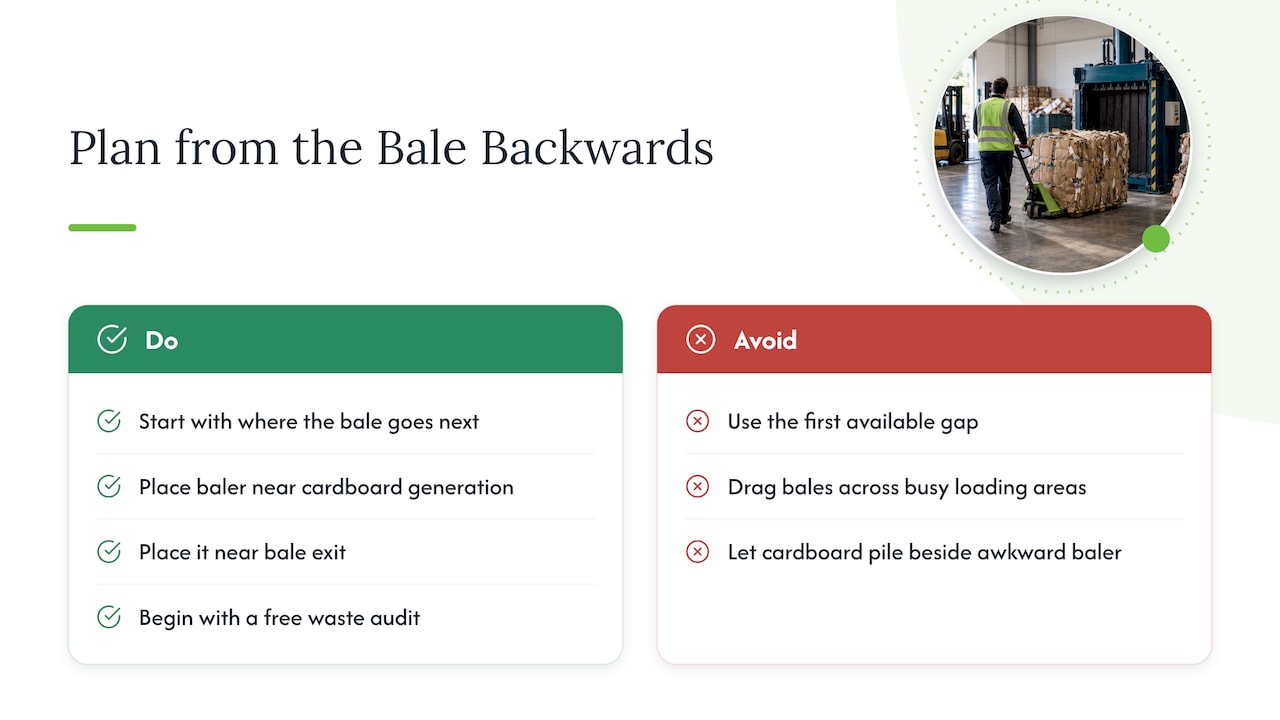
The layout also decides what you earn. Clean, well-formed bales on pallets are what buyers want, and a baler that is easy to use gets used. A baler that is awkward to reach ends up with cardboard piled next to it, which defeats the purpose.
Our advice: measure twice, tape out the envelope, call the electrician early, and let the bale route decide the position.
— Graham
Choosing a baler for a tight space
If you are short of room, these are the practical levers.
- Pick a compact vertical model and check the height as well as the footprint.
- Look for features that save floor space, such as strapping or wire loading from the top or front so the machine can stand closer to a wall.
- Move the baler, not the building. A modest relocation to a loading bay or a store room often frees more than a smaller machine does.
- Consider a refurbished machine. Our new and refurbished balers give you more choice of dimensions without a new-machine budget.
- Compare with a compactor if you want to keep waste enclosed and have outdoor space. Our guide to choosing a cardboard compactor explains when that makes sense.
For a wider look at the decision, our guide on what you need to know about cardboard balers covers capacity, running costs and bale handling.
A pre-order checklist
Before you sign for a baler, you should be able to answer yes to each of these:
- I have the supplier’s dimensions for the machine, with the door open and closed.
- I have marked the full working envelope on the floor.
- The ceiling height and everything hanging from it have been checked.
- The delivery route, doors and lifts have been measured.
- The floor is level, sound and suitable, and I know whether it needs anchoring.
- An electrician has confirmed the supply at that exact spot.
- Bales have a clear exit route and a storage place.
- Forklift and pallet truck movements avoid the operator’s area.
- Staff know who will be trained and how.
- I know who is collecting the bales and what they require.
Talk to us before you buy
We supply cardboard balers, compactors and the baling wire and tape that goes with them, and we buy back the bales. If you send us the dimensions of your space and a photograph of the spot, we will tell you what fits and what the working envelope should be. Start with the free waste audit and we will take it from there.
FAQ
How much floor space does a cardboard baler need?
It depends on the model. Small vertical balers take up a modest footprint, while large industrial ones need a bay of their own. Whatever the size, add a loading zone, door swing, bale exit and a service gap, and take the exact dimensions from the supplier’s data sheet.
Do balers need three-phase power?
Smaller balers often run on single-phase power, while larger models with bigger motors usually need three-phase. The requirement is set by the model, so check the data sheet and have an electrician confirm the supply at the exact spot where the baler will stand.
Can I put a baler outdoors?
Some sites do, but the machine, controls and electrics need suitable protection from weather, and the ground must be level and sound. Ask the supplier whether your chosen model is suitable for outdoor use, and consider a compactor if the machine must stand outside.
How big is a finished cardboard bale?
It varies by machine. Many are built to suit a standard 1200 × 800 mm EUR pallet, which makes stacking and collection easier. Ask for the bale size and weight for the model you are considering, and check what your buyer will accept.
Sources
- Safety, Health and Welfare at Work (General Application) Regulations 2007
- Health and Safety Authority
- Euro pallet (EUR / EPAL 1) size and specifications