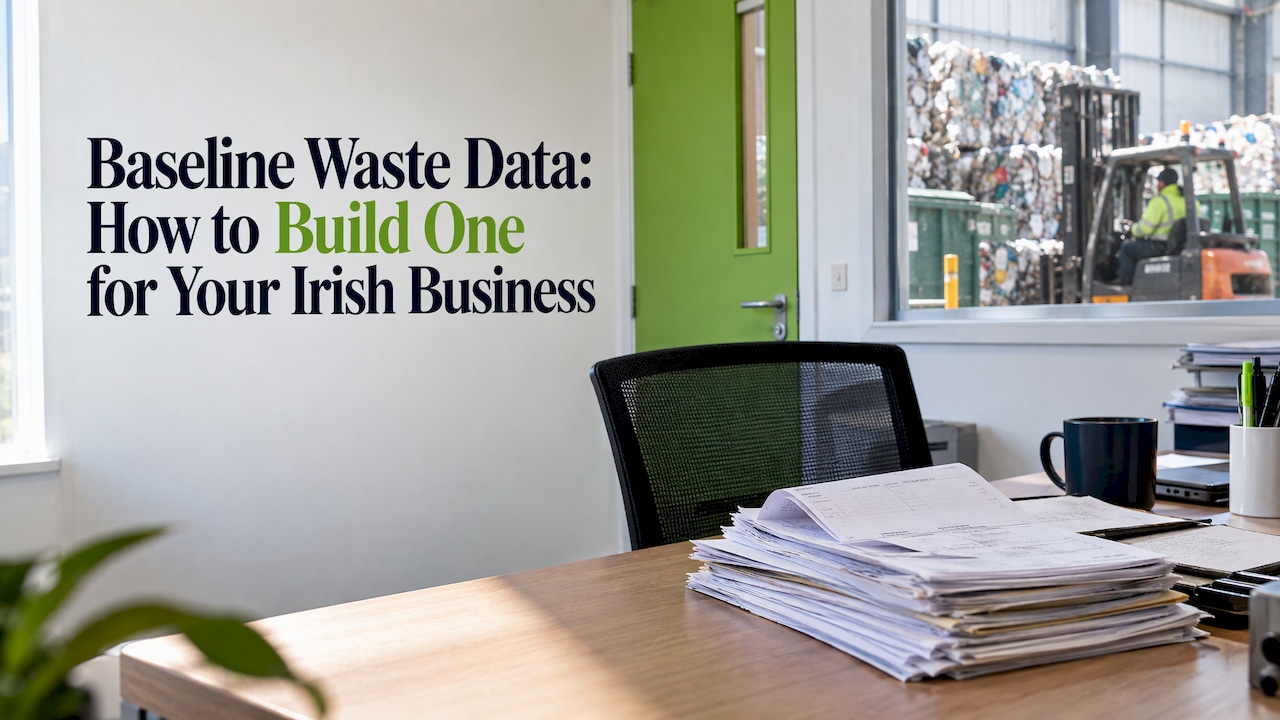
Baseline waste data is a verified record of how much waste your business produces, in which streams, and what each stream costs you, over a fixed period (ideally 12 months). Every saving, rebate and reduction target you set later is measured against it. Most of it already sits in your contractor invoices and weighbridge records. The work is to gather it, check it and organise it so one number per stream, per site, can be defended. Where a stream is clean cardboard or plastic, that number can also become income rather than cost, which is where we come in.
TL;DR
- A baseline is 12 months of waste quantities and costs, split by stream (general, food, dry recyclables, glass, other) and by site.
- Start with what you hold: contractor bills, weight dockets and bin-lift records. Irish contractors have on-board weighing, so ask for weights rather than estimating from lifts.
- Check the data before you trust it: reconcile invoices to dockets, query odd returns and write down where you estimated.
- Turn it into a benchmark (kg per cover, per employee or per square metre), set targets from year one and track against them in year two.
- Our Free Waste Audit gives you the baseline for your own site and shows which streams, such as cardboard and plastic, can earn rather than cost.
Table of Contents
- What baseline waste data actually is
- Why it pays: what the numbers have shown in Ireland
- What to collect, stream by stream
- How to build the baseline: five steps
- Check the data before you rely on it
- From baseline to targets
- Rules that shape your records
- Where Compact fits
- Our view
- FAQ
- Sources
What baseline waste data actually is
A baseline is a snapshot of where you are before you change anything. The Townhouse Doneraile climate action guide puts it plainly: log how much waste you generate and what it costs, keep general, food and recycled waste separate, and treat the current amount as your first benchmark.
Three things make a baseline useful rather than decorative:
- A fixed scope. Which sites, which streams, which 12 months.
- Quantities and costs together. Tonnes without euros cannot justify a baler. Euros without tonnes cannot show whether a price rise was a rate change or a volume change.
- A record of confidence. Which figures are weighed, which are estimated, and by how much you might be out.
The EPA’s hospitality guidance is encouraging on effort: much of the initial baseline work is gathering information the business already has and reporting it in an organised, consistent way.
Why it pays: what the numbers have shown in Ireland
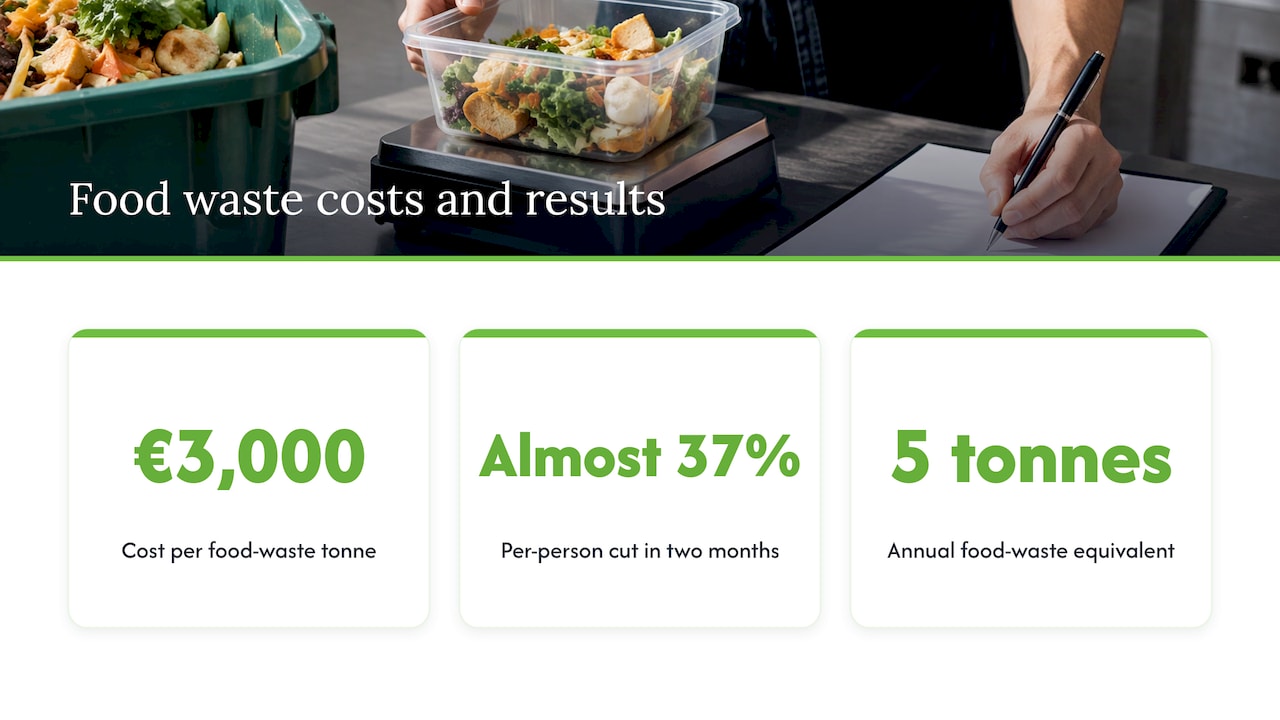
The EPA’s hospitality guidance estimates that every tonne of food waste costs a business €3,000, counting purchase, storage, cooking, serving and disposal, not just the bin charge. The same guidance reports a case where portion control and other measures cut food waste per person served by almost 37% in two months, equivalent to 5 tonnes a year.
Nobody can claim a result like that without a before figure. A baseline also exposes quick wins. The EPA notes that food waste found in general or recycling bins signals a cost saving through better segregation, because the Irish guidance says general waste is generally the most costly category and recyclables the least. Moving material between those bins changes your bill without changing your operations.
What to collect, stream by stream
For each site and each stream, record the same handful of fields. The Central Statistics Office uses a similar structure in its Waste Generation Survey 2024 booklet: for each List of Waste code, a description of the waste, the amount generated in tonnes, the location of treatment and, if treated on your premises, the recovery or disposal code. You do not need to file that survey to borrow its logic.
| Field | What to record | Why it matters |
|---|---|---|
| Site | Address or unit | Lets you compare sites fairly |
| Stream | General, food, dry mixed recyclables, cardboard, plastic film, glass, hazardous, other | Each carries a different charge |
| Quantity | Tonnes or kg per month, plus number of lifts | The core of the baseline |
| Basis | Weighed, billed by weight, counted by lifts, estimated | Shows how far to trust each figure |
| Cost | Collection, rental, lift fees, gate fees, any rebate | Turns tonnes into euros |
| Destination | Recycling, recovery, landfill, as stated by the contractor | Supports recycling-rate and reporting work |
| Activity measure | Covers, units produced, staff, square metres | Allows a benchmark |
If you hold hazardous waste, record it separately. The EU (Waste Directive) Regulations 2020 require hazardous waste producers and professional collectors to keep chronological records of the quantity, nature and origin of waste, kept for at least three years.
How to build the baseline: five steps
1. Gather 12 months of paperwork
Collect last year’s waste bills, weight dockets, collection schedules and contracts. The US EPA’s WasteWise guidance lists the same sources: purchasing and operating logs, invoices, hauling and disposal records and recycling contracts. Together they let you estimate annual waste generation and removal costs, and they form the baseline against which reduction options are measured.
Twelve months matters because most businesses have a season: Christmas cardboard for a retailer, summer food waste for a hotel, a shutdown week for a factory. A single month will mislead you.
Keep the files tidy as you go. A clear structure for waste profiling and records makes it easier to describe each stream consistently from the start.
2. Find out how you are billed
Check whether each contractor charges by lift or by weight. This changes how you read the data. A bin lift tells you volume, not mass, and a half-empty bin costs the same as a full one on a lift-based invoice. The EPA’s hospitality guidance says all waste contractors now have on-board weighing systems, that businesses are entitled to the weight data, and that it is far more accurate than estimating from bin lifts. Ask for it in writing, by stream, by month.
If you want to judge how well your current provider records and reports this, our waste contractor due diligence checklist lists what a documented service should show.
3. Fill the gaps with a short weighing exercise
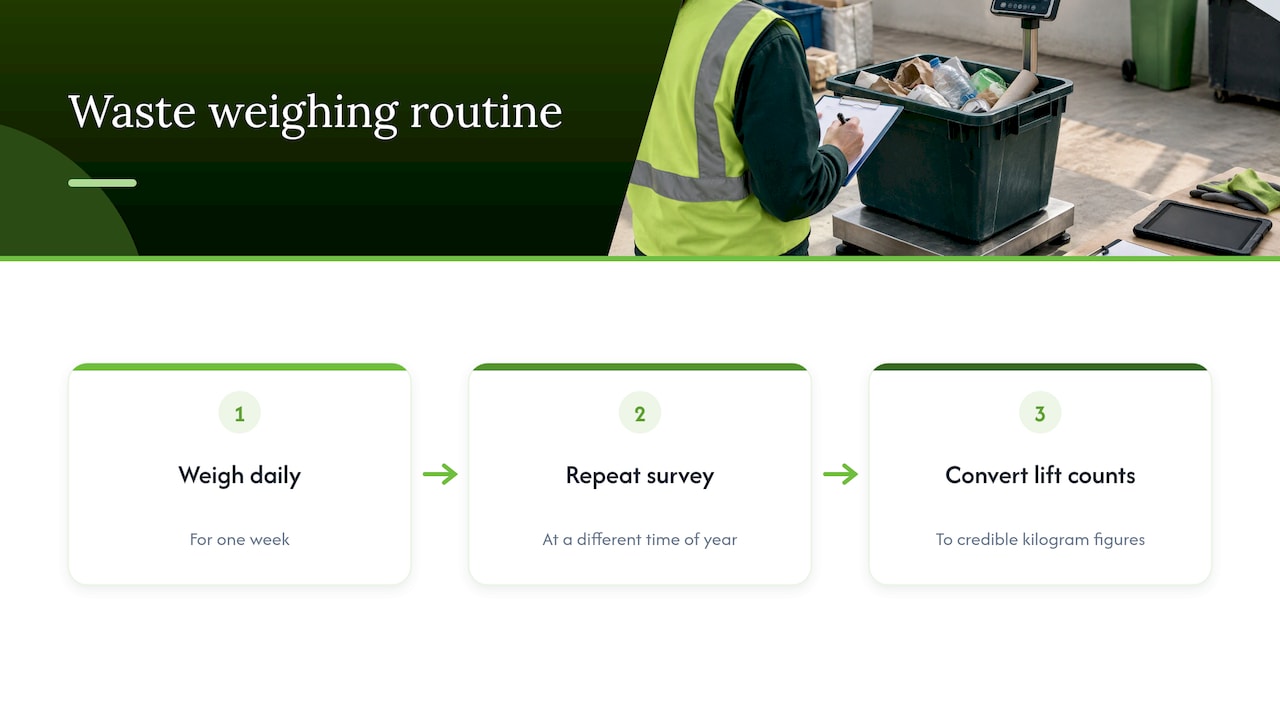
Where contractor figures stop (for example, material you carry to a bring facility yourself, or streams billed only per lift), measure directly. The EPA’s retail guidance recommends an internal survey: weigh waste from specific areas at the end of each day with a cheap electronic scale to find problem areas, and keep monthly figures in a spreadsheet. The same survey can look at recovery rates, segregation success and contamination.
A week of daily weighing, repeated at a different time of year, is often enough to turn a lift count into a credible kilogram figure. Our waste audit checklist sets out the weighing routine for managers.
4. Estimate what remains, and say so
Some records will be missing. The EPA’s food waste protocol for manufacturers advises querying odd contractor returns, asking about the composition of mixed waste, and filling the gap with a reasoned estimate, then documenting the uncertainty. That last part is what separates a baseline from guesswork: a figure marked “estimated, plus or minus 15%” can be improved next year, while an unmarked one just sits there.
5. Calculate totals, rates and costs
With the records in one sheet, work out:
- Total tonnes per stream, per month and per year.
- Recycling rate: recyclable tonnes divided by total tonnes.
- Cost per tonne by stream: total charge divided by tonnes, which shows where you pay most.
- A benchmark: kg of waste per customer, per cover, per employee or per square metre, as the Doneraile guide suggests.
A worked example. A distribution site produces 120 tonnes of general waste and 80 tonnes of mixed dry recyclables in a year, of which a large share is cardboard. Its general waste costs more per tonne than the recyclables. If a visual check of the general waste bins shows flattened cardboard in them, the baseline has already found a segregation saving. Add the 200 total tonnes to its 40,000 square metres and you have a benchmark of 5 kg per square metre per year to beat. The figures are illustrative, not a real customer’s.
Check the data before you rely on it
A baseline that falls apart under questions is worse than none. Three checks catch most errors:
- Invoice against docket. Do the tonnes on the bill match the weighbridge or on-board record?
- Mass balance. The EPA’s February 2026 webinar guidance on annual waste returns flags differences above 5% between tonnes in and tonnes out of a facility as a data quality check. You are not a facility, but the principle transfers: if what leaves your site is far from what your activity should generate, find out why.
- Seasonality. Does each month look plausible against your trading pattern?
For a compliance-minded view of what to keep and for how long, see our guide to a waste compliance audit in Ireland.
From baseline to targets
The EPA’s protocol is clear on sequence: use the first year’s data to set targets and pick the priority waste flows, then run the same measurement in year two to refine the data and track progress. Benchmarks in kilograms per month, week or day, say the EPA’s retail notes, can be used to track progress or compare against similar businesses.
Good first targets are narrow and tied to a stream:
- Move a named share of cardboard out of general waste.
- Cut food waste per cover by a set percentage.
- Reduce lifts per month by compacting or baling, so you pay for fewer collections.
- Raise the dry recyclables share of total tonnes.
Site-specific guides help here: we have written audit routines for manufacturers and restaurants, and a piece on facility waste streams for managers who need to report them. If your reporting extends to carbon, the same data feeds our guidance on measuring waste emissions for Scope 3.
Rules that shape your records
Most Irish SMEs fall under the Waste Management Act’s definition of commercial waste: waste from premises used wholly or mainly for trade, business, sport, recreation, education or entertainment, excluding household, agricultural and industrial waste. The Act, as revised, also defines a waste audit as an evaluation of how an activity is carried on, aimed at identifying opportunities to prevent or minimise waste and to recover it. That is exactly what a baseline feeds.
If you run a food business, a dedicated food waste collection is required by law in Ireland, according to the EPA, and used properly it also gives you accurate food waste data. Our overview of food waste regulations covers what applies to you, and packaging waste compliance covers the packaging side.
Where Compact fits
Gathering paperwork and weighing bins gives you the numbers. Deciding what to do about them is the harder step, and it is the one we focus on. Our Free Waste Audit is tailored to your site’s specific requirements, so the baseline reflects your streams rather than a generic template.
Where the baseline shows clean cardboard or plastic leaving as general waste, our bale buyback scheme turns those residues into revenue, and we supply the equipment to produce the bales, from cardboard balers to compactors. One team covers the audit, the equipment, the recycling and the payment, so your baseline leads to a result without handing the job between providers.
If your waste is wet, such as food or organics, a dewatering shredder or an organic waste composting machine targets weight and disposal cost directly. Our note on how to reduce wet waste weight explains why that matters when you are billed by the tonne.
Our view
Most businesses we speak to do not have a data problem. They have a data scatter problem: invoices in one inbox, dockets in a drawer, a site manager who “just knows” the cardboard is heavy in November.
The best baseline is the one that ends in a decision. If the numbers show you are paying to dispose of cardboard and plastic that someone will pay for, the baseline has done its job. That is why we put the audit first, the equipment second and the buyback after that: the audit says what you have, the baler makes it saleable, and the buyback closes the loop.
Start with twelve months, one spreadsheet and one person who owns it. Refine it every year. The businesses that treat waste as a measured asset are the ones that stop treating it as a fixed overhead.
Graham
FAQ
How long should baseline waste data cover?
Twelve months is the standard, because it captures seasonal peaks and troughs. The EPA’s food waste protocol asks for 12 months of records to calculate an annual quantity. If you have less, start recording now and mark older months as estimates.
Do I need to weigh everything myself?
No. Ask your contractor for weight data first, as the EPA says Irish contractors now have on-board weighing and you are entitled to the information. Weigh yourself only where records are missing, using short, repeatable exercises.
What is a good benchmark to use?
Use a measure tied to your activity: kg per cover for a restaurant, per employee for an office, per square metre for a property, per unit produced for a factory. The current amount is your first benchmark, and you compare against it each year.
How is a baseline different from a waste audit?
The baseline is the record of what you have produced and what it cost. A waste audit, as the Waste Management Act describes it, evaluates how you operate to find ways to prevent, minimise or recover waste. The baseline feeds the audit, and the audit tells you what to change.
Can baseline data show me where I can earn money from waste?
Yes. Once streams and costs are split, you can see which materials, typically cardboard and plastic, are leaving as general waste or at a recycling charge when they could be baled and sold. Our Free Waste Audit is built to find exactly that.
Sources
- EPA, Pathway to less food waste and better margins (2022)
- CSO, Waste Generation Survey 2024 booklet
- Townhouse Doneraile, waste management climate action guide (2025)
- US EPA, WasteWise waste assessment approaches
- EPA, February 2026 webinar guidance on annual waste data returns
- EU (Waste Directive) Regulations 2020, S.I. 323/2020
- Waste Management Act 1996 (revised)
- Waste Management Act 1996 (as enacted)
- Waste profiling for disposal: a generator’s guide