A commercial waste compactor presses loose waste into a smaller volume, so you pay for fewer collections, handle fewer bins and free up floor space. The right machine depends on what you throw away, how much of it there is and how it leaves your site. Start with a waste audit, because a compactor chosen without knowing your waste mix is usually the wrong size or the wrong type. Our free waste audit is the natural first step for Irish businesses.
TL;DR
- A compactor reduces waste volume so containers fill more slowly and fewer lifts are needed. Irish rules now also require separate recycling and food waste streams, so what you compact matters as much as how much.
- Match the machine to the material: cardboard compactors and balers for dry packaging, bin presses for general bins, EPS compactors for foam, dewatering shredders for wet waste.
- Size the unit on three inputs: waste volume, available space and how the waste is collected.
- Public tender values in Ireland show costs running from tens of thousands of euro per site, so audit first and compare supply, hire and buyback options.
- Isolate the power before cleaning, never use a machine with faulty guards or safety switches, and follow the HSA guidance.
Table of Contents
- What a commercial waste compactor does
- Types of commercial compactor and what they suit
- How to choose: three inputs that set the size
- What a compactor costs in Ireland
- Safety and the rules that apply
- Compacting without hurting recycling
- Where we come in
- Our view on compactors
- FAQ
- Sources
What a commercial waste compactor does
A compactor uses a hydraulic ram or press plate to squeeze waste into a container or bin. The waste weighs the same afterwards, but it takes up far less room. That changes three things in a business:
- Collection frequency. A container that holds three or four times as much between lifts is collected less often.
- Handling. Staff walk to one point instead of moving many bins, and fewer loose bags sit on the floor.
- Space and tidiness. One closed unit replaces a cluster of overflowing wheelie bins, which helps with pests, smell and fire risk.
The scale of the effect is visible in Dublin. Under the city council’s bin-bag ban pilot, four van-sized compactors were installed in May 2026 at Marlborough Place and Loftus Lane. Each can take up to 500 bin bags and crush them to between a quarter and a third of their original size. Your own ratio depends on the material: light dry cardboard and plastic film compress very differently from wet food waste.
Compaction also pairs with baling. A compactor presses waste into a container that is collected. A baler presses material such as cardboard into tied bales that can be sold. Which of the two you need is the first decision, and the second section below explains how to make it.
Types of commercial compactor and what they suit
There is no single machine called a commercial compactor. The type follows the waste.
Cardboard compactors
Retail units, warehouses and distribution centres generate large volumes of cardboard and light packaging. A cardboard compactor presses it into a container that is then emptied by the collector. It suits sites where the main aim is fewer lifts and a clean loading area. Our guide on choosing a cardboard compactor covers the detail.
Balers
If cardboard or plastic is your main stream and you want income from it, a cardboard baler produces tied bales that can be sold. We also supply Strautmann balers and the Balepress 53 for sites that want a bale-based routine, and baling wire and tape to run them. Our bale buyback scheme turns those bales into revenue instead of a disposal cost.
Bin presses and bin compactors
For general waste in offices, restaurants, hotels and small retail, a bin press reduces the contents of several bins into one. Our page on bin compactors for businesses explains how to choose between them. These units are compact enough to fit where a full-size static compactor will not.
Hydraulic and roller container compactors
A hydraulic compactor suits higher volumes of mixed dry waste. Roller container presses press waste into roller containers, which suits sites that already move waste in that format.
EPS compactors
Polystyrene foam is mostly air, so it fills a skip quickly while weighing almost nothing. An EPS compactor shrinks it dramatically, which matters for electronics retailers, food packers and fish processors.
Dewatering shredders and food waste machines
Wet waste is a different problem. A dewatering shredder shreds and removes liquid from waste such as packaging with product residue, and our page on where dewatering shredders pay off shows the sectors involved. For food waste on site, we offer organic waste composting machines, including the COMPACT-OC-500. Compacting food waste into a general waste bin is not the answer, as the next sections explain.
New or refurbished
If the budget is tight or the need is short-term, our refurbished compactors and balers are an option worth pricing alongside new equipment.
How to choose: three inputs that set the size
Most wrong purchases come from guessing. Our guide to compactor size and capacity sets the sizing on three inputs, and they are the right ones to work through.
- How much waste you produce, and of what. Weigh it over a few typical weeks, including peak periods such as Christmas for retail or summer for hospitality. Separate cardboard, plastic, general waste and food waste, because each needs a different answer.
- Where the machine will sit. Measure the footprint, the door and ceiling heights, the access for the collection vehicle and the space needed to open doors for service. Indoor units differ from outdoor ones, and a unit parked in a loading bay must not block deliveries.
- How the waste leaves the site. A compactor that is too heavy for the collector’s lift, or a container that does not match the haulier’s vehicle, creates problems on day one. Agree the collection method and frequency before you order.
There are a few practical checks on top of these: the electrical supply at the install point (many units run on a standard three-phase supply, so confirm with your electrician), a level, hard base, and who will operate the machine and train others. Keep one trained operator per shift, so the unit is used the same way every time.
A waste audit answers the first input with real weights instead of estimates. Our waste audit checklist shows what is measured, and our office waste audit page covers the office case with costed fixes. We run the audit free of charge, and we are also the supplier of the equipment, which means the audit result leads straight to a machine specification rather than a second round of enquiries.
What a compactor costs in Ireland
We do not publish prices for our equipment, because the right machine varies with the site. Public procurement gives a reliable sense of scale, though. In 2025 Waterford City and County Council valued a package of two 24-tonne-force static compactors, one 32-tonne-force compactor, four 40 cu.yd containers and a ramp at €150,000 excluding VAT. That is a heavy-duty civic amenity specification, well above what a shop or office needs, but it shows how containers, ramps and compactor units add up.
Hiring is another route. A Kerry County Council framework running from 1 November 2023 to 31 October 2025 covered collection of mixed dry recyclables and the hire of a compactor at each of five civic amenity sites, with an estimated total value of €500,000 excluding VAT. Collection and hire were bundled in that figure, so it is a ceiling on scale, not a unit price.
The running costs to budget for are:
- Collection and haulage, which should fall as containers hold more per lift.
- Electricity, usually modest for a ram-based unit compared with the haulage saving.
- Servicing and wear parts, which depend on the use. Planned maintenance is cheaper than a breakdown with a full container.
- Consumables, such as wire or tape if you bale.
On the income side, baled cardboard and plastic have a market value. Our cardboard bale prices guide explains what buyers pay and our bale buyback programme explains how the scheme works for Irish businesses. A baler can therefore reduce a cost line and open an income line at once, which a plain compactor cannot do for dry recyclables. Our cardboard baler cost page sets out what drives the price.
Compactors do not always lower the bill, and the Dublin evidence shows why the set-up matters. RTE reported in June 2026 that city-centre businesses using shared council compactors were paying around €25 a week for a container in one shop and €75 to €100 for the same amount of waste in another. Some also reported full compactors and faulty access fobs. A shared unit gives you no control over capacity or access. A machine on your own premises, sized to your waste, does.
Safety and the rules that apply
A compactor is machinery with a powerful ram, so safe use is part of the purchase.
The Health and Safety Authority’s Safe Hospitality guidance sets out the basics for compactors in larger premises:
- Isolate the machine from power when it is not in use, and before cleaning or maintenance.
- Do not use it if the guards or safety switches are not working.
- Wrap sharp waste before it goes in.
- Wear protective gloves and avoid loose clothing.
- Be aware of hand traps at the compactor plate and foot traps at the base plate.
The HSA’s guide to the General Application Regulations 2007 adds that where people could touch moving parts, those parts must have guards or protection devices that prevent access to the danger zone or stop the movement before it is reached. Guards must be robust, not easily removed, and interlocked where they are opened often. When you compare machines, look for emergency stops, interlocked doors and the CE marking, and make sure staff are trained before first use.
Waste segregation rules
The waste rules shape what you should put through a compactor. Under the Waste Management (Collection Permit) (Amendment) (No. 2) Regulations 2023, in effect from 1 July 2023, collection companies must give every commercial customer residual, mixed dry recyclable and bio-waste bins, weigh the waste collected, price recyclable and bio-waste bins below general waste, and collect recyclables and bio-waste at least fortnightly. Because collection is weighed and priced by stream, compacting recyclables separately from general waste is the sensible set-up. Our page on food waste regulations in Ireland covers the bio-waste side.
The Waste Management Act 1996 defines commercial waste as waste from premises used wholly or mainly for trade or business, sport, recreation, education or entertainment, so the duties apply to offices, schools and leisure venues as well as shops and factories.
Compacting without hurting recycling
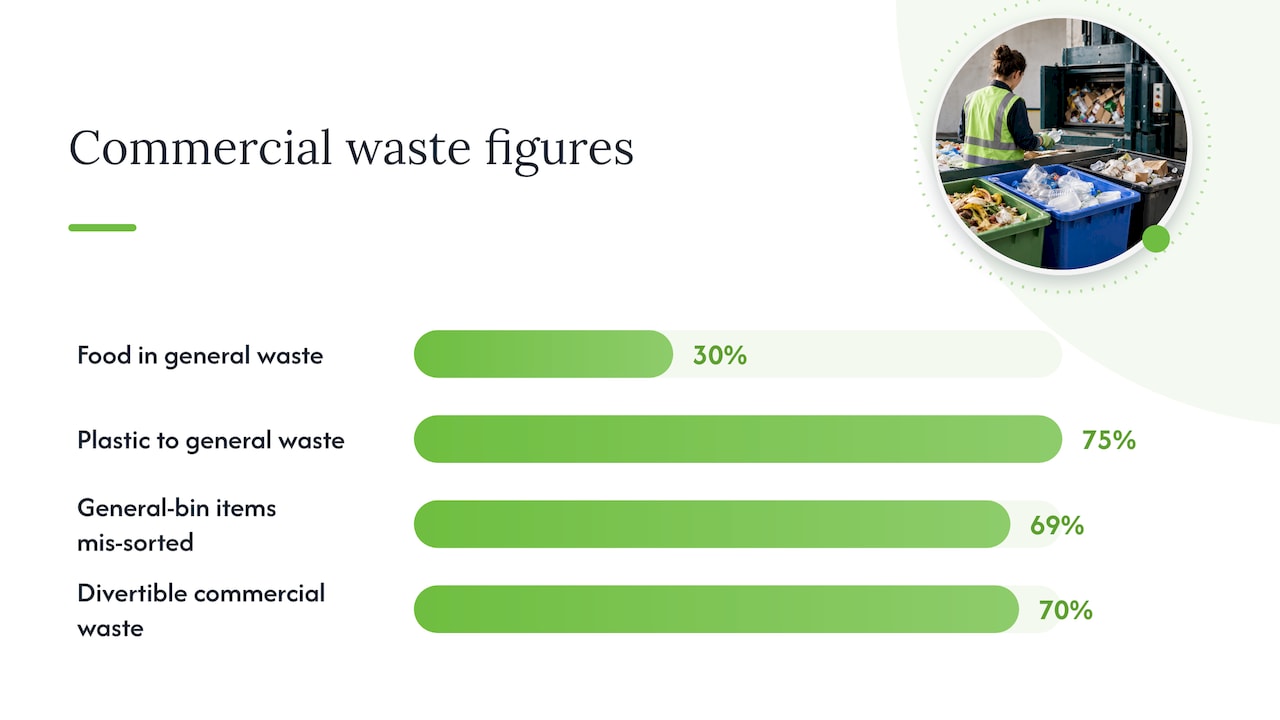
A compactor is only as good as the stream you feed it. The EPA found that food waste is the most common material in commercial general waste bins at 30%, that 75% of commercial plastic goes into general waste and that 69% of the items in general waste bins should have gone to recycling, organic or civic amenity streams. Compacting that mix into one container locks in the problem: you pay the general waste rate for material that could earn money or cost less.
The Department of Climate, Energy and the Environment cites a 2018 EPA study showing that 70% of the average commercial waste bin could be diverted to recycling. The practical rule is one compactor per clean stream:
- Cardboard and clean paper into a cardboard compactor or baler, kept free of food and liquid.
- Plastic film and soft plastics baled separately where volumes justify it.
- Food waste out of the general bin altogether, using a bio-waste bin or an on-site machine.
- Residual waste compacted last, once the other streams are out.
Clean, dry material also commands a better price. Contamination is what turns a sellable bale into a disposal cost. If your sustainability reporting needs the carbon effect of these changes, a guide to waste emissions calculation explains how waste is converted into emissions figures.
Where we come in
We handle the route from audit to equipment to recycling and payment for Irish businesses. The free waste audit measures your streams, and we then supply the cardboard compactor, baler, bin press or other machine that fits. Where the material is baled cardboard or plastic, our bale buyback scheme pays you for it, aiming to maximise the market rebate you receive.
If you are comparing options for a site now, send us your waste details through our landing page or start with the audit, and we will tell you which machine and which stream arrangement fit. For a first look at your options, see our page on cardboard balers and waste compactors in Ireland.
Our view on compactors
Most businesses ask us about a compactor when the bins have already overflowed. The machine is rarely the real question. The real question is what is in the bins and where it could go instead.
We see waste as an asset that has been filed under cost. Cardboard and plastic that reach a baler clean are a product with a buyer. The same material crushed into a mixed skip is a collection charge. So we begin with an audit, weigh what you produce, and then pick equipment that fits the waste, the space and the collector.
Our aim is a single point of service: the audit, the machine, the collection and the payment for your bales, handled by one team. That way no one has to coordinate a supplier, a haulier and a buyer who each see only part of the picture.
If you are about to buy a compactor, get the weights first. Everything else follows from them.
Graham
FAQ
How much waste volume does a commercial compactor save?
It depends on the material. In the Dublin pilot, each compactor crushes bags to between a quarter and a third of their original size, according to the Irish Independent. Light dry cardboard compresses well, while wet or dense waste compresses less. A waste audit gives you a realistic ratio for your own mix.
Do I need a compactor or a baler?
Choose a compactor when the aim is fewer lifts of general or mixed dry waste. Choose a baler when you generate steady volumes of clean cardboard or plastic and want to sell the bales. Many sites use a bin press for general waste and a baler for cardboard. Our audit shows which combination fits.
Can I put food waste in a compactor?
Food waste should be kept out of your general waste compactor. Irish regulations require a separate bio-waste bin for commercial customers, and food is the biggest single item in commercial general waste according to the EPA. For on-site treatment, an organic waste composting machine is the better fit.
Who can operate a compactor safely?
Only trained staff should use it. The HSA guidance calls for isolating power before cleaning or maintenance, working guards and safety switches, gloves, and no loose clothing near the machine. Give every operator a short induction and keep the manual with the unit.
Is a refurbished compactor a sensible choice?
For many sites it is. We supply refurbished compactors and balers, which suit lower budgets or shorter-term needs. Ask us about the right size for your waste and we will advise from the audit results.
Sources
- Waterford City and County Council compactor tender, etenders.gov.ie
- Kerry County Council compactor hire framework, etenders.gov.ie
- RTE: Dublin firms reporting difficulties over waste collection
- Irish Independent: Waste compactors installed in Dublin’s north inner city
- HSA: Safe Hospitality, machinery and equipment in larger premises
- HSA: Guide to the General Application Regulations 2007, work equipment
- gov.ie: Incentivised waste collection charges for the commercial sector
- Waste Management Act 1996, Law Reform Commission
- EPA: urgent action on household and commercial waste segregation
- Waste emissions calculation guide