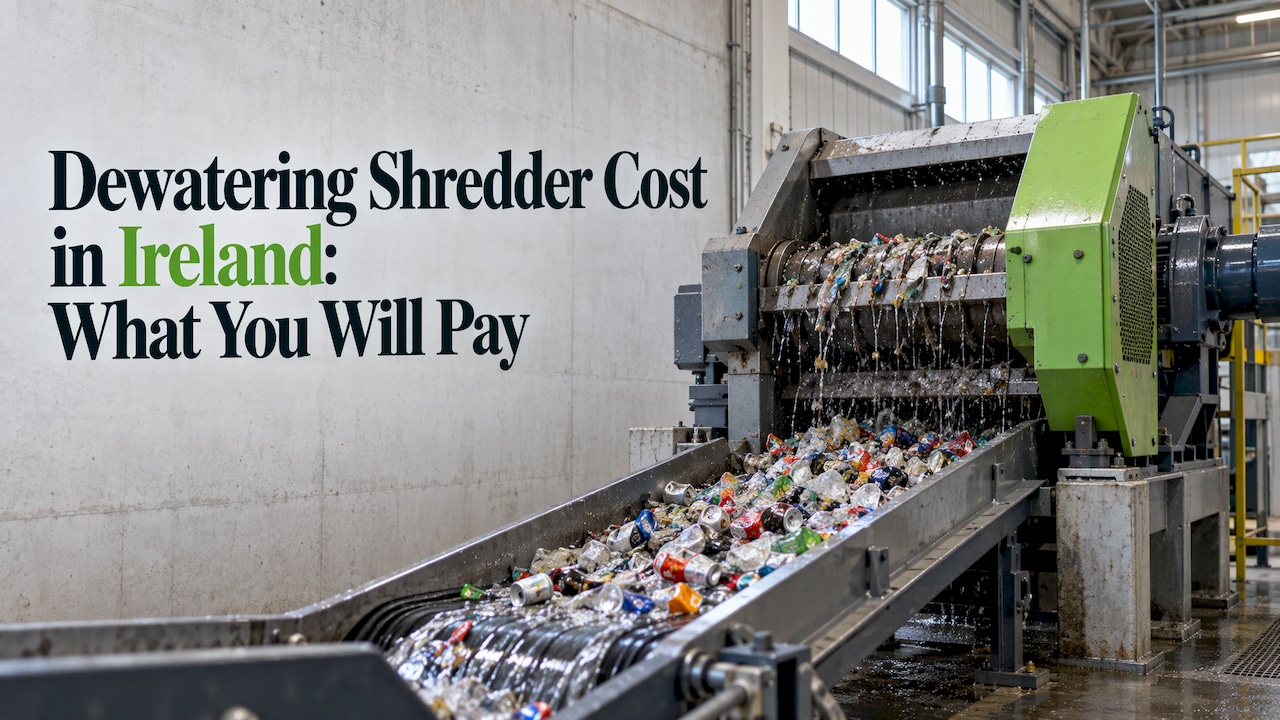
There is no single price for a dewatering shredder. The cost depends on what you feed it, how many tonnes you process and how much site work it needs. A compact unit for beverage or packaging waste sits in a very different bracket from a heavy-duty diesel shredder, which can run to six figures. The sensible way to budget is to price the whole installation and its running costs against what you pay now for wet waste to be hauled away. We do not publish list prices for our machines, so this guide shows you how to build that budget and what to ask for in a quote.
TL;DR
- Dewatering shredder prices vary with waste type, throughput, power and site works, so a fixed “typical price” is misleading.
- Large Irish public tenders and used-machine listings show shredders in the tens or hundreds of thousands of euro, but those are mostly heavy-duty, high-tonnage machines.
- Budget for the whole project: installation, conveyors, training, maintenance, energy and downtime, not just the machine.
- The payback comes from removing water weight, which cuts haulage and disposal charges, so your current waste bills are the best starting point.
- A free waste audit gives you the tonnage and cost data needed for an accurate quote.
Table of Contents
- What a dewatering shredder does, and why it affects the price
- The main factors that move the price
- What price signals exist in Ireland
- Costs beyond the machine
- How to estimate running costs
- A worked example of where the savings come from
- When owning makes financial sense
- Perspective
- Get a costed recommendation
- FAQ
- Sources
What a dewatering shredder does, and why it affects the price
A dewatering shredder reduces the size of wet waste and then squeezes out the liquid. Food waste, packaging scrap, pulped materials and contaminated solids are typical feeds. Removing the liquid cuts the weight you pay to move and dispose of, which is why dewatering systems are sold on lower hauling and disposal costs.
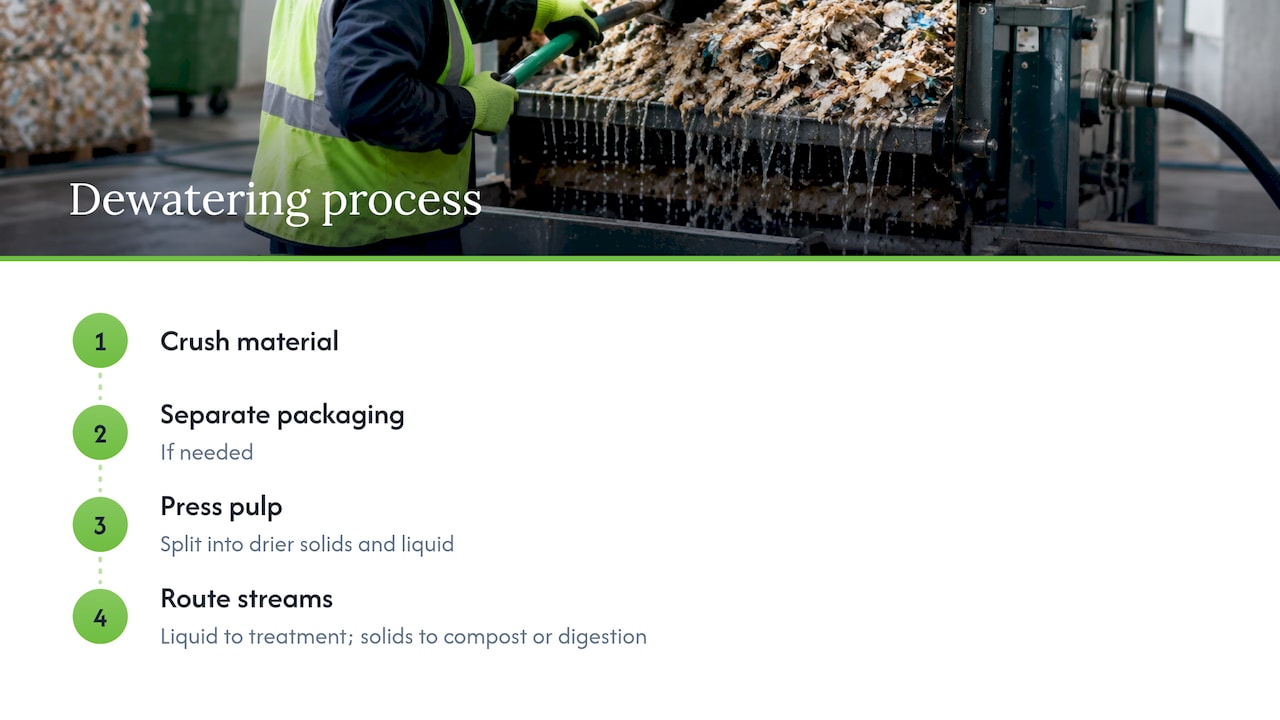
In practice, the process is usually a chain. The material is crushed, packaging is separated if needed, a screw press splits the pulp into drier solids and liquid, and each stream goes on its own way. One example describes shredding, de-packaging, pressing, then liquid to treatment and solids to compost or digestion. A machine that does only one of those steps costs less than a fully integrated line, so the first question in any quote is how many steps you actually need.
The waste type matters just as much. Matching the shredder to the waste helps meet footprint, throughput and particle-size requirements. Fibrous kitchen waste, plastic fines and bottled drinks all load a machine differently, and the build has to reflect that.
If you want the technical background before you talk to a supplier, our guide to industrial shredder dewatering machines covers how they work, and our page on where dewatering shredders pay off in Irish businesses shows the sectors that benefit most.
The main factors that move the price
Five things do most of the work in setting the quote.
Throughput
Output is quoted in tonnes per hour, and the range is wide. One screw press with crusher is rated at 2 to 10 tonnes per hour, while a large mobile shredder is documented at around 40 tonnes per hour. Buying more capacity than your site produces is the commonest way to overspend. Size it to your real tonnage, with sensible headroom for growth.
Power and drive
Motor or engine size shapes both purchase price and running cost. An Irish public tender for a slow-speed shredder asked for a minimum of 340 kW, a diesel tank of at least 730 litres and operation from -10°C to +37°C. That is specialist outdoor plant. A fixed, mains-powered unit in a food or drinks facility is a different class of purchase.
Particle size and the number of shafts
A finer output and tougher material both push you towards stronger shafts, more torque and sometimes a second or fourth shaft. A low-speed, high-torque shredder can give 10 to 15 mm output ready for dewatering. Ask what output size your downstream process or collector actually needs, because specifying finer than necessary adds cost.
Materials of construction and contamination
Wet, acidic or abrasive waste calls for suitable wear parts and corrosion resistance. Say plainly what is in the stream: glass, metal fragments, plastics or labels all change the specification.
New or refurbished
Refurbished equipment can bring the entry price down for the right duty. We supply refurbished compactors and balers, and the same logic of buying proven kit sized correctly applies when you compare options for shredding and dewatering.
What price signals exist in Ireland
Published figures for dewatering shredders are scarce, so use them as orientation rather than as a quote.
| Price signal | Figure | What it tells you |
|---|---|---|
| Irish public tender, slow-speed single-shaft diesel shredder with delivery, training and warranty | Estimated contract value of €600,000 excluding VAT | Heavy-duty mobile composting plant, with support and warranty bundled in |
| Used single-shaft shredder, like new, 706 operating hours | €50,000 | Second-hand shredders can sit well below new prices, but condition and hours matter |
| Used two-shaft shredder, 17,000 operating hours | €182,500 | Large two-shaft machines hold high prices even with heavy use |
Two cautions apply. These are all shredders for bulk material rather than a like-for-like dewatering line for a restaurant group or drinks packer, and a price tells you little without the hours, condition and what is included. A tender value also covers delivery, training and warranty, not only the machine. Smaller on-site dewatering units for packaging or beverage waste are priced to the application, which is why we quote after we understand your waste.
A useful reference point for the smaller end is our Beverage Dewatering C350 and Beverage Dewatering C900 pages, which describe the dewatering models we supply for drinks packaging.
Costs beyond the machine
The invoice for the machine is the visible part. A realistic budget adds the following.
Installation and site works. Commissioning, electrical supply, hardstanding or a pit, drainage for the liquid stream and any conveyor feeding the hopper. Depending on the project, guards, enclosures or magnetic separation may also be needed.
Training and compliance. The Irish tender above required the supplier to provide staff training, operational support and compliance with environmental and safety rules. Whatever your scale, make sure your operators are trained and your risk assessment covers the machine.
Energy. Drive power is the largest running item. Energy use varies by dewatering technology, so ask each supplier for the kWh per tonne on your waste, not a brochure figure.
Wear parts and maintenance. Cutters, screens and screws wear, and abrasive waste speeds that up. Ask for a recommended parts list and a service plan with prices.
Labour and downtime. Someone feeds, monitors and cleans the machine. If it stops, waste still arrives, so check how quickly service and spares reach your site.
Residual disposal. Dewatered solids and separated liquid still need a route. Confirm where each goes and what that costs, including any sewer discharge consent for liquids.
How to estimate running costs
Use a simple total cost of ownership model across several years rather than comparing sticker prices.
- Measure your waste. Record tonnes per week, how wet it is and how many collections you pay for. Our waste audit checklist shows what to record.
- Price the current route. Add collection, gate fees, bin rental and any surcharges for wet or heavy loads.
- Add the machine and installation. Spread this cost over the years you expect to use it.
- Add running costs. Energy, wear parts, servicing, labour and residual disposal, per tonne processed.
- Compare per tonne. Divide everything by annual tonnes, and test the result with a cautious figure for machine availability.
A manager comparing technologies should also remember that financial results can be close. A US solids-handling evaluation found that life-cycle costs of different dewatering technologies can be comparable, so factors like odour, building fit and how dry the output is can decide the choice.
A worked example of where the savings come from
The saving rests on water. In a plastics recycling case study, fines leaving the process held 70 to 80% water, and dewatering brought that down to 15 to 30%. Those figures are one operator’s result, not a promise for another site, but the principle holds across wet streams: you stop paying to transport and dispose of liquid.
Here is the arithmetic with illustrative numbers, not our prices. If a site sends 100 tonnes of wet waste a year and a dewatering process removes a large share of its weight, every tonne removed is a tonne you no longer pay haulage and gate fees on. Multiply your own tonnage by your own per-tonne rate to see the annual saving, then compare it with the annual cost of owning the machine from the model above.
If plastics are part of your stream, the same logic applies to material that ends up back in manufacturing. This overview of PCR plastics and scrap reduction shows how recycled content is being used in moulded products, which is the market clean, dewatered plastic feeds.

When owning makes financial sense
Owning a machine tends to make sense when waste is wet, arrives steadily and costs a lot to move. Rising disposal charges strengthen that case: a market analysis notes that as landfill taxes and separate collection fees rise, the economic case for on-site processing becomes more compelling.
The signs that you are a good candidate:
- You pay for frequent collections of heavy, wet loads.
- Your waste is predictable in volume and type.
- You have floor space, power and drainage near where waste arises.
- You want cleaner, drier material that a recycler or compost operator will take more readily.
- Your sustainability reporting rewards lower tonnage to disposal.
Our page on dewatering shredder benefits for Irish businesses goes through these in more detail.
Perspective
Most buyers ask us for a price before we know what they throw away. We understand why, but the machine is only half the sum. The other half is what your waste currently costs you.
That is why we start with the audit. We weigh and map what you produce, work out what you pay to move it, and only then recommend equipment. Sometimes that is a dewatering shredder. Sometimes it is a baler or compactor for dry cardboard and plastic, where our bale buyback turns the output into income. Because we supply the equipment and handle the recycling and payment, one plan covers the lot.
Our advice: size the machine to the tonnage you have, not the tonnage you hope for, ask for per-tonne running costs in writing, and judge the project on total cost over several years. That is how a dewatering shredder earns its place on a site.
Graham
Get a costed recommendation
We supply industrial dewatering shredders for Irish businesses, and every project begins with a free waste audit. You get a clear view of your tonnage, your current costs and the equipment that fits, so the quote you receive matches your site.
If part of your waste is dry cardboard or plastic, ask about our bale buyback scheme, which pays you for the baled material.
FAQ
How much does a dewatering shredder cost in Ireland?
It depends on throughput, power, materials and what is included. Published Irish figures range from tens of thousands of euro for used shredders to a €600,000 estimated contract value for a heavy-duty diesel unit with delivery and support. For a quote matched to your waste, start with a free audit.
Is a dewatering shredder worth it for a small business?
It can be when your waste is wet, heavy and collected often, because removing water cuts the weight you pay to haul and dispose of. Smaller units exist for packaging and beverage waste. Work out your annual wet tonnage and current cost per tonne first.
What running costs should I allow for?
Allow for energy, wear parts, servicing, operator time, downtime and the disposal of the dewatered solids and liquid. Compare suppliers on running cost per tonne processed, and spread the machine and installation cost across the years you expect to use it.
Can I buy a refurbished machine instead of a new one?
For many dry-waste duties, yes, and we supply refurbished compactors and balers. For dewatering shredders, tell us your waste and tonnage and we will advise which option suits your site.
Sources
- Industrial Waste Recycling Equipment for Mixed Waste
- Food, Organic and Kitchen Waste Shredding and Dewatering System
- Waste Shredding and Dewatering Systems
- Dewatering Screw Press With Crusher
- Doppstadt DW 3060 product page
- Irish eTenders notice: slow-speed single-shaft shredder
- Used shredders listing, Machineseeker Ireland
- Technical Memorandum 12: Solids Screening, Thickening and Dewatering
- Shredding and dewatering at a plastics recycler
- Food Waste Recycling Machine Market in the European Union
- Eco Friendly Plastics: Start PCR at 15%