
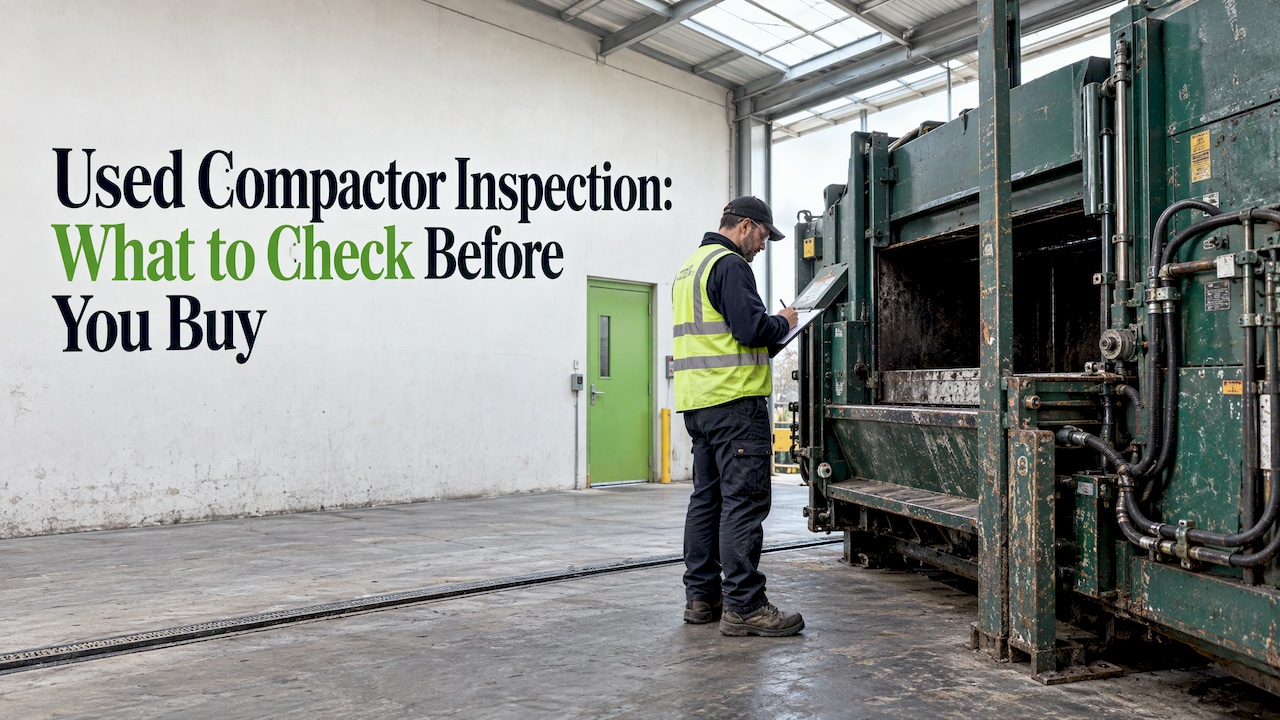
Inspect a used compactor in three passes: the paperwork, a static check of structure, hydraulics, electrics and guarding, and a powered test of the controls and safety switches. If any guard is broken or missing, or any safety switch fails, the machine does not go into service until it has been repaired and rechecked. The rest of this guide shows what to look at, in what order, and what a failed check means for your site in Ireland.
TL;DR
- Start with the records: service history, inspection reports and any repair notes tell you how the machine has been treated before you touch it.
- Check the static condition first: structure, door seals, hinges, bolts, hydraulic hoses, cylinders and electrical cables, with the power isolated.
- Then test under power: stop buttons, door interlocks and safety switches must all work, every time.
- In Ireland, a broken or missing guard or a faulty safety switch means the compactor stays out of use until it is repaired.
- Specialist hydraulic and electrical work belongs to a competent person, not the operator.
Table of Contents
- Why a used compactor deserves a structured inspection
- Step 1: Review the records before you view the machine
- Step 2: Static inspection with the power isolated
- Step 3: Guards, interlocks and safety switches
- Step 4: The powered test
- Red flags: when a used compactor should not be operated
- Who should do the specialist checks
- Document what you find
- Our perspective
- Match the machine to the job before you inspect it
- Use a general inspection checklist as your template
- Refurbished compactors and balers from Compact
- FAQ
- Sources
Why a used compactor deserves a structured inspection
A compactor is a machine that applies several tonnes of force in a confined chamber, often next to a loading bay where staff, drivers and contractors pass all day. A second-hand unit can be an excellent buy. It can also arrive with worn guide shoes, weeping hoses or a door switch that someone bypassed years ago. You cannot tell which from the paint.
Under the Safety, Health and Welfare at Work Act 2005, employers must ensure, so far as is reasonably practicable, that the plant and machinery they provide is safe and maintained. Buying used does not change that duty. The moment the unit is on your premises, its condition is your responsibility, so the inspection is part of the purchase, not an afterthought.
A good inspection also protects your budget. Defects found before delivery are a negotiation or a repair quote. Defects found after commissioning are downtime, a callout and sometimes an incident report. If you are still working out which type of machine you need, our compactor size guide covers the inputs that set capacity, and it is worth settling that before you start viewing units.

Step 1: Review the records before you view the machine
Paperwork shows you what the machine has been through. Ask the seller for the following before you travel:
- Service and maintenance history, with dates and who carried out the work.
- Any thorough examination or inspection reports.
- Records of repairs, especially to hydraulics, electrics and safety devices.
- The operator manual for the exact model, and the make, model and serial number so you can match it.
- Any notes on what material the unit has handled and where it was installed.
Why this matters in practice: Irish waste regulators expect proper record keeping on waste handling equipment. One Irish waste facility permit, for example, requires a register of all inspections and maintenance work, plus a maintenance schedule and a record of maintenance for all waste handling and processing equipment, available to the council on request. That permit applies to a specific facility, but the habit it describes is the right benchmark. A machine with a clean, dated trail of maintenance is easier to trust and easier to plan around.
Gaps are information too. A unit with no history at all is not automatically a bad unit, but it means your own inspection has to do all of the work, and you should treat the hydraulic and electrical checks below as essential rather than optional.
Step 2: Static inspection with the power isolated
Walk round the machine slowly before anyone switches it on. Isolate the power first, and if you are viewing it on the seller’s site, ask them to confirm the isolation rather than assuming it. The manufacturer’s guidance for balers and compactors follows the same logic: a general walk-round, then doors opened to inspect the chamber. The RAM-PACK operator manual sets out a daily general inspection and an oil leak check, with further monthly checks on hinges, fixings and hoses. The same pattern works well for a purchase inspection.
Structure and chamber
- Body and frame: look for cracks, distorted panels, repaired welds and heavy corrosion, particularly at the base and around the door frames.
- Compaction plate or ram: check for scoring, bending or damage at the edges, and for signs the plate has been hitting something it should not.
- Guide shoes, rails and wear pads: uneven wear or play suggests the ram is not tracking squarely, which loads the cylinders and the structure.
- Chamber interior: open the doors and inspect the walls and floor. Dents and tears show what has been forced through it.
- Door hinges and seals: the doors should close squarely and seal well. A door that sags or leaks is a sign of wear and a nuisance with liquid waste.
- Fixings: nuts and bolts joining the plate to the hydraulic rams, and the bolts anchoring the unit to its base, should be tight and complete. Missing or loose parts are a stop sign, not a note for later.
- Stability: the machine must stand firmly on a level surface. Ask where it will be installed and whether the base is suitable.
Hydraulic system
Hydraulics are where used compactors most often cost money, so spend time here.
- Check the reservoir oil level and the oil’s appearance. Very dark, milky or foamy oil points to contamination or poor maintenance.
- Look at every external hose for chafing, cracking, bulges and weeping fittings. Look under the machine and at the floor beneath it for oil staining.
- Inspect the cylinders and their connections for leaks, and the rods for scoring or pitting.
- Where you can, look at internal hoses for rubbing and wear.
- Check the pressure gauge and sight glass, if fitted, are intact and readable.
The manufacturer guidance is blunt on leaks: the RAM-PACK manual says never to operate the machine where there are oil leaks, damaged hydraulic hoses or loose, damaged or missing parts, and to take it out of service immediately if any of these occur. Treat a visible leak on a used unit the same way, and have it put right before commissioning rather than monitoring it.
Electrical system
- Inspect cables and glands for cuts, crushed sections, taped repairs and exposed conductors.
- Open the control panel if the seller allows it and look for corrosion, loose terminals, burn marks or amateur wiring.
- Check that plugs and sockets are the correct type for the machine. The RAM-PACK manual lists missing correct plugs and sockets among the reasons not to operate the unit.
- Check the stop buttons, indicator lights and any timer or key switch for physical damage.
Do not open or work inside live electrical or hydraulic systems yourself. Visual checks are for operators. Fault finding and repair are for a competent person, covered below.
Step 3: Guards, interlocks and safety switches
This is the part of the inspection that decides whether the unit can be used at all. The Health and Safety Authority (HSA) guidance for larger premises is direct about compactors: do not use the compactor if the guard is broken or not fitted, or if the safety switches do not work or cannot be safely operated. Controls or safety devices that are not working properly must be reported to the supervisor straight away.
In practice, check these points:
- Guards present and complete. Every guard the design calls for is fitted, undamaged and secured. Anything fixed with makeshift fasteners or held by tape is a defect.
- Door interlocks. The machine must not cycle when the loading door is open, and opening the door mid-cycle must stop it. Test this several times, not once.
- Stop buttons. Each emergency or stop control must halt the machine at once and need a deliberate reset.
- Switch and valve contact. The door contact with its safety valves and switches should be properly aligned, so a door that is shut actually registers as shut.
- No bypasses. Look for jumper wires, taped switches, magnets or bolts used to defeat an interlock. These are common on machines that have been used hard, and they are a reason to stop the inspection and rectify before any use.
The HSA’s separate guidance on machinery guarding says guards should be visually examined and any broken or missing guards repaired or replaced, and that interlock mechanisms should be checked and tested to ensure they work, with broken ones repaired or replaced. Apply that to your used unit on day one, and again on a regular schedule afterwards. Our own compactor safety guide for Irish employers goes further into guarding, isolation and operator practice.
Step 4: The powered test
Only once the static checks and the guarding checks pass should the machine be run, and only by someone trained on it. Ask the seller to run it with you present.
- Run several empty cycles. Listen for unusual pump noise, knocking, or hesitation at the top or bottom of the stroke.
- Watch the ram. It should travel smoothly and squarely without jerking or drifting.
- Check for leaks again while the system is under pressure. Hoses that look fine at rest can weep once pressurised.
- Check the gauge reading against the manual’s working pressure, where a gauge is fitted.
- Test the stop buttons, interlocks, timers and lights again under power.
- Confirm the machine returns to its rest position and holds there.
If you plan to load it with real material for the test, agree that with the seller first, and keep everyone clear of the loading area while it cycles.
Red flags: when a used compactor should not be operated
Some findings are not negotiation points. They mean the machine stays switched off until repaired and rechecked. The manufacturer’s manual and the HSA guidance agree on the main ones:
| Finding | Why it stops the machine |
|---|---|
| Broken or missing guard | Exposes people to moving parts; HSA says do not use |
| Safety switch that fails or cannot be operated safely | The machine can cycle when it should not |
| Broken or bypassed interlock | Door can be open during compaction |
| Damaged electrical cables or components | Shock and fire risk, unpredictable controls |
| Damaged hydraulic hoses or oil leaks | Loss of pressure, slip hazard, hose failure under load |
| Loose, damaged or missing parts | Structural and mechanical failure under load |
| Unstable machine or soft, uneven base | The unit can move or distort when it cycles |
| Wrong plugs or sockets | Improvised connections create an electrical hazard |
If you find any of these on a unit you are buying, the sensible sequence is to record the finding with photos, ask for the repair to be completed and documented, and reinspect before accepting delivery. Do not accept the machine on the promise that it will be fixed on site later.
Who should do the specialist checks
Operators can do visual and functional checks: walk-round, leaks, guards, stop buttons. Anything involving the inside of electrical panels, hydraulic pressure settings, pumps and valves should go to someone with the right training and experience. In Irish workplace safety language that is a competent person.
The HSA’s consultation on persons carrying out statutory examinations makes the employer’s side clear. The employer engaging an inspector should make reasonable enquiries that the provider is suitable, and records of training, experience and knowledge can show competence. So when you book an engineer to check a used compactor, ask about their experience with this type of equipment and keep the paperwork they give you.
A practical split looks like this:
| Task | Operator | Competent person |
|---|---|---|
| Daily walk-round, leak spotting | Yes | |
| Stop button and door interlock function test | Yes | Yes |
| Guard condition, visual | Yes | Yes |
| Hydraulic pressure and relief valve settings | Yes | |
| Electrical panel, wiring and switch repair | Yes | |
| Pump, motor and cylinder repair | Yes | |
| Written inspection report for your file | Yes |
Document what you find
Write the inspection down on the day. A one-page record with the make, model and serial number, the date, who inspected, what was found, what was repaired and what remains open becomes the first entry in the machine’s history on your site. Keep it alongside risk assessments, training records and the operator manual.
Then build the maintenance plan from it. A sensible plan separates checks by frequency:
- Daily, by the operator: walk-round, leak check, guards in place, stop button works.
- Monthly: hydraulic oil level, hoses, door hinges and seals, fixings, switch contact, cables.
- Periodic, by a competent person: hydraulic and electrical testing, pressure checks, structural inspection and safety system verification, at the interval the manufacturer and your risk assessment set.
The manufacturer’s manual for your model sets the intervals that apply. Use it as the baseline and let your risk assessment tighten it where the machine works hard, for example in a high-volume distribution site compared with a small retail unit.
Our perspective
We see the same pattern on Irish sites again and again. A business buys a compactor or baler on price alone, then discovers that the real cost was in the condition: a tired hydraulic circuit, a door switch nobody trusts, no paperwork to say what has been done.
Our view is that a used machine is only as good as the inspection behind it and the support around it. That is why we treat refurbished compactors and balers as a proper product, with the same attention to guarding, safety devices and hydraulics that you would expect on a new unit, and why we start with your waste rather than with the machine.
A free waste audit tells us how much material you generate, what it is, and how it is handled today. From there the right machine, new or refurbished, and the right size becomes obvious, and so does the inspection list that goes with it. If you generate clean cardboard or plastic, a baler can also turn that stream into income through our bale buyback scheme.
Whatever route you take, insist on the records, test the safety devices, and put the first inspection on file.
Graham
Match the machine to the job before you inspect it
Inspecting a sound machine that is the wrong size or type still leaves you with a problem. Before you view anything, be clear on what you will put in it. Dry cardboard and plastic suit a baler, which produces tied bales you can sell. Mixed general waste and bulky items point to a compactor. Wet or food-heavy waste needs different handling again.
Our pages on cardboard compactors, cardboard balers and the hydraulic waste compactor explain how each type works, so you know what a healthy example should look like when you stand in front of one.
If the unit will be used by several staff or shifts, think about training at the same time. Before anyone operates it, they should know where the stop controls are, what the guards are for, and that a faulty safety device is reported at once, not worked around.
Use a general inspection checklist as your template
A written checklist stops you forgetting items when a seller is chatting and the clock is running. Any good pre-use equipment inspection checklist and warning signs guide shows how to turn a walk-round into a repeatable routine with pass, fail and action columns. Adapt that approach to a compactor by building the sections above into your own form: records, structure, hydraulics, electrics, guards and interlocks, powered test, and a sign-off line for the person who inspected.
Keep the completed form. It is your evidence that the machine was checked on the day it arrived, and it makes the next inspection quicker because you can compare like with like.
Refurbished compactors and balers from Compact
If you would rather start from a machine that has already been through a workshop, we supply refurbished compactors and balers alongside new equipment, and we can help you choose the right unit after a free waste audit. You can see the full range on compact.ie.

We handle the whole chain: the audit, the equipment, collection and recycling. For businesses producing baled cardboard or plastic, our bale buyback scheme turns a disposal cost into a payment. Contact us with your waste volumes and your site layout and we will point you to the right machine.
FAQ
How long does a used compactor inspection take?
A records review and a careful static and powered check of a single unit usually takes a couple of hours, depending on its size and how much paperwork there is. Specialist testing of hydraulic pressures and electrical systems by a competent person takes longer and should be booked separately. Do not rush the guarding and interlock tests, since those decide whether the machine can be used.
Can I inspect a used compactor myself?
Yes, for the visual and functional checks: structure, leaks, hoses, cables, guards, stop buttons and door interlocks. Work inside electrical panels or on hydraulic pressure settings should go to a competent person with the right training and experience. Keep a written record of what you checked either way.
What is the most serious defect to look for?
A broken or missing guard, or a safety switch that does not work or cannot be operated safely. The HSA says not to use the compactor in either case. Next on the list are oil leaks, damaged hydraulic hoses and damaged electrical cables, all of which mean taking the machine out of service until it is repaired.
What documents should come with a used compactor?
Ask for the operator manual, the service and maintenance history, any inspection or examination reports, and repair records, especially for safety devices, hydraulics and electrics. Note the make, model and serial number so the documents match the machine in front of you. Start your own file from the day it arrives.
How often should a compactor be inspected after purchase?
Operators should do a quick walk-round and leak check each day of use, with a fuller monthly check of hoses, oil level, hinges, fixings and switches. A competent person should then carry out periodic examinations at the interval the manufacturer’s manual and your risk assessment set.
Sources
- Safe Hospitality Part 6: machinery and equipment in larger premises, HSA
- Safe Hospitality Part 2, HSA
- Safety, Health and Welfare at Work Act 2005, Irish Statute Book
- RAM-PACK 400, 500 and 600 operator manual
- Waste facility permit WFP-WH-2022-0002-00
- HSA consultation paper on persons examining equipment
- Pre-use equipment inspection checklist and warning signs