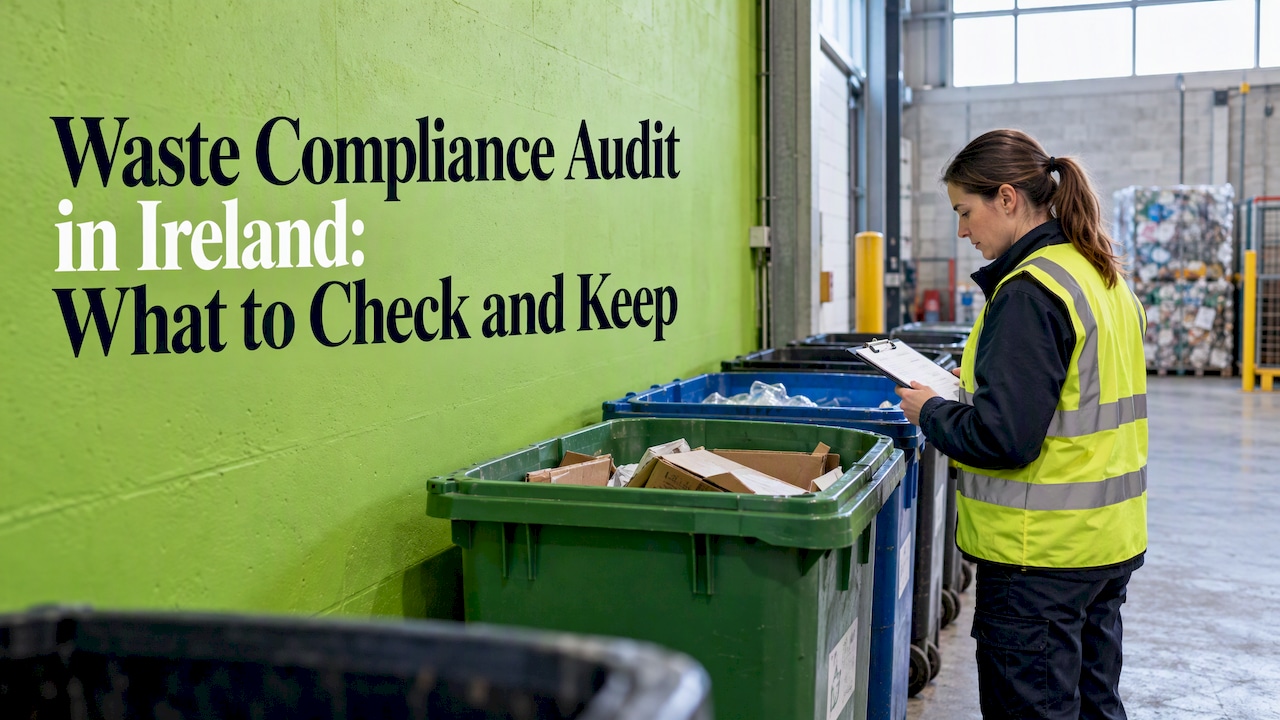
A waste compliance audit is a structured check that your business handles its waste the way Irish law expects: the right contractor, the right paperwork, the right segregation and records you can produce on request. Done well, it also shows you what your waste costs and where it can be reduced. This guide sets out the duties that apply, a practical way to run the audit yourself, the evidence to keep and what to do with the findings.
TL;DR
- Under Irish law the waste producer carries primary responsibility for waste, including removal and disposal costs, so your audit must prove where every stream goes.
- Check four things: your collector or facility is authorised, your waste movement documents are complete, your streams are segregated, and your records are retained.
- Start with a desktop review of bills and dockets, then walk the site and compare what you find with what you pay for.
- Use the results to cut cost: cleaner segregation, fewer collections and recyclables sold as bales instead of paid for as waste.
- If you want a second pair of eyes, our free waste audit is a practical place to start.
Table of Contents
- What a waste compliance audit actually covers
- The Irish duties your audit should test against
- How the EPA checks compliance, and what that tells you
- How to run your own waste compliance audit
- Records and evidence to keep
- Turning audit findings into lower costs
- Where Compact fits
- Our view: audit first, then buy equipment
- FAQ
- Sources
What a waste compliance audit actually covers
A compliance audit asks one question: can you show that your waste is managed lawfully from the moment it is produced to the moment it is recycled or disposed of? It is different from a general waste audit, which measures what you throw away and why. In practice the two overlap, and the best exercise does both in one pass. If you want the measurement side in detail, our waste audit checklist for managers walks through weighing and recording each stream.
A useful compliance audit covers five areas:
- Who takes your waste. Is each collector or facility authorised for the waste types they handle?
- What you can prove. Do you hold dockets, weighbridge tickets, certificates and returns for each stream?
- How you separate waste. Are food, dry recyclables, glass, hazardous items and general waste kept apart where you generate them?
- What obligations are specific to your sector. Retail, manufacturing, food and packaging businesses each carry extra duties.
- How you reduce waste. The law expects effort at prevention, not only tidy disposal.
The Irish duties your audit should test against
You do not need to be a lawyer to audit against these. You need to know which duties exist and be able to point to evidence for each.
You are responsible for your waste
The Department of Climate, Energy and the Environment states that primary responsibility for managing waste, including removal and disposal costs, lies with the waste producer or the person in possession of it. Handing waste to a contractor does not end that responsibility. It is why your audit should follow the waste beyond your gate.
Use authorised collectors and facilities
Businesses must dispose of waste through an authorised waste collection provider or take it to an authorised waste facility. Waste activities themselves need authorisation under the Waste Management Act 1996, and depending on the activity this may be an exemption, a licence, a permit or a certificate of registration. Your audit should record the permit or authorisation of every contractor and the waste codes it covers. Our waste contractor due diligence checklist goes deeper on what to ask for.
Prevention is a legal duty
Section 28 of the Waste Management Act 1996 says anyone carrying on a commercial or industrial activity must have due regard for waste prevention and take reasonable steps to minimise the waste produced. The same section allows regulations that may require businesses to carry out waste audits, run reduction programmes and keep related records. So an audit that also identifies prevention measures is evidence of reasonable steps, not a bonus.
Sector-specific obligations
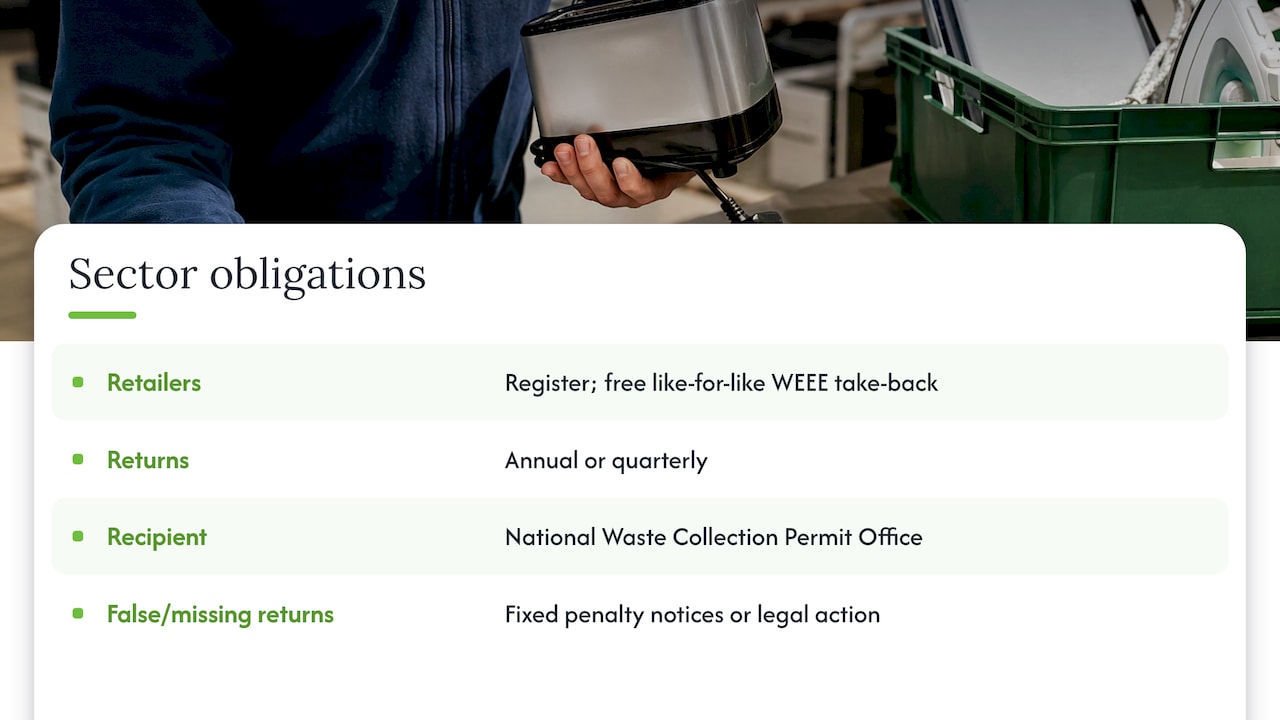
Retailers selling electrical and electronic equipment or automotive and industrial batteries must register with an approved collective compliance scheme or their local authority, and must take back WEEE free of charge when a customer buys a like-for-like item. If you handle packaging or food waste, the rules differ again: see our guides on packaging waste compliance, packaging regulations and food waste regulations.
Waste operators and collectors have their own reporting load. They must submit annual or quarterly returns to the National Waste Collection Permit Office, and false or misleading information or missing returns can lead to fixed penalty notices or other legal action. If you are a producer rather than an operator, this is the reason to ask your contractor how it reports your tonnages.
How the EPA checks compliance, and what that tells you
The EPA does not publish a single audit template for every business, but its approach is a good model for your own. It uses site visits, desk-based assessments, remote compliance assessments and emissions monitoring to check compliance with permit conditions. That mix of paper review and physical inspection is exactly the structure to copy.
Its guidance for self-complying B2B producers of WEEE and batteries is practical. Those audits generally take 1 to 1.5 hours and may include data validation and a tour of the premises. The same guidance advises having a senior manager responsible for legal compliance available and keeping all relevant records, including recycling or destruction certificates and waste movement documents. It also encourages producers to use the visit to raise problems, as inspectors may be able to advise on best practice.
The lesson for any business: a regulator wants to see a named responsible person and documents that match what is on the ground. If you can walk an inspector through both without hunting for paperwork, you are in good shape.
How to run your own waste compliance audit
Allow a half day for a single site, longer for multi-site operations. The sequence below keeps it manageable.
Step 1: Desktop review
Gather twelve months of waste invoices, collection dockets, weighbridge tickets, certificates and any permit copies. A desktop audit means reviewing what your contractors have billed and reported before you look at a single bin. List for each stream:
- the contractor and its permit or authorisation number
- the waste type and, where relevant, its waste code
- collection frequency and bin or container size
- tonnage or lift counts and cost per tonne or per lift
- the destination: recycling, recovery or disposal
Gaps show up quickly. Streams with no dockets, weights that never change month to month, or a contractor with no permit on file are all findings.
Step 2: Walk the site
Now compare paper with reality. MyWaste.ie advises that identifying the quantity and type of waste you produce is the essential first step to seeing what can be prevented, which sits at the top of the waste hierarchy. On the walk, check:
- Are bins labelled and located where waste is created?
- Is food waste separated from dry recyclables, and is recycling kept clean and dry?
- Are hazardous items, batteries and electrical items kept out of general waste?
- Is there cardboard or plastic in the general waste bin that should be baled or recycled?
- Do containers match the collection frequency, or are they collected half empty?
Spot-check a few bins by opening them and photographing the contents. Photos date-stamped on the day are good evidence of the baseline.
Step 3: Close the gap between paper and practice
List every mismatch: a contractor you use but cannot find a permit for, a stream you produce but have no records for, a bin that contains the wrong material. Give each an owner and a date. This action list is the real output of the audit.
Step 4: Repeat on a schedule
A one-off audit decays fast. Staff change, suppliers change and volumes shift. Re-run a short version quarterly and a full one annually, and keep each report so you can show progress.
Records and evidence to keep
There is no single retention period that fits every business, because it depends on your permit status and sector. The examples below come from official sources and show the scale of what regulators expect.
| Record | Why it matters | Retention example |
|---|---|---|
| Waste movement documents and collection dockets | Prove where each load went | Keep with your audit file; the EPA expects them to be available at an audit |
| Recycling or destruction certificates | Prove the end treatment | Keep with movement documents |
| Contractor permits and authorisations | Prove you used an authorised provider | Keep current copies and note renewal dates |
| Environmental management and waste minimisation records (EPA licence holders) | Show ongoing control | At least seven years, with infrastructure and contamination records kept indefinitely |
| Plastic bag stock and supply records (accountable persons) | Required under the 2023 levy regulations | Minimum of four years |
If you do not hold an EPA licence, the seven-year figure is not a legal requirement for you, but it is a sensible benchmark for keeping the core audit file. Check your own permit conditions and sector rules, and ask your compliance adviser if you are unsure which period applies.
Turning audit findings into lower costs
Most audits start as a compliance exercise and finish as a cost review, because the same data answers both questions. MyWaste.ie reports that businesses can use no-cost or low-cost measures to reduce waste costs by as much as 10%, and that monitoring waste, reviewing bills and spot-checking bins help track progress.
The most common fixes the audit points to:
- Segregate more streams. Separating food, mixed recyclables and glass usually shifts material out of the more expensive general waste bin.
- Reduce contamination. Clean, dry recycling is easier to accept and worth more.
- Use returnable packaging and ask suppliers to decant supplies so less packaging arrives in the first place.
- Right-size collections. If bins leave half empty, cut the frequency or the container size.
- Bale what has value. Cardboard and plastic that are baled cleanly can be sold rather than paid for as waste. Our guide to cutting waste disposal costs within one or two billing cycles and the wider piece on how Irish businesses can reduce waste costs show how.
There is a bigger picture too. The EPA describes the circular economy as keeping resources in use for as long as possible and maintaining their value through reuse. For a business, that translates directly into treating clean cardboard and plastic as a material with a price, not a bill.
If you run a plant, the same logic applies at larger scale: see how to run a manufacturing waste audit in Ireland, or the shorter version for offices in our office waste audit guide. For multi-stream sites, facility waste streams explains how to turn reporting into bale value.
Where Compact fits
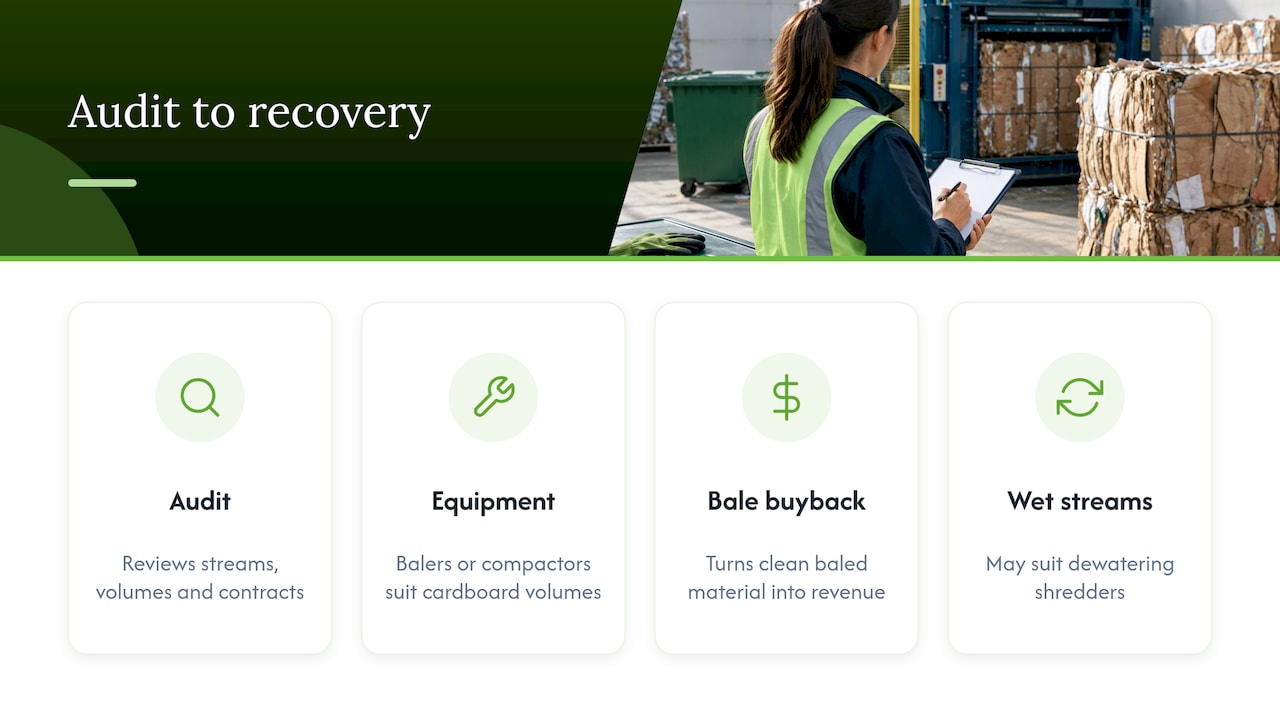
We built our service around one idea: the audit, the equipment and the sale of recyclables should sit with one team. Our free waste audit looks at your specific streams, volumes and contracts, and is designed to help you meet legal and corporate standards while finding cost savings.
If the audit shows a lot of cardboard going into general waste, we can supply cardboard balers or cardboard compactors to suit your volumes, and our bale buyback scheme is designed to turn clean baled material into revenue. Wet or bulky streams may suit dewatering shredders. Our own guide to cardboard bale prices shows what buyers pay.
To see what an audit would find at your site, book a free waste audit and bring your last year of waste invoices.
Our view: audit first, then buy equipment
Most businesses we meet start the conversation with a bin or a machine. We would rather start with the invoices.
A compliance audit gives you something rare in waste management: a complete, honest picture. Once you can see every stream, its weight, its contractor and its cost, the right answer is usually obvious. Sometimes it is simply a better segregation routine. Often it is a baler, because cardboard is the stream where paying to dispose of something that buyers want is hardest to justify.
That is why we offer the audit free and keep the whole chain under one roof: audit, equipment, collection and payment for bales. It means one point of contact and no finger-pointing between a consultant, a machine supplier and a collector. Our aim is to maximise the rebate you receive for the material you already produce.
Keep your audit file current, put a named person in charge, and treat each finding as a cost line you can remove.
Graham
FAQ
Is a waste audit a legal requirement for Irish businesses?
Not as a blanket rule for every business. Section 28 of the Waste Management Act 1996 requires waste prevention and reasonable steps to minimise waste, and it allows regulations that may require audits, reduction programmes and records. Check whether your permit conditions or sector rules impose a specific audit duty, and treat a regular audit as your evidence of reasonable steps.
How long does a waste compliance audit take?
An EPA audit of self-complying WEEE and battery producers generally takes 1 to 1.5 hours. Your own internal audit takes longer the first time, usually a half day for a single site, because you are building the baseline of contractors, permits and records. Later reviews are much quicker.
What documents should I have ready?
Have contractor permits, collection dockets, waste movement documents, recycling or destruction certificates and any returns or registrations your sector requires. The EPA also advises having a senior manager responsible for legal compliance available during an audit.
Can I be held responsible if my contractor does something wrong?
The primary responsibility for managing waste lies with the waste producer or the person in possession of it, so you should verify that each contractor is authorised for the waste you give them and keep proof. Ask a qualified environmental or legal adviser about your specific situation if a problem arises.
Can an audit really reduce my waste costs?
Often, yes. MyWaste.ie reports that no-cost or low-cost measures can reduce waste costs by as much as 10%. Your result depends on your streams and contracts, which is why the audit looks at your actual bills before recommending anything.
Sources
- EPA: What to expect at an EPA audit, guidance for B2B producers
- EPA: Who needs a waste licence
- Department of Climate, Energy and the Environment: Waste Enforcement
- Local Government Ireland: Business and industrial waste
- EPA webinar guidance on annual waste data returns
- Waste Management Act 1996, Section 28
- EPA Environmental Inspection Plan 2026 to 2029
- MyWaste.ie: How to manage your business waste
- EPA: Compliance and performance reporting by licensees
- S.I. No. 698/2023, Circular Economy (Environmental Levy) (Plastic Bag) Regulations
- EPA: Circular economy FAQs