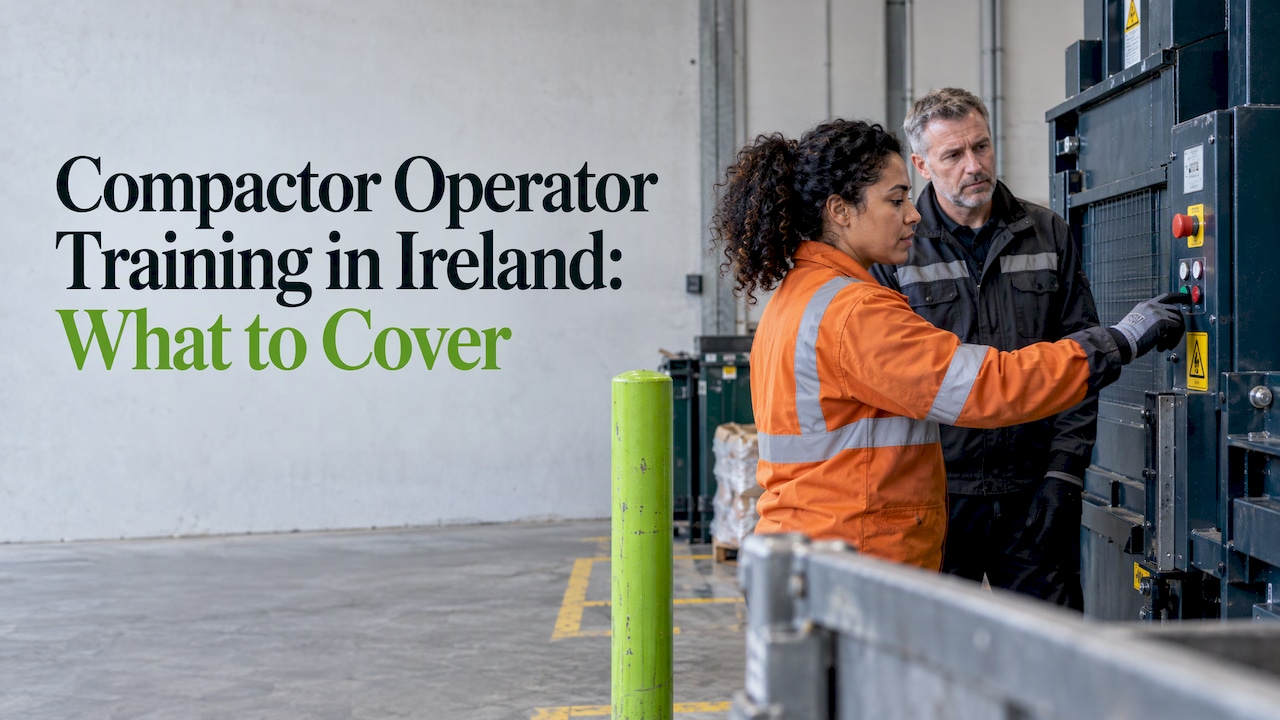
If your staff load a waste compactor or baler, Irish law expects them to be trained for that machine before they use it, and expects you to be able to show it. Good training is short, specific to your equipment and repeated. It covers start-up and shutdown, safe loading, isolation before cleaning, what to do with a jam, and who is allowed to operate the machine. Done well, it also protects the income from your baled cardboard and plastic. This guide sets out what to teach, how to run a toolbox talk and what records to keep.
TL;DR
- Under section 10 of the Safety, Health and Welfare at Work Act 2005, you must train staff on the specific task and repeat the training as appropriate.
- Train on joining, on a change of task and whenever new equipment arrives. Authorise operators by name, in writing.
- Cover start-up and shutdown, loading, jams, isolation before cleaning, guards and bale stacking.
- Keep a record per person: name, content, date and certificate or sign-off.
- Simple, consistent sorting rules, taught once and checked often, cut contamination and disposal costs.
Table of Contents
- What the law asks of you
- Who needs training
- What operator training should cover
- Training is not the same as competence
- Records that stand up to an inspection
- A recycling toolbox talk you can run in ten minutes
- What good training is worth
- Perspective: what we tell facilities managers
- Getting the right machine and the numbers behind it
- FAQ
- Sources
What the law asks of you
The duty sits with the employer. Section 10(1)(b) of the Safety, Health and Welfare at Work Act 2005 requires adequate safety, health and welfare training, given during working time and without loss of pay. That training must include instruction on the specific task and on emergency measures. Section 10(3) names the moments when training is due: on recruitment, on a transfer or change of task, when new work equipment or systems are introduced and when new technology arrives. Section 10(2) adds that it must be repeated periodically as appropriate. The revised Act, updated to 9 April 2026, still carries these duties under section 10.
There is a second layer for machinery. The Health and Safety Authority (HSA), Ireland’s workplace safety regulator, explains in its guide to the General Application Regulations 2007 that where equipment needs competence to be used safely, the employer must confine its use to employees properly trained for it and put controls in place. A baler or compactor falls squarely into that thinking: it can crush, and not everyone on site should be able to start it.
Note what is missing: there is no single national “compactor licence”. Roller and plant-operator courses that dominate search results are for construction machines and are a different subject. For a workplace baler or compactor, the standard is competence for your machine and your site, proven by training, assessment and records.
Who needs training
Three groups, each with a different depth.
- Authorised operators. The people who start, load, cycle and clear the machine. They get full training and a written authorisation.
- Occasional users. Kitchen, retail or warehouse staff who only drop material into a hopper or a chute. They need the loading rules, the no-reach rule and what to do if something goes wrong.
- Supervisors and maintenance staff. They need isolation procedures, container exchange, inspection routines and how to monitor the others.
The HSA’s Safe Hospitality guidance goes further for compactors in busy premises: consider restricting use to over-18s or keeping the machine behind a locked cage. Whichever group someone belongs to, the point of the list is that “anyone who happens to be passing” is never an operator.
What operator training should cover
The HSA has no page devoted to compactor operator training, so use the closest authoritative material. The UK Health and Safety Executive’s compaction equipment guidance says compactors should be operated only by suitably trained staff. It lists the content: safe working procedures, spotting and reporting defects, what causes blockages (including suitable and unsuitable feedstock), what to do when a defect or blockage occurs, and the use of a banksman during container exchange. It also calls for refresher training and regular monitoring. It is UK guidance, but the physical hazards are the same in Cork or Cavan, and it is a sound benchmark.
Turn that into a syllabus your people can follow:
Before the machine runs
- Walk-round check: guards in place, safety switches working, door interlocks closing, no debris round the base, clear access and lighting.
- Know the machine’s rated capacity and what must never go in. Sealed containers, gas cylinders, aerosols and liquids are the usual culprits, and your equipment manual lists the specifics for your model.
- Know where the isolator and emergency stop are, and who holds any key.
Loading and cycling
- Load from the correct position. Never reach into the chamber or lean over the ram.
- Do not overfill or force the door. Break down boxes and remove plastic strapping where the instructions say so.
- Start the cycle only when the area is clear, and watch it complete.
Jams, faults and cleaning
- Isolate before any cleaning, clearing or maintenance. The HSA’s hospitality guidance says to isolate machines before cleaning or maintenance, not to use a compactor if guards or safety switches fail and to report faults to a supervisor immediately.
- Hazards to name explicitly: hand and finger traps, toe and foot traps, and cuts from glass inside bags.
- Stop, tag and report. A jam is never cleared by a second person “just reaching in”.
Bales and containers
- Tie-off and ejection procedure for balers, including wire or strap handling.
- Safe stacking. The HSA’s bale stacking alert says employers must risk-assess stacked recycled materials such as cardboard, plastic sheeting and bottles. Its controls include level, debris-free, drained ground, bales of similar size and weight with the heavier ones at the bottom, ideally containment on three sides, pyramid formation for single stacks, keeping pedestrians out and training on unstable stacks and on fire and emergency procedures.
- If a container is exchanged by a haulier, who guides the lorry and who keeps people clear.
Emergencies
What the alarm means, where the extinguisher is and who calls whom if someone is trapped. Walk the route once rather than describing it.
Training is not the same as competence
The HSA’s code of practice on industrial trucks is written for forklifts, not balers, but its structure transfers well. It sets out basic training, function-specific training, supervised on-the-job practice, an assessment of the operator and written authorisation for the specific type of machine. It also makes the point that training alone does not ensure competence: monitor performance, and reassess when risks change.
In practice that gives you a five-step routine for each new operator:
- Classroom or toolbox session on the content above.
- Demonstration on your own machine by someone competent.
- Supervised use, with the trainee doing the work and the supervisor watching.
- A short practical assessment: the walk-round, a full cycle, a simulated jam and isolation.
- Written authorisation naming the person and the machine.
The same logic covers experienced hires. The HSA’s code on rider-operated lift trucks says that where someone claims prior training, the employer should insist on evidence, be satisfied it fits the specific equipment and workplace and, if there is none, arrange an assessment and any training it shows is needed before they operate. “I used one at my last job” is a reason to assess quickly, not to skip.
Records that stand up to an inspection
If an inspector or an insurer asks, a vague memory of a talk last spring is not evidence. The HSA’s rider-operated truck code expects a record for each employee who completed training and testing: enough to identify the person, the nature and content of the training and a copy or details of any certificate. The HSE’s statutory training policy is a useful model for format. It starts from a training needs assessment, then records name, personnel number, programme and date, with signed attendance sheets, certificates and practical technique records on file.
A one-page template for each operator works:
| Field | Example entry |
|---|---|
| Name and role | Goods-in operative |
| Machine | Vertical baler, loading bay 2 |
| Training content | Start-up, loading, isolation, jams, bale stacking |
| Date and trainer | Date, name of the competent person |
| Practical assessment | Passed, with the supervisor’s initials |
| Authorised in writing | Yes, with date |
| Refresher due | Date set by your risk assessment |
If you also run telehandlers or skid steers to move bales, keep a separate line for each machine type. A marketplace for heavy machinery attachments shows how many different attachments and machine types can sit on one yard, and each carries its own training requirement.
For a wider check of what paperwork a waste-producing site should hold, see our guide to a waste compliance audit in Ireland.
A recycling toolbox talk you can run in ten minutes
A toolbox talk is a short, informal briefing given at the workplace, usually at the start of a shift. Here is a structure for one on recycling and compactor use. Run it with the machine in view.
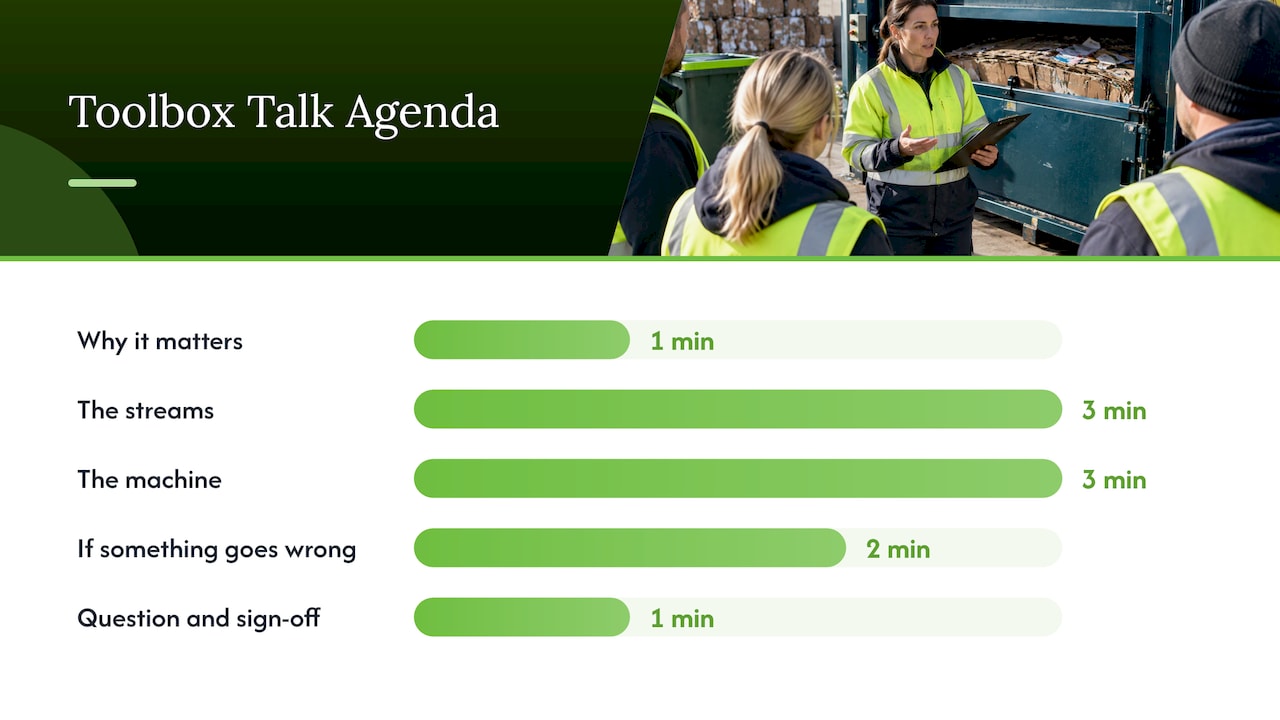
- Why it matters (one minute). Contaminated or badly sorted loads cost money and, on a compactor, cause jams. Clean, well-baled cardboard and plastic can earn money.
- The streams (three minutes). Show each bin and say what goes in it. Use colour-coded, clearly labelled containers in every place where waste is produced.
- The machine (three minutes). Demonstrate the no-reach rule, the guard check and where the emergency stop is. Point out the hazards named above.
- If something goes wrong (two minutes). Stop, isolate, tell the supervisor. Nobody clears a jam alone.
- Question and sign-off (one minute). Everyone signs the attendance sheet. That sheet goes into the records.
Keep the rules simple. At The Merrion Hotel in Dublin, overly complex recycling guidelines had led to staff disengagement. After a simpler, consistent system and a training programme, more than 70% of the workforce completed the training within two months, the recycling rate rose by 13 percentage points to 74% and disposal costs fell. The case study is a supplier’s account of one hotel, so treat it as an illustration, not a promise. But the lesson travels: fewer rules, taught well, beat a long poster nobody reads.
For new starters, put the same content into the induction, and repeat it with a short refresher when something changes: a new stream, a new machine, a new contractor.
What good training is worth
Training pays back in two places: fewer injuries and better material. A Green Business Ireland case study from 2018 describes an engineering company with 200 employees that diverted 50% of its waste from landfill, cut landfill costs by €8,000 a year and received €2,000 for baled cardboard and plastic, a total annual saving of €10,000. Repak’s hotel case study describes The Grand Hotel Malahide separating and baling plastic and paper on site, using colour-coded bins and training staff to follow the processes.
Both examples share one feature: someone decided who does what and then made sure everyone knew. Bales only earn money when the material is clean, dry and tied properly, and that depends on the person at the hopper.
Perspective: what we tell facilities managers
Most of the sites we visit already own the machine. What they lack is a routine: who is allowed to use it, who checks it and where that is written down.
Our advice is to treat the baler or compactor as part of one system, from the audit that sizes the equipment, through the machine, to the bales that leave the yard and the payment that comes back. A machine matched to your waste, with a small trained group of operators, gives you less handling, fewer jams and cleaner bales.
Start with the free audit, because it shows what you actually produce. Then size the equipment to that, train the people who will use it and keep the record. Our baler training page on the six safety skills operators need to work solo is a good place to set the standard for your team.
Graham
Getting the right machine and the numbers behind it
Training is easiest when the equipment suits the site. A machine that is too small gets overfilled, and one that is awkward to load invites shortcuts. We supply cardboard balers, cardboard compactors, hydraulic compactors and refurbished compactors and balers for Irish businesses, and our team can walk through your waste and your layout before you decide.
Our free waste audit analyses your specific requirements, helps you meet legal and corporate standards and finds cost savings. Once your staff are producing clean cardboard and plastic bales, our bale buyback scheme turns them into revenue. Our pages on how the buyback programme works and cardboard bale prices give the detail.
If you want one partner from audit to equipment to recycling and payment, book your free waste audit. For the wider safety picture, our compactor safety guide for Irish employers goes through the site-level duties.
FAQ
Do I need a certificate to operate a workplace compactor or baler in Ireland?
There is no single statutory licence for a workplace compactor or baler. The law requires that the person is trained and competent for the specific machine, and that you can show it. A written authorisation and a training record per operator is the practical proof.
How often should operators be retrained?
Section 10(2) of the 2005 Act requires training to be repeated periodically as appropriate, so the interval comes from your risk assessment. Retrain on any change of task or new equipment, and add a short refresher when monitoring shows bad habits, such as reaching in or skipping the walk-round.
Can anyone on staff drop cardboard into the compactor?
Only if they have been told the loading rules and the machine is guarded. For busy premises, the HSA suggests considering restricting use to over-18s or keeping the machine in a locked cage. Name the authorised operators and keep the key or isolator with them.
What should a recycling toolbox talk include?
The streams and what goes in each, the machine’s guard and no-reach rules, what to do in a jam or emergency and a signed attendance sheet. Ten minutes beside the machine works better than a long presentation in a meeting room.
Sources
- Safety, Health and Welfare at Work Act 2005, section 10 (Irish Statute Book)
- Safety, Health and Welfare at Work Act 2005, revised (Law Reform Commission)
- HSA guide to the General Application Regulations 2007: work equipment
- HSA Safe Hospitality: machinery and equipment in larger premises
- HSE compaction equipment guidance (UK)
- HSA safety alert: bale stacking in the recycling industry
- HSA code of practice: safe use of industrial trucks
- HSA code of practice: rider-operated lift trucks
- HSE policy on statutory OSH training
- The Merrion Hotel case study
- Green Business Ireland resource efficiency case study (2018)
- Repak hotel case study: Prevent and Save