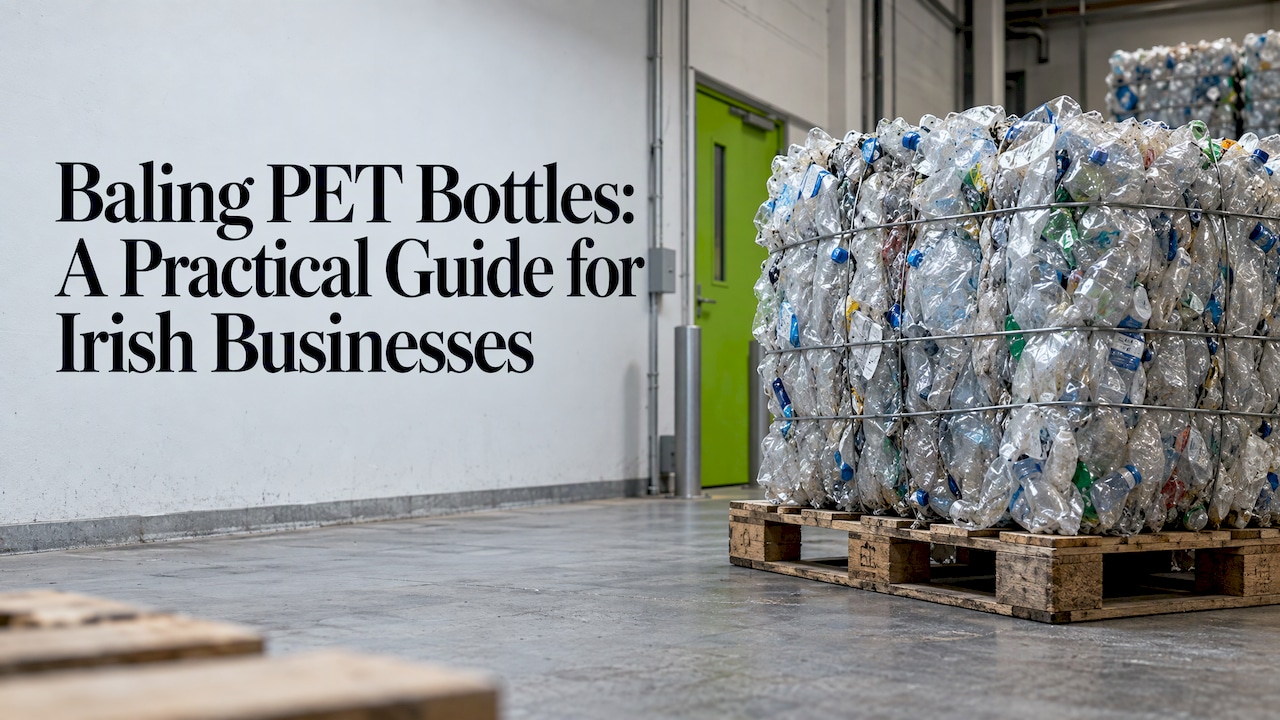
Baling PET bottles means compressing empty, sorted bottles into dense, tied bales that are cheaper to store and collect and easier for a recycler to buy. Done well, it turns a bulky, low-value waste stream into a tidy product with a market. Done badly, it produces contaminated bales that buyers reject. We supply balers and compactors and run a free waste audit and a bale buyback scheme, so this guide covers the full routine, from sorting to storage, and where an Irish business should start.
TL;DR
- Sort first, bale second: clean, empty PET bottles in a single stream make a bale a buyer will accept. Contamination is what turns a bale into a cost.
- Tie bales with wire, keep them dry, and store them on pallets and under cover.
- Ireland’s Deposit Return Scheme covers many drinks bottles. Know which of yours carry the Re-turn logo before you decide what goes into a bale.
- Bale stacking is a recognised safety hazard in Ireland. The Health and Safety Authority (HSA) sets out what employers should do.
- A free waste audit shows how many bottles you generate and whether a baler pays for itself.
Table of Contents
- Why bale PET bottles at all?
- Which bottles can go in the bale?
- Mind the Deposit Return Scheme
- How to bale PET bottles, step by step
- Bale size, density and what buyers expect
- Choosing a baler for bottles
- Safety: stacking and handling bales
- From cost to revenue: what happens to the bales
- Where we start with a business
- Our view
- FAQ
- Sources
Why bale PET bottles at all?
PET bottles are light but extremely bulky. A skip or bin full of loose bottles is mostly air. That costs you in three ways: floor space taken up by bins, collection frequency (you pay for lifts that carry very little weight) and staff time spent emptying, moving and tidying containers.
A baler compresses the bottles in a chamber and holds them as a block, tied with wire or strap. The same weight of material then takes up a fraction of the space, can be stacked on pallets and is easier to load. Buyers and haulers can count, handle and weigh bales far more quickly than loose bottles.
There is also a regulatory reason to get your plastics organised. Since 1 July 2023, Irish waste collectors must offer commercial customers separate residual, mixed dry recyclable and bio-waste collections, and Repak advises businesses to keep recyclable packaging segregated, clean and dry. The same rules, as set out on My Waste, require recyclable and bio-waste to be collected at least fortnightly, weighed, and priced so that recycling costs less than general waste. Weighed bales fit that system well, because the weight is known and the material is clean.
The businesses that gain most are those that generate bottles every day: hotels, bars and restaurants, convenience and grocery stores, offices with canteens, event venues, schools and contract caterers.
Which bottles can go in the bale?
The most common mistake is treating the baler as a place to put every piece of plastic. Buyers pay for a defined material, not for “plastic”.
For PET, the industry reference is a clean stream of whole bottles. The ISRI guidelines describe an acceptable PET bottle bale as whole screw-neck bottles that are clear, transparent green or transparent light blue, free of contents and free-flowing liquids, and rinsed. Other coloured PET and PET thermoforms (trays, clamshells) depend on what the individual buyer will allow, so agree this before you start baling them together.
In practice that means:
- In the PET bale: empty water, soft drink and juice bottles made of PET, ideally with the cap attached.
- Keep out: other plastics such as bottles in different resins, film, foam, cartons, glass, metal, paper and anything that held chemicals. The model PET bale specification from the Association of Plastic Recyclers lists prohibited items including #7 plastics, film, foam, hazardous-material containers and batteries, and notes that a buyer may reject an entire load.
- Separate stream: HDPE bottles such as milk jugs. The Association’s sorting guidance groups PET (#1) and HDPE (#2) bottles together as a bottle category for sorting, but they are different materials, and your buyer will want to know which you are selling.
Plastic film is a different job altogether. If your site also generates stretch wrap and shrink film, look at plastic film recycling equipment rather than putting it through a bottle bale.
The lesson from Irish guidance is the same: Engineers Ireland’s summary of EPA best practice stresses that plastic quality has to be controlled at source. If material is not collected properly at the start, a quality end product becomes harder and more costly to produce. For you, “source” is the bin beside the counter, the bar or the canteen.
Mind the Deposit Return Scheme
Ireland’s Deposit Return Scheme began on 1 February 2024. It covers most plastic, aluminium or steel drinks containers from 150ml to 3 litres that carry the Re-turn logo. The deposit is 15 cent on containers from 150ml to 500ml and 25 cent on containers over 500ml up to 3 litres. Since 3 July 2024, plastic drinks containers up to 3 litres must have their caps attached.
What this means for a business depends on which side of the counter you are on:
- If you sell drinks: under the DRS Regulations 2024, retailers must charge the deposit as a separate line, register with the approved body (Re-turn), provide visible and accessible take-back facilities, and store returned bottles for return to that body. Bottles taken back through the scheme follow the scheme’s route, not your general recycling stream.
- If you consume drinks (offices, hotels, venues): check which of your bottles carry the Re-turn logo and which fall outside the scheme, for example because of size or because they are not drinks containers. Decide with your waste partner which stream each type goes into before you start baling.
Do not bale deposit-bearing containers in a way that conflicts with how your own site handles returns. Agree the routine in writing with whoever manages your site’s recycling.
How to bale PET bottles, step by step
The basic sequence is the same whatever size of baler you use. What changes is how much of it you can do reliably day after day.
1. Collect at the point of use
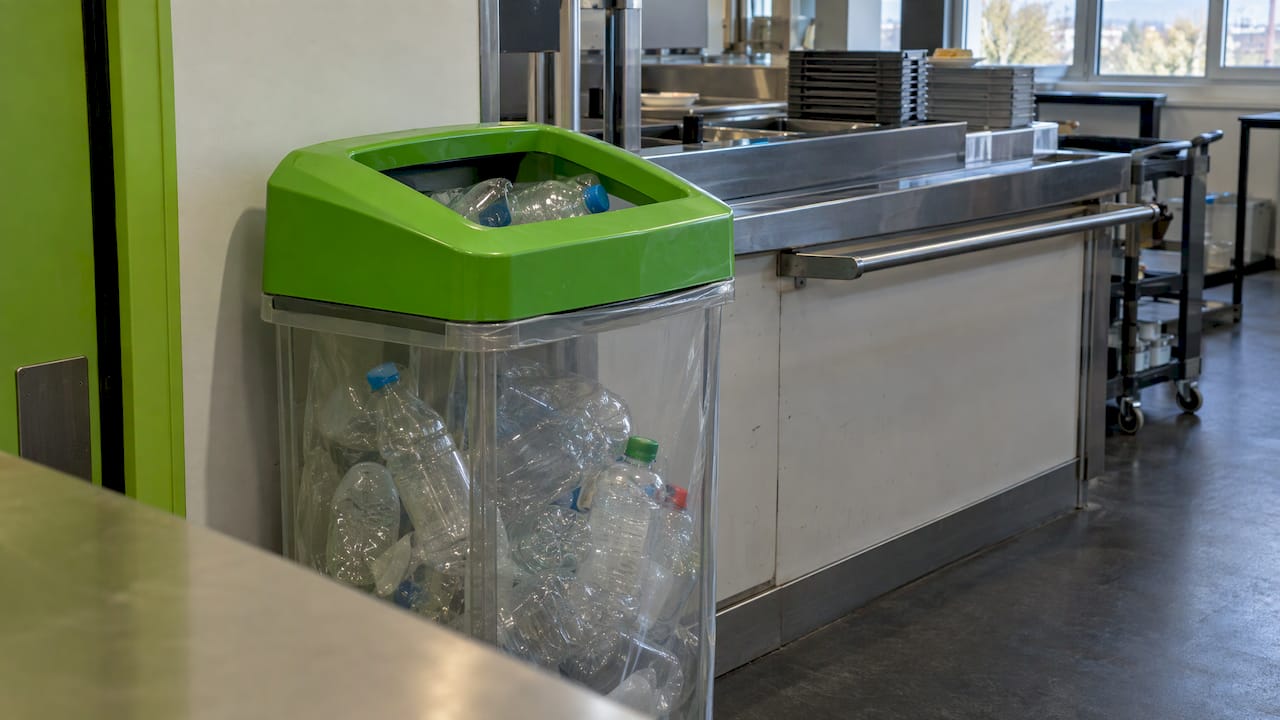
Place clearly labelled, PET-only bins where bottles are finished with: bars, canteens, bedrooms, meeting rooms, event stalls. Fewer, better-placed bins beat many generic ones. Staff behaviour at this step decides the contamination level of every later step.
2. Empty, drain and remove contaminants
Bottles should be free of liquid. Liquid squeezed out under pressure makes bales heavy, messy and unattractive to buyers, and moisture is one of the things the Zero Waste Scotland guidance for sorting plants asks suppliers to keep to a minimum, alongside contaminants such as PVC, polystyrene, paper, film, glass, metal and cartons. Remove other materials at the bin, not at the baler.
3. Crush or pierce where needed
PET springs back after compression and traps air. Pre-flattening or perforating bottles helps the baler reach a dense bale. The same Scottish guidance notes that sorting plants prefer bottles crushed flat so that near-infrared sorting equipment can detect them. Material should also be baled only once.
4. Load and compress
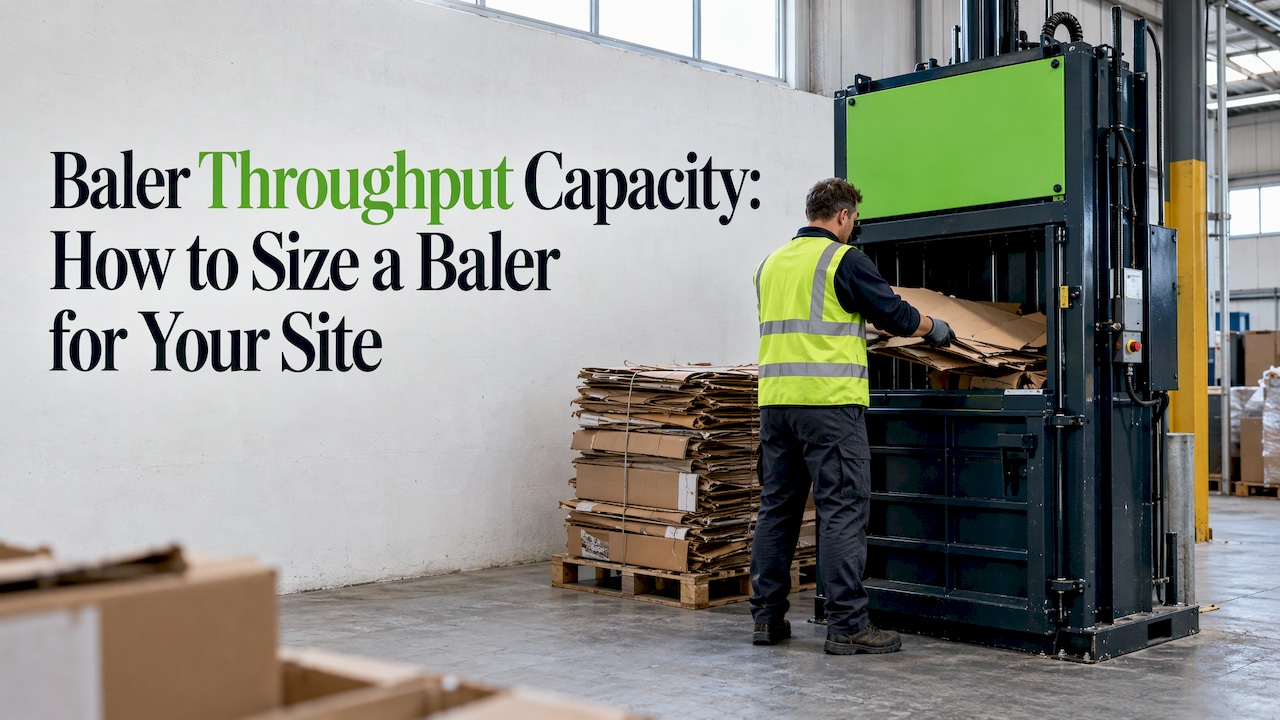
Feed the chamber evenly, close it and run the compression cycle. Overfilled or unevenly loaded chambers give soft, lopsided bales that burst when lifted. Keep the loading area clear of anyone who is not trained on the machine.
5. Tie the bale
Use non-corrosive wire and tie in a single direction, as the US specification does. That specification calls for 10 to 12 gauge galvanised wire, no plastic wrap and no cardboard headers. Sorting plants in the UK, per the Scottish guidance, prefer bales tied with five or six wires, weighing around 500 kg or a little more. Your own buyer’s requirements always take priority, so ask before you settle on a wire pattern. We stock baling wire and tape for the machines we supply.
6. Eject, label and store
Move finished bales onto pallets, label the material and date, and keep them dry. The US specification asks for the bottom bale on a pallet, storage indoors or under cover, and no more than two weeks uncovered outdoors. Our own bale storage guidelines cover storage for Irish sites in more detail.
7. Weigh and record
Under the commercial waste rules, collectors must weigh waste and report it. Weighing your own bales gives you the figures you need to check what you are being paid and charged. Our waste audit checklist shows how managers can structure that record.
Bale size, density and what buyers expect
There is no single Irish standard for PET bale size. The most detailed published reference is the Association of Plastic Recyclers’ model specification, written for North America. It sets bales at a minimum of 30 by 42 by 48 inches (roughly 76 by 107 by 122 cm) and a density of 15 to 18 pounds per cubic foot (about 240 to 290 kg per cubic metre). Treat it as a benchmark for what a well-made bale looks like, not as a rule that applies in Ireland.
The same Association also publishes a variant that allows PET thermoforms. It permits clear thermoforms such as egg cartons, clamshells, cups and trays at more than 2% but no more than 10% of bale weight, all optically sorted as PET. That shows how much of the price depends on the exact mix.
What matters for you:
| Factor | What buyers look for | What you control |
|---|---|---|
| Material | Single resin, mostly clear PET bottles | Bin design, staff briefing |
| Contamination | No film, glass, metal, other resins | Sorting at source |
| Moisture | Dry bales, no free liquid | Draining before baling |
| Density | Firm bales that hold shape on lifting | Chamber loading, baler pressure |
| Tying | Strong, non-corrosive wire in one direction | Wire grade and pattern |
| Storage | Palletised, covered, clean | Storage area |
A bale that scores well on this table is one a buyer will take without argument. A bale that does not may be downgraded or rejected, and then you have paid to produce a bale you cannot sell.
Choosing a baler for bottles
Size the machine to your volume, your space and your staff, not to the cheapest option on a catalogue.
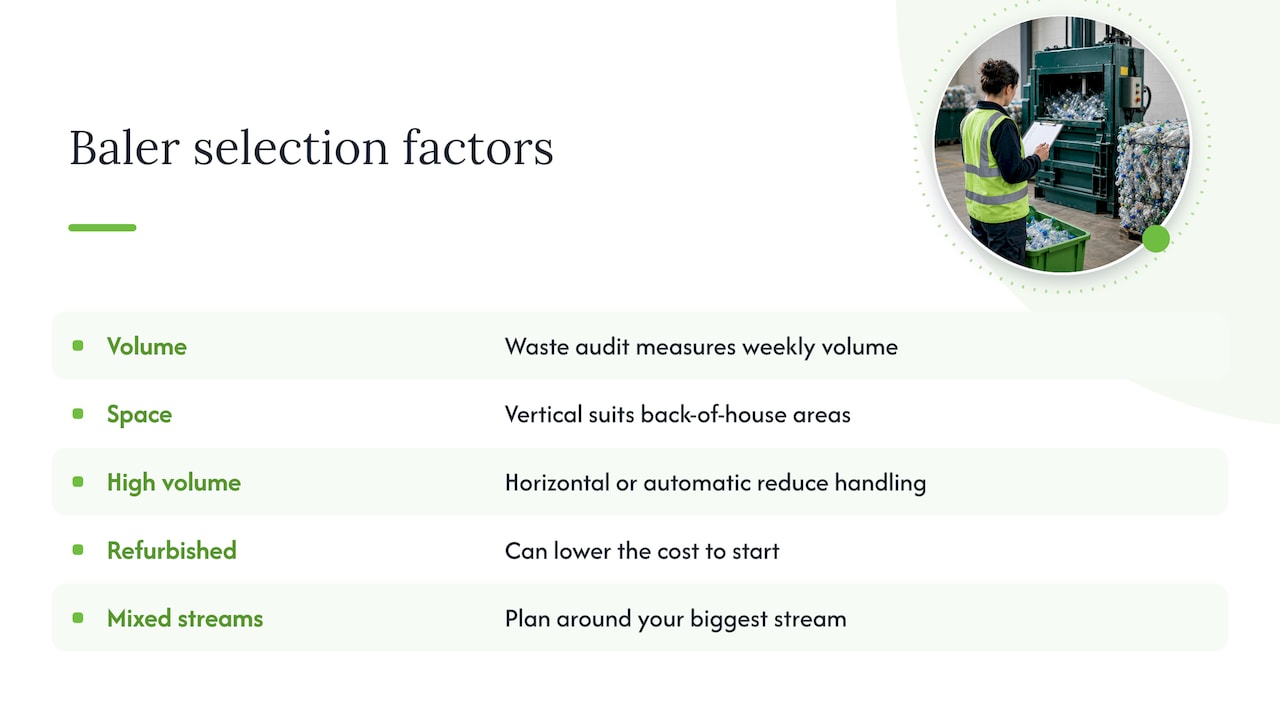
Volume. Count how many bottles you generate in a week and how often they are collected today. A small hospitality site and a busy retail distribution centre need very different machines. This is exactly what a waste audit measures.
Space. A vertical baler takes up little floor space and suits back-of-house areas. Larger horizontal or automatic machines suit steady, high volumes and reduce handling. Guidance from manufacturers generally puts vertical machines as the cheaper option up front, with horizontal or automatic machines giving better return where volumes are high.
Who operates it. A machine that is awkward to load will be used badly. Look at how many people will run it, what training they will have and how the bale is ejected.
New or refurbished. A refurbished baler can lower the cost of getting started. See also our range of new and refurbished balers for Irish businesses, and what to expect on cost in our baler price guide.
Mixed streams. Many sites bale both cardboard and plastic. If so, plan the machine around your biggest stream and your dry recyclables as a whole, rather than bottles alone. Our guide to cardboard recycling solutions in Ireland is a good place to see how the streams fit together.
Safety: stacking and handling bales
Bales are heavy, and stacks can fall. The Health and Safety Authority’s safety alert on bale stacking calls on employers to risk-assess stacking hazards for recycled materials, and plastic bottles are named among them. Its recommendations include:
- Stack on level, drained ground.
- Use bales of similar size and weight, or put heavier bales at the bottom.
- Use three-sided containment, step back the open sides and interlock bales.
- Keep a written procedure for dealing with unstable stacks.
- Keep pedestrians out of stacking areas.
- Use vehicles fitted with falling-object protection and warning devices.
- Consider the distance between stacks to limit the spread of fire.
For day-to-day safety, make sure only trained staff run the baler, that doors and guards are in working order, and that the baler is serviced on a schedule. If you are unsure whether your storage meets the HSA’s expectations, speak to your safety officer or a competent safety adviser.
From cost to revenue: what happens to the bales
A tidy bale of clean PET is a commodity. Once you produce one reliably, the question changes from “who will take this away?” to “who will pay for it?”. That is the principle behind a buyback arrangement: you bring the bales, a buyer collects them and you receive payment against the material.
It only works if the bale is good. Each of the steps above exists to protect the price of the finished bale. It is also why measuring matters: you need the weights, the mix and the volume to know what a baler will return. Our overview of the bale buyback programme explains how that works for Irish businesses.
Recycling markets for other materials follow the same logic of clean, sorted input, as this solar panel recycling guide shows for a very different product.
Where we start with a business
We suggest starting with a free waste audit. We analyse your waste and your site, work out what you actually generate and where the costs are, and then work out whether a baler, a compactor or a change in collection suits you. If you decide to buy equipment, we can supply it. If you produce bales, we can buy them back through our bale buyback scheme.
From audit to equipment to recycling and payment, that is one point of contact rather than three suppliers.
To see the range, start with our new and refurbished balers or book the audit and we will tell you what makes sense for your volumes.
Our view
Most bottle-baling problems start long before the baler. A bale is only as good as the bin it came from, and a baler bought without knowing the volume is either too big, too small or in the wrong place.
That is why we begin with a waste audit. We look at what a site really throws away, what is recyclable, what the collection costs and how much a bale could be worth. Equipment is the second step, not the first.
Our aim is simple: take the cost out of waste and, where we can, put revenue in. We turn cardboard and plastic residues into income through our bale buyback scheme, and we handle collection and recycling so that you can get on with running the business. For a facility manager, that means one partner from audit to payment.
Graham
FAQ
Can I bale plastic bottles of any type together?
No. Buyers want a single material. PET bottles belong in a PET bale, and other plastics such as HDPE need their own stream. Mixed bales are more likely to be downgraded or rejected, so sort at the bin and agree what your buyer accepts before you start.
Do I need to remove the caps before baling?
Not necessarily. Irish rules now require caps on plastic drinks containers up to 3 litres to be attached, and attached closures are treated as part of the package in sorting guidance. Check your buyer’s specification for any restrictions.
How much do PET bottle bales weigh?
It depends on the baler and the buyer. Sorting plants in the UK, according to Zero Waste Scotland guidance, prefer bales of around 500 kg or slightly more. A site audit will tell you what is practical for your machine, your space and your collection.
Are bottles returned through the Deposit Return Scheme part of my bale?
Containers taken back under the scheme go back to the approved body, Re-turn, as the regulations require of retailers. Agree with your waste partner how your site separates these from other PET before you start baling.
Sources
- Enhanced Legislation for Commercial Business Waste, Repak
- Legislation, My Waste
- Guidelines for Plastic, ISRI
- Model Bale Specification: PET Bottles (No PET Thermoforms), APR
- Model Bale Specification: PET Bottles with PET Thermoforms, APR
- Best Management Practices, APR plastic sorting
- Best practice guidance for waste-plastic management in Ireland, Engineers Ireland
- Deposit Return Scheme, Citizens Information
- S.I. No. 33/2024, Separate Collection (Deposit Return) Regulations, Irish Statute Book
- Guidance on sorting and processing of plastic bales for MRFs, Zero Waste Scotland
- Bale Stacking in the Recycling Industry, Health and Safety Authority