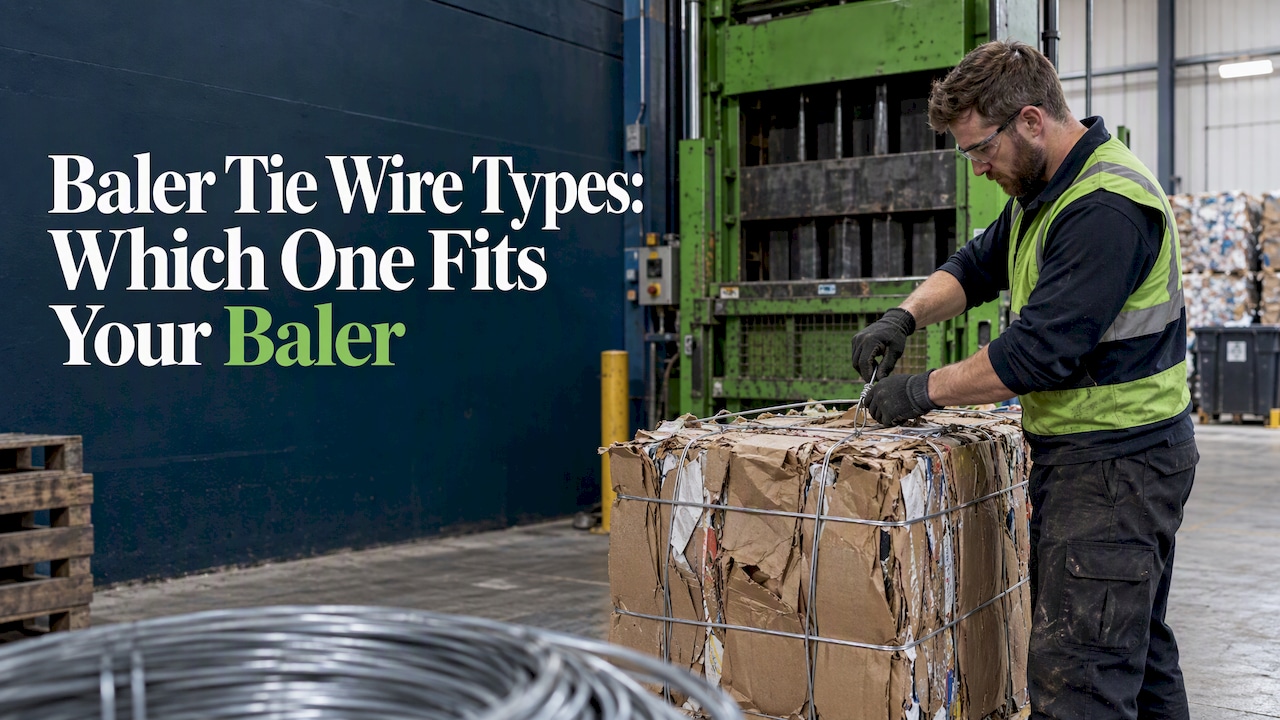
There are four forms of baler tie wire: single-loop ties, double-loop ties, box wire and stem (carrier) wire. There are two finishes, black annealed and galvanised, and a range of gauges. Your baler decides the form. Your material and storage conditions decide the finish. The density and spring-back of what you bale decide the gauge. Get all three right and bales stay tied, knotters stay clear and your buyer gets a clean, dense bale.
This guide goes through each type in plain terms, shows how to match wire to machine, and flags the mistakes that cost Irish sites money.
TL;DR
- Form follows the machine. Manual vertical balers take pre-cut ties. Automatic horizontal balers take continuous box wire or stem wire.
- Finish follows storage. Black annealed is soft and knots easily. Galvanised resists rust if bales sit outdoors or in damp conditions.
- Gauge runs backwards. A lower number means thicker, stronger wire, so 9-gauge is heavier than 14-gauge.
- Springy materials need more. Plastic film, foam and textiles push outwards harder than flattened cardboard, so check the wire against the material, not only the weight.
- Check the baler manual first, then confirm with your supplier before ordering a full pallet.
Table of Contents
- The four forms of baling wire
- Black annealed or galvanised: choosing the finish
- Gauge: the number that runs backwards
- Match the wire to the material, not just the weight
- Temper: why wire is not just wire
- How to choose: a five-step check
- Perspective: what we see on Irish sites
- Why this matters under Irish waste rules
- Common mistakes with baler tie wire
- Wire, baler and buyback from one source
- FAQ
- Sources
The four forms of baling wire
Baling wire is usually sorted by form first, because form is tied to how your machine ties. BalingWire.com’s product guide groups it into single-loop ties, double-loop ties, boxed wire and carrier (stem) wire, and that is the split most of the trade uses.
| Form | What it is | Typical baler | Tied by |
|---|---|---|---|
| Single-loop bale tie | Pre-cut length with a loop at one end | Vertical (downstroke) baler | Hand |
| Double-loop bale tie | Pre-cut length with a loop at each end | Manual-tie balers handling materials that expand | Hand |
| Box wire | Continuous coil, supplied in a box | Automatic single-ram horizontal baler | Machine |
| Stem (carrier) wire | Continuous, high-volume coil | Automatic two-ram horizontal baler | Machine |
Single-loop ties
These are the ones most Irish shops, warehouses and distribution units will know. You build a bale in a vertical baler, open the door, thread the pre-cut wire through the channels, loop it round and twist or hook it closed. They suit the lower volumes a retail or office site produces. Lengths are cut to match the bale size, so the first question to answer is how long a tie your baler needs.
Double-loop ties
A loop at each end gives a stronger, more secure closure. They tend to be chosen for materials that push back harder once the ram releases. If your single-loop ties are springing open on a particular waste stream, double loops are worth discussing with your supplier.
Box wire
Box wire is a continuous coil fed to an automatic tying system. It is common on single-ram horizontal balers where the machine ties each bale itself. You are no longer cutting and threading by hand, so wire consistency matters far more: a coil that is too hard or uneven can jam the knotter.
Stem wire
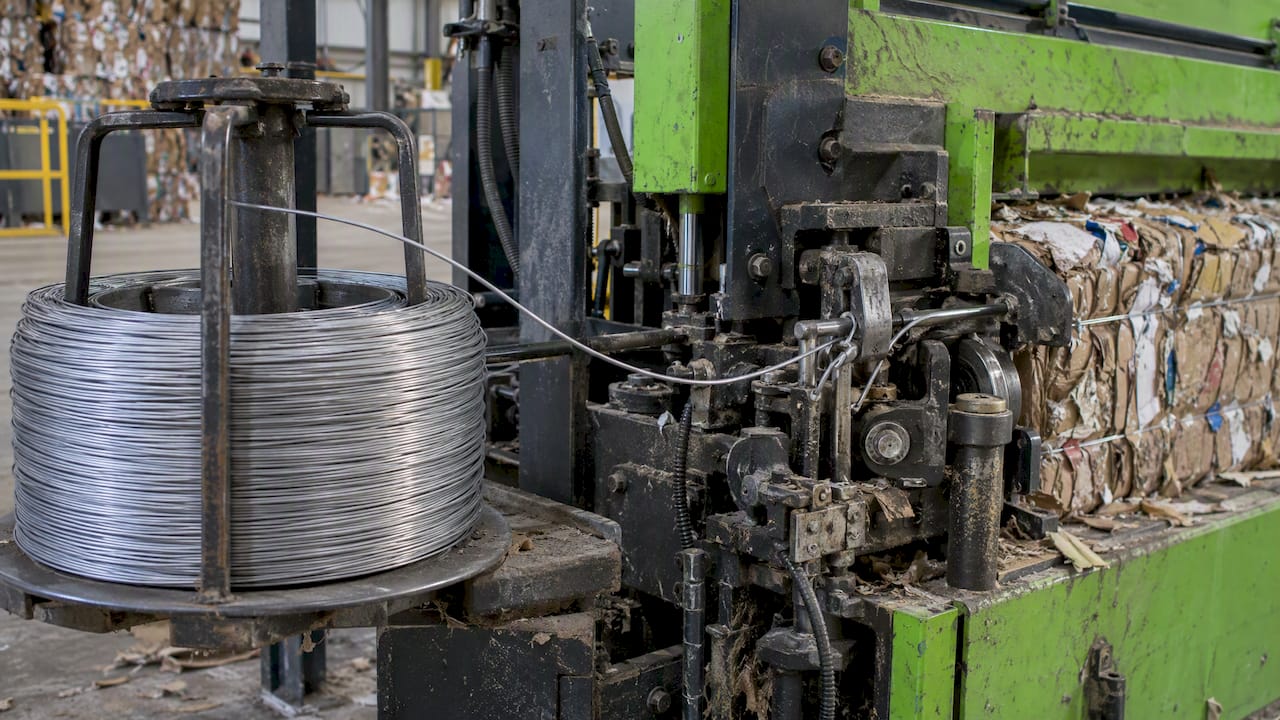
Stem wire (also called carrier wire) is the continuous, high-volume option for automatic two-ram balers, the machines that run for long shifts in recycling plants and large distribution centres. If you have one of these, your supplier will already be specifying a particular coil.
One point from the trade body ISRI is worth knowing. Balers come in two basic configurations, vertical and horizontal, and automatic wire-tie systems are offered only on horizontal balers. So if you run a vertical baler, automatic wire types are not an option for that machine, however attractive the cost per bale looks.
Black annealed or galvanised: choosing the finish
Wire finish is the second decision, and it is mostly about where your bales go after they leave the baler.
Black annealed wire has been heat-treated to make it soft and flexible. That softness is the point: it bends and knots without snapping, and it copes with materials that expand after compression. It is the standard choice for indoor use and dry storage, and it is widely used in recycling. American Wire Works describes it as the type for indoor dry storage, with galvanised wire recommended for outdoor storage or damp conditions.
Galvanised wire carries a zinc coating. That coating resists corrosion, so it suits bales stored in a yard, under a lean-to or in a damp building. Irish weather is the obvious reason to think about this. A bale of cardboard sitting in a yard through a wet winter will tell you quickly whether the wire was the right finish. The trade-off is that galvanised wire is generally stiffer, so check that your baler’s tying system is built for it.
A simple rule:
- Bales go straight onto a lorry or into a dry store: black annealed is usually fine.
- Bales wait outdoors or in a damp store for days: galvanised is the safer choice.
- Automatic baler: follow the manufacturer’s specification, because knotters are set up for a certain temper.
Gauge: the number that runs backwards
Gauge is where procurement mistakes happen. The gauge system is counterintuitive: a smaller number means thicker, stronger wire. BalingWire.com notes that this is behind many ordering errors, with businesses buying wire that is too weak for their material or heavier and dearer than they need.
In general terms:
- Standard industrial baling wire sits roughly in the 11 to 14 gauge range, according to Eastern Wire’s guide.
- 9-gauge is heavy wire for dense materials and high compression.
- 14-gauge is light wire for low-density materials such as cardboard.
Under-gauging leads to bale failure. Over-gauging raises your cost per bale and can make knotting less reliable. Many suppliers also quote wire in millimetres rather than gauge, so make sure you compare like with like. If a quote says 3.0 mm and your old order said 12-gauge, ask the supplier to confirm they are the same product rather than assuming.
Match the wire to the material, not just the weight
Two bales of the same weight can behave very differently. What matters is how much the material wants to spring back after the ram lets go.
BalingWire Direct’s guide makes the point that the choice depends on the baler and the material: foam, textiles and tyres exert constant outward pressure, and failing to allow for that spring-back is a common reason bales burst in transit even when the wire is strong enough for the static weight.
For Irish businesses, the usual streams look like this:
- Cardboard. The most common bale. Lighter gauges generally cope, provided the bale is properly compressed and the wire is the right length.
- Plastic film and wrap. Springier than cardboard. Tie-in more wires, or use a heavier gauge, if bales are loosening.
- Polystyrene (EPS). Usually compacted rather than baled, which is a different machine altogether. See our EPS compactors.
- Textiles and foam. High spring-back. Speak to your supplier before ordering wire.
Industry guidance also frames the ideal wire as a balance. ISRI’s equipment article is a good place to read about how tie systems work, and the practical takeaway is that you want enough tensile strength to hold the bale and enough elongation to absorb the energy of expanding material without the wire snapping.
Temper: why wire is not just wire
Two coils of the same gauge and finish can still behave differently. Small differences in how the wire is annealed, including time in the furnace and cooling rate, change how ductile it is and how well it knots. For automatic balers a soft, consistent temper helps prevent knotter jams. This is the detail that gets missed when a buyer compares only price per kilo and gauge.
If your automatic baler has started jamming at the knotter after a change of supplier, suspect the wire before you suspect the machine. Keep the old label, ask for the new spec and compare.
How to choose: a five-step check
- Identify your baler. Vertical or horizontal, manual or automatic, single-ram or two-ram. The plate on the machine or the manual gives the make and model.
- Read the recommended wire. Manufacturers specify form, gauge range and length. Start there.
- Decide the finish. Indoor and dry: black annealed. Outdoor or damp: galvanised.
- Consider the material. Note anything springy. Test one bale before ordering a quantity.
- Check the bale after tying. A bale that bulges, loosens or lets wires slip is telling you the gauge, length or number of ties is wrong.
For manual balers, count your ties per bale and your bales per week, then work out annual wire use. That figure is what to negotiate on, not a single box price.
Perspective: what we see on Irish sites
Wire is a small line on the invoice, but it is one of the cheapest places to lose money. A burst bale means lost material, lost time and, if a buyer rejects the load, lost revenue. We see the same pattern repeatedly: a site buys the cheapest wire that looks about right, bales loosen, and the team compensates by tying more wires or running the baler less full. The false saving disappears quickly.
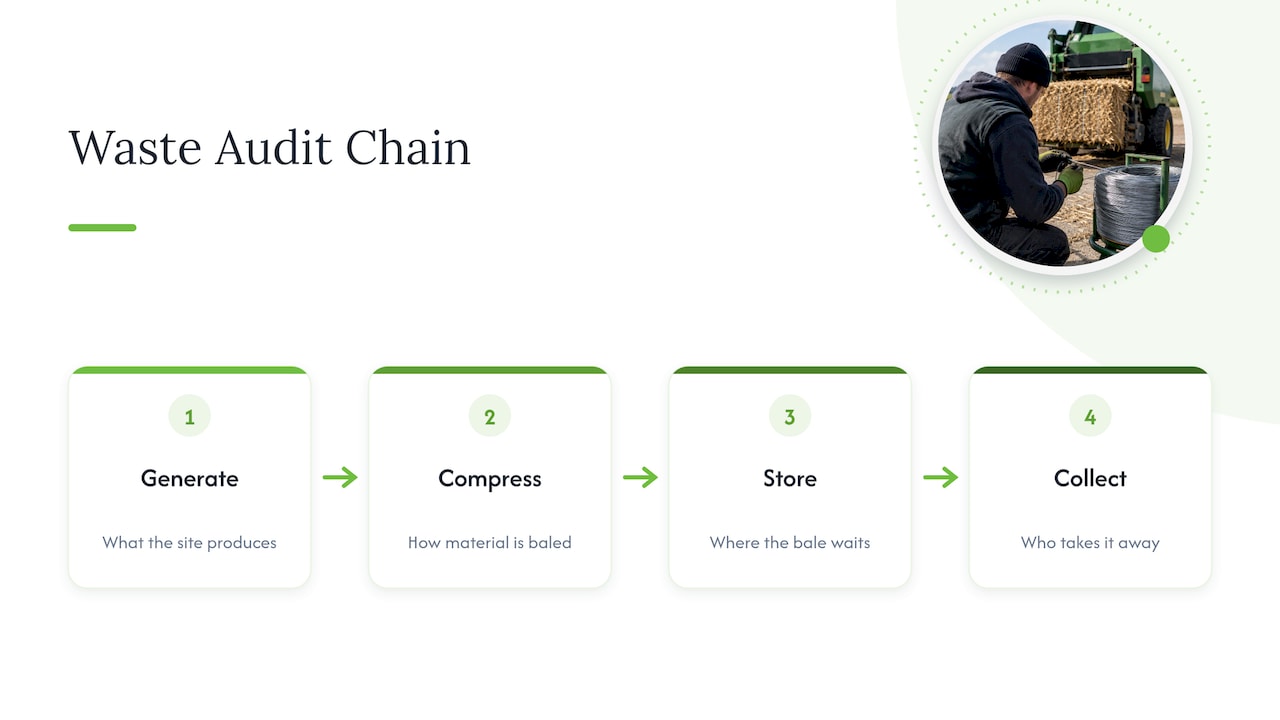
Our advice is to treat wire as part of the system, alongside the baler, the material and where the bale ends up. That is why we look at the whole chain in a waste audit: what you generate, how it is compressed, how it is stored and who collects it. A well-tied, dense, clean bale is the product you are selling to a recycler, and the buyer pays for quality. If you are baling cardboard and want to know what a good bale is worth, our page on cardboard bale prices sets out what buyers are paying.
— Graham
Why this matters under Irish waste rules
Ireland’s Circular Economy Act was signed into law in 2022, and the government’s announcement lists a mandatory segregation and incentivised charging regime among its measures. For a business, the direction is clear: clean, separated streams are cheaper to deal with than mixed ones. Good baling supports that. A well-tied bale of single-material cardboard or film is easier to store, transport and sell than loose or mixed material.
Check current requirements for your own sector with your waste collector and the relevant local authority, as the detail of commercial segregation obligations can change.
Common mistakes with baler tie wire
- Ordering by gauge number without checking direction. Remember that lower is thicker.
- Using galvanised wire where the knotter expects black annealed, or the reverse, without checking the manual.
- Mixing suppliers on an automatic baler and not checking temper.
- Wrong length. Too short and you cannot close the tie. Too long and it is wasteful and untidy.
- Storing wire badly. Coils left in a damp yard can rust before use, even black annealed wire, which has no zinc coating.
- Ignoring spring-back on plastic, foam and textiles.
Wire, baler and buyback from one source
If you want your wire, baler and bale sales sorted in one place, we can help. Our baling wire and tape range sits alongside our cardboard balers and refurbished compactors and balers. Once you are producing good bales, our bale buyback scheme can turn them into income. Not sure where to begin? Start with a free waste audit and we will look at your volumes, your machine and your material together. If you are still choosing a machine, read our guide to what you need to know about cardboard balers.
FAQ
What is the difference between baling wire and tie wire?
Baling wire is tie wire made specifically for securing compressed bales, so it is annealed or galvanised to knot reliably and hold under tension. General tie wire, such as that used in construction, is not designed for the load or the knotters of a baler. Use baler-specific wire on any baling machine.
What gauge is standard baling wire?
Most industrial baling wire falls between 11 and 14 gauge. Lighter gauges such as 14 suit low-density materials like cardboard, while heavier gauges suit dense or springy loads. Always check your baler’s manual for the range it is designed to tie.
Can I use galvanised wire on any baler?
Not automatically. Galvanised wire resists corrosion and is useful for outdoor or damp storage, but automatic knotters can be sensitive to wire stiffness. Confirm with the baler manufacturer or your supplier before switching finishes.
Do automatic balers use different wire from manual ones?
Yes. Manual vertical balers use pre-cut single or double-loop ties that you thread by hand. Automatic horizontal balers use continuous box wire or stem wire fed to the tying system.
Sources
- Landmark Circular Economy Act signed into law, gov.ie
- Baling Wire, Bale Wire, Bale Ties: information, BalingWire.com
- Baling Wire Buyer’s Guide, American Wire Works
- What is Baling Wire? Types, Gauges and Industrial Uses, Eastern Wire
- How to choose the right baling wire, BalingWire Direct