Hotel waste management means coordinating measurement, prevention and diversion across every department, not just paying a contractor to empty bins. The immediate action is a short waste audit or a review of your hauler’s recent weight tickets, giving you baseline figures for total waste, food waste and diversion rate before you change anything else.
TL;DR:
- A hotel waste management program must start with measuring baseline waste quantities, including total waste, food waste, and diversion rates, to inform effective actions.
- Conducting a waste audit involves defining scope, choosing measurement methods, categorizing waste consistently, sampling properly, and noting hotspots to identify key reduction opportunities.
- Upstream prevention measures, such as portion calibration and menu design, significantly cut food waste before it reaches guests, since most waste occurs during procurement and prep.
- Proper segregation infrastructure and contracted collection terms are crucial for high diversion rates, requiring dual guest bins, dedicated sorting stations, and weighed collections from haulers.
- Building ongoing governance through departmental KPIs, regular reporting, and staff accountability supports lasting waste reduction, with pilots often recouping investments within one to two years.
Table of Contents
- What is hotel waste management, and why does measurement matter first?
- How do you run a practical hotel waste audit?
- Which prevention measures actually cut food waste before it’s created?
- How should you design segregation and collections to lift your diversion rate?
- When do balers, compactors and composters actually pay for themselves?
- How do you build governance and KPIs that make waste reduction stick?
- How Compact turns a waste audit into equipment and revenue
- Handling hazardous waste specific to hotels
- What strategies actually get guests to reduce waste?
- What legal and reporting requirements apply across different regions?
- How does waste management fit into a hotel’s wider sustainability programme?
- Does better waste management change how guests and owners see your brand?
- Author perspective: why measurement-first pilots outlast big sustainability launches
- Get a baseline, then get paid for your recyclables
- Sources
- FAQ
What is hotel waste management, and why does measurement matter first?
Most hotels manage waste by contract, not by data. A hauler collects bins on a schedule, invoices monthly, and nobody asks what’s actually inside them. The Hotel Waste Measurement Methodology exists precisely because that approach hides the two things that actually drive costs and emissions: how much waste you generate, and how much of it you’re diverting from landfill.
The methodology sets out core metrics every property should track:
- Total waste generated, in metric tonnes
- Total food waste, in metric tonnes
- Waste per square metre or per guest-night, for benchmarking across properties or seasons
- Diversion rate, the percentage of waste redirected from landfill to recycling, composting or reuse
Standard metrics matter because they let you set targets, compare performance across sister properties, and prove results to ownership or certification bodies. A hotel that only knows its monthly bin count cannot reliably assess the impact of changes like a new buffet format, due to variability in occupancy on given days. Comparable data turns waste from a cost line into a manageable metric, the same way you already manage occupancy or RevPAR.
How do you run a practical hotel waste audit?
A waste audit doesn’t need a consultancy retainer or a week of disruption. It needs a defined scope and a consistent method.
- Set your boundaries first. Decide whether the audit covers guest rooms only, or extends to food and beverage outlets, back-of-house prep, events space and any ongoing construction or refurbishment waste.
- Choose your measurement method. Contractor weight tickets from your hauler give you a fast, low-effort baseline if the collector already weighs loads. Where that data isn’t available, run an in-house weigh sample: separate a representative week’s waste into categories and weigh each stream on a simple platform scale.
- Categorise consistently. Use a fixed template every time: food waste, recyclable dry mixed (cardboard, plastics, glass, metal), residual general waste, cardboard as its own line if volumes are high, and hazardous waste kept separate throughout.
- Sample and extrapolate. A one or two-week sample, taken during a representative occupancy period, extrapolates to monthly and annual baselines. Avoid sampling only over a quiet week or a single unusual event.
- Flag hotspots as you go. Note which department or shift generated the heaviest food waste stream. Often it’s obvious within days.
Pro Tip: Run your first weigh sample during a normal mid-week period, not a weekend banquet or a slow off-season week. Extrapolating from an outlier week will skew your entire annual baseline.
Which prevention measures actually cut food waste before it’s created?
Roughly 70% of hospitality food waste happens before food reaches the plate, during purchasing, prep and buffet service, not on guest plates. That means the highest-value interventions sit upstream, in kitchen planning and procurement, not in “clean plate” campaigns.
Academic work on hotel food systems points to specific, testable levers rather than vague good intentions:
- Demand-synchronised mise en place, so prep quantities track forecast covers instead of a fixed daily routine
- Portion calibration checks, run periodically against actual plate waste
- Buffet pans sized smaller and replenished more often, rather than kept full for visual appeal
- Clear signage and staff protocols that reward frequent top-ups over one large early fill
- Menu design that reuses core ingredients across multiple dishes, reducing the range of perishables ordered
- Supplier pack sizes and order cadence matched to actual weekly throughput, not bulk discounts that outlast shelf life
Where surplus does occur, structured donation or repurposing routes are worth building into standard operating procedure. Most jurisdictions have food safety and liability provisions covering genuine donation, so check local guidance before setting up a redistribution partnership, and document the process so it’s repeatable.
How should you design segregation and collections to lift your diversion rate?
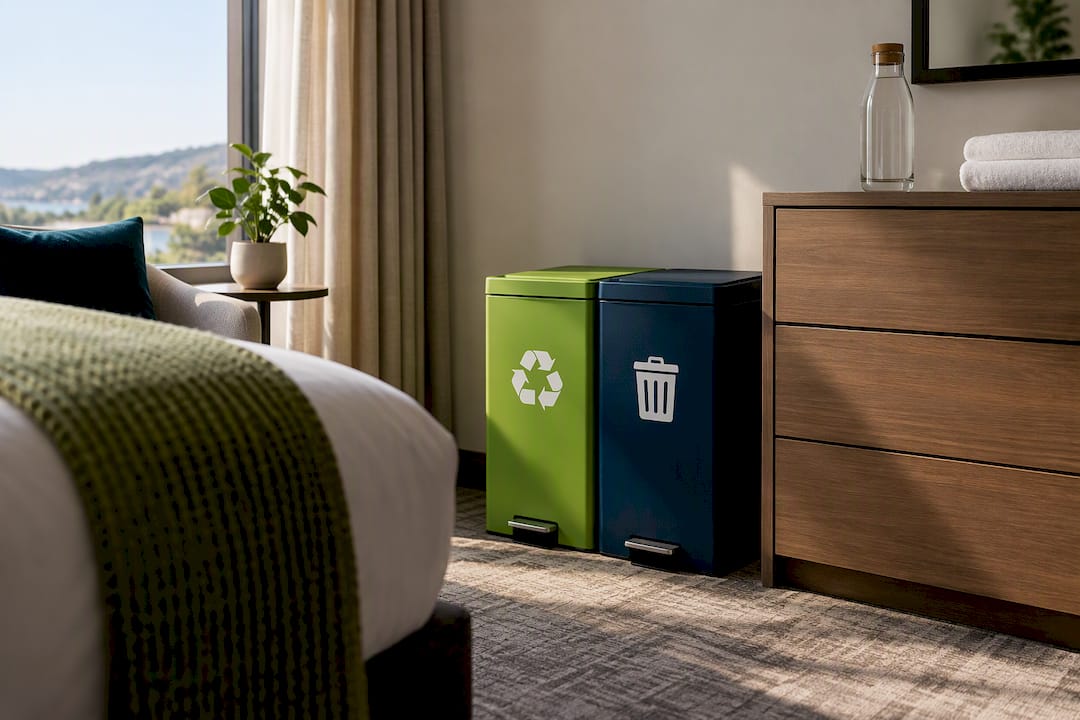
Infrastructure decides whether good intentions turn into diverted tonnes. Guest rooms need dual bins (recycling and general waste) with unambiguous signage, because guests will not sort correctly if the system asks them to think too hard.
Back-of-house needs dedicated sorting stations near kitchens and loading bays, with someone responsible for spot-checking contamination before bins go to the compactor or collection point.
Contract terms with your hauler deserve just as much attention as the bins themselves:
- Insist on weighed collections, not estimated or flat-rate billing
- From 1 July 2023, Ireland requires commercial collectors to provide separate residual, mixed dry recycling and bio-waste bins, collect them on a weighed basis, and price plans so that recycling and organics collection cost less than sending the same material to residual waste
- Fortnightly collection frequency for recyclables and bio-waste as a contractual minimum
- Track contamination rate and kilograms diverted per guest-night as ongoing KPIs, not one-off audit figures
An Environmental Protection Agency estimate suggests up to 70% of what ends up in commercial black bins could have been recycled instead, which tells you how much of the opportunity is sitting in poor segregation rather than genuine residual waste.
When do balers, compactors and composters actually pay for themselves?
Capital equipment makes sense once volume, storage constraints and collection frequency line up against the cost of continued haulage. If you’re paying for frequent cardboard or film collections because bins fill fast, that’s usually the clearest signal.
A few criteria to weigh before buying or leasing:
- Volume threshold. If cardboard or film consistently fills more than one or two large bins a week, a baler or compactor likely pays back through reduced collection frequency and, where a buyback scheme applies, direct revenue from baled material.
- Storage space. Balers need somewhere dry to store finished bales pending collection; undersizing storage relative to monthly bale output erodes the savings you were chasing.
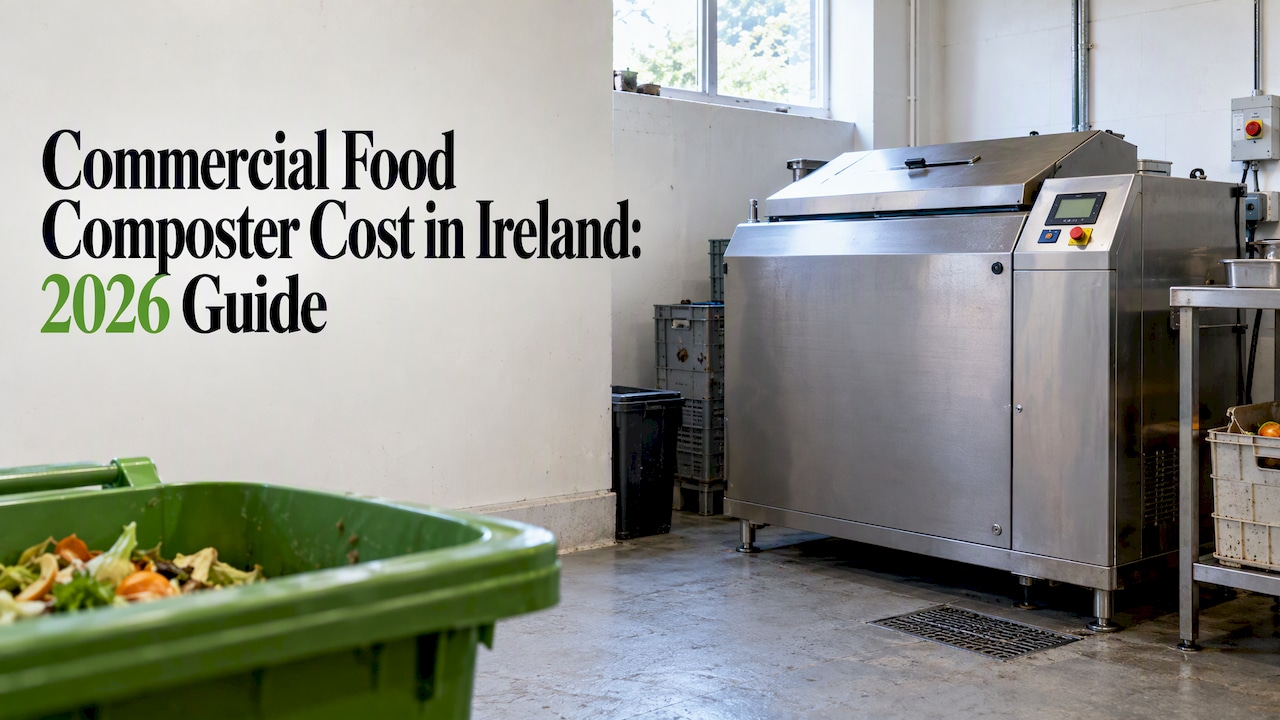
- Composting fit. On-site composting machines suit hotels with consistent daily food waste volumes and space for the unit and its operational routine; off-site organic collection or anaerobic digestion suits properties with limited back-of-house space or inconsistent volumes.
- Maintenance and safety. Any baler or compactor needs a maintenance schedule and trained operators; factor this into the total cost, not just the purchase price.
Pro Tip: Size any baler to your monthly bale volume, not your weekly one. Undersized equipment that runs constantly at capacity fails faster and pushes you back toward the haulage costs you bought it to avoid.
How do you build governance and KPIs that make waste reduction stick?
Equipment and audits only work if someone owns the follow-through. A small green team, drawing from housekeeping, food and beverage, and procurement, gives waste reduction a clear owner rather than leaving it to whoever notices the bins are full.
- Assign one person per department to report their stream’s tonnage monthly
- Report tonnes by stream, diversion rate and food waste per guest-night every month, not just at audit time
- Feed food waste data back to kitchen and procurement teams directly, so portion or ordering changes happen close to where the waste occurred
- Review targets quarterly against your original audit baseline, not against industry averages alone
The financial case supports the effort: sector studies show hospitality food waste reduction pilots frequently recoup investment within one year, and the large majority within two, with measurement and staff engagement cited as the deciding factors between pilots that stall and ones that scale.
How Compact turns a waste audit into equipment and revenue
Compact’s free waste audit gives you the property-level baseline this whole approach depends on: current tonnage by stream, contamination issues, and where your contract terms are costing you money.
From there, the pathway is straightforward. Audit findings point to whether a baler, compactor or on-site composter suits your volumes. Once cardboard and plastic film are being baled consistently, Compact’s bale buyback scheme pays for that material directly, converting what used to be a disposal cost into a revenue line. It’s audit, then equipment, then payment, run as one connected process rather than three separate vendor relationships.
Handling hazardous waste specific to hotels
Hotels generate more hazardous waste than most managers realise, and it rarely comes from any one obvious source. Pool and spa chemicals (chlorine, pH adjusters), cleaning and laundry chemicals, aerosols, batteries from guest devices and remote controls, fluorescent tubes and LED units, and printer or toner cartridges from the business centre all fall under hazardous or special waste categories in most jurisdictions.
The rule that matters most: hazardous streams must never mix with general or recyclable waste, either in bins or during storage. Contamination here isn’t just a diversion-rate problem, it’s a compliance and safety issue that can trigger fines or void hauler contracts.
Practical steps that keep hazardous handling under control:
- Store hazardous materials in a designated, secured area away from food storage and guest-accessible spaces
- Use a licensed hazardous waste contractor separate from your general hauler, with documented collection records
- Train housekeeping and engineering staff to recognise hazardous items (spent bulbs, chemical containers, battery packs) rather than binning them with residual waste
- Keep safety data sheets accessible for any chemicals stored on site, and review disposal routes annually as products or suppliers change
Spa and pool operations deserve particular attention, since chemical waste volumes there are often higher than managers expect and the disposal rules stricter than for standard cleaning products. If your property runs a spa, confirm your hazardous waste contractor explicitly covers those chemical categories rather than assuming general hazardous cover extends to them automatically.
What strategies actually get guests to reduce waste?
Guests won’t sort waste correctly if the system asks them to think. The properties that get meaningful guest participation design for near-zero effort, not for education campaigns.
Room-level signage works only when it’s specific: “Bottles and cans here” outperforms “Please recycle” because it removes the guest’s need to guess. Pairing a recycling bin with a general waste bin, placed together and clearly labelled, consistently produces better sorting than a single bin with a poster above it.
Linen and towel reuse programmes remain one of the highest-participation guest initiatives in hospitality, largely because the ask is passive: guests simply leave items on the rail rather than the floor. The same passive-participation principle applies to reducing single-use amenities, refillable dispensers replace individually wrapped miniatures without requiring any guest decision at all.
Where hotels do ask guests to actively participate, framing matters. A short, honest explanation, “we reduced buffet waste by 30% by switching to smaller, more frequent refills”, tends to land better than generic sustainability messaging, because it’s specific and verifiable. Guests are increasingly sceptical of vague claims and responsive to concrete ones.
Feedback loops help too. A visible note at breakfast stating last month’s food waste reduction, drawn from your own audit data, turns your measurement programme into a guest-facing story rather than an internal spreadsheet nobody sees.
What legal and reporting requirements apply across different regions?
Waste regulation varies significantly by jurisdiction, and applying one region’s rules to another property is a common and costly mistake for multi-site operators.
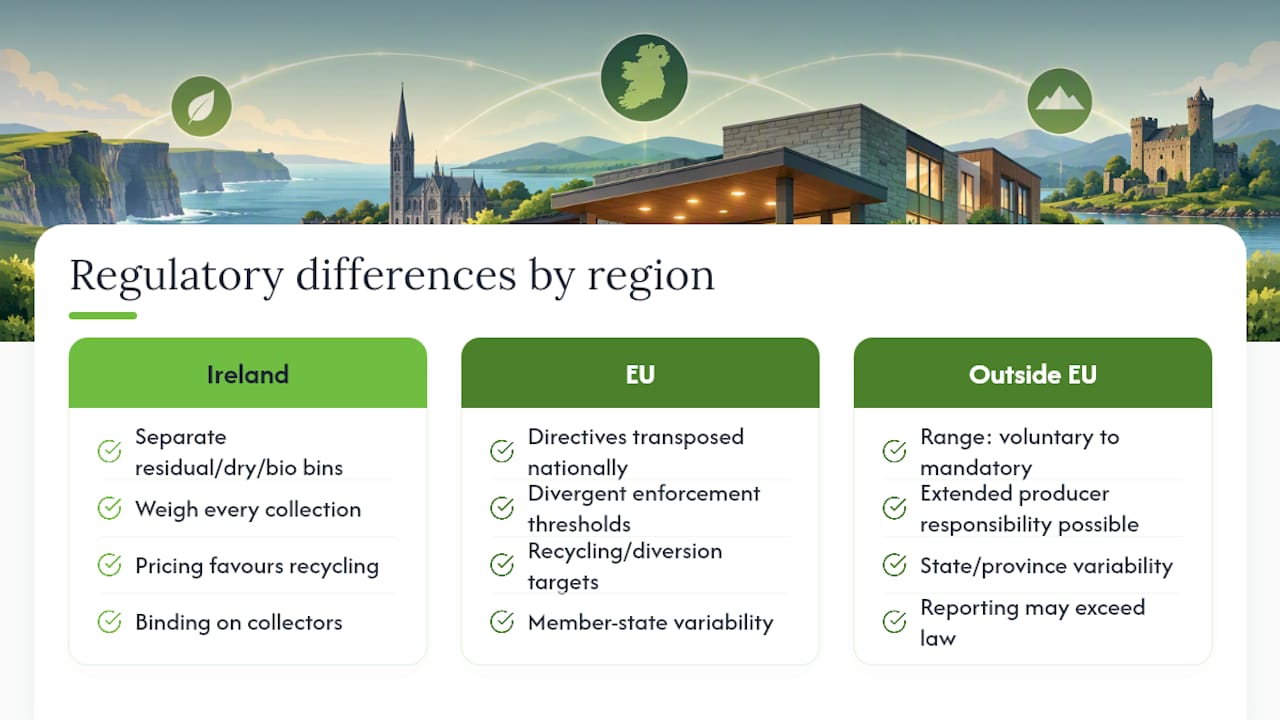
In Ireland, commercial waste collection has operated under incentivised charging since 1 July 2023: collectors must supply separate residual, dry recyclable and bio-waste bins, weigh every collection, and structure pricing so that recycling and organic waste collection cost less than sending equivalent material to residual disposal. This is a binding requirement on collectors, not a voluntary scheme, and hotel contracts should reflect it explicitly.
Across the EU more broadly, waste framework directives set diversion and recycling targets that member states transpose into national law with varying enforcement mechanisms and reporting thresholds. Hotels operating across multiple EU countries should not assume that Irish requirements apply elsewhere, even where the underlying EU directive is shared, because national transposition details differ.
Outside the EU, requirements range from voluntary sustainability reporting frameworks to mandatory extended producer responsibility schemes, depending on the country and, in federated systems, the specific state or province. Reporting obligations tied to hotel certification programmes, corporate ESG disclosure requirements, or franchise brand standards often exceed baseline legal minimums, so treat regulatory compliance as a floor rather than the target.
The practical takeaway for any multi-property operator: confirm the specific regional rule before assuming a policy from one market transfers to another, and build your reporting template to capture the metrics your strictest jurisdiction requires, then apply that same rigour everywhere.
How does waste management fit into a hotel’s wider sustainability programme?
Waste sits inside a bigger system, and treating it as an isolated cost centre misses most of the value. Energy, water and waste programmes overlap constantly: a property that measures and reduces food waste is usually the same property with disciplined kitchen energy use, because both come from the same operational rigour rather than separate initiatives.
Certification frameworks reflect this overlap directly. Sustainability standards used across the hospitality sector typically bundle waste diversion targets alongside energy intensity, water use and carbon reporting, because auditors and guests alike now expect a coherent programme rather than isolated wins. A hotel that can show strong diversion rates but has never measured energy use looks incomplete to any serious certification body.
Carbon reporting is where the connection becomes concrete. Landfill-dependent hotels in one Irish audit of 30 properties produced 39% more carbon than circular-focused operators, a direct link between waste diversion practice and a property’s overall emissions profile. Any hotel building a carbon reduction plan without addressing waste diversion is leaving one of the more accessible reduction levers untouched.
Practically, this means your green team’s remit shouldn’t stop at waste. The same monthly reporting cadence covering tonnes by stream and diversion rate should sit alongside energy and water metrics on one dashboard, reviewed by the same team. Separate reporting streams for separate resources tend to produce separate, uncoordinated actions, whereas a single sustainability report forces trade offs and priorities to be weighed together.
Does better waste management change how guests and owners see your brand?
Guests notice waste practices more than most managers assume, and increasingly factor them into booking decisions and reviews. A visible recycling system, honest signage, and staff who can answer a guest’s question about sustainability practices all signal operational competence that extends well beyond waste.
The reputational risk runs in both directions. A hotel caught greenwashing, claiming sustainability credentials without underlying data to support them, faces a sharper backlash than one that simply says nothing, because guests and increasingly journalists check specific claims against evidence. This is precisely why a measured, auditable baseline matters more than a marketing statement: if you claim a diversion rate, you need the audit data behind it.
For ownership groups and franchise brands, waste performance increasingly features in operator scorecards and ESG disclosure requests from investors. A property manager who can produce a monthly report showing tonnes diverted, food waste per guest-night and year-on-year improvement is in a materially stronger position during brand audits or refinancing conversations than one who can only describe general good intentions.
Corporate and events bookers have become a specific driver here. Businesses booking conference space or long-stay corporate accounts increasingly ask for sustainability data as part of procurement, and a hotel with genuine measurement in place answers that question in minutes rather than scrambling to produce an estimate. That single capability has, in several sector accounts, become a differentiator in competitive corporate bids where room rates and amenities were otherwise comparable.
Author perspective: why measurement-first pilots outlast big sustainability launches
Most hotels don’t fail at waste reduction because they lack ambition, they fail because they launch a comprehensive programme with no baseline to measure it against. I’d rather see a manager run one measured pilot, a buffet format change, a new segregation contract clause, than announce a five-point sustainability plan with no numbers behind it. Pilots that show a verified tonnage drop get funded again. Vague initiatives quietly disappear after one budget cycle. Start with the audit. Everything durable follows from there.
— Graham
Get a baseline, then get paid for your recyclables
Compact’s free waste audit gives you the tonnage, contamination and diversion baseline this entire approach depends on, at no cost to your property.
Where other routes leave you guessing at savings before committing to equipment, Compact starts with the data: you see your actual cardboard, food waste and residual volumes before deciding whether a baler, compactor or composter makes financial sense. Once you’re baling cardboard or plastic film consistently, the bale buyback scheme pays you directly for that material, so what used to be a line-item cost becomes a source of ongoing revenue instead. There’s no need to manage separate vendors for audit, equipment and recycling income. Book your free waste audit and get the baseline figures your team needs before the next budget cycle.
Sources
- Hotel Waste Measurement Methodology
- Introduction of incentivised waste collection charges will increase sustainability in the commercial sector
- From Linear to Circular Transition: A Multi-Level Perspective on Waste Generation and Circularity Potential in Irish Hotels
FAQ
What are the main types of waste found in hotels?
Hotels typically generate food waste, mixed recyclables (cardboard, plastic, glass, metal), general residual waste, and hazardous waste such as pool chemicals, batteries and fluorescent tubes. A 30-hotel Irish audit found average composition of 50.5% general waste, 30.3% food waste and 19.1% recycling.
What are the 7 steps in managing hotel waste?
A practical sequence runs: define audit boundaries, measure baseline tonnage, categorise streams, identify prevention opportunities, improve segregation infrastructure, invest in equipment where volumes justify it, then report and adjust monthly. This mirrors the structure set out in the Hotel Waste Measurement Methodology.
What are the four main types of waste management?
The commonly recognised categories are prevention (reducing waste at source), reuse, recycling or composting, and residual disposal to landfill or energy recovery. Effective hotel programmes prioritise them in that order, since prevention avoids cost entirely rather than just diverting it.
How much can a hotel save by reducing food waste?
Sector pilots show many properties recoup their investment within one year, and the majority within two, driven mainly by menu, portioning and buffet changes rather than new equipment. Results depend on consistent measurement to verify savings against baseline.
Does Compact charge for a waste audit?
No, Compact’s waste audit is offered free of charge and gives you baseline tonnage, segregation and contamination data. Equipment such as balers and compactors is priced individually and available on request through Compact’s site.