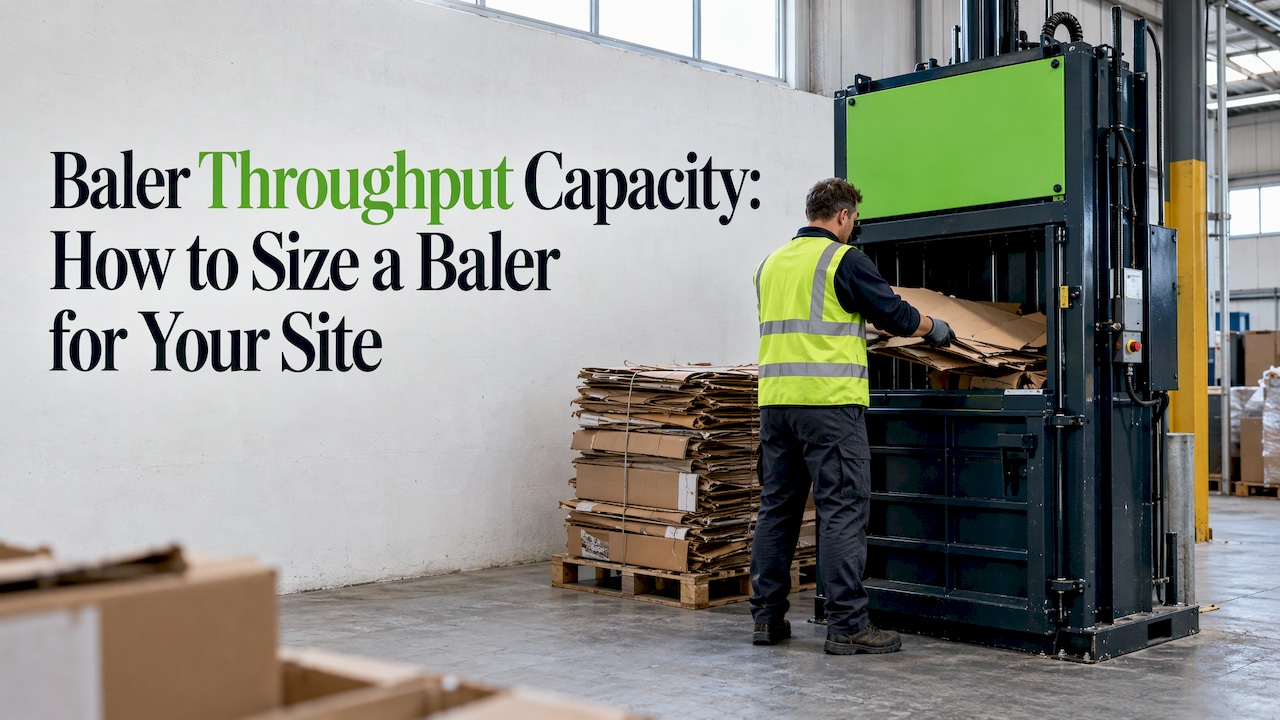
Baler throughput capacity is the amount of material a baler can process in an hour or a shift, usually quoted in tonnes per hour. It is not the weight of one bale, and it is not the number on the brochure. For most Irish retailers, warehouses and factories, the figure that matters is how much cardboard or plastic arrives in your busiest hours and whether the baler, the loading method and the bale collection can all keep pace. We size balers from that peak, not from catalogue maximums, and the first step is a free waste audit that measures what your site actually produces.
TL;DR
- Throughput is continuous output over time (tonnes per hour). Bale weight is the output of one cycle. Do not mix them up when reading a specification.
- A rated figure assumes uniform material, steady feeding and no stoppages. Your real figure depends on your material, how it is loaded and how quickly bales are cleared.
- Size the baler from your peak hours, not your daily or weekly average, and leave headroom rather than buying the maximum.
- A baler is only as fast as its loading, tying and bale removal. A bottleneck anywhere caps the whole system.
- Check the collection arrangement for baled material before you invest, then match bale size and weight to your forklift and your buyer.
Table of Contents
- What throughput capacity actually means
- Typical throughput by baler type
- Why real throughput is lower than the rating
- How to size a baler for your waste
- Avoiding the bottlenecks around the baler
- What throughput means for your costs
- A quick sizing checklist
- Get your baler sized from your own numbers
- FAQ
- Sources
What throughput capacity actually means
Two numbers appear on almost every baler specification, and they answer different questions.
Bale weight is what one finished bale weighs. It tells you what your forklift or pallet truck must lift and what a buyer will receive.
Throughput is how much material the machine can compress over a period of time. One industry explainer puts the distinction simply: throughput reflects continuous performance across a shift, while bale weight reflects a single cycle. We cite it only for that definition.
The link between them is arithmetic you can do yourself:
Throughput = bale weight x bales completed per hour
Take an illustrative case, not a Compact specification. A machine making 450 kg bales and completing three an hour is processing 1.35 tonnes an hour. If the operator needs ten minutes to load, tie and eject each bale, you will never see more than six bales an hour regardless of what the brochure says. Throughput is the result of the whole cycle, not just the press.
Why the word “capacity” confuses buyers
Searching for baler capacity returns a mixture of results: agricultural wrap balers, large square balers pulled by tractors, and industrial waste balers. They use the same word for very different things. A farm baler quoting bales an hour behind a tractor tells you nothing about a vertical cardboard baler in a supermarket back yard. If you run a business that generates cardboard, plastic film or similar dry recyclables, you are in the waste baler category, and the rest of this guide is written for you.
Typical throughput by baler type
Throughput rises sharply as you move from vertical to horizontal machines, and again when you add automatic tying and a mechanised feed. Published ranges vary by manufacturer and by material, so treat the following as an orientation, not a promise.
| Baler type | Typical use | How throughput is usually described |
|---|---|---|
| Vertical baler | Shops, restaurants, hotels, small manufacturing | Measured in bales per shift or per day. Operator loads, ties and removes each bale by hand |
| Semi-automatic horizontal | Mid-sized distribution and manufacturing sites | Several tonnes an hour at the upper end, with the operator still tying or assisting |
| Fully automatic horizontal or channel baler | Large distribution centres, recycling sites | Continuous feed and automatic tying, quoted in tonnes per hour |
| Twin-ram baler | High-volume recycling and processing | The highest throughput class, built for dense bales for export or shipping |
For a sense of scale at the top end, a twin-ram baler installed at a Northern Ireland recycler was reported to achieve up to 13.5 tonnes per hour on cardboard and up to 30 tonnes per hour on refuse-derived fuel. That is the lesson to take from it: the same machine, with the same press force, produced more than double the hourly output depending on what went into the chamber. A figure without a material attached is incomplete.
Most Irish businesses reading this will never need that class of machine. A shop, a warehouse or a hotel typically needs a baler that comfortably clears its peak cardboard and then sits idle, and that points to a vertical machine or a compact horizontal. Our cardboard baler range covers that spread, and the guide to cardboard baler sizes shows how footprint and bale size line up with typical Irish sites.
Why real throughput is lower than the rating
A manufacturer’s rating describes good conditions: uniform material, a steady feed, no pauses. Your site has none of those. In practice, the figure you achieve is shaped by:
- Material type and density. Flattened corrugated cardboard compresses quickly. Bulky, uncrushed boxes, soft plastic film and mixed loads fill the chamber with air and take more cycles per tonne.
- How the material is fed. Hand loading is limited by the person at the machine. A conveyor or tipper keeps the chamber full without waiting.
- Operator routine. Tying, ejecting and moving a bale all take time, and they take more time on a manual machine.
- Moisture and contamination. Wet or dirty material behaves differently from clean, dry stock and can slow the cycle.
- Bale format and tying. Larger bales mean fewer cycles but more to handle. Automatic tying removes a pause from every cycle.
- Interruptions. Breaks, shift changes, a full bale store or a late collection all stop the machine.
The practical conclusion: a catalogue number tells you the ceiling. Your own waste stream, your staffing and your layout decide how close you get to it.
How to size a baler for your waste
Here is the routine we use when we look at a site, and one you can follow yourself to understand the answer.
Step 1: Measure your peak, not your average
Twenty tonnes of cardboard spread evenly over a week is a very different job from twenty tonnes that arrive in a few delivery windows. Your baler has to cope with the delivery morning, not the quiet Thursday. Record what arrives on your busiest days, which material it is, and how long it takes to appear. Our waste audit checklist sets out how to weigh and log this properly, and it is the part most sites skip. Without weights, every later step is a guess.
Step 2: Convert the peak into an hourly figure
Divide the peak quantity by the hours you realistically have to bale it. Count only productive hours: remove breaks, tying time and the interruptions that always occur.
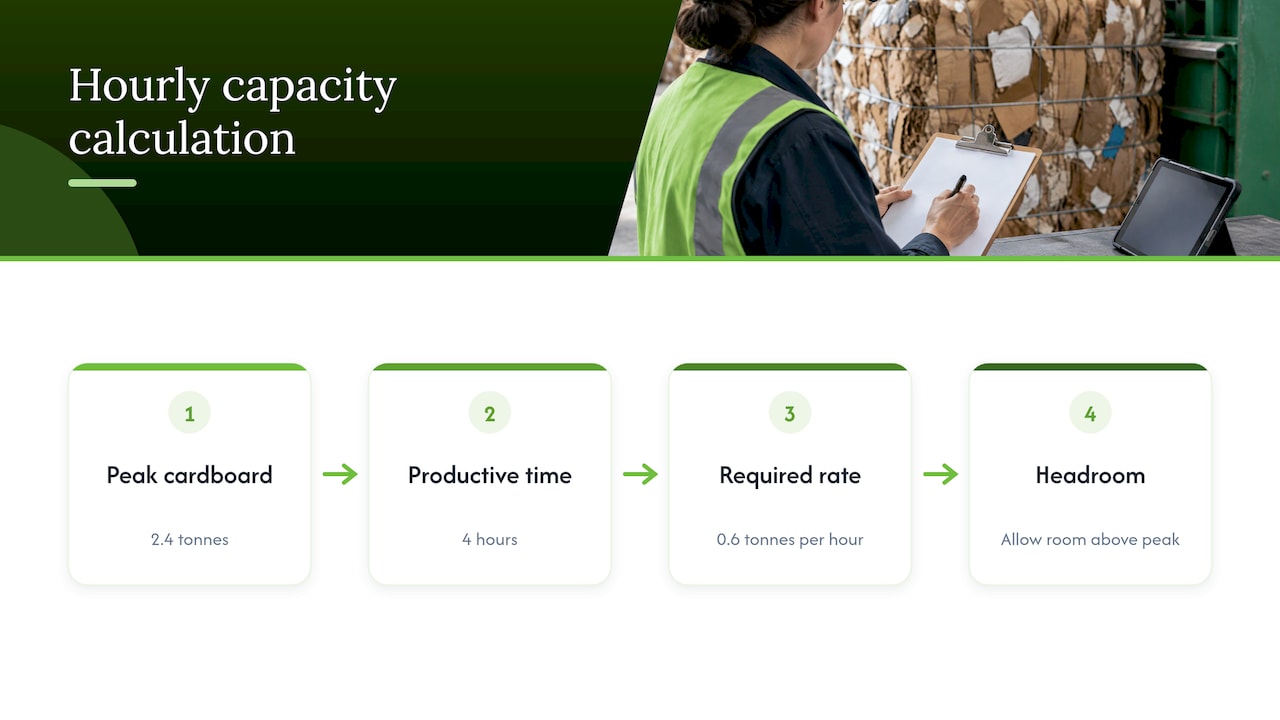
A worked example, again illustrative: a distribution unit receives 2.4 tonnes of cardboard on its busiest morning and wants it baled within four productive hours. That is 0.6 tonnes an hour. A site with this profile does not need a machine rated in double-digit tonnes an hour. It needs a baler and a loading routine that reliably deliver 0.6 tonnes an hour at peak with some room to spare.
Step 3: Add headroom, not maximum capacity
Specify a little above your peak so that growth and bad days do not overwhelm the machine. Do not specify the biggest machine you can afford. Paying for capacity you rarely use costs money in purchase price, floor space and power, and it can also produce bales that are larger or denser than your forklift or buyer wants.
Step 4: Match the machine class to the site
The broad rule is that vertical balers suit retail, hospitality and light manufacturing, and horizontal balers suit larger sites where continuous or semi-automatic feeding saves labour. Space, power supply and staffing narrow the choice further. If budget is the constraint, a refurbished compactor or baler can put a higher-class machine within reach, and our price guide for Irish cardboard balers explains what drives the cost.
Step 4b: Consider a compactor instead
If your material is mixed, wet or not worth baling, a compactor may fit better than a baler. Our guide to choosing a cardboard compactor walks through where each machine earns its place.
Step 5: Check the collection arrangement first
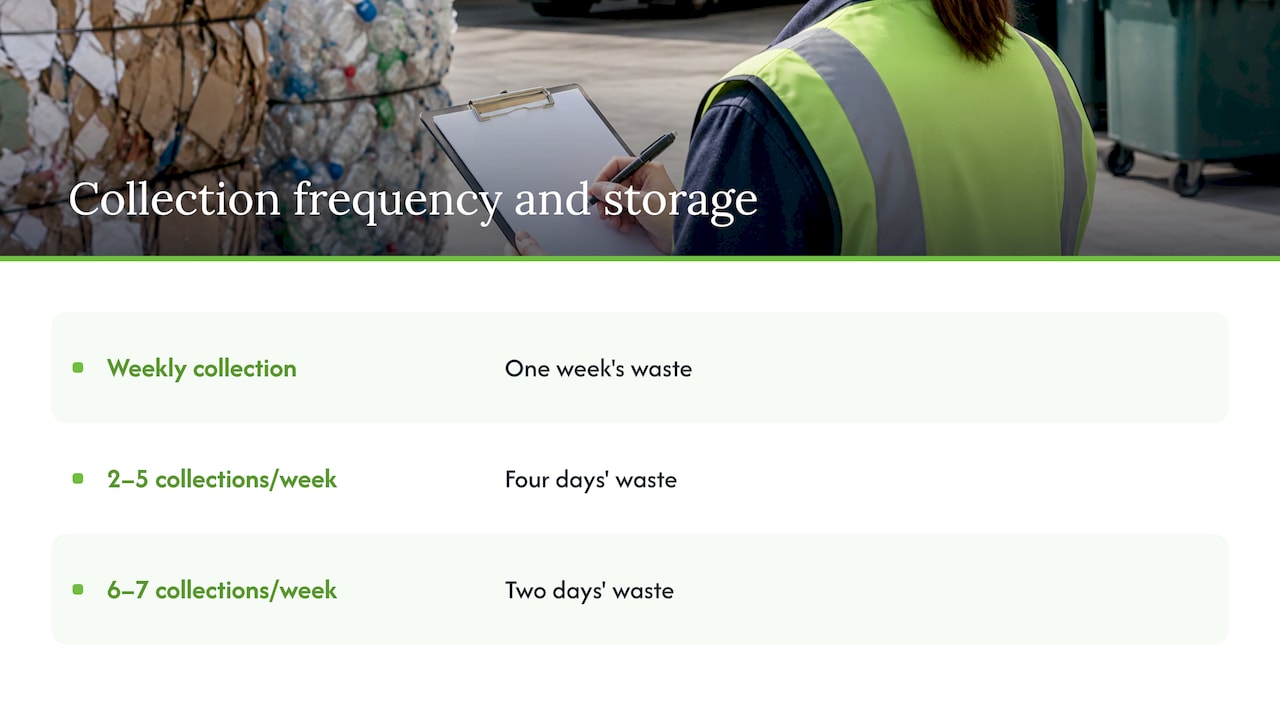
A baler that nobody will collect from is a poor investment. Guidance from the Northern Ireland Building Control waste storage guide, published in 2010, sets the storage you should plan for by collection frequency: a week’s waste for a weekly collection, four days’ waste for two to five collections a week, and two days’ waste for six or seven. It also notes that councils and waste contractors may not accept baled waste. That guide applies in Northern Ireland, but the principle holds in the Republic: confirm what your collector or buyer will take, in what bale size and weight, before you commit to a machine.
Avoiding the bottlenecks around the baler
Buyers tend to fixate on the press. In our experience of how these installations are specified, the limit is usually somewhere else in the chain. Work through each link:
- Loading. If cardboard has to be carried across a yard and fed by hand, the operator sets the throughput. A larger feed opening, a ground-level loading position or a mechanised feed reduces the time between cycles.
- Tying. Manual wiring pauses the machine on every bale. Automatic tying removes that pause on machines that offer it. Whichever you use, keep baling wire and tape stocked so a missing reel never stops the line.
- Bale removal and storage. A full bale store stops production as surely as a breakdown. Calculate how many bales your peak produces and where they sit until collection.
- Forklift and handling. Match bale weight to what your forklift can lift and what your buyer’s vehicle can carry. A bale you cannot move safely is a bale you should not make.
- Collection frequency. The less often bales are collected, the more space you need. More frequent pickups let you run a smaller store.
High-throughput sites that bale continuously also tend to look at what happens to material that cannot be baled. Residual streams are increasingly assessed for energy recovery, including converting waste into green hydrogen, and that conversation starts from knowing exactly how many tonnes you handle and how reliably.
What throughput means for your costs
Throughput feeds straight into the economics of your recycling:
- Labour. The slower and more manual the cycle, the more staff minutes go into every tonne. Horizontal and automatic machines cut labour per bale at higher volumes, at a higher purchase price.
- Collections. Denser, well-formed bales fill a container or lorry better, so you pay for fewer collections.
- Bale value. Clean, well-tied, correctly sized bales are what buyers want. Poor bales are harder to sell and can be rejected.
- Handling. Larger bales save cycles but need suitable lifting equipment and storage.
The last point is where baling turns from a cost into income. Cardboard that is clean and baled to the right specification can be sold, and our guide to cardboard bale prices shows what Irish buyers pay. Under our bale buyback programme, we buy the bales back, so throughput that produces consistent, good-quality bales is worth money rather than just saving it.
A quick sizing checklist
Before you ask for any quote, have these answers ready:
- Which materials do you bale: cardboard, plastic film, or both?
- How many tonnes arrive on your busiest day, and over how many hours?
- How many productive hours are available to bale at peak?
- Who loads the machine, how, and from how far away?
- What bale size and weight can your forklift and your collector handle?
- Where will bales be stored, and how often are they collected?
- How much floor space, headroom and power supply does the location offer?
If you cannot answer the first three, start there. That is exactly what an audit is for.
Our view on throughput
Most baler enquiries begin with the wrong question: how big a machine can I get? The better question is how much material you need to clear at your worst hour, and what stops you doing it. Over-specifying leaves you with a machine, a footprint and a power bill you never fully use. Under-specifying leaves bales piling up and staff working around the problem.
We start with the numbers. A free waste audit weighs what you produce, sees how it is handled and checks what your collection arrangement allows. From that we can point you to the right class of machine, whether vertical, horizontal or a compactor, and whether new or refurbished makes sense.
The second half of the question is what happens to the bale. We offer a single point of service from audit through equipment to recycling and payment, so the baler you choose is sized for the bales we will buy back. A well-sized baler producing clean, consistent bales turns what was a disposal cost into a revenue line.
Graham
Get your baler sized from your own numbers
If you would rather not do the weighing and the arithmetic yourself, we will do it with you. Our free waste audit looks at the material your site generates and how it is handled, then recommends the equipment and the collection arrangement that fit. Once the baler is running, our bale buyback scheme pays you for the cardboard and plastic you bale.
For larger or specialist needs, see our Strautmann balers, the Autoload baler for mechanised feeding, or the Jumbo Load baler for higher volumes.
FAQ
Is baler throughput the same as bale capacity?
No. Bale capacity, or bale weight, is what a single bale weighs. Throughput is how much material the baler processes over an hour or a shift. Multiply bale weight by the number of bales you complete each hour and you get a realistic throughput.
What throughput does a typical shop or warehouse need?
It depends on your peak, not your weekly total. Divide the cardboard that arrives on your busiest day by the productive hours you have to bale it, then add some headroom. Many shops and small warehouses land well inside the range of a vertical baler, while larger distribution sites look at horizontal machines. A waste audit gives you the peak figure to work from.
Why is my baler slower than its specification?
Specifications assume uniform material, steady feeding and no stoppages. Slow loading, bulky or mixed material, manual tying, waiting for a forklift or a full bale store all reduce real output. Look at the whole cycle from loading to bale removal, not just the press.
Do I need a bigger baler to make more money from bales?
Not necessarily. Income depends on producing clean, well-formed bales to the size and weight your buyer wants, consistently. A baler matched to your volume and fed properly does that better than an oversized machine used occasionally.
Sources
- Understanding baler throughput rates
- Twin-ram baler installation in Northern Ireland
- Northern Ireland Building Control waste storage guide