Store bales on firm, level, well-drained ground, stack them no more than three high (two if they are soft), keep silage bales at least 20 m from surface water unless you have effluent collection, and keep hay and straw well away from buildings. Those are the core rules from the Health and Safety Authority (HSA), Teagasc and Irish water regulations. This guide sets them out in order. It then covers the other kind of bale many Irish sites handle: baled cardboard and plastic waiting for collection.
TL;DR
- Choose a level, smooth, hard or well-drained site with easy access and no overhead power lines. Soft or uneven ground raises the risk of machinery incidents and bale movement.
- Stack round bales no more than three high, or two if they are soft or unwilted, and keep them on their curved sides in a pyramid, chocked at the bottom row.
- Under the Irish GAP regulations, silage bales must not be stored outside farmyards within 20 m of surface water or a drinking water abstraction point without effluent collection. Without it, stack two high at most.
- Keep moisture low in hay and straw, and check packed hay with a temperature probe after baling. Store flammable material well away from houses and livestock buildings.
- Baled cardboard and plastic need their own plan: dry, stable, accessible and away from ignition sources.
Table of Contents
- Two kinds of bale, one set of principles
- Choosing the storage site
- Stacking heights and methods
- Protecting water: the 20 m rule for silage bales
- Keeping bales in good condition
- Fire: temperature checks and distances
- Keeping people safe around stored bales
- Storing baled cardboard and plastic on a commercial site
- Turn site waste into storable, saleable bales
- FAQ
- Sources
Two kinds of bale, one set of principles
In Ireland, “bale storage” usually means forage: hay, straw and wrapped silage. The HSA notes that baled silage is now made on over two-thirds of Irish farms and accounts for one third of all silage made. That is a lot of heavy, awkward bales sitting in yards and field corners (HSA, Working Safely with Bales on the Farm).
Businesses also bale. Retailers, manufacturers, logistics hubs and food producers press cardboard, plastic film and similar material into dense bales that wait on site until a buyer collects them. The materials differ, but the same questions apply. Is the ground firm? Is the stack stable? Is it away from water, ignition sources and people who should not be near it?
The first half of this guide follows Irish farm guidance, because it is the official rulebook for forage bales. The second half applies the same thinking to recycling bales.
Choosing the storage site
The HSA advises picking an uncluttered site from which bales can be removed conveniently and safely at feeding time. The ground should be level, smooth and, where possible, hard or well drained, because soft or uneven ground increases the risk of machinery incidents. Stacks should sit well away from overhead power lines (HSA).
A practical checklist before you commit to a spot:
- Surface: firm and smooth. For wrapped silage, the surface also must not puncture the film.
- Slope: as flat as you can find. Teagasc advises storing on level ground to reduce the risk of movement (Teagasc, Take care of Silage Bales).
- Access: room for a loader or bale grab to approach and leave without reversing blind.
- Clearance: no overhead lines. Agriland, reporting the HSA’s advice, adds that bushes, briars and low overhanging branches should be removed (Agriland).
- Distance: away from watercourses (see below) and from homes and livestock buildings (see the fire section).
If you must use sloping ground, Teagasc says to place bales with their flat ends facing the slope, or on their flat end.
Stacking heights and methods
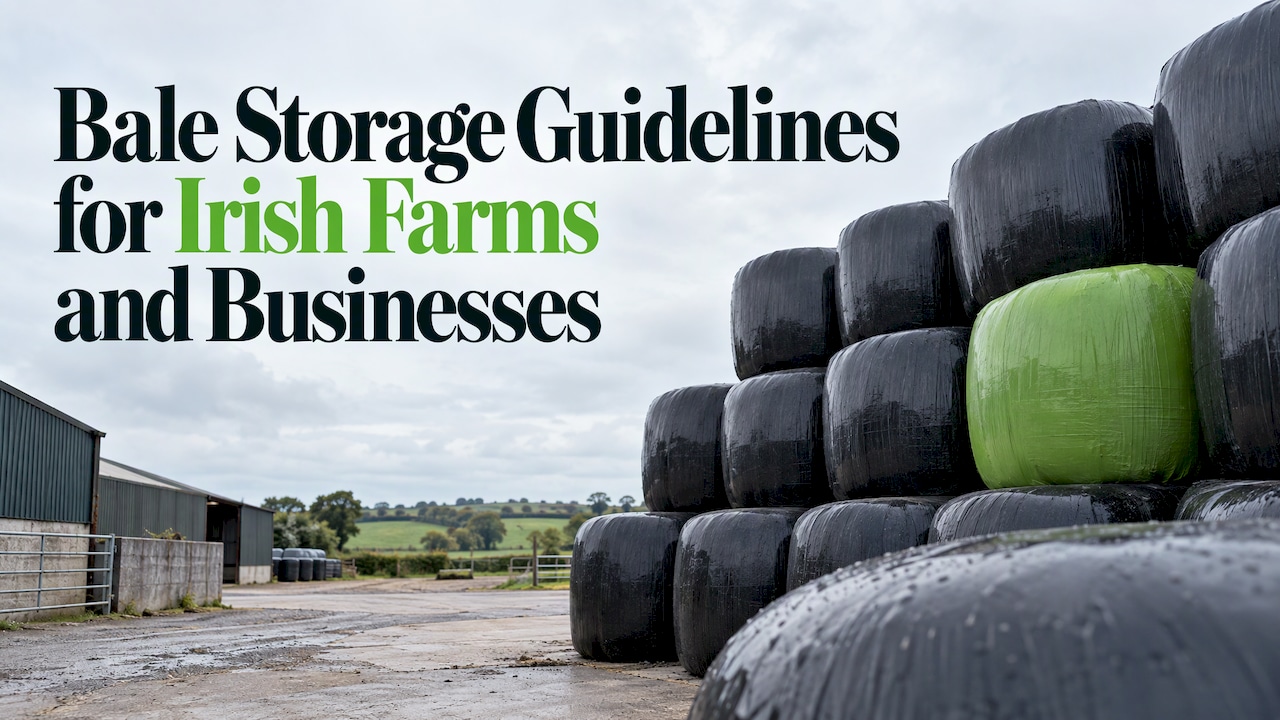
The HSA gives a clear maximum: no more than three round bales high. Where bales are not very dense, such as unwilted hay, or are soft, which for wrapped silage means below 35% dry matter, the advice drops to two high (HSA).
The safest way to stack round bales, according to the HSA, is on their curved sides in a pyramid. The bottom row’s outer bales should be held with chocks or other supports. Stacking round bales on their ends is not recommended, because variable density lets them shift.
The stakes are real. Teagasc reports that the HSA states at least 5% of farm workplace deaths result from falling bales. It recommends that where stacking is unavoidable, bales go on their curved sides. Round bales on their ends should only be a single layer on level ground (Teagasc, Farm safely this summer).
Weight matters too. Teagasc notes silage bales can weigh from 350 to 1,000 kg depending on moisture. A wet, heavy bale at the top of a stack is a different proposition from a dry one.
| Situation | Maximum stack | Source |
|---|---|---|
| Dense round bales | 3 high | HSA |
| Unwilted hay or soft silage bales (below 35% dry matter) | 2 high | HSA |
| Silage bales without adequate effluent collection | 2 high | S.I. No. 113/2022 and S.I. No. 588/2025 |
| Round bales on their ends | Single layer, level ground only | Teagasc / HSA |
Protecting water: the 20 m rule for silage bales
This is the rule that catches people out. Under Article 15 of the European Union (Good Agricultural Practice for Protection of Waters) Regulations 2022, silage bales must not be stored outside farmyards within 20 m of surface waters or a drinking water abstraction point unless there are adequate facilities to collect and store any effluent. Where those facilities are inadequate, bales may only be stored two high (S.I. No. 113/2022).
The 2025 Regulations carry this forward. They also require that effluent from silage bales in a building or yard is collected and held so that it cannot run off or seep into groundwater or surface water (S.I. No. 588/2025). Teagasc’s field guidance says the same in plain terms: in a field, keep bales 20 m from a watercourse or drain, and in a yard, have facilities to collect effluent (Teagasc).
Why so strict? The Waters of Life framework says silage effluent has a biochemical oxygen demand of 30,000 to 80,000 mg/l, against less than 2 mg/l for unpolluted surface water. In a stream it strips out oxygen fast and causes fish kills (Waters of Life Framework).
The same framework suggests ways to cut the problem at source:
- Wilt silage for two to three days, depending on weather, to reach 25% to 30% moisture.
- Wrap in impermeable plastic.
- Store ideally on hard-core or concrete.
- Stack no more than two bales high.
Silage made in wet weather has more moisture and is more likely to produce effluent, particularly when stacked two rows high. If you are in the Basic Income Support or other schemes with conditionality requirements, Teagasc’s summary of the Department’s handbook repeats the two-high and 20 m limits (Teagasc, DAFM handbook summary).
Keeping bales in good condition
Wrapped silage
Teagasc advises carrying bales to the storage yard straight after baling and wrapping, while they are still firm. Place them on a surface that will not puncture the film, inspect them regularly through the year, and repair any damage with silage tape.

The payoff for that discipline is long storage life. Teagasc adviser Kevin O’Sullivan explains that bales stay safe for as long as the film keeps air out, so a two-year-old bale can still be in good condition. Damaged film lets air in, and mould and localised rot can then spread through the bale (Teagasc). Bird and rodent damage, and sharp stubble or stones under the bale, are the usual culprits, so a clean hard base earns its cost.
Hay and straw
Moisture is the number to watch. The CFPA-E guideline on self-ignition says a moisture content of 20% or higher, with enough air, is a necessary condition for self-ignition in hay and straw. Below 13%, biological activity does not start. For straw going indoors, below 15% at loading prevents self-ignition (CFPA-E Guideline No. 31).

In practice that means not baling damp, and letting hay dry fully in the field before it goes under cover. Hay stored indoors should sit in a clean, dry, ventilated space with room for air to move around the stack.
Fire: temperature checks and distances
Hay fires usually start inside the stack, days or weeks after baling. The CFPA-E guideline recommends checking packed hay twice a day for six weeks after baling with a temperature probe. It gives these readings:
| Core temperature | What it indicates |
|---|---|
| Below 40°C | No sign of self-ignition |
| 60 to 80°C | Consider calling the fire brigade |
| 100°C or higher | A self-ignition fire is under way |
Source: CFPA-E Guideline No. 31. If you reach the middle band, do not start pulling the stack apart on your own. Call the fire service first, because opening a hot stack feeds it air.
On distance, the HSA’s Fire, Electricity and Chemicals guidance says hay, straw and other flammable material should be stored well away from the dwelling house and other stock buildings. Fuels and agrochemicals should be kept securely away from combustible material (HSA). The HSA’s draft Agricultural Code of Practice, published for consultation, recommends a minimum of 18 m between flammable materials and dwellings or livestock buildings (HSA draft Code). As it is a draft, check the HSA site for the final wording.
Teagasc also reminds farmers that fire is a real danger in silage season. Machines should be cleaned down regularly, and extinguishers should be present, checked and refilled (Teagasc).
Keeping people safe around stored bales
The HSA says many people have been killed working with bales on Irish farms, some crushed by falling bales and some rolled over by round bales. The practical rules follow from that:
- Never climb a stack, and never work beside one that is unchocked or higher than recommended.
- Use a bale grab or handler suited to the weight, not improvised lifting.
- Keep children away. The HSA draft Code says children must be kept away from dangerous areas such as stacked bales, and recommends fencing off hazardous areas or high places where they could fall (HSA draft Code).
- Plan the workload. Teagasc notes the hay and silage season brings short working windows, and fatigue is a big risk. It encourages farmers to plan work with contractors in advance (Teagasc).
Storing baled cardboard and plastic on a commercial site
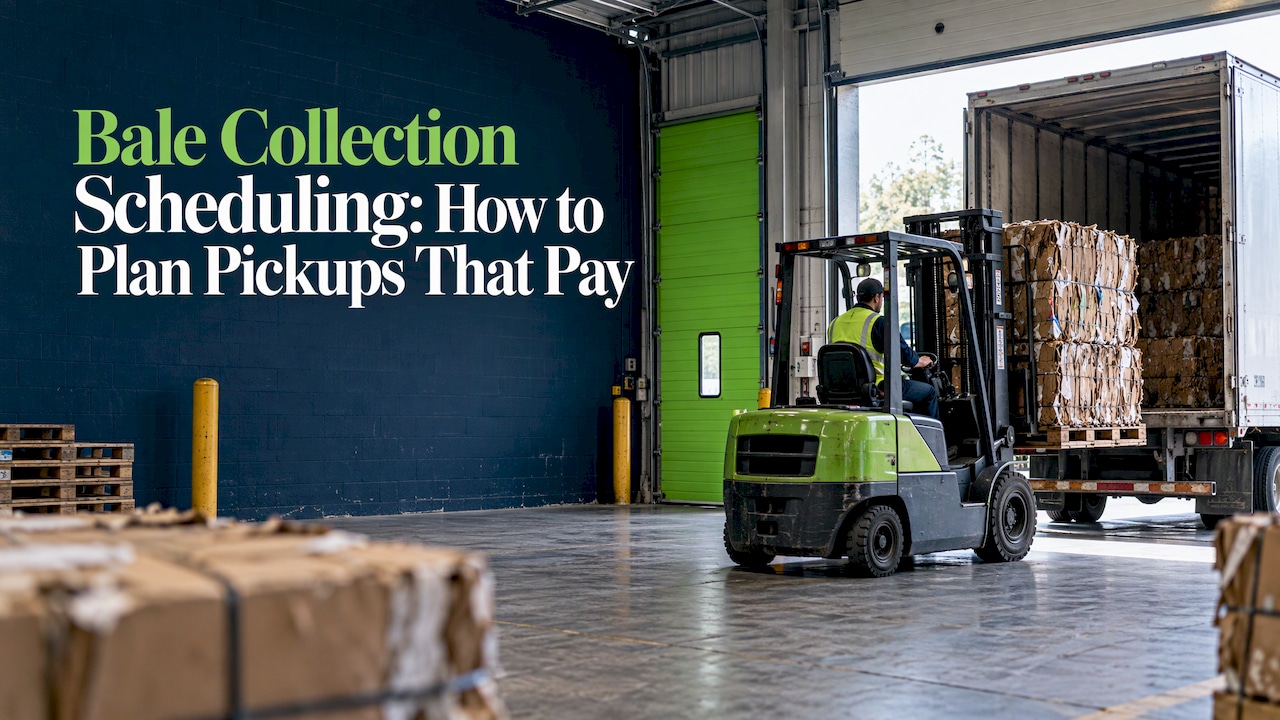
If you run a warehouse, retail unit, factory or facility, your bales are not feed. They are a commodity, and the way you store them affects both safety and what a buyer will pay. The farm principles carry over directly.
Pick a firm, flat, dry spot. A baled load can weigh hundreds of kilos. It needs a level concrete or hard surface, as with silage bales, and protection from rain. Wet cardboard loses value and gets heavier.
Keep stacks stable and low. Stack so the pile cannot topple onto a person or a forklift route, and do not build higher than your handling equipment can safely reach. Strapping that is tight and intact holds a bale together, which is why the right baling wire and tape matters.
Treat baled paper and plastic as combustible. Keep them away from ignition sources, electrical panels and heaters, and keep access clear for emergency crews. Talk to your insurer and fire officer about distances for your site, as they will set the standard for your building.
Plan the footprint before you buy. A baler needs floor area, headroom and power, and you also need somewhere to hold finished bales. Our guide to baler space requirements covers floor area, height and power.
Train the operator. Safe baling and safe stacking go together. Our baler training programme article sets out six safety skills operators need to work alone.
Keep bales clean and sorted. Buyers pay for clean, consistent material. How the market values baled cardboard is covered in our piece on selling cardboard bales, and clean plastic is covered in our plastic bale procurement checklist.
Do not forget liquids. Wet waste streams produce leachate, just as silage produces effluent. If part of your waste is wet, see our leachate management audit article. A dewatering shredder can also be part of the answer.
Our view on bale storage
Most storage problems we see are really planning problems. The bale is made, then someone asks where it goes. On a commercial site, that gap costs money in two ways: space gets lost to loose, bulky waste, and baled material sits in the wrong place and loses value.
We start with the waste, not the machine. A free waste audit looks at what your site actually produces, so the baler or compactor, the storage area and the collection pattern all fit together. Densifying material is only half of it. A bale you can stack safely, keep dry and move easily is a bale you can sell.
That is why we offer one point of service from audit through equipment to recycling and payment. Through our bale buyback programme, cardboard and plastic bales can become revenue rather than a disposal cost. Safe storage and a tidy, well-sized baling area help make that happen.
Graham
Turn site waste into storable, saleable bales
If your business generates cardboard, plastic film or other recyclables, we can help you work out the right equipment and storage set-up. We supply cardboard balers, compactors and refurbished equipment, and we buy back suitable bales through our We Buyback Bales service. Start with a free audit and we will look at your volumes, your space and your collection needs.
Book your free waste audit to see what your site’s waste could do for you.
FAQ
How high can I stack round bales in Ireland?
The HSA advises a maximum of three round bales high. If the bales are not dense, such as unwilted hay, or are soft (wrapped silage below 35% dry matter), it advises two high. Silage bales without adequate effluent collection are limited by regulation to two high.
How far must silage bales be from a stream or drain?
Outside farmyards, silage bales must not be stored within 20 m of surface water or a drinking water abstraction point unless adequate effluent collection facilities exist. This comes from the 2022 GAP Regulations, and the 2025 Regulations continue the effluent requirements. Check the current regulations or ask your Teagasc adviser for your holding.
How do I stop stored hay catching fire?
Bale hay and straw dry, because self-ignition needs moisture of 20% or more with enough air. After baling, check packed hay with a temperature probe twice a day for six weeks. Keep stacks well away from houses and livestock buildings. If readings reach 60 to 80°C, consider calling the fire brigade.
Do the same rules apply to baled cardboard and plastic?
The farm rules are written for forage, so they do not apply directly. The same sound practice does: a firm, flat, dry base, stable stacks, clear access and distance from ignition sources. For your own site, follow your insurer’s and fire officer’s requirements.
Can I be paid for baled recyclables?
Yes, where the material is clean and suitably baled, buyers pay for it. We buy back cardboard and plastic bales from Irish businesses. Our bale buyback programme page explains how it works.
Sources
- HSA, Working Safely with Bales on the Farm
- Teagasc, Take care of Silage Bales
- Agriland, Are you storing bales correctly and safely?
- Teagasc, Farm safely this summer
- S.I. No. 113/2022, GAP Regulations 2022
- S.I. No. 588/2025, GAP Regulations 2025
- Waters of Life Framework of Measures
- Teagasc, DAFM Explanatory Handbook for Conditionality Requirements
- CFPA-E Guideline No. 31, self-ignition in hay and straw
- HSA, Fire, Electricity and Chemicals
- HSA Draft Agricultural Code of Practice
- Teagasc, Make safety a priority this silage season