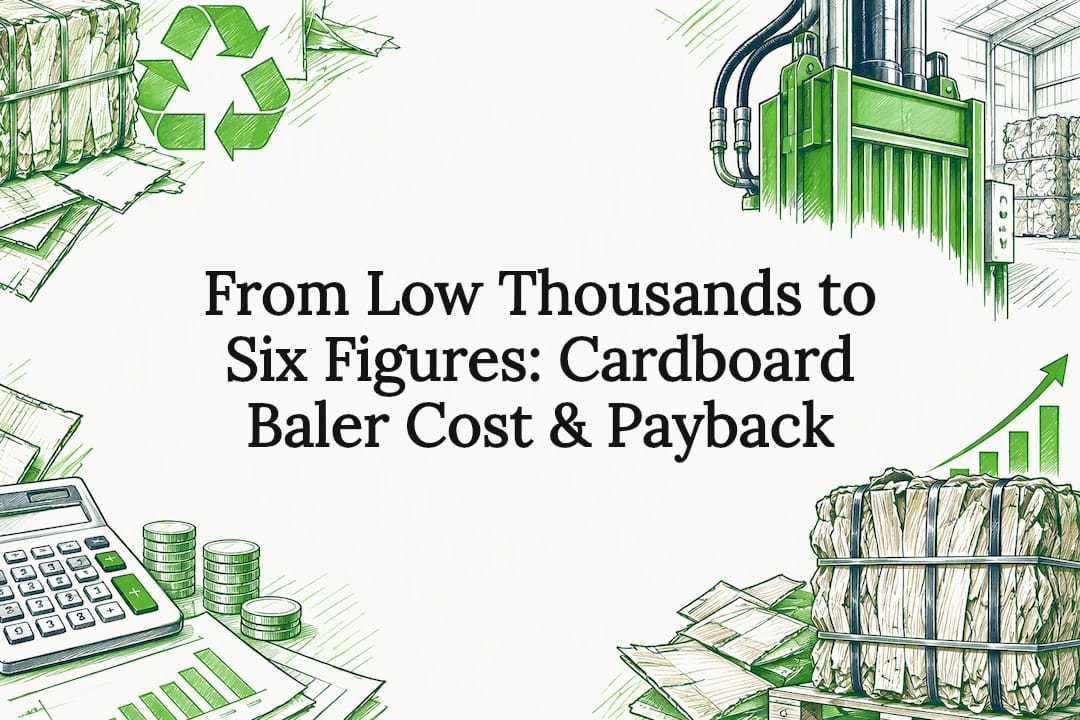
Expect to budget from a low-entry range for small vertical balers to six-figure sums for fully automated horizontal lines, with the exact figure set by machine size, automation level and site complexity. Delivery, installation and annual service commonly add to that base price, so treat the machine cost as a starting point rather than the full project figure. Return on investment then depends on how much you save on haulage and how reliably you can sell the bales you produce.
TL;DR:
Fully automated horizontal balers, suitable for continuous high-volume sites, can cost from tens of thousands to hundreds of thousands of dollars, depending on throughput.
Delivery, installation, and commissioning often add several thousand pounds to the machine’s base price, especially for complex or hard-to-access sites.
Proper waste volume measurement and a site-specific audit can significantly improve budgeting accuracy and reduce the risk of over- or under-sizing the baler.
Bale rebate income fluctuates with market demand, so using a conservative export price estimate and sensitivity testing improves payback predictions.
Leasing, renting, or buying refurbished machines can lower initial costs but require careful evaluation of warranties, spare parts availability, and safety compliance costs.
Table of Contents
Price ranges by baler type and capacity
Baler pricing tracks size, hydraulic power and how much of the process is automated. According to a cost breakdown from Current Cost, basic manual vertical balers can start in the low thousands, which suits smaller retail units or offices generating modest cardboard volumes. Step up to mid-size hydraulic verticals and small horizontals and you move into the mid-range band, a fit for warehouses or distribution depots producing several bales a week.
Fully automated industrial horizontal lines sit at the top end, and the same cost guide puts these systems anywhere from tens to hundreds of thousands, depending on throughput and integration. These are the machines for high-volume operations such as large retailers, logistics hubs or manufacturers generating continuous cardboard waste around the clock.
Automation changes the economics in a specific way: auto-tie systems, infeed conveyors and photocell controls raise the purchase price but cut the labour needed to run the machine, which is where much of the long-term saving comes from rather than from the machine itself.
Entry-level vertical balers suit low-volume sites and typically need manual loading and tying.
Mid-range hydraulic verticals and small horizontals handle higher daily volumes with less operator intervention.
Large automated horizontal lines suit continuous, high-tonnage operations and justify their price through labour and haulage savings.
Auto-tie and conveyor systems add to upfront cost but reduce the ongoing labour needed per bale.
What else counts towards your total project cost
The machine price is only one line on the invoice. A component breakdown from Current Cost shows that delivery, installation and commissioning often add several thousand pounds to the base price once labour and materials are included, so it pays to plan for the whole project rather than just the headline figure.
Delivery and crane costs rise with machine weight and site access; a ground-floor unit with a clear loading bay costs far less to deliver than a machine going into a tight upper-floor space.
Installation and commissioning cover electrical connection, conveyor fitting and any PLC integration for automated lines, all of which add labour hours on top of the equipment cost.
Warranty and service packs vary in scope; a longer warranty or an annual service contract raises the upfront or ongoing cost but reduces the risk of unplanned downtime.
Permits, site works and VAT can apply depending on the installation, and any structural or electrical work needed to prepare the site should be quoted separately from the machine itself.
New, refurbished, lease or rental: choosing your route
Buying new gives you a full warranty, the longest expected service life and predictable maintenance costs, at the price of the highest upfront capital outlay. Refurbished machines lower that capital cost significantly, but the savings only hold if you carry out proper due diligence: check hydraulic cylinder condition, platen flatness and whether the control panel has been updated, and factor in the cost of spare parts you may need early on. Compact’s refurbished compactors and balers range is one option to explore if the lower capital route suits your budget.
Leasing or short-term hire makes sense when volumes are seasonal, when you are testing a new waste stream before committing capital, or when cash flow matters more than long-term ownership cost.
Ask any vendor or lessor what warranty length applies and what it excludes.
Confirm spare parts availability and average lead time before signing.
Get the service SLA in writing, including response time for breakdowns.
Clarify who owns the machine at the end of a lease term.
Working out your payback period
A simple way to frame return on investment is annual net benefit divided by total project cost. Annual net benefit is your haulage savings plus bale rebate income, minus running costs such as electricity, consumables and service contracts.

Take an entry-level vertical baler with a low total project cost after delivery and installation. If reduced skip collections and modest bale sales cover the annual running cost and leave a net benefit, payback typically lands within a couple of years. A mid-range hydraulic vertical or small horizontal, with a higher total cost but proportionally larger haulage savings and bale volume, can reach a similar payback window if throughput is high enough to justify the extra spend.
Model bale rebate income conservatively. Recovered paper export price data shows OCC and cardboard grades move with export and mill demand, so basing your forecast on a price-index average rather than a recent peak avoids overstating your return. Run a sensitivity check too: if rebate income falls by a quarter, or your bale volume varies with seasonal trade, your payback period stretches, and it is worth knowing by how much before you commit.
Pro Tip: Build your payback model around a conservative rebate price and revisit it every time your collection or sales contract comes up for renewal.
Safety and standards that affect installation cost
Compliance is not optional, and it shapes both the installation scope and the ongoing running cost. BS EN 16500 sets safety requirements for vertical baling presses, covering guarding and design features that can influence which model you choose and how much installation work is needed. An EPA safe system of work checklist sets out PPE and procedural controls commonly expected around baler operation, which means budgeting for training and documented procedures alongside the machine itself.
Check the relevant EN standard for your baler type before finalising a spec.
Budget for guarding, interlocks and lock-out systems where they are not already fitted.
Keep training records and safety procedures on file to demonstrate compliance.
What buyers typically get wrong on budget
The most common mistake is sizing the machine to guessed volumes rather than measured ones, which leads to a baler that is too small within a year or too large to justify its running cost. A proper waste audit fixes this by matching the spec to real throughput and often shortens payback as a result. Insist on a site visit and a written commissioning checklist before you sign anything.
— Graham
Get a costed baler proposal
Guessing at machine size from a price list is how most procurement budgets go wrong. Compact’s free waste audit replaces the guesswork with a measured volume estimate, a spec recommendation matched to that volume, and an estimate of likely bale rebate income, so the proposal you receive is costed against your actual waste stream rather than an assumption.
Compact’s Bale Buyback scheme then gives you a route to offset part of that capital outlay: instead of paying to have cardboard collected, you sell the baled material back through Compact, turning a cost line into revenue over the life of the machine. The core question for any baler purchase is not the sticker price but the net cost after haulage savings and bale income, and that is what the audit is built to answer.
Request a free waste audit to get a volume-based baler recommendation.
Ask about Bale Buyback if you want ongoing revenue from your cardboard stream.
Browse Compact’s cardboard baler range to see the options an audit might recommend.
If you are ready to move forward, get your free waste audit and receive a proposal costed against your own volumes.
Sources
FAQ
How much does a cardboard baler cost?
Prices range from a low-entry range for small manual vertical balers to six-figure sums for fully automated horizontal lines, based on component cost data from Current Cost. Delivery, installation and commissioning typically add to that base machine price, so the final project cost depends heavily on site complexity.
Is a cardboard baler worth it?
For most operations generating regular cardboard waste, a baler pays for itself through reduced haulage costs and income from selling baled material, though the payback period depends on volume and rebate prices. A free waste audit can model this against your actual waste stream before you commit to a purchase.
What is the average cost of a baler?
There is no single average figure, since cost depends heavily on machine type, size and automation level. Current Cost’s price bands show a wide spread from entry-level vertical models to large automated horizontal lines, so the right comparison is against machines matched to your own throughput.
How much does one bale of cardboard cost?
Bale value tracks recovered paper market prices rather than a fixed figure, and these move with export and mill demand according to Letsrecycle’s export price data. Modelling your expected rebate income against a price-index average rather than a recent peak gives a more reliable budget figure.