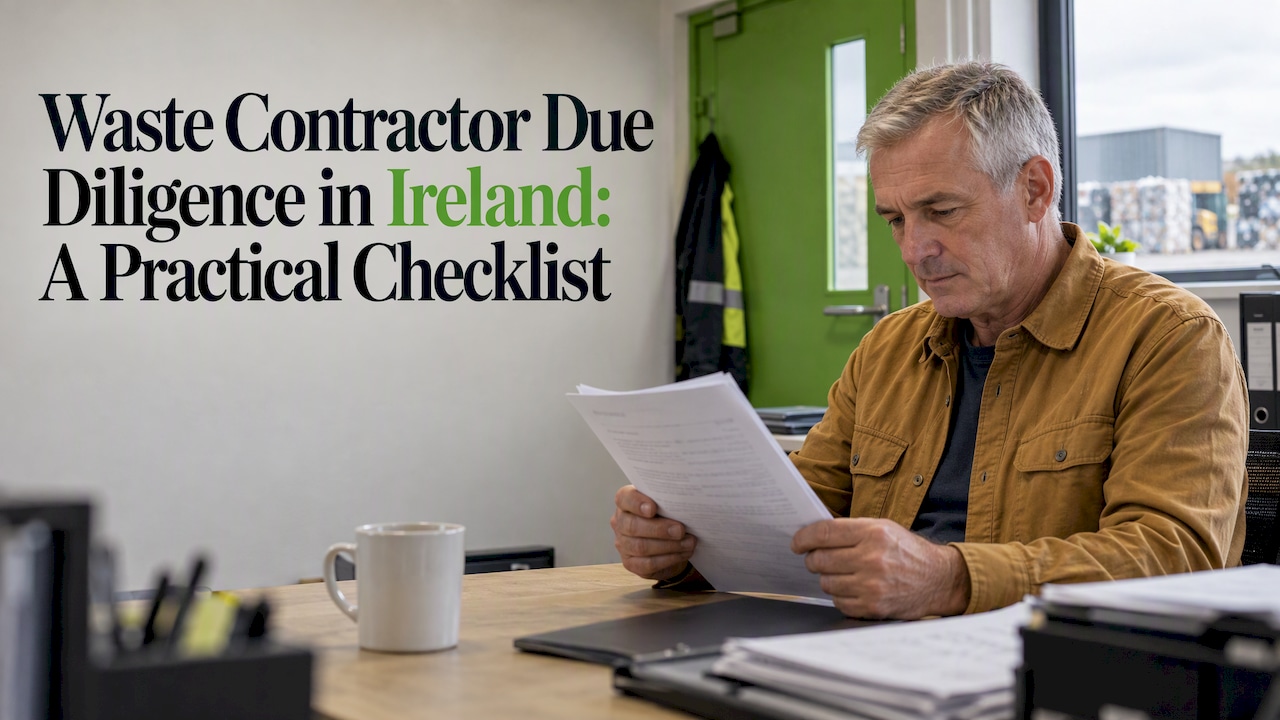
Before you sign with a commercial waste contractor in Ireland, check five things: that they hold a valid waste collection permit, that the permit covers your exact waste codes, that the facilities receiving your waste are authorised, that their insurance and subcontractors stand up, and that the contract gives you weights and records. Your business stays responsible for its waste after the truck leaves, so a gap in any of these lands on you, not only on them.
This guide walks through each check in the order a procurement officer or facility manager would do it, with the official sources to use and the documents to keep.
TL;DR
- The producer of the waste carries primary responsibility for it, so verifying your contractor is your legal interest, not a courtesy.
- Ask for the permit reference and confirm that its schedule lists every EWC code you generate, plus the facilities your waste is sent to.
- Check the receiving facility’s own authorisation (EPA licence, council permit or certificate of registration), not just the collector’s.
- Build a compliance file: permit, transfer records, weighbridge data, invoices and destination evidence.
- Write weights, reporting, extra charges and price-change rules into the contract, then use a waste audit to test the numbers.
Table of Contents
- Why the duty sits with you
- Step 1: Verify the collection permit
- Step 2: Check the permit covers your waste
- Step 3: Check where the waste ends up
- Step 4: Insurance, subcontractors and site safety
- Step 5: What the contract should say
- Records to keep
- Use a waste audit to test the numbers
- Our perspective
- How Compact can help
- FAQ
- Sources
Why the duty sits with you
It is tempting to treat waste as the contractor’s problem once it is collected. Irish policy does not see it that way. The Department of the Environment states that primary responsibility for waste lies with the person holding or producing it, and that nobody may hold, transport, recover or dispose of waste in a way that causes, or is likely to cause, environmental pollution.
In practice, businesses must use an authorised waste collection provider or take waste to an authorised facility. If your contractor tips material at an unauthorised site, you cannot rely on “we paid someone to take it”. That is the reason for due diligence: it is evidence that you took reasonable steps.
The checks below are practical good practice built on those rules. They are not legal advice. If you handle hazardous waste, or you have had an enforcement query, speak to your local authority’s waste enforcement officer or an environmental solicitor.
Step 1: Verify the collection permit
Anyone collecting waste from your premises needs a waste collection permit. Local authorities issue these under the Waste Management (Collection Permit) Regulations 2007 and the 2008 amendment. Applications are now handled centrally: all collection permits are issued by the National Waste Collection Permit Office (NWCPO), which is run through Offaly County Council.
What to do:
- Ask the contractor for their permit number in writing, before the tender or quote is accepted.
- Check that number against the NWCPO records. Do not rely on a PDF the contractor sends you, because it may be out of date.
- Confirm that the legal name on the permit matches the company that will invoice you. Trading names and group companies cause confusion here.
- Note the permit’s validity and set a calendar reminder to recheck it when you renew the contract.
If a contractor hesitates to share a permit number, treat that as your answer.
Step 2: Check the permit covers your waste
A valid permit is not a blanket one. The application must identify each waste type, the estimated quantity, the collection areas and the intended receiving facilities, using European Waste Catalogue (EWC) codes. So the permit schedule is the document that matters, not the front page.
Before you compare quotes, list what you actually produce. A typical mixed commercial site might have:
| Stream | Typical handling question |
|---|---|
| Cardboard and paper | Is the correct packaging code on the schedule, and where is it baled or sorted? |
| Mixed dry recyclables | Which facility sorts it, and what is the reported recovery route? |
| Food and organic waste | Is the collector permitted for it, and is there a brown bin service? |
| Residual waste | Where is it landfilled, incinerated or used for energy recovery? |
| Hazardous or special waste | Is the code on both the collector’s permit and the facility’s authorisation? |
| WEEE, batteries, wastewater, C&D waste | Often outside a standard commercial collection and needing a separate route |
The last row matters. The 2023 amendment defines commercial kerbside waste as excluding wastewater, construction and demolition waste, bulky waste, commercial hazardous waste and streams that must be collected another way, such as WEEE and batteries. A contractor quoting a single “commercial waste” price may not be authorised for everything on your site.
If you want a worked example for one common stream, our guide to cardboard EWC code 15 01 01, baling and audit proof shows how coding and documentation fit together.
Hazardous streams need a double check
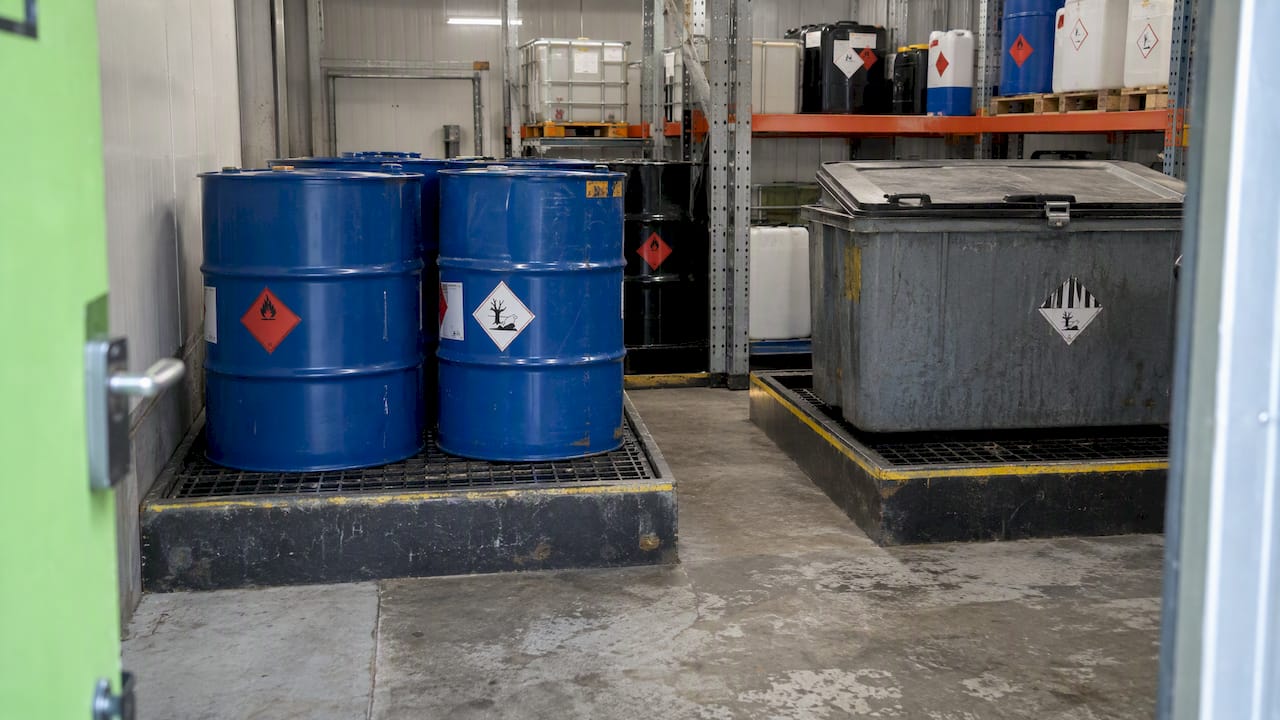
For asbestos, chemicals, oily waste or anything classed hazardous, confirm that the specific code appears on the collector’s permit and the receiving facility’s authorisation. Your own site matters too: staff and drivers should recognise what they are handling, and clear labelling reduces mistakes. A refresher on hazard sign meanings for facility managers helps when you are setting up storage areas for these materials.
Step 3: Check where the waste ends up
The collector is only the first link. Waste then goes to a transfer station, sorting plant, recycler, landfill or energy-recovery facility, or is exported. Each needs its own authorisation.
The EPA explains that disposal and recovery activities need authorisation under the Waste Management Act 1996, unless exempt. Depending on the activity, that means an EPA waste or IPC licence, a local authority waste facility permit, or a certificate of registration. EPA licensing covers the larger activities, such as landfills, transfer stations and hazardous waste disposal.
A short test for each facility on your contractor’s list:
- Which authority regulates it: the EPA or a city or county council?
- Does its authorisation cover your waste code?
- Is the authorisation current, and does the named operator match the facility you are told about?
On reporting, the EPA notes that permitted collectors report the types of waste collected and where it is brought. Irish treatment facilities are authorised by the EPA or, for smaller ones, the local authority, and direct exports are reported to the National Transfrontier Shipment Office. If your contractor says material is exported, ask for the destination and the treatment it receives.
Beware of vague answers such as “it goes to a recycler”. A reliable contractor can name the facility, the route and the outcome, and can show evidence of acceptance at the end of the chain.
Step 4: Insurance, subcontractors and site safety
Permits show legal authorisation. They do not show that a contractor can pay for a spill, a fire or an injury on your property. Ask for current certificates and read them yourself:
- Public liability and employer’s liability, with limits that make sense for the risk on your site.
- Pollution or environmental impairment cover, if your waste could contaminate land or water.
- Vehicle and equipment cover where bins, compactors or balers are serviced on site.
Subcontracting is the quiet risk. Ask directly: will anyone other than your contractor collect or process this waste? If yes, that party needs its own authorisation for the streams concerned, and you want their name in the contract.
Finally, ask about safe working. Request method statements and driver induction arrangements for your site, and check how they handle bin and equipment maintenance. For compactors and balers, make sure responsibilities for servicing, lockout and operator training are written down.
Step 5: What the contract should say
Once the contractor passes the legal checks, the contract decides whether you can verify the service afterwards. Irish rules help you here. Since 1 July 2023, commercial customers must be offered incentivised waste charging and a three-bin system for residual, mixed dry recyclable and organic waste. Waste collectors must also give you data on the weight of waste collected, which lets you check invoices.
Write these items into the agreement:
| Clause | What to specify |
|---|---|
| Scope | Each waste stream and EWC code, with the permit reference |
| Collection frequency | Days, time windows, and what happens on a missed lift |
| Weights and reporting | Weight per lift, per stream, monthly summaries in a usable format |
| Destinations | Named receiving facilities, and notice if they change |
| Charges | Lift fees, per-kilogram rates, contamination fees, call-out and bin rental |
| Price changes | How often prices may move, the notice period and any cap or index |
| Subcontracting | Prior written consent and proof of authorisation |
| Evidence | Access to transfer records and acceptance evidence on request |
| Termination | Notice period, equipment removal and final reconciliation |
Ask for a list of every possible extra charge. Contamination, overweight bins, access problems and fuel surcharges are common sources of invoice surprises. If a rate is not in the schedule, it should not appear on the bill.
Records to keep
Due diligence is only useful if you can show it later. We suggest keeping one compliance file per contractor, with:
- the permit reference and the date you checked it
- the permit schedule showing your waste codes
- the authorisation details for each receiving facility
- transfer records or collection dockets for every lift
- weighbridge or lift weight data and the matching invoices
- insurance certificates with their expiry dates
- contract, change notices and any complaint history
Review the file at least once a year and each time a stream, site or supplier changes. Reconcile a sample: pick three months, then compare the weight reported, the weight invoiced and the destination named. Differences are the early warning that something is wrong.
Use a waste audit to test the numbers
Due diligence on the contractor is half the picture. The other half is what you hand over. If your bins are contaminated or your streams are mixed, you pay more and your contractor’s reporting becomes harder to trust. A waste audit gives you a baseline: how much of each material you produce, where it is generated and what it costs to move.
A good audit helps in three ways. It shows which streams can be separated, so clean cardboard, plastic film or food waste stops inflating the residual bill. It gives you your own weights to compare against the contractor’s. And it shows which streams carry resale value. For a step-by-step method, see our waste audit checklist for managers, or our guides on how to cut waste disposal costs within one or two billing cycles and reduce wet waste weight. If you are in manufacturing, start with our manufacturing waste audit guide. Food businesses should also read food waste regulations in Ireland.
Our perspective
Most businesses we meet ask about price first and permits last. We would reverse that. A cheap lift fee means little if the permit does not cover your codes, or if you cannot see weights to check the bill.
The second thing we see is that well-run sites measure before they negotiate. When you know your tonnages by stream, you can compare quotes on the same basis, and you can see which materials are worth selling rather than paying to remove. Clean, baled cardboard and plastic often behave more like a commodity than a cost, which is why our work starts with an audit and ends, where it makes sense, with a buyback of the bales. You can see how that works in our guide to cardboard recycling rebates for Irish businesses.
What we would ask any contractor, including ourselves, is simple: show me the permit, show me where it goes, show me the weights. If those three answers come easily, the relationship is usually sound.
— Graham
How Compact can help
If you are reviewing your contractor, the cleanest starting point is knowing what you produce. Compact offers a free waste audit for Irish businesses, and where the material suits it, we supply balers and compactors and buy back the bales, so recyclables become a payment rather than a charge.
Book your free waste audit to get a clear picture of your streams, or see how our bale buyback scheme works for cardboard and plastic. If you are weighing equipment, our cardboard balers and cardboard compactors pages are the place to begin.
FAQ
How do I check that a waste contractor is permitted in Ireland?
Ask for their waste collection permit number and verify it with the National Waste Collection Permit Office, which issues all collection permits. Then read the permit schedule to confirm it lists your waste codes and the facilities it uses. A permit alone does not prove coverage for your streams.
Am I still responsible if my contractor dumps waste illegally?
The Department states that primary responsibility lies with the person holding or producing the waste. That is why using an authorised collector and keeping records matters. If you suspect a problem, stop using the contractor and contact your local authority’s waste enforcement team.
What documents should I keep from my waste contractor?
Keep the permit reference and the check date, transfer or collection records, lift weights, invoices, insurance certificates and proof of the receiving facility’s authorisation. Keep them together per contractor so a council inspector or auditor can follow one chain from your site to the destination.
How often should I review my waste contractor?
Check the permit and insurance at each contract renewal and at least once a year. Review them sooner if your waste streams change, the contractor changes facilities or uses a subcontractor, or the invoices stop matching reported weights.
Can a waste audit help with contractor checks?
Yes. An audit gives you your own measured weights by stream, so you can test your contractor’s reporting and your invoices. It also shows which materials could be separated and sold, which lowers the volume going to costly residual waste.
Sources
- Who needs a waste licence, Environmental Protection Agency
- Waste Enforcement, Department of Climate, Energy and the Environment
- Business and industrial waste, Local Government Ireland
- Guidance Manual, Waste Collection Permit Regulations, Kilkenny County Council
- S.I. No. 104/2023, Waste Management (Collection Permit) Regulations amendment
- Waste permits, South Dublin County Council
- FAQs, Environmental Protection Agency
- Legislation, MyWaste