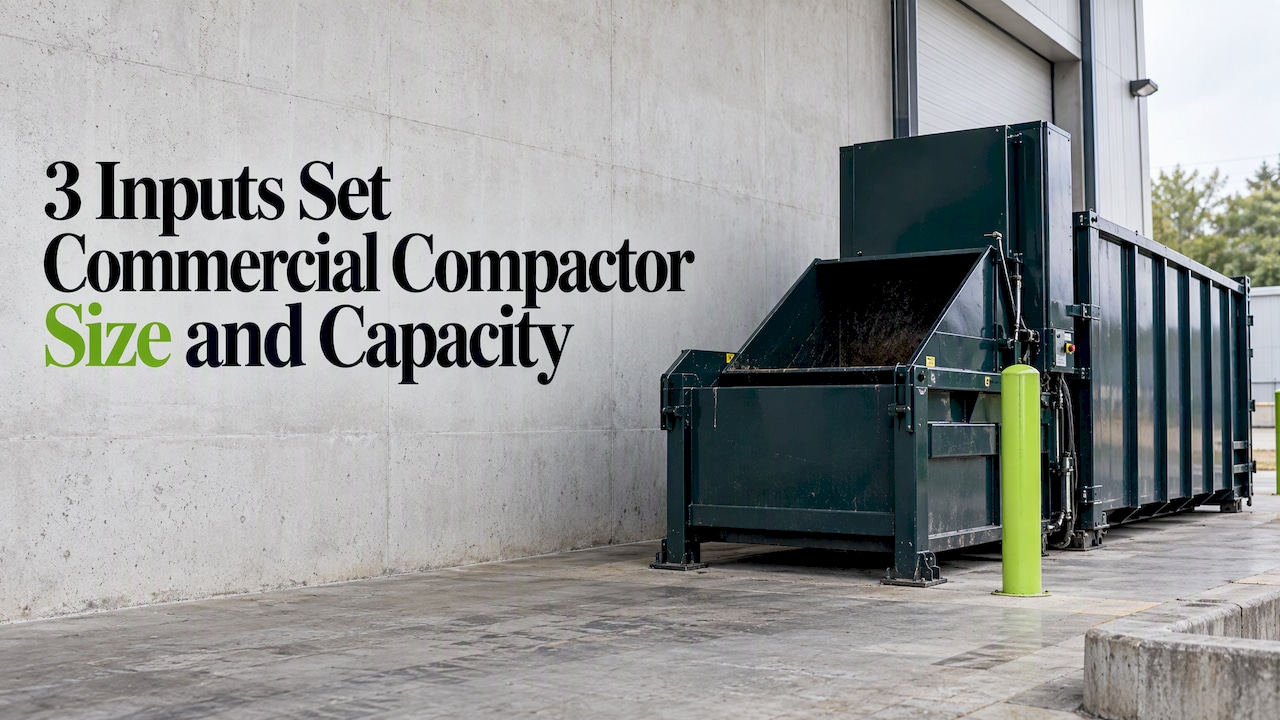
Three things decide the compactor you need: your waste type, your weekly volume or pulls per day, and how the machine is loaded. Get those right and the chamber size follows. Manufacturer design guidance such as the SP Industries compactor design guide works the same way, and our free waste audit at Compact turns your estimates into a firm specification.
TL;DR:
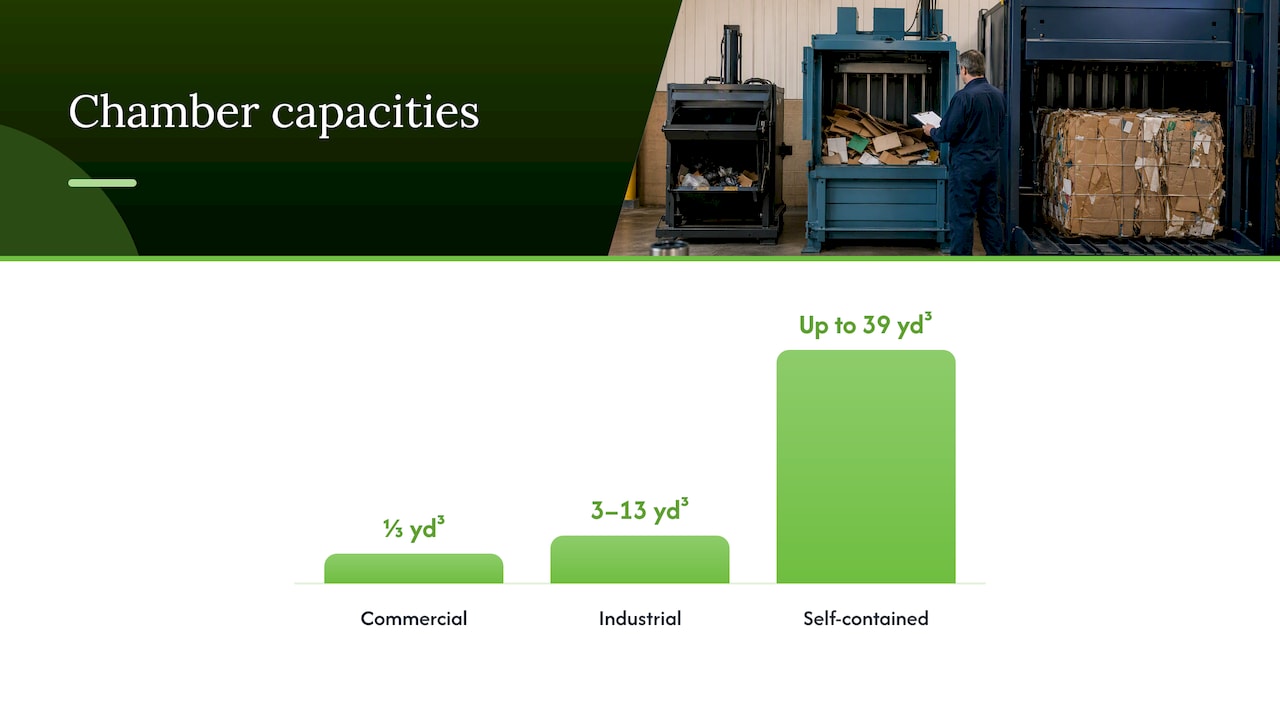
- Commercial chambers start at 1/3 cubic yard, industrial models span 3 to 13 cubic yards, and sealed units reach 39 cubic yards.
- A busy site handling light waste may need a different duty class from a quieter site handling heavy loads, even when chamber capacity matches.
- Wet waste calls for sealed joints and heavier construction, while bulky items may require a precrusher to prevent jams and ram damage.
- When clean cardboard dominates, a baler produces saleable tied bales; a general compactor suits loose mixed waste, while EPS needs specialist equipment.
- Confirm hopper height, door width, turning space, ramp needs, and cycle time before ordering, since collection vehicles must reach and remove the container.
Table of Contents
- Which type of commercial compactor suits your site?
- How do waste type, volume and duty cycle set the size?
- Quick sizing reference by machine class
- How do you calculate the compactor you need?
- What installation and maintenance details change the specification?
- How does a professional waste audit settle the question?
- Where most buyers go wrong when specifying a compactor
- Book your free waste audit and get the size right
- FAQ
- Sources
Which type of commercial compactor suits your site?
Before capacity comes the family of machine. Each type solves a different access and loading problem, so choosing the type first stops you sizing something that will never fit your yard or dock.
- Static compactors are installed in a fixed position and push waste into a detachable container. Public tenders for them, such as an Irish notice for static compactors at a civic amenity site, cover purchase, installation and commissioning together.
- Container and RoRo compactors compress into a large roll-on, roll-off container. They suit high-tonnage sites where a haulier collects full containers.
- In-bin and in-dock compactors sit inside a building or at a loading dock. Our hydraulic compactor range covers many of these tighter installations.
- EPS and foam compactors shrink expanded polystyrene, which is mostly air. Our EPS compactors are built for that job.
A baler is a different machine. A compactor squeezes loose waste into a container, while a baler presses clean material such as cardboard into tied bales that can be sold. If your main stream is clean cardboard, our cardboard balers may suit you better than a compactor.
Typical uses vary. Retail back-of-house usually produces cardboard and mixed dry waste. Manufacturing adds packaging offcuts and bulky items. Hospitality brings wet food waste, and civic amenity sites handle a bit of everything.
Three practical constraints steer the choice: vehicle access to the yard, the height of the hopper you must load, and how the container is tipped or lifted.
How do waste type, volume and duty cycle set the size?
Waste does not compress equally. Cardboard and light plastics squash dramatically, mixed dry waste compresses moderately, wet food waste compresses little and leaks, bulky items resist crushing, and EPS collapses to a fraction of its loose volume. The more compressible the material, the more loose waste fits in each compacted load, so a smaller chamber can do the same work.
Frequency matters just as much. The SP Industries guide recommends matching duty class to pulls per day, and it sets out commercial, industrial and extra heavy classes accordingly. A site loading a machine many times a day needs a heavier class than one that fills a container over a week.
Capacity ranges to anchor your thinking: the SP design guide lists stationary compactors from a fraction of a cubic yard in commercial models up to 13 cubic yards in industrial models, with self-contained units reaching 39 cubic yards. That spread is why a one-size answer does not exist.
Here is how the main streams behave in practice:
- Cardboard: compresses well, so volume drops sharply and pulls are infrequent.
- Mixed dry waste: moderate compaction, needs a sturdy ram and sensible loading height.
- Wet and food waste: needs wet seals and heavier construction so liquids stay contained.
- Bulky waste: may need a precrusher before it enters the chamber.
- EPS: a specialist machine gives far better results than a general compactor.
Wet and bulky streams deserve special care. Liquid loads corrode and strain standard hardware, and large awkward items can jam or damage a ram. Specifying heavier plate, sealed joints or a precrusher at the start costs far less than replacing a machine that was undersized for its waste.
Quick sizing reference by machine class
Use this as a first filter, not a final specification. The ranges below come from the SP design guide, which describes commercial, industrial and self-contained categories, and they are given in cubic yards as the guide states them.
| Class | Chamber capacity | Typical duty | Sample applications |
|---|---|---|---|
| Commercial | 1/3 cubic yard | Lighter, less frequent pulls | Shops, small restaurants, offices |
| Industrial | 3 to 13 cubic yards | Heavier, more frequent pulls | Factories, distribution centres, larger retail |
| Self-contained | Up to 39 cubic yards | Sealed, high-volume use | Food waste, wet streams, high-tonnage sites |
The overlap between commercial and industrial is deliberate. A busy site with light waste and a quiet site with heavy waste can land in the same chamber size but a different duty class, which is why duty matters as much as volume.
Compaction ratios convert loose volume to chamber volume. The guide shows ratios differ for mixed paper, metals, wet waste and wood, so a ratio for one stream should never be applied to another. As a rule of thumb, the higher the ratio, the smaller the chamber you can justify.
Consider a precrusher or a baler instead of a larger compactor in two cases: when bulky items keep stalling the ram, or when your waste is mostly clean cardboard that earns money as a bale.
How do you calculate the compactor you need?
You can estimate your needs before anyone visits your site. Work through these steps for each waste stream.
- Estimate weekly loose volume. Count bins, cages or roll containers filled each week and convert to cubic metres. Weigh a sample if you can.
- Choose your acceptable pulls. Decide how often you are happy to have a container collected, then divide weekly pulls by operating days to get pulls per day.
- Apply a compaction ratio. Divide loose volume by the ratio for that material, taking the ratio from the design guide for your waste type, to find the compacted volume per week. Match that to a chamber and duty class.
- Run a worked example. Say a shop generates 30 cubic metres of loose cardboard weekly, purely as an illustration. At a ratio of 4:1, which is also illustrative, that becomes 7.5 cubic metres compacted per week. Collect once a week and you need a container holding at least that much, plus headroom.
Pro Tip: Size for your busiest week, not your average one, because seasonal peaks are when undersized machines fail.
Our waste audit checklist gives you a worksheet to record these numbers cleanly before you speak to a supplier.
What installation and maintenance details change the specification?
A nominal size on paper can fail on site. Several practical details change what you should buy.
- Access and loading height: check hopper height, cleartop opening size and the width of any doors or ramps. The SP guide includes cleartop opening and cycle time guidance for exactly this reason.
- Vehicle access: collection lorries need turning space, a firm base and, for some systems, a ramp. A Waterford council notice for hire-purchase static compactors specifies 24-tonne and 32-tonne compaction force machines together with containers and vehicle access ramps, which shows how much access shapes a real specification.
- Cycle time and throughput: a faster cycle lets a smaller chamber keep up with busy loading, so compare cycle time alongside chamber volume.
- Service and maintenance: agree a service schedule and spares route before purchase. Public tenders routinely state compaction force and installation scope up front, and private buyers benefit from doing the same.
- Roller container systems: where high payloads are handled, our roller container presses are worth reviewing.
Treat the site survey as part of the specification, not an afterthought. A machine that is the right size but cannot be delivered, loaded or collected is the wrong machine.
How does a professional waste audit settle the question?
Estimates get you close. A measured audit gets you right. Our free waste audit helps you assess your waste management needs, so you can make decisions based on your requirements. You can read the detail on our free waste audit page.
Once the audit defines your need, we can supply the equipment: compactors, balers, EPS compactors and refurbished compactors and balers. That means one point of contact from assessment through equipment supply.
Sizing also affects revenue. Through our bale buyback scheme we buy back baled cardboard and plastic, so a correctly sized machine captures more saleable material instead of sending it to landfill at a cost. Undersized equipment overflows and wastes that value.
Where most buyers go wrong when specifying a compactor
In our experience the most common error is buying on chamber size alone. Buyers fix on a cubic yard figure and overlook duty class, then may find the machine struggling over time. The second error is ignoring the waste mix: a compactor sized for cardboard will not cope when food waste appears on the same line.
If I had to rank priorities, I would use this order:
- Duty class first: it determines whether the machine survives your real workload.
- Serviceability second: a machine you cannot get repaired quickly becomes an expensive skip.
- Recycling value third: where your waste includes clean cardboard, size for capture so material earns money rather than costing it.
Everything else, from colour to brand, is secondary.
— Graham
Book your free waste audit and get the size right
Our free waste audit removes the sizing guesswork. We measure what you actually produce, check your site constraints and recommend a specification that fits, so you are not paying for capacity you will never use or struggling with a machine that is too small.
- Advice on your waste management requirements
- Advice on capturing value through bale buyback
Request your free audit through our enquiry page, or start with our free waste audit and we will arrange a visit.
FAQ
How do I size a compactor for my business?
Start with your waste type, weekly volume and how often you are willing to have containers collected. Convert loose volume to compacted volume using a ratio for your material, then match the result to a duty class. A manufacturer design guide sets out those classes and capacity ranges.
What is the purpose of a compactor?
A compactor squeezes waste into a smaller volume so you need fewer collections and less storage space. That lowers haulage costs and keeps the waste area tidier and safer. For clean cardboard, a baler goes a step further by producing bales you can sell.
Does waste type change the size I need?
Yes. Cardboard and EPS compress heavily, while wet food waste and bulky items compress far less and need heavier construction. The same weekly volume can therefore call for very different chambers depending on what is in it.
Can a plate compactor be used as a waste compactor?
No. A plate compactor is construction equipment that compacts soil and aggregate, and its performance is governed by centrifugal force rather than weight alone. A waste compactor is a different machine, built to press waste into a container.
Sources
- Globalspec
- Design Guide
- Ireland: Rubbish compactors Purchase, installation and commissioning of two static compactors for a split level site, including 2 compactor containers and 2 open containers To be delivered and installed at Mallow Civic Amenity
- European Dynamics – View CfT Workspace