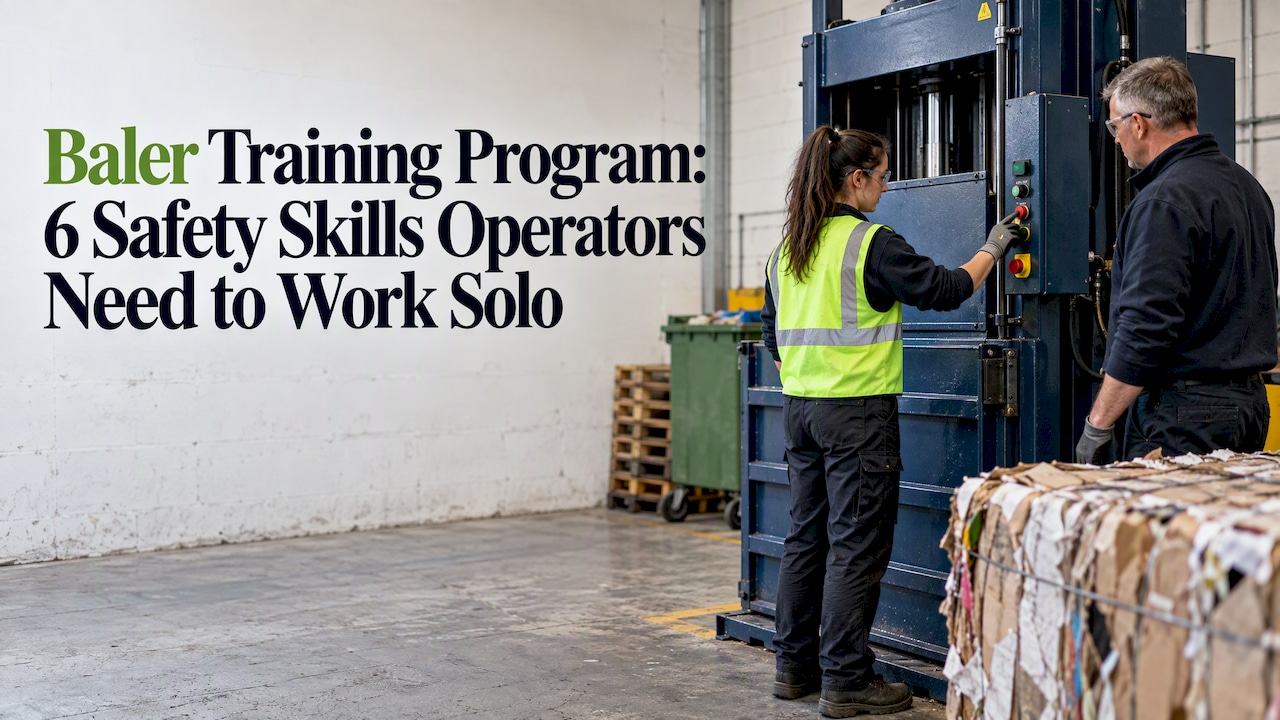
A compliant baler training programme produces an operator who can inspect, run and safely isolate a vertical baler without supervision. That means working controls and guards checks, correct personal protective equipment, a clear step-by-step operating sequence, lockout and tagout before any cleaning or clearing work, and a rehearsed response to faults and emergencies. The sections below set out how we structure each of those elements in practice.
TL;DR:
- Before each shift, operators should test guards, interlocks, emergency stops, and platen movement, then accept only materials approved for that specific machine.
- Before clearing jams or cleaning, workers must isolate power, apply a personal lock and identifying tag, verify isolation, and engage mechanical platen supports.
- Training should combine theory, practice on the actual baler, and supervised assessment; the HSA recommends a trainee to instructor to machine ratio of 3:1:1, with a practical ceiling of 4:1:1.
- Supervisors should trigger refresher training after incidents, equipment changes, or declining compliance, rather than relying on a fixed calendar schedule.
- Operators may perform only routine checks permitted by the manual; authorized, factory trained personnel must handle other repairs, with defects and service dates logged.
Table of Contents
- Essential syllabus: the minimum topics a course must cover
- Step-by-step safe operating procedure for vertical balers
- Cleaning, maintenance and safe isolation before anyone opens the chamber
- Course structure, assessment and trainer selection
- Supervisor duties, competence assurance and refresher training
- Legal and regulatory compliance requirements related to baler operation
- Our approach: audits, training and bale buyback in practice
- Start here: a free audit, the right baler and proper training
- FAQ
- Sources
Essential syllabus: the minimum topics a course must cover
A baler course earns its certificate only when every trainee can demonstrate the same core competencies, not just recall them in a classroom test. HSE guidance on bale handling sets out the minimum training elements operators need before they touch the controls unsupervised: checks of guards and safety devices, a habit of reporting defects, a written safe system of work covering both operation and cleaning, correct PPE, and a rehearsed emergency response.
Course designers should build a syllabus around measurable outcomes rather than a generic safety briefing. Each trainee should finish the course able to:
- Identify and test interlocks, guards and platen supports before switching the baler on.
- Read warning signage and controls correctly, including emergency stops and status lights.
- Select and wear the right PPE: gloves, eye protection, safety footwear and hearing protection where noise levels require it.
- Apply manual handling technique when loading bulky or heavy material to avoid strain injuries.
- Report a defect or near miss immediately, using the site’s incident reporting route.
- Follow the written safe system of work for both normal operation and routine cleaning.
Ergonomics matters more than most syllabuses allow for. Repeated bending, twisting and lifting to feed a baler causes a steady trickle of manual handling injuries, so a good course spends real time on loading posture and the use of mechanical aids where they exist, not just on the hydraulics.
Step-by-step safe operating procedure for vertical balers
Once the theory is covered, trainees need a procedure they can follow at the machine every single cycle, not a memory of a demonstration from weeks earlier. The sequence below reflects the safe system of work HSE expects operators to be trained in and should be visible as a laminated card near the control panel.
- Carry out a pre-use check at the start of every shift or whenever the operator changes: confirm guards are fitted, interlocks function, the emergency stop resets correctly, and the platen moves freely with no visible hydraulic leaks.
- Clear the loading area and confirm no one else has access to the chamber or the bale exit point.
- Feed only the materials the machine is rated for, cardboard, specific plastics or textiles as specified, and never attempt to compress prohibited items such as aerosols, sealed containers or electricals.
- Close and secure the loading door or guard before starting the compression cycle.
- Run the cycle from the control panel only, standing clear of the chamber and bale exit at all times.
- Tie the completed bale using the correct wire or strap tension for the material type.
- Eject the bale following the machine’s own sequence, keeping hands and feet clear of the platen and exit rollers.
- Stack or move the finished bale using the site’s manual handling or mechanical lifting procedure.
If a jam, fault or unusual noise occurs mid-cycle, the operator should stop the machine immediately, isolate it, and report it to a supervisor rather than attempting a quick fix. Faults involving the chamber or platen are never a one-person job.
Pro Tip: Keep the laminated step-by-step card at eye level on the control panel, not in a folder in the office, so new operators actually use it during their first unsupervised cycles.
Cleaning, maintenance and safe isolation before anyone opens the chamber
Pressing “stop” is not the same as isolating a baler, and this is the point where training programmes most often fall short. Before any cleaning, adjustment or jam clearance, the machine must go through a proper lockout and tagout sequence: isolate the power source, apply a physical lock, attach a tag naming the person and the reason, then verify isolation by attempting to start the machine before anyone reaches into the chamber.
Clearing a jam without this sequence is one of the most consistently cited causes of serious injury in baling operations, and HSE’s guidance on baling and compacting machinery stresses that clearance must always follow a written safe system of work. A platen held up only by hydraulic pressure is not a supported platen: mechanical supports must be physically engaged and visually verified before anyone’s hands or arms go near it.
Day-to-day maintenance that trained operators can usually carry out includes:
- Clearing debris from around the loading area and exit rollers.
- Checking and topping up hydraulic fluid where the manual permits operator-level checks.
- Logging any unusual noise, vibration or hydraulic leak in a maintenance record.
The manufacturer’s own operation and maintenance manual is explicit that repairs beyond routine operator tasks must be carried out only by authorised, factory-trained personnel, and that the manual itself is never a substitute for proper operator training. A maintenance log that records every defect, check and repair date gives supervisors a clear audit trail and flags recurring problems before they become safety failures.
Course structure, assessment and trainer selection
A credible baler course follows the same three-stage model the HSA Code of Practice recommends for powered equipment generally: basic theory, function-specific practical training on the actual machine the operator will use, and a supervised on-the-job assessment period before sign-off. Compressing all three into a single afternoon rarely produces a genuinely competent operator, and any shortened course should have its reasoning documented in writing, including why the trainee’s prior experience justifies it.
Ratios matter as much as hours. The HSA Code of Practice suggests a desirable trainee:instructor:machine ratio of 3:1:1, and recommends never exceeding 4:1:1 where practical, so that each trainee gets genuine hands-on time rather than watching from the back of the room.
When appointing or accrediting a trainer, employers should ask for:
- Evidence of the trainer’s own competence on the specific baler type being taught.
- A record of previous training delivered and outcomes assessed.
- Familiarity with the site’s own safe systems of work, not just generic baler theory.
Supervisor duties, competence assurance and refresher training
Supervisors carry ongoing responsibility once the certificate is issued. That means periodic spot checks on operating practice, controlling who holds keys or access codes to the baler, and auditing that lockout and tagout procedures are actually being followed rather than skipped under time pressure.
Refresher training should be triggered by a near miss or incident, the introduction of a new or different baler model, or a noticeable drop in an operator’s adherence to safe procedure, not left to an arbitrary calendar date alone. Keeping training logs, assessment records and authorisation dates in one place lets a supervisor spot who is overdue for refresher training before it becomes a gap that an inspector or insurer finds first.
Legal and regulatory compliance requirements related to baler operation
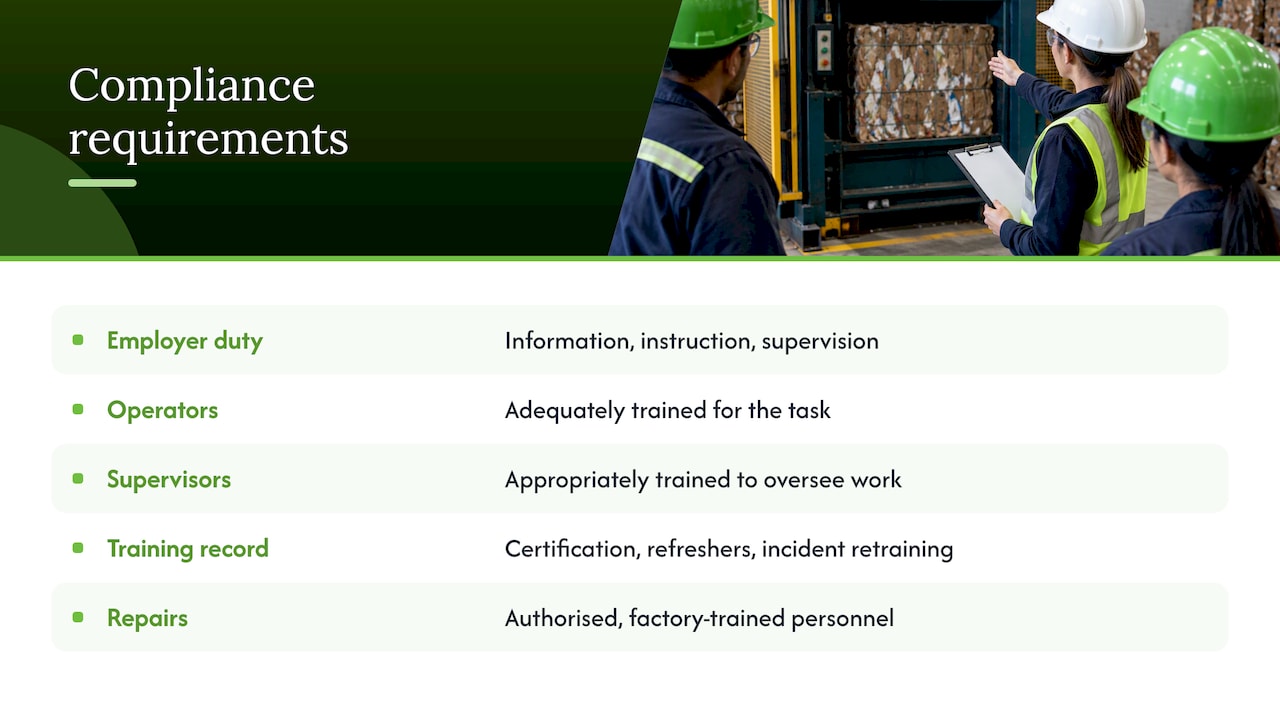
Employers carry a direct legal duty to provide training, not just equipment. Under Irish law, the Safety, Health and Welfare at Work Act 2005 requires employers to give employees information, instruction and supervision in a form and language they can understand, and to ensure that anyone operating machinery like a baler is adequately trained for the task, as set out by Citizens Information. That duty extends to supervisors, who also need appropriate training to oversee the work safely.
Compliance is not a one-off event. A training record that shows initial certification, refresher dates and incident-triggered retraining gives an employer a defensible position if an inspector asks how a particular operator was assessed competent. Manufacturer documentation reinforces the same point from a different angle: service and repair work beyond routine operator tasks must go to authorised, factory-trained personnel, and a manual on a shelf is never treated as equivalent to documented operator training. Treating training as a liability safeguard, properly logged and renewed, tends to reduce both regulatory exposure and unplanned downtime from operator error.
Our approach: audits, training and bale buyback in practice
We start most training conversations with a free waste audit, because the right training scope depends on the actual machines and materials on a site, not a generic course. An audit tells us whether an operator needs training on a single vertical baler or across several baler and compactor types, and that shapes everything from PPE choice to cycle-specific procedure.
Correct training also pays for itself through our Bale Buyback scheme: well-tied, correctly compressed bales attract better rebates than loose or poorly formed ones, which gives operators a direct, practical incentive to follow procedure on every cycle rather than cut corners near the end of a shift.
— Graham
Start here: a free audit, the right baler and proper training
We assess your site through a free waste audit, matching the baler you need to the material volumes you actually handle and the training your team requires to run it safely. We supply new and refurbished cardboard balers and can point you to accredited instructors for your operators.
- Request a free waste audit to identify the right equipment and training scope for your site.
- Get fitted with a baler sized to your material volumes, including refurbished options.
- Pair trained operators with a bale buyback scheme to turn correctly formed bales into revenue.
Book your free waste audit and we will take it from there.
FAQ
What is the best baler on the market?
The right baler depends on material type, volume and available space rather than a single “best” model, which is why a site-specific audit matters more than a general ranking. Vertical balers suit lower-volume sites with limited floor space, while higher-throughput operations often need a different configuration entirely.
What is a baler used for?
A baler compresses recyclable materials such as cardboard, plastic film or textiles into dense, strapped bales that are far easier and cheaper to store and transport than loose waste. Compressed bales also attract better rebates from recyclers than loose material of the same weight.
How much money can a baler make?
A baler itself does not generate income directly, but correctly formed bales of cardboard can be sold back through buyback arrangements, turning a waste cost into a revenue stream. The return depends on bale quality, material type and current market rates for recyclables.
What is the average lifespan of a baler?
A baler’s working life depends heavily on usage intensity, material type and how consistently it receives the routine maintenance set out in the manufacturer’s manual. Machines serviced on schedule and repaired only by authorised personnel, as the manufacturer’s own manual specifies, tend to run reliably for considerably longer than those maintained informally.
Sources
These sources underpin the safety procedures, training structure and maintenance guidance covered above.
- HSE — Bale handling and baling safety
- HSA — Code of Practice: Safe Use of Industrial Trucks (training sections)
- Terex — Vertical Recycler Baler operation, maintenance and installation manual