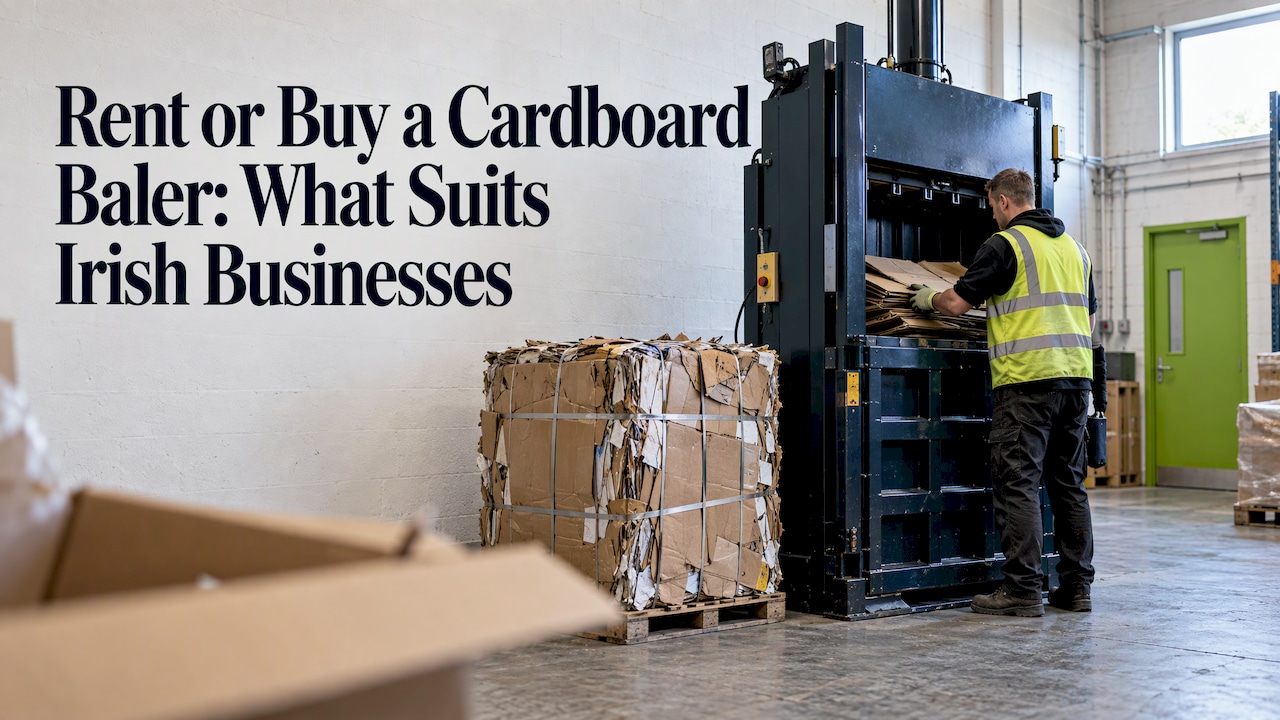
For most Irish businesses that produce cardboard every week, buying a baler, new or refurbished, is the stronger long-term choice. You own an asset that works for you every day, and you can sell the bales it produces. Hiring keeps cash free in the short term, but you pay for the machine indefinitely and a hire agreement is not designed around bale income. Below is how to decide for your own site, how to work out the break-even point, and what to check before you sign anything. If you want a figure for your own volumes, our free waste audit gives you one.
TL;DR
- If you fill more than a few cages or bins of cardboard each week, ownership usually costs less over a machine’s working life than open-ended hire.
- A refurbished baler lowers the entry price of owning, so the capital argument for hiring is weaker than it first looks.
- Baled, clean cardboard can earn money. A baler you own and a buyback arrangement turn a disposal cost into income.
- Check headroom, footprint, power and access before choosing any machine, whichever route you take.
- Work out break-even with your own numbers: purchase price, expected life, servicing, and the bale income you can realistically expect.
Table of Contents
- What you are really deciding
- When buying wins
- When hiring is considered
- Break-even: a method you can run in ten minutes
- What bales can earn
- Space, power and access: the checks that apply to both routes
- Contract terms to settle before you sign
- Which baler fits which business
- Why we recommend owning
- Taking the next step
- FAQ
- Sources
What you are really deciding
The rent-or-buy question looks like a cash-flow choice, but it is really about three things: how much cardboard you produce, how long you will keep producing it, and whether you want the bales to earn money.
A baler compresses loose cardboard into dense, strapped bales. That cuts the number of bin lifts you pay for, frees floor space, and makes the material tidy enough to sell. Those benefits only repay the machine if it runs every week. A site with steady cardboard output for many years is a buyer. A site running a one-off project or a short seasonal peak is the only case where hire can make sense, and even then a refurbished machine is worth pricing.
If you are still working out the machine type, our guide to cardboard baler sizes explains how bale weight and chamber size relate to volume.
When buying wins
Buying is the better route when most of these apply:
- Your cardboard is constant. Retail, food distribution, wholesale, manufacturing and e-commerce fulfilment generate cardboard all year. A machine bought once is used for years rather than paid for monthly with no end.
- You want to sell the bales. Compressed, baled cardboard is the form a buyer wants. Owning the machine means you control when bales are made and how they are stored, and every tonne you sell improves the return on the purchase.
- You can use the space. A baler needs a fixed footprint. If you can give it one, a permanent machine suits you.
- You want predictable costs. Once bought, the main running costs are baling wire or tape, power and servicing, which you can budget.
If you prefer to keep the outlay low, a refurbished machine gives you ownership at a lower starting price. Our refurbished compactors and balers are the place to start, and our cardboard balers cover the new range.
When hiring is considered
Businesses hire for understandable reasons: no upfront cash, a monthly figure that goes straight to the running costs, and the idea that servicing is bundled in. These are real attractions, and they are the reason hire ranks so well for this search.
The weakness is time. A monthly fee has no end date, so the longer your cardboard keeps coming, the more the machine costs you without ever becoming yours. Terms also vary between agreements: minimum periods, who pays for call-outs, how wire or tape is supplied, and what happens if you want to end early. If you do consider hire, treat the contract like any other supply agreement and read each of those terms.
A short, defined need is the one situation where this logic reverses: a temporary site, a fit-out, or a pilot before you commit. For anything permanent, the arithmetic below usually points to owning.
Break-even: a method you can run in ten minutes
No honest article can give you one break-even figure, because the inputs are yours. What it can give you is the method. Use the same time horizon for both options, such as five years.
Step 1: Total cost of owning over five years
Add the purchase price (new or refurbished), delivery and installation, five years of baling wire or tape, power, and five years of servicing and likely repairs. Then subtract the machine’s resale or scrap value if you expect any.
Step 2: Total cost of hiring over five years
Multiply the monthly fee by 60. Add any delivery, collection, set-up or call-out charges and any consumables billed separately.
Step 3: Add the effect on your bins
Count how many bin or skip lifts you pay for now, and estimate how many you will need after baling. Both options reduce lifts, so this saving is common to both and mostly cancels out. It matters only if one option fits your site worse than the other.
Step 4: Add bale income
Estimate your tonnes of baled cardboard per year and multiply by the price a buyer pays per tonne. Then be conservative: price depends on cleanliness and grade, and on what the market is doing. This is the line that most often turns the comparison towards ownership, because the machine you own keeps earning after it is paid for.
An illustration, with made-up numbers
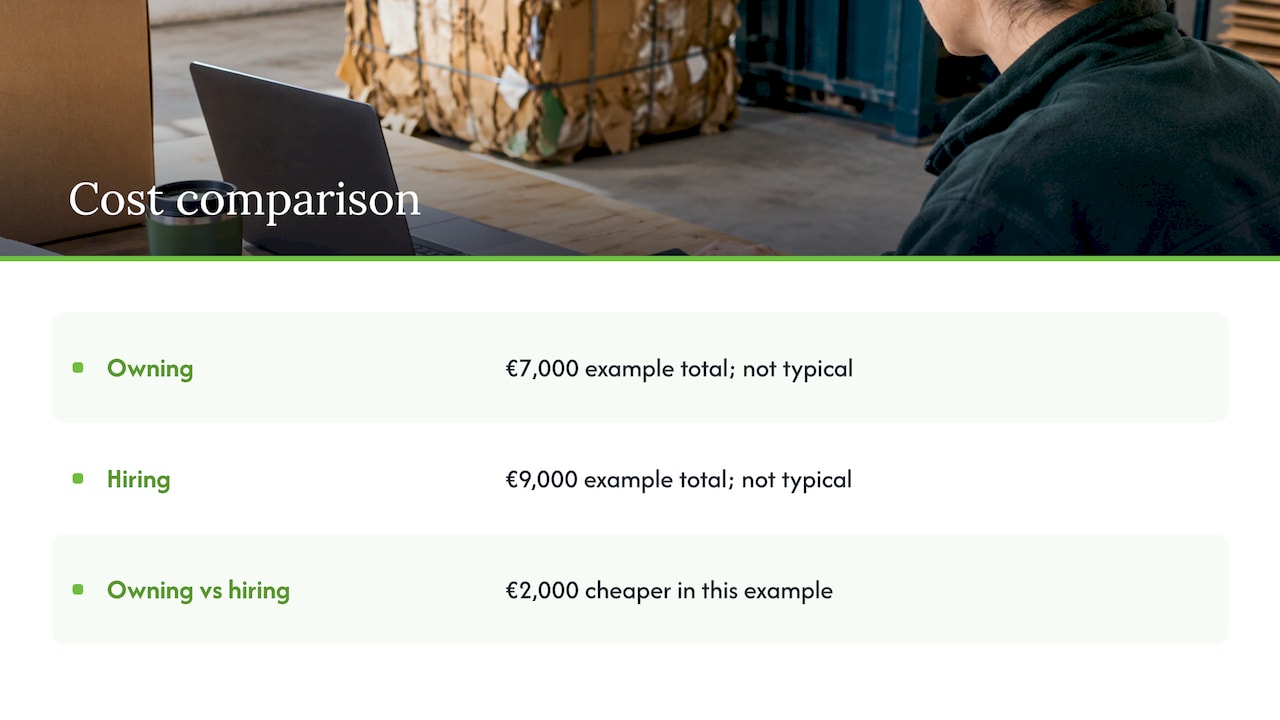
Suppose a machine costs €6,000 to buy and install, with €200 a year for wire and servicing, so €7,000 over five years. A hire fee of €150 a month is €9,000 over the same five years. These figures are purely for illustrating the arithmetic, not typical prices. On those assumptions owning is €2,000 cheaper, and the gap widens every year after year five. Add bale income and the gap grows again. Put your own quotes into the same four steps.
For real price ranges and what drives them, our cardboard baler cost guide breaks down what you pay and what is included.
What bales can earn
Revenue is the part of the rent-or-buy question that rental pages tend to skip. Clean, baled cardboard is a commodity that recyclers pay for. A 2018 Green Business Ireland case study of an Irish engineering company with 200 employees recorded an annual saving of €10,000: landfill costs fell by €8,000 a year and the company received €2,000 for baled cardboard and plastic. Your own figure will depend on volume and quality, but the pattern is clear: baling reduces what you pay to dispose of waste and creates something to sell.
What affects the value of a bale:
- Cleanliness. Cardboard contaminated with food, liquids, plastic film or polystyrene is worth less or may be rejected.
- Bale density and consistency. Uniform, well-strapped bales are easier to handle and transport.
- Volume. A buyer collecting a full load is more efficient than one making small pickups.
- Storage. Bales kept dry keep their value.
Our pages on cardboard recycling rebates and cardboard bale prices cover how the per-tonne price is set, and selling cardboard bales explains how to protect your return once you have them.
Space, power and access: the checks that apply to both routes
Whether you buy or hire, the machine has to fit your site. The Northern Ireland Building Control Waste Storage Guide gives useful planning dimensions. It lists a top-loading mini baler at a typical compression ratio of 6:1, with a footprint of roughly 1.0 m by 1.0 m and a minimum headroom of 2.2 m. A standard top-loading baler is listed at 4:1, with a 2.0 m by 1.0 m footprint and 2.7 m minimum headroom. Although the guide is a Northern Ireland publication, those are machine dimensions and apply equally on a site in the Republic.
Before choosing, measure:
- Floor area for the machine, plus working room to load and tie off a bale.
- Ceiling height, including doors, lights and sprinklers.
- Route in. Can the machine physically get through your doors and into position?
- Bale storage. Finished bales need a dry spot and a way to reach the collection vehicle.
- Power supply. Confirm what the machine needs against what the location provides.
- Where staff will load it. Cardboard needs to reach the baler without long carrying.
The same guide notes that balers are mechanical equipment, so they need a management strategy: staff training, restricted access to the machine, and baling carried out as needed. It also notes that councils and waste collection contractors may not accept baled waste without prior agreement. So confirm in advance who will take your bales.
Contract terms to settle before you sign
Whatever you pick, put these in writing.
| Question | Why it matters |
|---|---|
| Who services the machine, and how quickly do they attend? | A baler that is down means overflowing cardboard. |
| Is delivery and installation included? | It can be a separate and substantial line. |
| Who supplies wire or tape, and at what price? | It is a regular cost that is easy to overlook. |
| Is operator training included? | It supports safe use and consistent bales. |
| What is the minimum term and exit route (hire)? | A long minimum term can outlast your need. |
| Who will buy the bales and how is payment calculated? | It decides whether the machine earns. |
| What is the warranty (purchase)? | It sets your exposure to repair bills early on. |
If you are buying, our baling wire and tape page covers the consumables.
Which baler fits which business
| Situation | Suggested route |
|---|---|
| Small shop or café, a few cages of cardboard a week | Compact vertical baler, new or refurbished |
| Supermarket, wholesaler or distribution centre, daily cardboard | Larger baler or a compactor, bought |
| Manufacturer with mixed cardboard and plastic film | Baler sized for both streams, with an audit first |
| Short-term project or temporary site | The one case where hiring a unit for a fixed period may fit |
| Business wanting a high-throughput, heavy-duty machine | Look at Strautmann balers |
If your cardboard arrives loaded into a large container rather than loose, a compactor may suit better than a baler, and our cardboard compactors are worth comparing.
Why we recommend owning
Most of the businesses we speak to are not really asking whether to rent or buy. They are asking what their waste costs them and whether it can stop being a cost. A hire fee answers a cash question. It does not change how you handle cardboard.
Owning a baler changes the whole arrangement. You decide how the cardboard is handled, you produce a bale that has a market value, and our bale buyback scheme exists so that the bales you make are paid for. We design it so that the cost you used to see on an invoice becomes a rebate.
That is why we start with an audit rather than a machine. We analyse your specific requirements, size the equipment to your volume, and keep the process in one place from audit through to equipment, collection and payment. For some businesses the right starting point is a refurbished machine, and we supply those too.
Graham
Taking the next step
The quickest way to settle rent versus buy for your own site is to put real numbers behind the break-even method above. Our free waste audit looks at what your site produces and what you pay to dispose of it, so you can size a baler properly and see what the bales could return.
Once you know your volumes, we buy back bales from businesses that bale their cardboard and plastic, and our bale buyback programme page explains how the scheme works. For a wider look at lowering waste spend, see how Irish businesses can reduce waste costs.
FAQ
Is it cheaper to rent or buy a cardboard baler?
Over a few years of steady use, buying is usually cheaper, because a monthly fee carries on with no end while a purchased machine is paid for once. Add bale income and the gap widens. Run the four-step break-even method above with your own quotes to confirm it for your site.
Can I buy a second-hand or refurbished baler?
Yes. A refurbished baler gives you ownership at a lower starting cost than a new one, which suits businesses that want to avoid a large outlay. We supply refurbished compactors and balers in Ireland.
Does baling cardboard really earn money?
It can. Clean, well-baled cardboard has a market price per tonne, and a 2018 Irish case study recorded €2,000 a year from baled cardboard and plastic at one engineering company. Your return depends on volume, cleanliness and the buyer. An audit gives you an estimate for your own site.
What do I need to prepare before a baler is installed?
Measure floor area, headroom, the route into the building and your power supply, and decide where bales will be stored and collected. Typical top-loading balers need between 2.2 m and 2.7 m of headroom. Staff should be trained, and access to the machine should be restricted.
Sources
- Waste Storage Guide, Northern Ireland Building Control
- Resource Efficiency a Must for Business, Green Business Ireland case study, 2018