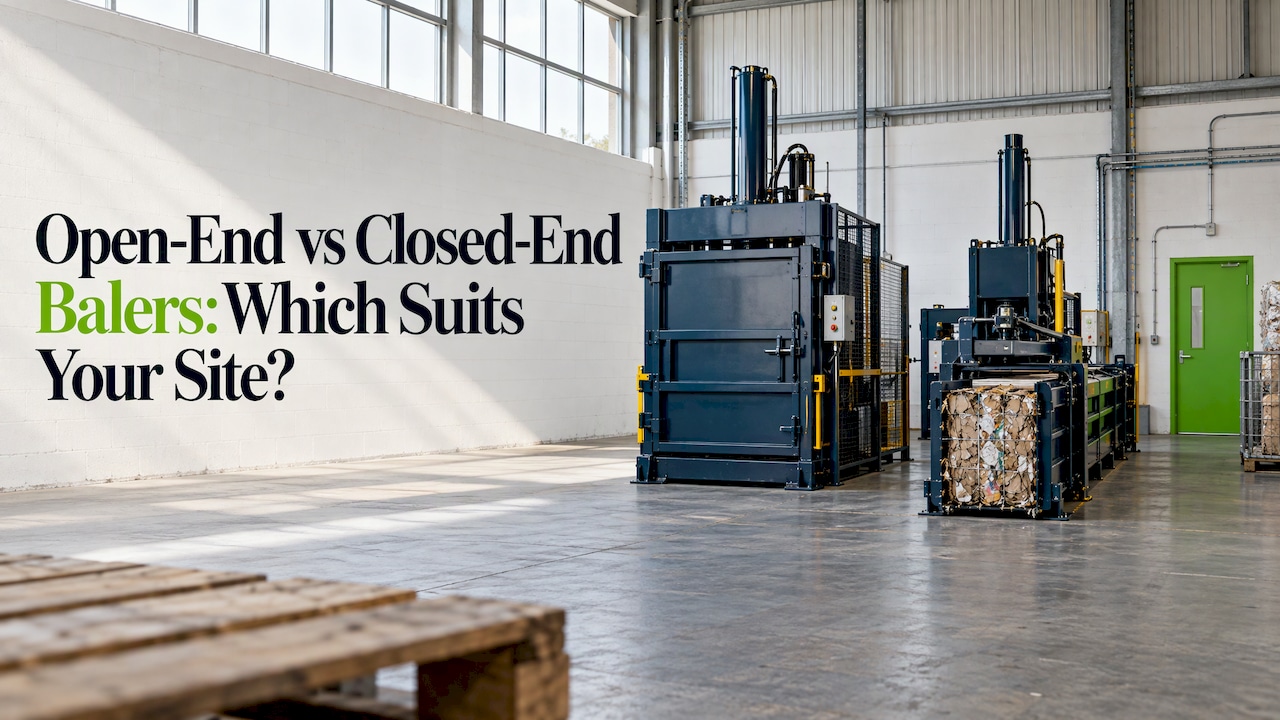
A closed-end baler compresses each bale against a solid door and usually needs someone to tie it by hand. An open-end baler pushes material through an open channel, so it forms bales one after another and can tie them automatically. For most Irish businesses the choice comes down to how much cardboard and plastic you produce each week, how many people you can spare to run the machine, and how much floor space you have. Compact’s free waste audit measures those three things before you commit to either design.
TL;DR
- Closed-end: one bale per cycle, pressed against a closed door, usually tied by hand. It suits low to mid volumes and tighter spaces.
- Open-end: continuous baling through an open channel, with automatic tying. It suits high, steady volumes where labour time matters.
- Volume decides: the more tonnes you bale each week, the more the automation of an open-end machine pays back. Below that, a closed-end machine does the job.
- Bale quality sets income: dense, uniform, clean bales are what a buyer pays for, whichever design you choose.
- Measure first: audit your actual tonnage, space and materials before choosing a machine.
Table of Contents
- The difference in plain terms
- Side by side
- Volume: the first question to answer
- Labour: who ties the bale?
- Bale quality and the materials you bale
- Space: plan the whole area, not just the machine
- Cost: purchase price is only one line
- Choosing: a short checklist
- One site, one machine, one partner
- Our view on open-end versus closed-end
- Frequently asked questions
- Sources
The difference in plain terms
A baler is a hydraulic press. A ram pushes loose cardboard, film or plastic into a tight block, and wire or strapping holds the block together so it can be stacked, lifted by forklift and sold. Both designs do that. What differs is what the material is pushed against.
In a closed-end baler the chamber has a solid door at the far end. The ram compresses material against that door. When the bale reaches the right size, the operator opens the door, ties the bale with wire, and the bale is ejected. Then the cycle starts again. A single-ram machine of this type is described in the Recycling Today Baler Guide, which gives it as a low-capacity machine for cardboard, paper, plastic and light metals. It processes about three bales an hour. The guide dates from 1997, but the principle has not changed.
In an open-end baler there is no door at the far end. The bale is formed inside a channel, and resistance comes from friction in the channel and from the compressed material already inside it. This is why an open-end baler begins with a “plug” bale, the first bale that creates resistance for the ones behind it. After that, bales are extruded one after another. Most are fitted with an automatic tying system, so the machine ties, ejects and starts the next bale without stopping.
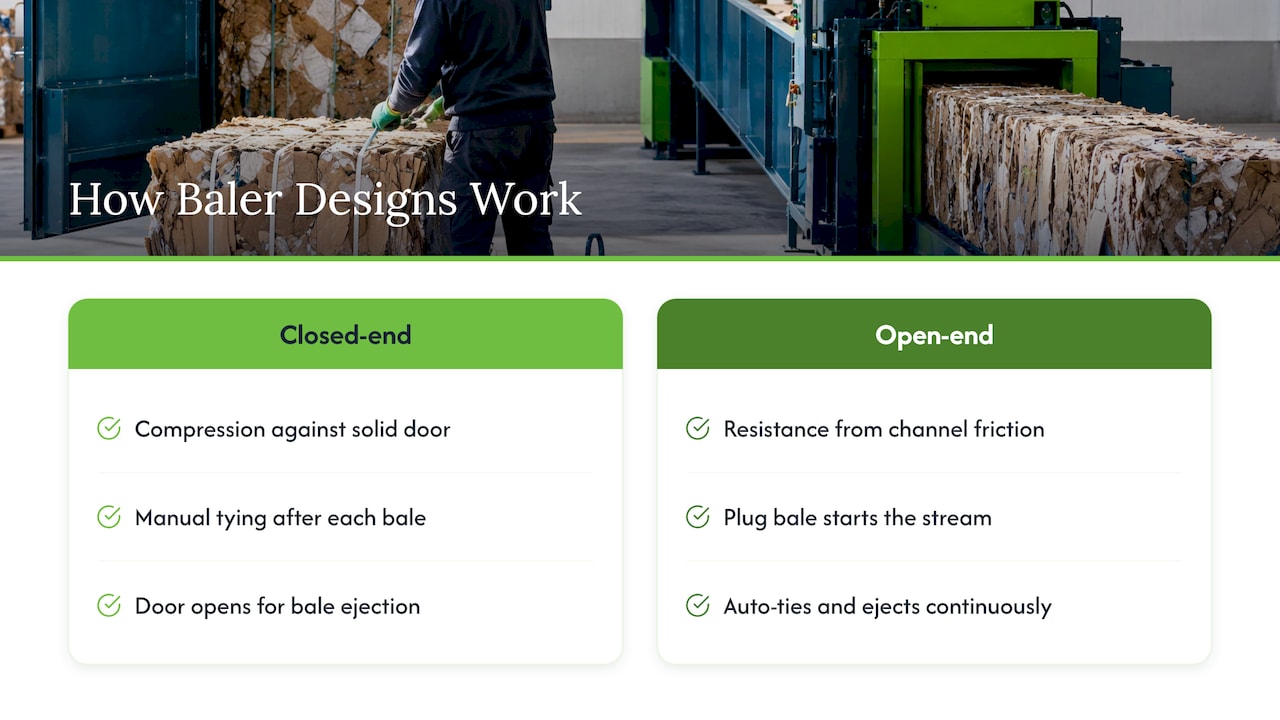
Put simply, closed-end is batch baling and open-end is continuous baling.
Side by side
| Closed-end baler | Open-end baler | |
|---|---|---|
| How the bale forms | Ram presses against a solid door, one bale per cycle | Material is pushed through an open channel, bales form in sequence |
| Tying | Usually manual | Usually automatic |
| Output | Lower, in batches (around three bales an hour for a single-ram machine) | Higher, continuous |
| Labour | Operator ties and discharges each bale | Operator loads, machine ties and ejects |
| Bale uniformity | Very square, exact, dense bales | Dense, though the first bale after a start can be looser and lengths can vary |
| Switching materials | Easy, one bale at a time | Better with a steady, consistent feed |
| Footprint | Generally more compact | Generally longer, with room for conveyor and discharge |
| Best fit | Low to mid volumes, mixed streams, limited space | High volumes of cardboard or film, labour-sensitive sites |
Volume: the first question to answer
Throughput is the clearest dividing line. A closed-end machine is limited by the time it takes to load, press, open, tie and eject, and a person is involved at most steps. An open-end machine removes the stops between bales, so more material moves through in a shift.
That does not mean bigger is better. A machine running well below its capacity costs more to buy and takes more floor space for no gain. A closed-end baler that runs steadily through a working day, handling the cardboard from a supermarket, a pharmacy distribution unit or a mid-sized manufacturer, is often the sensible fit.
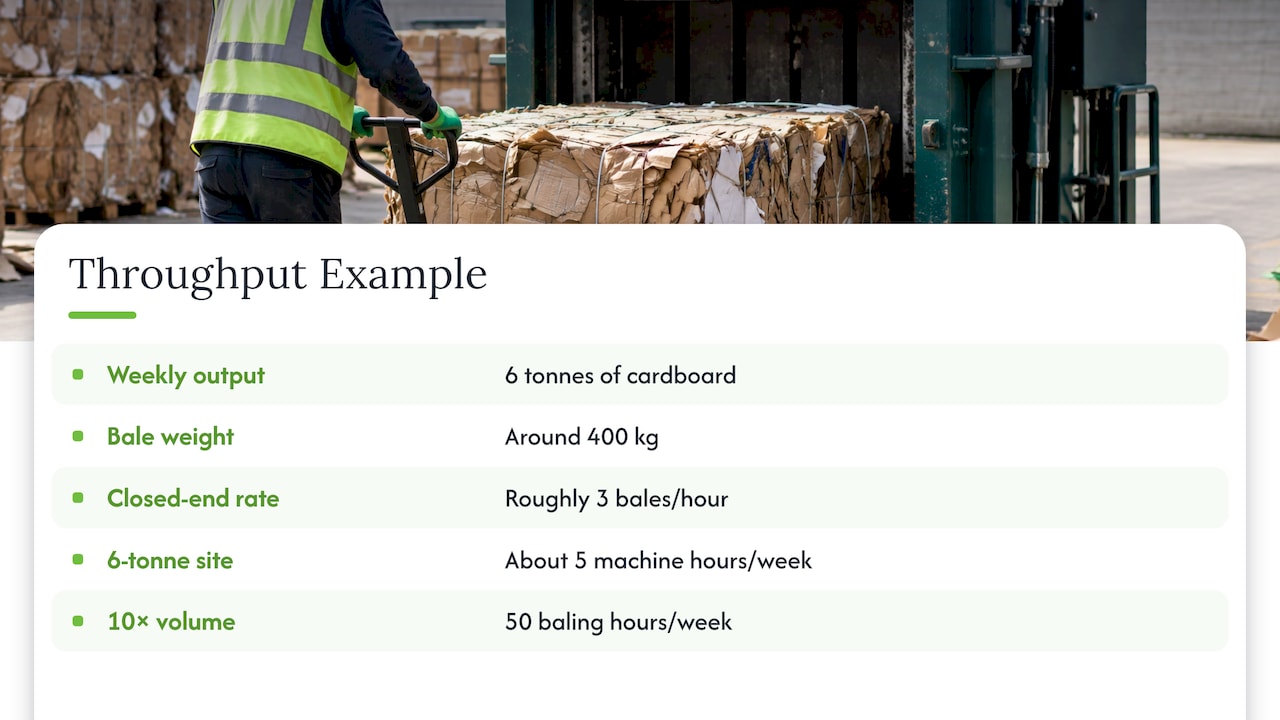
Here is a simple illustration, not a measured case. A site produces six tonnes of cardboard a week and each bale weighs around 400 kg. That is about 15 bales a week. At roughly three bales an hour on a closed-end machine, the baling itself takes about five hours of machine time across the week, plus tying and moving bales. Spread across five days, that is an hour a day. A site producing ten times that volume would face fifty hours of baling a week, and there the continuous, auto-tied output of an open-end machine becomes the practical answer.
Your own numbers will differ, which is why they should come from a measured audit and not from an estimate. Our free waste audit looks at your actual requirements so the machine matches the waste you produce. If you already know your volumes, cardboard baler sizes explains how bale dimensions and chamber sizes relate to the amounts you handle.
Labour: who ties the bale?
The biggest day-to-day difference is who does the tying. With manual tie-off, someone threads the wire, secures it and checks the bale before it goes to the store. That takes time and attention every cycle, and it needs to be done safely. With auto-tie, the machine does this, and the operator’s job reduces to loading material and moving finished bales.
If your cardboard comes in bursts, for example after a delivery or at the end of a shift, manual tie is fine: someone is on hand anyway. If you want a machine that can run while staff do other jobs, automatic tying is worth planning for.
Wire is a running cost whichever design you choose, so it is worth sourcing it with the machine. Compact supplies baling wire and tape for this purpose.
Bale quality and the materials you bale
Bale quality matters because it sets what you can sell the bale for and how many lorry loads you need to move it. Closed-end balers have a good reputation here: because the bale is made in a closed chamber, the guide above describes the bales as very square, exact and dense. That suits rigid or heavy materials such as plastics and cans, and it makes it easy to switch between materials of different density.
Open-end balers also make very dense bales when the feed is consistent. The trade-off is that the first bale after a start can be looser, and lengths can vary. A steady stream of one material, such as cardboard, is where they work best.
Material fit in practice:
- Cardboard in high volumes: well suited to open-end baling.
- Cardboard in low to mid volumes: well suited to closed-end baling.
- Plastic film and shrink wrap: both designs work, with open-end favoured for continuous high-volume film.
- Rigid plastics and cans: closed-end baling is a natural fit because of the high compaction against the door.
- Mixed streams: closed-end baling lets you change materials between bales without upsetting the machine.
Whatever the design, how you feed the machine changes the result. Keeping bulky, low-density items separate from compactable material, filling the chamber evenly and removing contaminants all help produce a bale a buyer will accept. Contamination is the most common reason a bale is downgraded.
Space: plan the whole area, not just the machine
A baler’s footprint is only part of the picture. You also need room to load, to discharge bales, to reach controls, to let a technician service the machine and to stage cardboard before it goes in. Open-end machines tend to be longer, and with a conveyor they need a clear run. Closed-end machines are generally easier to fit into a tight back-of-house area, though you still need space to open the door and tie the bale.
Height, power supply and floor loading matter too. Our guide to baler space requirements covers floor area, height and power so you can check a site before you order. Measure the delivery route as well: doorways, loading bays and ramps are where installations often go wrong.
Cost: purchase price is only one line
Open-end machines cost more to buy because they are larger and more automated. Closed-end machines cost less to buy and need more hands-on time. Neither number tells you the real cost. What matters is the full cycle:
- Purchase or lease cost of the machine.
- Labour time per tonne baled.
- Haulage savings from denser bales and fewer collections.
- Wire or strapping per bale.
- Electricity and servicing.
- Income from the bales you sell.
That last line is where baling can change from a cost to an income. Green Business Ireland’s resource efficiency case studies describe an engineering company with 200 employees that diverted half its waste from landfill. It cut landfill costs by €8,000 a year and received €2,000 for baled cardboard and plastic, a total saving of €10,000 a year (2018 figures). Your numbers will vary with your volumes and market prices, but the pattern is the same: baling reduces disposal cost, and clean bales produce revenue.
Utilities, including electricity and waste, made up 3 to 11% of operating costs across the retail formats in a Forfás study of retail operating costs in Ireland (2008). Waste is a small line, but one you can control. For ballpark machine pricing, see our guide to cardboard baler cost in Ireland.
Choosing: a short checklist
Work through these in order. The first answer usually decides the design.
- How many tonnes of cardboard and plastic do you produce each week, and is the flow steady or in bursts? Steady, high volumes point to open-end. Moderate or bursty volumes point to closed-end.
- Who will run the machine, and for how long each day? If baling competes with other jobs, auto-tie is worth considering.
- What materials do you bale? Mixed or rigid materials favour closed-end. One consistent bulky stream favours open-end.
- How much room do you have, including access? Measure the whole working area, not just the machine.
- How will bales leave the site? Forklift or pallet truck access, storage space and collection frequency all affect what you can handle.
- Who will buy the bales, and what do they require? Buyer specifications for density, weight and cleanliness should shape your choice. See how our bale buyback works.
- Who will service the machine? Planned maintenance on a critical machine costs less than an emergency call-out and a full skip of uncompressed cardboard.
If you are unsure of the answers, that is the point at which an audit is better than a guess.
One site, one machine, one partner
We built our service around the idea that the baler is one step in a chain: audit, equipment, collection and payment for the bales. Our audit analyses your specific requirements. We supply cardboard balers, including Strautmann balers, and cardboard compactors, and we offer refurbished compactors and balers where that suits a budget. Through our bale buyback scheme we pay for your recyclable bales, so the machine and the income come from the same place.
If you would like to know which design fits your site, book a free waste audit. You will get a recommendation based on your volumes, your space and the materials you bale.
Our view on open-end versus closed-end
Most of the baler conversations we have start with the machine: open-end or closed-end, big or small. We think that is the second question. The first is what your waste is worth and what it costs you now.
A baler that is too small leaves you paying for extra collections. A baler that is too big takes up space and capital you could have used elsewhere. The right machine is the one sized to the cardboard and plastic you actually produce, and that comes from measuring, not from a brochure.
That is why we begin with an audit and why we pair equipment with a buyback arrangement. When the bales you make are bought, density and cleanliness stop being abstract. They become income. Whichever design suits your site, the aim is the same: tidy, dense, saleable bales, a clear routine for your team, and one point of contact from the first visit to the payment for the bales.
Graham
Frequently asked questions
Is a closed-end baler better than an open-end baler?
Neither is better in general. A closed-end baler suits low to mid volumes, mixed materials and tighter spaces, and it makes very uniform bales. An open-end baler suits high, steady volumes where automatic tying saves labour. Your weekly tonnage decides.
Do open-end balers always tie automatically?
Most open-end machines are supplied with auto-tie, and continuous baling relies on it. Closed-end machines are usually tied by hand, although some versions offer easier wire-tie systems. Check the tying method when you compare machines, because it changes the labour you need.
What is a plug bale?
It is the first bale in an open-end baler. Because the channel has no door, the first bale acts as a plug that creates resistance for the bales that follow. That is why the first bale after a restart can be looser than the rest.
Which design gets the best price for bales?
Buyers pay for density, uniformity and cleanliness, not for the design of the machine. Either type can make a saleable bale if the feed is clean and the chamber is filled evenly. Our cardboard bale prices page shows what buyers look for.
How do I know which baler my site needs?
Start with your weekly tonnage, the materials you handle and the space you have. A free audit measures these and recommends a machine to suit, so you are not guessing at capacity.
Sources
- Baler Guide, a supplement to Recycling Today (p2infohouse.org)
- Resource Efficiency case studies, Green Business Ireland (2018)
- The Cost of Running Retail Operations in Ireland, Forfás (2008)