The best way to buy a used cardboard baler in Ireland is as a refurbished machine from a supplier that also sizes it to your site, delivers it and can take the finished bales off you. Classified ads, machinery marketplaces and imports can be cheaper on the day, but then you carry the checking, the transport and the risk. We supply new and refurbished cardboard balers to business customers across the island of Ireland, and this guide shows how the options compare so you can choose with your eyes open.
TL;DR
- Asking prices for used balers on Irish classifieds run roughly from €2,850 to €5,500, and that is before VAT, transport and installation.
- A refurbished baler bought from a supplier gives you a machine that has been worked on, sized for your cardboard volume and delivered to your site.
- Match the machine to your site first: power supply (single or three phase), floor area, ceiling height and bale weight.
- The baler only pays off fully when the bales are sold. A buyback arrangement turns the cardboard from a cost into income.
- Start with a free waste audit so you buy the right size, not the cheapest listing.
Table of Contents
- What “used” and “refurbished” mean when you buy
- Your options compared
- Match the baler to your site before you compare prices
- How to judge a used or refurbished machine
- What a used baler really costs
- The cost most buyers forget: the income side
- Baler or compactor?
- Who should buy refurbished
- Next step: get the right machine for your site
- FAQ
- Sources
What “used” and “refurbished” mean when you buy
The two words get used loosely in ads, so separate them before you compare prices.
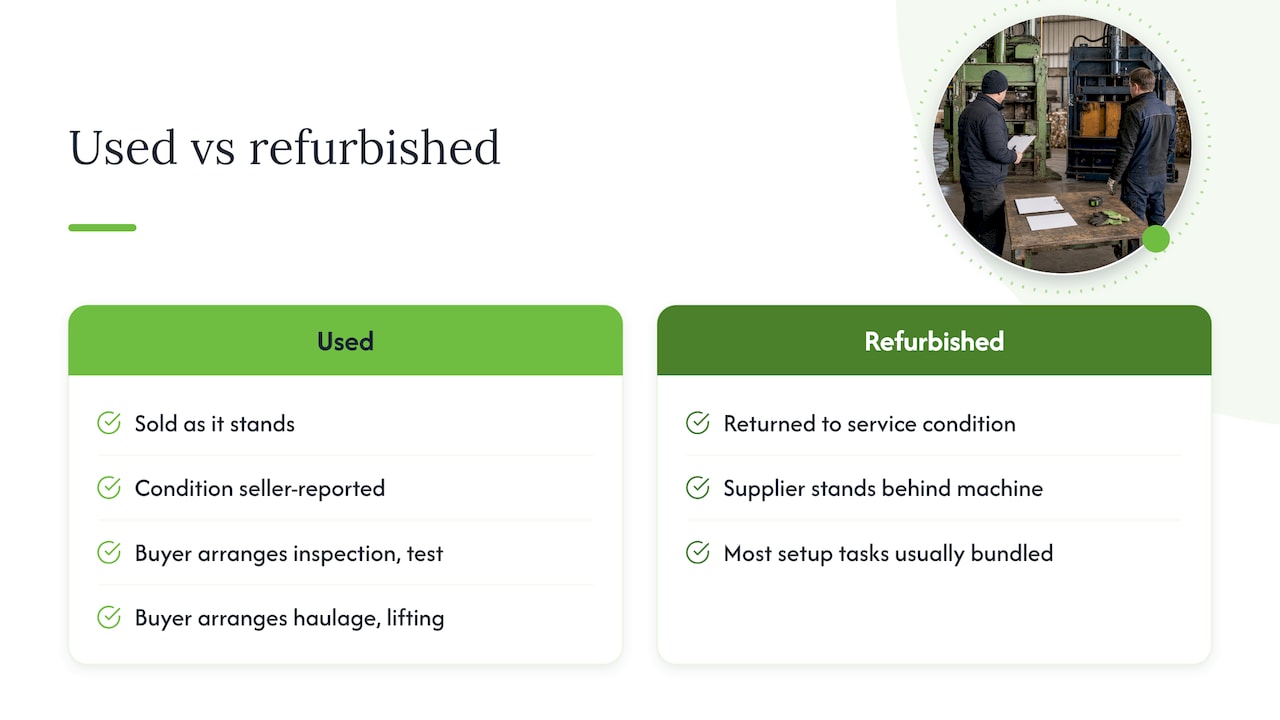
Used (second-hand) means a machine sold as it stands. It may have been well kept or it may have been working hard for a decade. What you know about it is what the seller tells you.
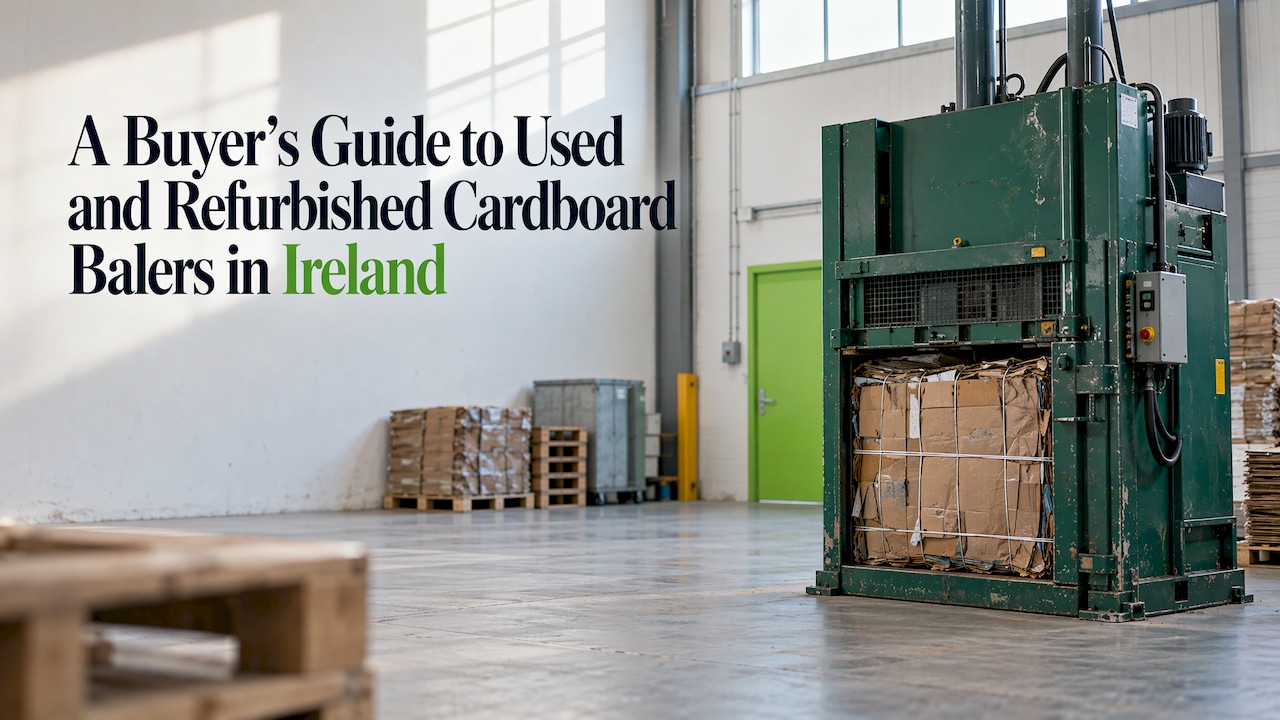
Refurbished means the machine has been taken in, worked on and put back into service condition by the seller, often from trade-in or ex-rental stock. You are paying for that work and for a supplier who stands behind the machine.
For a facility manager the practical difference is time. A used machine from an ad leaves you to arrange inspection, a test run, haulage, lifting, wiring and a safety check. A refurbished machine from a supplier usually bundles most of that into one purchase. Our own refurbished compactors and balers range is built around that single-purchase idea.
Your options compared
There are five realistic routes to a second-hand cardboard baler in Ireland. Here they are side by side, with the route we recommend first.
| Route | What you get | Typical strength | What you handle yourself |
|---|---|---|---|
| Refurbished from a specialist supplier (Compact) | A reconditioned machine matched to your site, supplied to businesses anywhere on the island of Ireland | One point of contact from audit to equipment to bale sales | Little: sizing, supply and the bale outlet sit with one team |
| Other specialist dealers with used stock | Trade-in or ex-rental machines | Choice of makes | Comparing offers, confirming what work was done |
| Online classifieds | Private or trade sellers, one machine per ad | Low headline prices | Inspection, negotiation, collection, installation |
| Machinery marketplaces and auctions | Many listings, sometimes from abroad | Wide choice of models | Import, haulage, paperwork, power and safety checks |
| Overseas dealers | Machines built for other markets | Occasional bargains | Voltage match, transport costs, manuals and spares |
The table shows the pattern: as you move down, the headline price tends to fall and the number of jobs you take on yourself rises. For most business owners the cost of those jobs, in staff time and risk, is what decides it.
Refurbished from a supplier that handles the whole job
This is the route we recommend, and the reason is straightforward. A baler is not an isolated purchase. It sits between the cardboard your staff generate and the buyer who collects the bales. Getting the size wrong, or having no outlet for the bales, wastes the saving.
We offer a free waste audit that looks at your actual requirements, then supply the equipment, and our bale buyback scheme pays for the baled cardboard and plastic. That single route from audit through equipment to recycling and payment is why a refurbished machine from us costs less to own than a cheap ad that leaves you managing the rest.
If you want a vertical baler for a shop or small warehouse, start with our cardboard balers. If you prefer a particular make, see our Strautmann balers.
Other specialist dealers
Some dealers in Ireland and abroad sell used and ex-rental balers. They can be a good source of choice, but each one describes its machines differently. One may mean a full strip-down and repaint, another a clean and a test. Ask each for the same list of work done, and you will be able to compare them fairly.
Online classifieds
Classifieds are where most Irish buyers start looking. A DoneDeal listing for a 250 kg baler was asking €2,850, with related baler ads priced between €2,850 and €5,500. Those are asking prices on one day, not what machines sell for, and listings come and go, so treat them as a rough range rather than a price list.
The saving on an ad is real only if you can inspect the machine, collect it and install it yourself. Most small businesses cannot easily do all three.
Machinery marketplaces and auctions
Marketplaces list hundreds of machines from many countries, which is useful for seeing what exists. They are, though, listing services, not suppliers. The person selling is rarely the one who will commission the machine or answer the phone when it jams on a Monday morning. If you buy from a listing, plan for your own transport and your own electrician.
Overseas dealers
A machine built for another market may run on a different voltage or have documentation in a different format. Irish and EU sites expect a manual and a risk assessment with the machine. Buying locally keeps the machine, the manual and the support in the same country as you.
Match the baler to your site before you compare prices
A cheap baler that does not fit your building or your cardboard volume is the most expensive one you can buy. Work through these five checks first. They apply to every route above.
1. Bale weight and cardboard volume
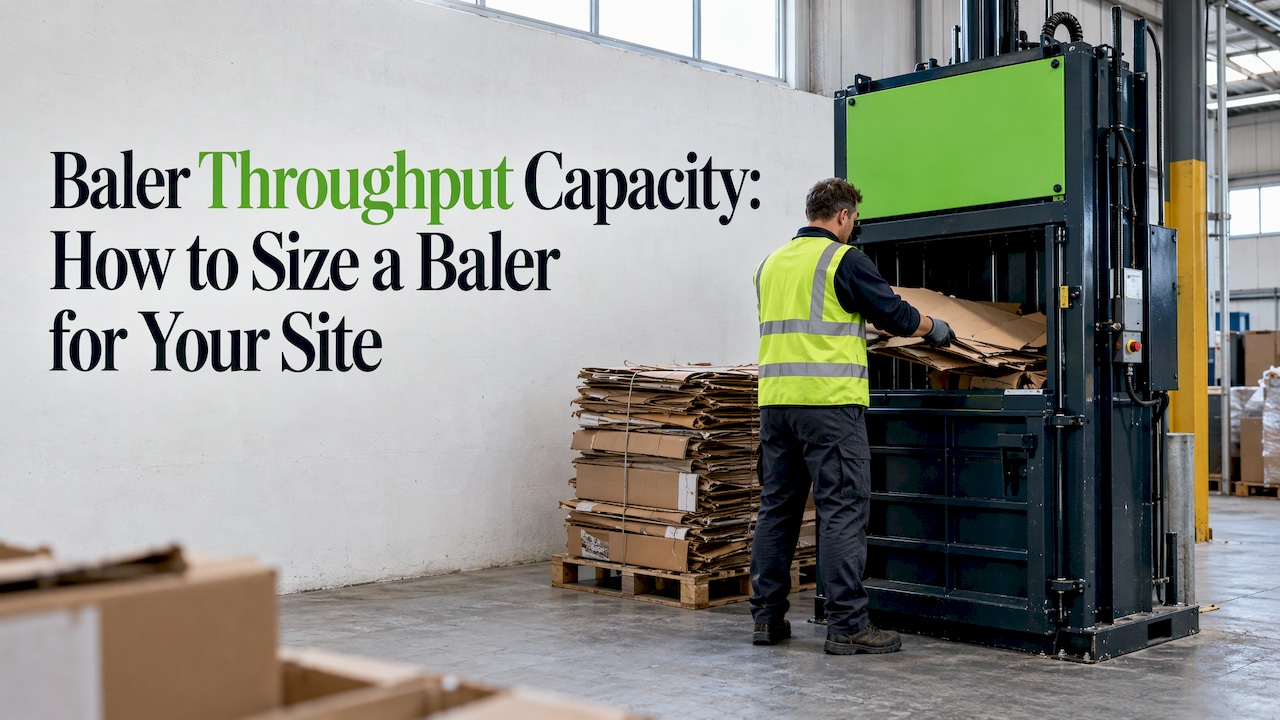
A small vertical baler makes bales of around 50 kg that one person can lift onto a pallet. A larger vertical machine can make bales of 300 kg that need a pallet truck. One manufacturer’s published specification for a vertical baler, for example, quotes bales up to 300 kg with a 72-second cycle, which shows how much the figures vary between models. Add up how many cages or pallets of flattened cardboard you produce each week, then choose a bale size your team can move safely and a buyer will collect.
2. Power supply
Balers run on either single-phase or three-phase electricity. Many smaller vertical machines run from a single-phase supply and larger ones need three-phase. Check which your premises has before you buy, because adding three-phase to a unit that lacks it can cost more than the machine.
3. Floor area and height
A vertical baler typically stands close to two metres tall and needs working room in front to load it and tie off the bale. Measure the door the machine will pass through, the ceiling clearance, and the space for a pallet to sit beside it. Our guide to baler space requirements gives floor area, height and power figures. Before delivery, it also helps to mark out the spot and walk the route the cardboard will take, as set out in this guide to warehouse layout design.
4. Loading and workflow
Put the baler where cardboard is produced, not where it is convenient for the delivery driver. If staff must carry boxes across the building, they will leave them in a corner and the baler sits idle.
5. Baling wire or tape
Every baler needs tie material. Check what your machine uses and keep a stock. We supply baling wire and tape so you can order it with the machine.
How to judge a used or refurbished machine
You do not need to be an engineer. You need a short list of questions, and the answers in writing.
- Make, model and age. These let you find the manual and spare parts.
- Work carried out. Ask for the refurbishment in plain terms: what was replaced, what was tested, whether it was repainted and whether the hydraulics were checked.
- Hours or history. Where did it come from? Trade-in and ex-rental machines have a known source, which a private ad often cannot show.
- Safety features. Interlocks on the loading door and an emergency stop should be present and working. Refuse to use any baler where they are missing or bypassed.
- Documents. An operation manual and a risk assessment should come with the machine. Treat the manual as part of the purchase: in Ireland an employer must keep work equipment safe for staff, and your staff need to be trained on the machine before first use.
- A test run. See the machine press a load and complete a bale, or have it commissioned on site.
- Warranty and support. Get the terms in writing, and ask who services the machine afterwards.
When you buy refurbished from us, you deal with one team that sizes the machine for your site, supplies it and arranges the bale outlet. That takes most of the list above off your hands.
What a used baler really costs
The asking price is only one line of the bill. Build the total before you compare options.
| Cost line | What to find out |
|---|---|
| Purchase price | Asking price, and whether it is quoted with or without VAT |
| VAT | Irish VAT is charged at a standard rate of 23%, and trade listings often quote prices excluding VAT, so add it to the comparison |
| Transport and lifting | Delivery from where the machine is, and a pallet truck or crane to place it |
| Electrical work | Isolator, socket or three-phase connection by a qualified electrician |
| Tie material | Wire or tape for the bales |
| Servicing | Annual check and a plan for breakdowns |
| Training | Short induction for each person who will use it |
Worked example. Take a classified ad at €2,850. With 23% VAT added that is €3,505.50. Add haulage, lifting and an electrician and the figure rises further, before you count the hours of staff time collecting and testing it. Compare that against a refurbished machine supplied, delivered and sized for your site as one quote, and the gap usually narrows or closes. We do not publish a price for each machine, so ask us for a quote; our cardboard baler price guide explains what drives the figure.
The cost most buyers forget: the income side
A baler saves money by cutting the number of collections and the space cardboard takes up. It earns money when someone buys the bales. Loose cardboard in a skip is a cost. Dense, clean bales are a product.
This is why the most useful question when you choose a baler is not just how much it costs but who takes the bales and what you are paid. Our bale buyback programme pays businesses for baled cardboard and plastic, and our guide to cardboard bale prices sets out what buyers pay per tonne. A machine bought from a stranger on a classified site does nothing about this side of the equation.
If you also produce wet or bulky waste, we supply dewatering shredders and cardboard compactors for sites where a compactor suits the volume better than a baler.
Baler or compactor?
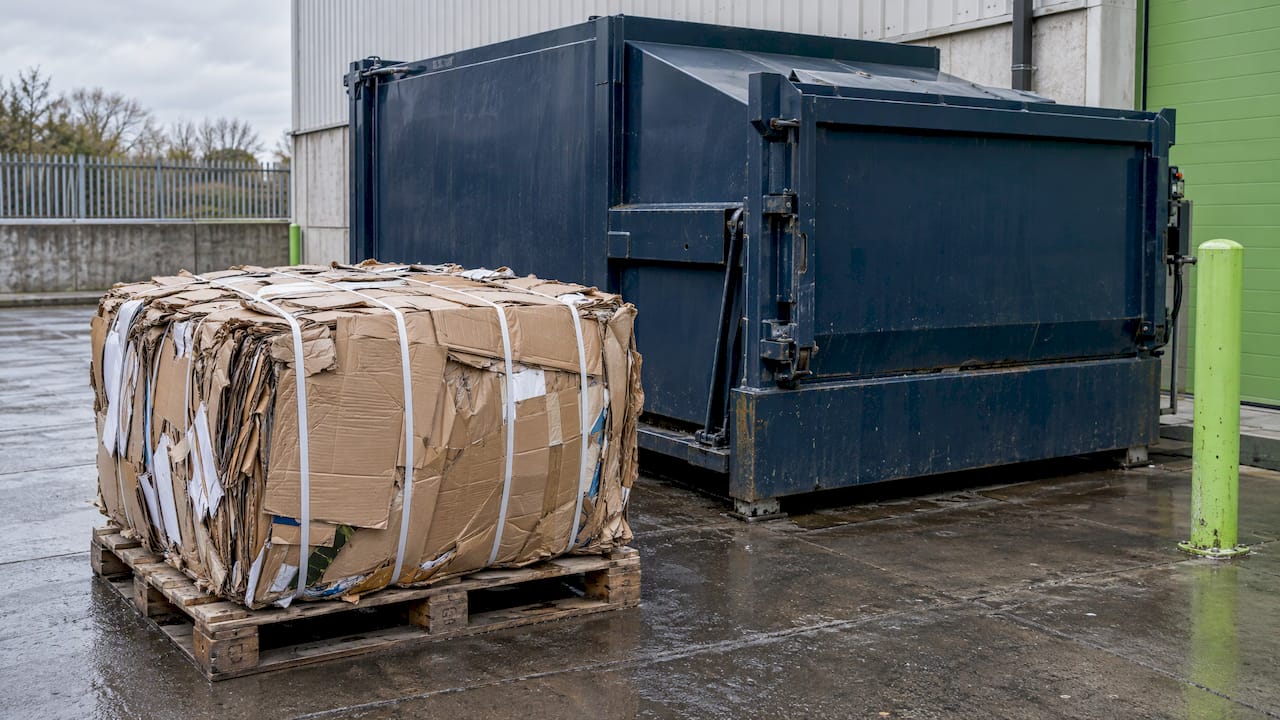
A baler compresses cardboard into a tied bale that is sold as a material. A compactor squeezes mixed waste into a closed container that is hauled away. Choose a baler when your waste is mostly clean cardboard and plastic film, because bales can be sold. Choose a compactor when you have large volumes of general waste or mixed material. Many sites use both. Our guide to choosing between balers and compactors goes through the volumes where each makes sense.
Who should buy refurbished
Refurbished suits you if:
- You produce steady cardboard from deliveries or packaging, such as a retail unit, a distribution site, a manufacturer or a hotel.
- You want a lower purchase cost than new without a long search.
- You want one supplier responsible for sizing, delivery and the bale outlet.
- You manage several sites and want to standardise on a model that is simple to support.
If you are unsure which size you need, the audit is the place to begin. We measure what you generate and recommend a machine to match.
Our view: buy the outcome, not the machine
We see a used baler as a tool for one job: turning cardboard from a cost into a product you can sell. The machine itself is the smaller part of that decision.
That is why we start with an audit of what your site generates, recommend the right machine, new or refurbished, and then buy the bales back. One team, one route from the cardboard in your loading bay to the payment for the bale.
A refurbished baler matched to your volume, power supply and floor space is usually the strongest value in the category. It keeps the capital cost down, cuts collections and starts earning back through the bales.
Graham
Next step: get the right machine for your site
If you are comparing used and refurbished cardboard balers, we can show you a refurbished machine sized to your site and explain how the bales turn into income. Our new and refurbished balers for Irish businesses page shows what we supply across the island of Ireland, and the free waste audit is the quickest way to find the right size.
To see the range now, go to our refurbished compactors and balers page.
FAQ
How much does a used cardboard baler cost in Ireland?
Asking prices on Irish classified sites for used balers have run from about €2,850 to €5,500 in the ads we reviewed, depending on the size and condition of the machine. Add 23% VAT where the price is quoted without it, plus transport and installation. For a refurbished machine supplied by us, ask for a quote based on your site.
Is a refurbished baler as good as a new one?
For most cardboard volumes, a refurbished baler does the same job as a new one at a lower purchase cost. What matters is that it has been reconditioned, that the safety features work, and that it fits your cardboard volume and power supply. We supply both new and refurbished machines and will recommend the one that suits your site.
What power supply does a cardboard baler need?
Smaller vertical balers commonly run from a single-phase supply, and larger machines usually need three-phase. Check which your building has, and have a qualified electrician connect the machine. Our baler space requirements guide lists floor area, height and power figures.
Can I sell the bales my baler makes?
Yes. Clean, dense cardboard bales have a market value, and our bale buyback scheme pays businesses for them. Ask us how it works for your volume.