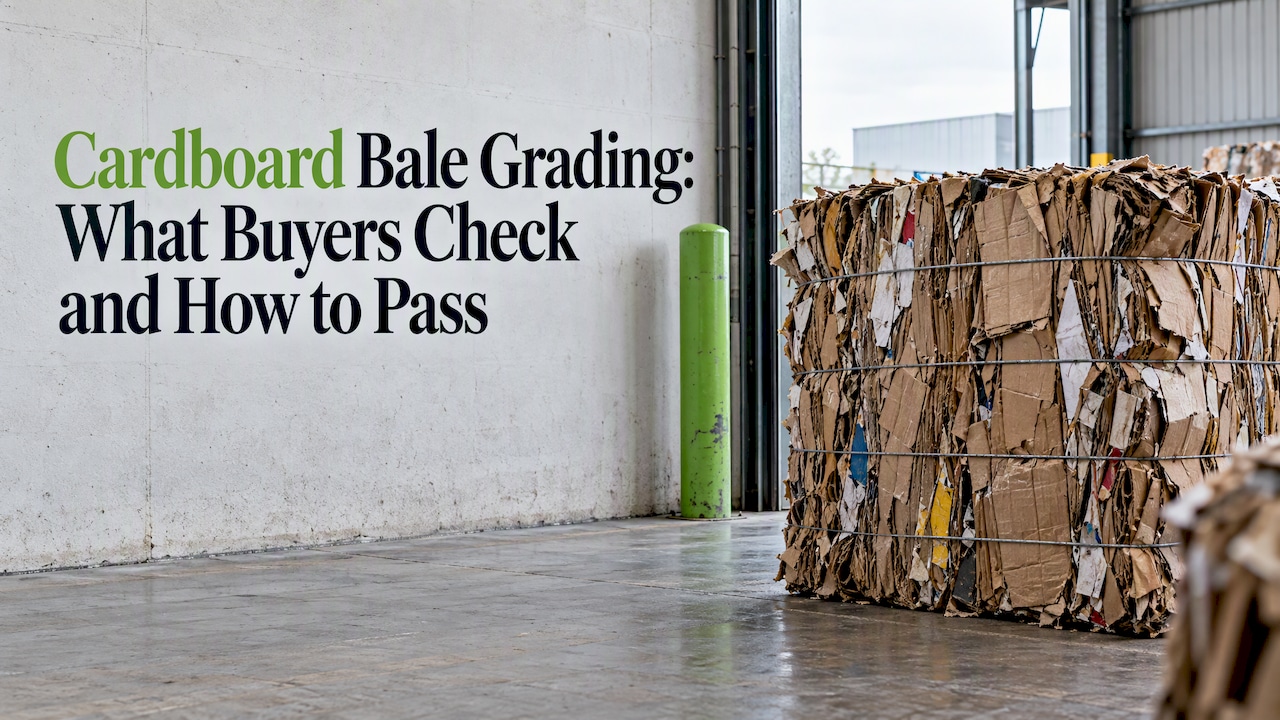
Cardboard bale grading is how a buyer decides what your bale is, and therefore what it is worth. In Ireland and across Europe the reference is the EN 643 standard: most commercial corrugated falls into grade 1.04 or 1.05, and the bale is then judged on moisture, contamination and how well it has been pressed and tied. Get those three things right and the grade holds. Get them wrong and the price drops, or the load is refused.
TL;DR
- Most business cardboard is sold as EN 643 grade 1.04 (corrugated packaging with other board mixed in) or 1.05 (ordinary corrugated board, “OCC”).
- Buyers check moisture, non-paper impurities and prohibited materials. Wet, greasy or plastic-laden bales are downgraded or rejected.
- Tight, well-tied bales of a consistent size are accepted more easily and cost less to haul.
- The grade you actually achieve matters more than the headline market price. Keep a log of what goes in and ask your buyer for their written tolerances.
- A waste audit shows what your cardboard really looks like before you buy a baler or sign a contract.
Table of Contents
- What cardboard bale grading actually means
- The grades of corrugated cardboard, and how they differ
- What buyers check before they accept a bale
- Why grade matters more than the headline price
- How to produce bales that hold their grade
- Bale size, density and what it does to haulage
- Baler or compactor: which suits your grading goals?
- Perspective: grading is a habit, not an event
- Find out what your cardboard is worth
- A quick pre-sale checklist
- FAQ
- Sources
What cardboard bale grading actually means
Grading is a shared language between the person who produces a bale and the mill that will pulp it. Instead of arguing about whether cardboard is “good”, both sides refer to a defined grade.
In Europe, paper and cardboard are graded under EN 643. According to the FEFCO recyclability factsheet, the standard lists grades that define the material’s source, prohibited substances, moisture levels and delivery form. The same document names the two grades that matter for corrugated: 1.04 Corrugated Paper and Board Packaging, and 1.05 Ordinary Corrugated Board.
You will also hear American terms such as OCC (old corrugated containers). In Ireland, traders often use OCC as shorthand for the 1.05 type of material, and quoted prices follow the same logic.
Grading is not the same as the waste classification on your paperwork. The European Waste Catalogue code for packaging cardboard is a legal matter covered in our guide on avoiding fines with the right cardboard waste code. The grade is commercial: it decides the price.
The grades of corrugated cardboard, and how they differ
The difference between grades is mostly about what else is allowed in the bale alongside corrugated board. The EN 643 presentation from CEPI, the European paper industry body, sets this out.
| Grade | What it is | What else may be in it |
|---|---|---|
| 1.04.00 | Used paper and board packaging | At least 70% corrugated board, the rest other packaging papers and boards |
| 1.04.02 | Corrugated paper and board | A higher corrugated share (at least 80%) |
| 1.05.00 | Ordinary corrugated board: used boxes and sheets of corrugated board of various qualities | May include up to 10% other packaging papers and boards |
| 1.05.01 | Corrugated board of various qualities | May include up to 5% other packaging papers and boards |
The same standard sets limits on what should not be there. For these corrugated grades, non-paper components are capped at 1.5%, and the total of unwanted material (including outthrows and non-paper items) is capped at 3% for 1.04 and 2.5% for 1.05.
In practice, this means:
- A shop or warehouse bale that is nearly all brown cartons can usually be offered as 1.05.
- A bale that includes cereal-box board, grey board, paper wrap and the odd folding carton sits in 1.04. It is perfectly saleable, but a mill pays for fibre quality, so expect a different price.
- A bale with a lot of plastic film, polystyrene or wet material may not meet either grade.
Mill requirements vary by site and by contract. Treat the table as the standard’s definitions, and ask your buyer which grade they are buying and what tolerances they apply.
What buyers check before they accept a bale
A grade on paper means nothing until a load is inspected. Mills and merchants look at the same handful of things.
Moisture
Water adds weight but no fibre, so buyers penalise it. One European mill group’s acceptance conditions for recovered paper set a maximum of 12% moisture for grades 1.04 and 1.05, and state that moisture above 20% or chemical contamination can lead to rejection. French interprofessional recommendations aligned with an earlier EN 643 version use a 10% reference moisture content, with price deductions above that and total load rejection typically above 25%.
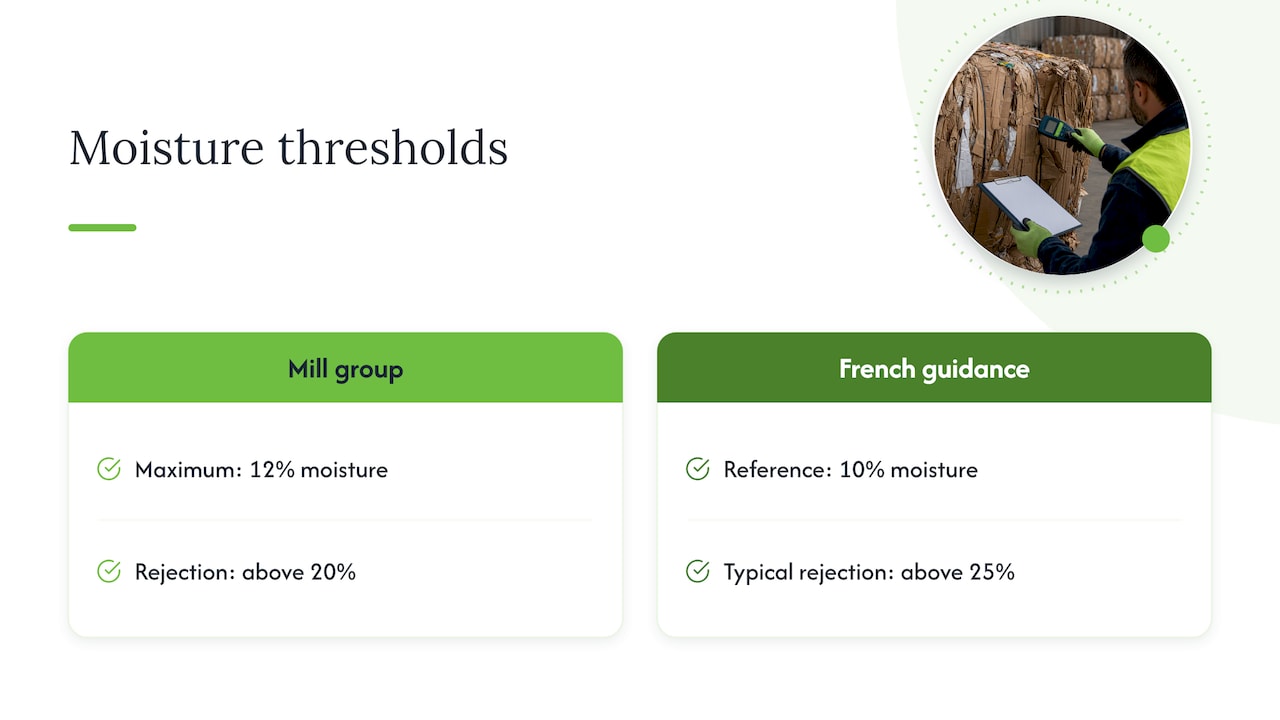
The exact numbers differ between buyers, which is the point: ask for yours. What does not differ is the cause. Cardboard stored outside, in an open skip, or beside a drain gets wet, and wet cardboard bales badly.
Non-paper impurities
Plastic wrap, strapping, tape, polystyrene, metal and food residue all count against you. The mill conditions above cap non-paper impurities below 1.5%, in line with the EN 643 limit, and exclude material contaminated with food or chemicals, bituminous paper and waste from hospitals and nursing homes. A pizza box with grease through it is a contaminant, not corrugated.
Prohibited materials
Only a few things cause outright refusal: hazardous contamination, chemicals, medical waste. They are rare in a clean commercial stream, but one stray item can condemn a load, so the point of segregation is at the bin, not at the weighbridge.
Bale integrity
The same mill conditions expect bales that are tightly compressed, properly secured and sized to suit the mill’s handling equipment. A bale that bulges, sheds wire or collapses when lifted is a problem for the haulier long before it is a problem for the grader.
Why grade matters more than the headline price
OCC prices move with the market. In February 2026, for example, IMtrade reported German domestic OCC at 112 to 115 and export OCC at 155 USD per ton CNF. Those are market indicators between traders, not what a small Irish business is paid per tonne at the door.
What you receive is the market level less haulage, handling and any deductions for quality. A commentary on recovered-paper trading from ForestSource makes the same point: real landed value is driven by contamination levels more than by headline prices, so buyers and sellers should agree specific tolerance limits and inspect loads against them.
So two businesses selling in the same week can see very different returns. The one with dry, clean, tight bales is paid close to the going rate. The one with damp, mixed bales gets a deduction, or a rejection and a return haul. For what Irish buyers actually pay, see our page on cardboard bale prices in Ireland and the rebates available to Irish businesses.
How to produce bales that hold their grade
Most downgrades are avoidable. These habits make the difference.
- Keep cardboard dry. Store it under cover, and keep baling and storage areas away from drains and open skips. This protects against the single most common deduction.
- Separate at the point of use. Put a clearly labelled cardboard-only container where the boxes are opened: goods-in, stockroom, kitchen. Plastic wrap, polystyrene and strapping go in their own stream.
- Remove food-contaminated board. Greasy pizza boxes and takeaway packaging belong in general or food waste, not the bale.
- Flatten and feed consistently. Flattened boxes bale denser than whole ones. Loading the chamber evenly gives a squarer, more stable bale.
- Press to full cycle and tie properly. Using the correct wire or tape for your machine, and tying off each bale fully, prevents bales springing open in transit. Our baling wire and tape range is matched to the machines we supply.
- Stack and store bales off the ground and under cover. A dry bale left in the rain is a wet bale at collection.
- Keep a simple log. Record dates, weights and any rejection notes. If a deduction is disputed, evidence beats memory.
Bale size, density and what it does to haulage
A bale is a unit of freight as well as a unit of fibre. Denser bales mean more tonnes on each lorry, and that is why buyers prefer them. HSM, a baler manufacturer, notes in its guide to selling cardboard bales that bale density is a critical factor for freight economics, because denser bales allow higher payloads per truckload and strengthen the case for larger horizontal balers.
The logic holds anywhere: if a haulier can load more tonnes per trip, the cost per tonne falls, and that tends to be reflected in what you are offered. Principles of palletising and loading freight apply here too: stable, uniform units are quicker to load and safer in transit.
Bale weight varies with the type of baler, the chamber size and the material, so check the stated bale weight on a machine’s specification before you buy. Our cardboard baler range includes vertical and horizontal options, and our guide on what to know before choosing a cardboard baler walks through volumes and space.
Baler or compactor: which suits your grading goals?
The choice affects how saleable your cardboard is.
- A baler presses cardboard into tied, stackable bales. Bales are clean, dry if stored properly, easy to grade and straightforward to sell, which is why they suit buyback arrangements. See our cardboard baler page.
- A compactor compresses material into an enclosed container that is collected as a whole. It suits high volumes and mixed dry waste, but a compacted load is harder to inspect and grade, and cardboard in a mixed compactor will not usually earn a bale price. Our guide to choosing a cardboard compactor explains where each makes sense.
If your goal is to be paid for cardboard, a baler with a clean, segregated stream is usually the more direct route.
Perspective: grading is a habit, not an event
We see the same pattern on site after site. A business buys a baler, the first bales are excellent, and six months later the quality has slipped because the cardboard bin has become a general bin. Nothing is wrong with the machine. The grade is lost upstream, in the stockroom, in the yard, in the hands of whoever is clearing the shelves on a busy Friday.
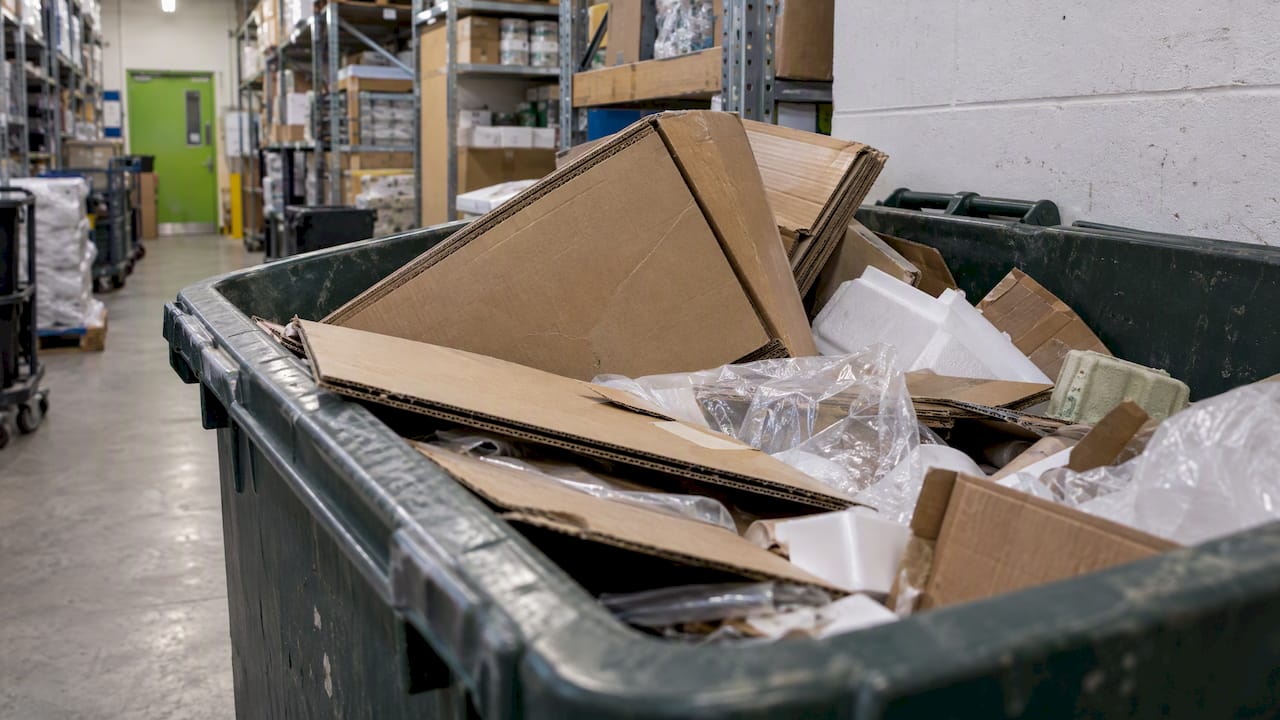
Our view is that a bale is only as good as the habit behind it. Put the container where the boxes are opened, label it plainly, keep it under cover, and tell staff why it matters: clean, dry cardboard is a product, and contaminated cardboard is a cost. Then measure. Weigh what leaves, note what is rejected, and watch the pattern.
That is why we start with an audit rather than a machine. Until you know how much cardboard you produce, how dry it stays and what gets mixed in, any equipment decision is a guess.
— Graham
Find out what your cardboard is worth
If you produce cardboard regularly, the first step is to know your own numbers. Compact offers a free waste audit that looks at your volumes, how the stream is handled and whether baling would pay. If baling makes sense, we supply the baler and, through our bale buyback scheme, can buy back qualifying bales so that your cardboard becomes revenue rather than a disposal cost.
One point of contact covers the audit, the equipment and the sale of the bales, so there is no gap between the machine and the money. If you would like to see how the numbers might look first, our waste audit checklist shows what to weigh and record.
A quick pre-sale checklist
Before a collection or a buyer’s inspection, run through this list:
- Are the bales dry to the touch, with no staining or mould?
- Is there any plastic film, strapping, polystyrene or food residue visible?
- Are the bales tied securely, and the same size and shape as each other?
- Can the bales be stacked and moved by forklift without breaking?
- Do you know which grade your buyer is buying, and what their moisture and impurity limits are?
- Do you have a record of weights and dates?
A yes to all six puts you in a strong position. Any no is a deduction waiting to happen.
FAQ
What are the different grades of corrugated cardboard?
Under the European EN 643 standard, the main grades are 1.04 (used packaging with at least 70% corrugated board, the rest other packaging papers and boards) and 1.05 (ordinary corrugated board, which may include up to 10% other packaging papers and boards for 1.05.00, or 5% for 1.05.01). Buyers may also use terms such as OCC for the 1.05 type. Always confirm which grade your buyer applies.
How much does a bale of cardboard weigh?
It depends on the baler and the material. Smaller vertical balers make lighter bales that can be moved by hand or pallet truck, while larger horizontal machines make much denser bales for forklift handling. The specification for each machine states the typical bale weight, and a denser bale generally carries more tonnes per lorry.
How much is a tonne of cardboard worth?
It moves with the market and with your quality. Price indicators for OCC between traders, such as those reported by IMtrade, are not the same as the figure paid to a business, because haulage and quality deductions come off. We publish what Irish buyers actually pay on our cardboard bale prices page.
Why would a buyer reject a bale of cardboard?
The usual reasons are excess moisture, food or chemical contamination, too much plastic or other non-paper material, and bales that are poorly pressed or tied. Some mill conditions treat moisture above 20% as grounds for rejection. Keeping cardboard dry and separate at the source prevents most problems.
Sources
- FEFCO factsheet on recyclability for corrugated cardboard packaging
- CEPI presentation of the EN 643 standard
- General acceptance conditions for recovered paper
- Interprofessional recommendations on recovered paper
- IMtrade Impress, February 2026
- ForestSource on recovered paper grades
- HSM guide to selling cardboard bales
- Guide to palletising freight