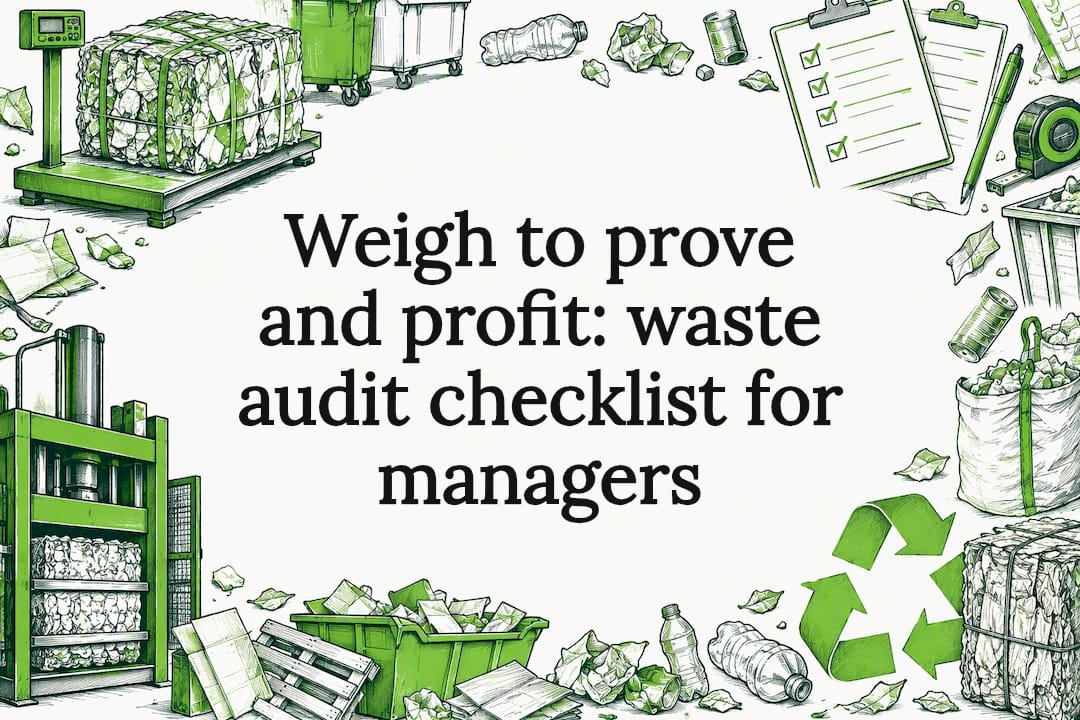
A usable waste audit checklist walks you through six stages: plan, prepare, sort and measure, record, analyse, and act. Follow it properly and you end up with a weighed baseline for every waste stream plus a concrete action plan, backed by records that stand up to EPA audit scrutiny and EMAS-style verification. Done well, it also flags which streams, cardboard especially, carry resale value worth capturing through a buyback arrangement.
TL;DR:
- Accurate waste audits require selecting a representative period, aligning with normal collection schedules, to prevent misrepresenting waste profiles.
- Proper measurement depends on calibrated scales, tare records, and consistent sampling protocols for reliable weight and contamination data.
- Identifying streams with resale value, especially cardboard, can offset disposal costs through buyback arrangements or equipment investments.
- Safety protocols mandate isolating hazardous or unidentified waste, detailed record-keeping, and team briefings to ensure compliance and prevent health risks.
- Follow-up audits at three to six months and annually are essential for verifying improvements and maintaining accurate waste management KPIs.
Table of Contents
- Step-by-step checklist for planning and conducting a waste audit
- Essential equipment and documentation to bring
- Safety, hazardous waste handling and regulatory evidence to keep
- How to measure, record and organise audit data
- How to analyse results and set operational KPIs
- From findings to action: implementing changes and tracking progress
- How often to run audits and how to benchmark results
- Compact’s practical perspective on turning audits into value
- Common pitfalls and how to avoid them
- Get a free waste audit and find out what your waste is worth
- FAQ
- Sources
Step-by-step checklist for planning and conducting a waste audit
Start by defining scope: which waste streams you are auditing, over what period, and what gets excluded (hazardous or clinical waste is assessed separately, never sorted by hand). A one-week office audit looks nothing like a food-production audit, so write the boundaries down before anyone touches a bin.
Next, build a small team with clear roles. You need a lead auditor to run the day, a safety officer to manage risk, a recorder to log weights and observations, and an operations liaison who knows the site’s collection schedule and can keep normal work moving around the audit.
Timing matters more than most managers expect. Schedule the audit around your actual collection cycle, not a convenient quiet day, and notify your waste contractor in advance so collections are not accidentally delayed or diverted. The EPA’s national waste characterisation work flags that single-day sampling can misrepresent a site’s true waste profile, so pick a period that reflects normal operations.
- Confirm scope, objectives and exclusions before the audit date.
- Assign the lead auditor, safety officer, recorder and operations liaison.
- Notify contractors and align the audit with your usual collection schedule.
- Set up a secure sorting area with labelled containers and PPE on hand.
- Sort visible, non-hazardous waste only, using consistent minimum sample volumes.
- Weigh, photograph and log every stream before it leaves the sorting area.
Keep the sorting protocol simple and repeatable: a secure, ventilated area, clearly labelled containers per material type, and a sampling cadence that captures enough volume to be representative rather than just whatever is easiest to grab.
Essential equipment and documentation to bring
Reliable figures depend on reliable kit. Before the audit starts, check that scales are calibrated and that you tare each empty container before adding waste, since a skipped tare step quietly distorts every net weight that follows.
- Calibrated weighing scales, spare batteries, and a tare-first routine for every container.
- Labelled bins or bags for each material stream, plus tarps and a trestle table for sorting.
- PPE (gloves, eye protection, sturdy footwear) and a basic first-aid kit on site.
- A clipboard-based worksheet or a digital checklist app for real-time logging.
- Pre-visit records: waste transfer notes, collection logs, permits, safety data sheets for suspect materials, and staff training records.
For larger or multi-site operations, field apps and bin-fill sensors can speed up repeat audits, but they are an addition to the manual protocol above, not a replacement for it on a first baseline audit.
Safety, hazardous waste handling and regulatory evidence to keep
Run a risk assessment before anyone opens a bin. The EPA’s waste classification guidance is explicit that suspected hazardous or clinical items should never be sorted by hand without proper testing or documented process knowledge: isolate anything you cannot identify and escalate it rather than guessing.
- Brief the whole team on exclusions before sorting begins.
- Isolate unidentified, hazardous, clinical or sharps waste immediately.
- Retain waste transfer records, permits, training logs and incident records as your evidence file.
- Keep photographs of storage areas and sorting conditions for audit trails.
The EPA’s own guidance on what inspectors check lists these same categories, premises inspection, document validation, and a closing meeting, as the backbone of a B2B compliance audit. If you are working towards EMAS or ISO 14001 verification, the same records double as evidence for an independent reviewer.
Pro Tip: Photograph every sorting station before and after each session; it is the fastest way to answer a regulator’s follow-up question months later.
How to measure, record and organise audit data
Weigh every container empty first and record that tare weight, then weigh it full to get the gross figure. Subtract tare from gross for the net weight of that stream, and repeat the measurement where volumes vary noticeably between days.
Classify each weighed item two ways: by material (cardboard, mixed plastics, food waste, general residual) and by source (office, production floor, back of house). That dual grid is what lets procurement and operations each act on the part of the problem they actually control.
- Log contamination (wrong material in the wrong bin) as a separate note on each stream.
- Photograph contaminated loads as evidence for internal training or contractor disputes.
- Record collection frequency for each stream alongside its weight.
Sampling design matters more than spreadsheet complexity: the EPA’s characterisation methodology warns that under-sized samples and one-off surveys routinely misrepresent a site’s real waste mix.
How to analyse results and set operational KPIs
Once the weights are in, calculate a small set of figures: kilograms by stream, kilograms per full-time employee or per square metre, your contamination rate, and your current disposal cost baseline. These four numbers are enough to spot where the money and the risk actually sit.
- Flag heavy streams with resale value; cardboard is the most common candidate for a buyback arrangement.
- Compare disposal cost per stream against potential rebate or recycling value.
- Set a follow-up measurement at three to six months, with annual verification after that.
Recent regulatory change reinforces why this matters: the 2023 amendment requiring incentivised commercial charging means collectors must now weigh commercial collections and structure pricing to reward recycling, so your own weighed baseline becomes the yardstick you check contractor invoices against.
From findings to action: implementing changes and tracking progress
Turn every audit finding into a line in an action register: what changes, who owns it, by when, and what saving or weight reduction you expect. Vague recommendations get forgotten; assigned, dated ones get done.
- Build an action register with owners, deadlines and expected outcomes.
- Fold confirmed changes into procurement specifications and collection contracts.
- Write short SOPs so operations staff know the new sorting or storage rules.
- Schedule the follow-up weigh-in and prepare a short results summary for management.
Pro Tip: Present follow-up results against the original baseline figures, not in isolation, so the improvement is obvious at a glance.
How often to run audits and how to benchmark results
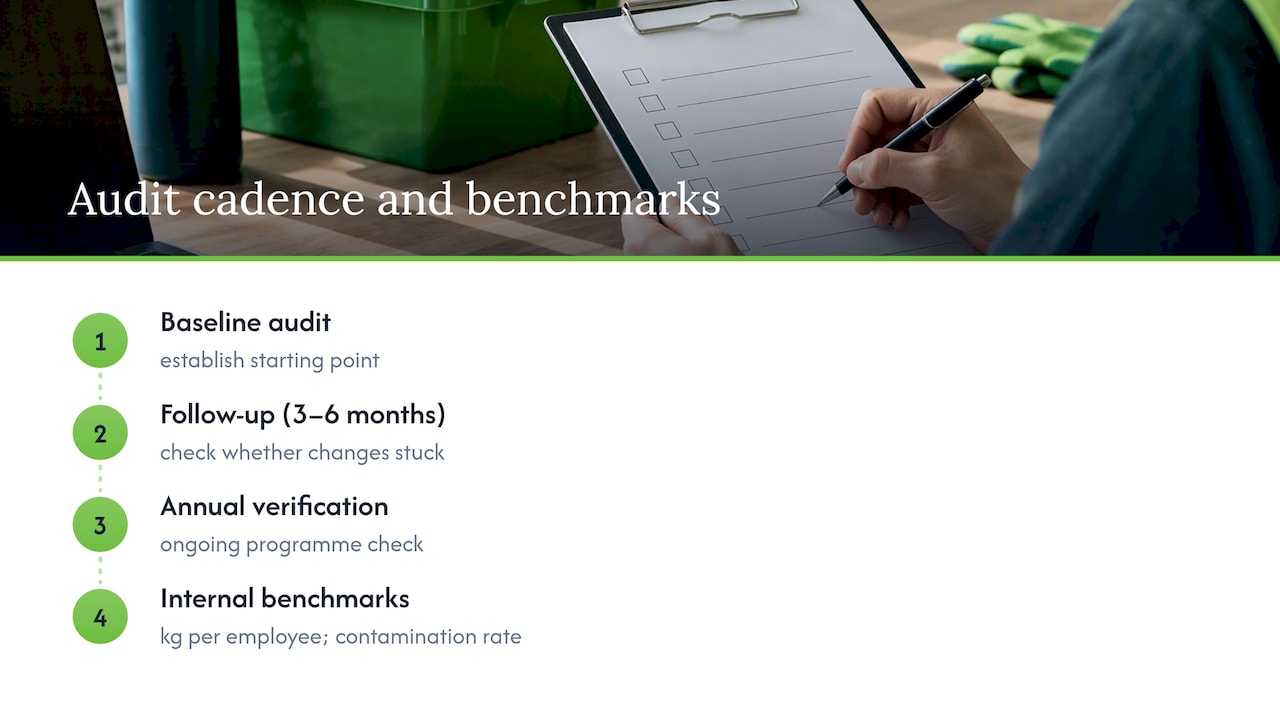
A sensible cadence is a baseline audit, a follow-up at three to six months to check whether changes stuck, then annual verification for an ongoing programme. A single one-day survey is acceptable for a quick scope check, but the EPA’s sampling guidance cautions against treating it as representative for anything you plan to act on long-term. Use kilograms per employee and contamination rate as your internal benchmarks year over year, since sector-wide figures vary too much to be reliable targets on their own.
Compact’s practical perspective on turning audits into value
A tailored audit does two jobs at once: it tells you where waste is costing you money, and it tells you where that same material has resale value. Cardboard is a common example, a stream that looks like pure cost on a disposal invoice but may have potential buyback value if processed properly.
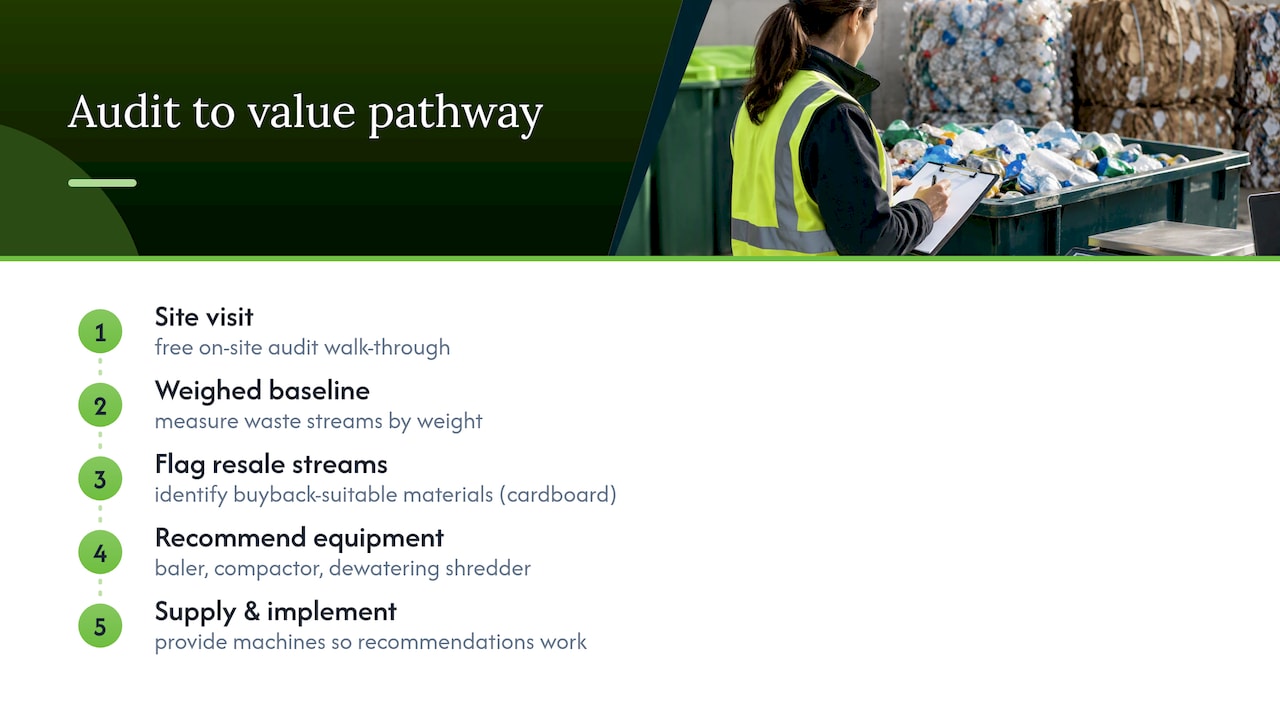
That is the gap a Free Waste Audit is built to close: a site visit that produces a weighed baseline, flags which streams suit a buyback arrangement, and identifies where a baler, compactor or dewatering shredder would cut handling costs. We also supply the cardboard balers and compactors that make baling practical on site, so the audit’s recommendations have a direct route into equipment rather than sitting in a report.
Common pitfalls and how to avoid them
The most common audit mistake is sampling bias: picking a quiet day, relying on memory instead of weights, or quietly skipping an awkward stream. The second is treating hazardous waste casually, which is both a safety risk and a regulatory one.
The remedy is boring but effective: plan the visit around a normal operating day, write SOPs before you start, bring procurement into the findings meeting, and keep every weight, photograph and record for the regulator who might ask later.
— Graham
Get a free waste audit and find out what your waste is worth
If reading the checklist above has you thinking about the hours it takes to run properly, that is exactly the gap a Free Waste Audit is designed to fill. We visit your site, weigh your streams, and come back with a baseline, an action plan, and a clear view of whether your cardboard or plastic residues are worth putting through We Buyback Bales.
To get started, we will ask for recent waste transfer notes, your current collection schedule, and a site contact who can walk us through daily operations. From there, booking the audit is the only next step, and what you get back is a working plan rather than another spreadsheet.
FAQ
How to perform a waste audit?
Define your scope, assemble a small team, then sort, weigh and record each waste stream over a representative period rather than a single quiet day. Analyse the weighed data for cost and contamination patterns, then turn the findings into an action register with owners and deadlines.
What should be included in an audit checklist?
A solid checklist covers scope and objectives, team roles, PPE and sorting equipment, a tare-then-weigh measurement method, a material-and-source classification grid, and a record of contamination and collection frequency. It should also flag exclusions for hazardous or clinical waste that must never be hand-sorted.
What are the 5 R’s of waste management?
Definitions vary slightly, but a common version is refuse, reduce, reuse, recycle and rot (compost). A waste audit is what tells you which of these five levers will actually move the needle for your specific streams, rather than guessing.
How often should waste audits be done?
A practical rhythm is a baseline audit, a follow-up at three to six months to confirm changes have stuck, and annual verification after that for an ongoing programme. A single one-day survey can work as a quick check, but the EPA’s sampling guidance warns it can understate how variable your streams really are.
Sources
- What to expect at an EPA audit — Guidance for B2B producers and self‑complying battery producers (EPA)
- Gov