Composting your restaurant’s food waste is usually best handled by separating scraps at source and either contracting a commercial composting service or, where you have the space and operational controls, installing commercial-grade on-site equipment. Many areas now require food waste to be segregated where a separate collection exists. Start by measuring your current waste stream and booking a free waste audit to see which route suits your kitchen.
TL;DR:
- Commercial composting or off-site collection are the most common options, with off-site being preferred for lower operational burden.
- Contamination from plastics, heavy grease, and non-organic materials is the main cause of load rejection, so proper separation at source is crucial.
- Regulations require proper segregation, treatment, and documentation, especially for pathogen control and approvals from licensed haulers.
- On-site composting requires space, control, and monitoring, making it suitable mainly for larger kitchens with sufficient throughput.
- A waste audit helps determine whether on-site equipment is justified and identifies potential cost savings and operational adjustments.
Table of Contents
- Options for dealing with restaurant food waste
- What to include and exclude from a restaurant compost stream
- Regulatory and compliance essentials restaurants must know
- Setting up a practical in-restaurant system
- Costs, savings and potential revenue from composting
- When to use a professional provider and how Compact helps
- Implementation checklist and the first 90 days
- Composting as one part of a diversion-first strategy
- Compact’s offer: a free audit and composting equipment
- Primary sources and further reading
- FAQ
- Sources
Options for dealing with restaurant food waste
Most restaurants choose between four pathways, and the right one depends on volume, space and how much operational control you want.
On-site composting equipment ranges from small countertop-adjacent units to industrial systems that process several hundred kilograms a day. Smaller kitchens tend to fit compact units into a back-of-house corner, while higher-volume operations need dedicated space, ventilation and a dependable power supply.
Off-site collection is the route most restaurants settle on. A hauler drops bins, you fill them with segregated scraps, and the material goes to a licensed composting or treatment facility. It needs less kitchen floor space and less staff training on the biology of composting, which is why it remains the default for many sites, as outlined in this food waste collection service overview.
Pre-processing, using dehydrators or pulpers, does not compost anything itself. It reduces the weight and volume of scraps before they leave the building, which matters when haulage is charged by weight. The processed output still needs to go somewhere, either into a composting system or out with a collection service.
Anaerobic digestion suits restaurants near existing AD infrastructure. It produces biogas and digestate rather than finished compost, and some national waste strategies rank it above composting on environmental grounds where the infrastructure exists.
- On-site equipment: more control, more space and staff time required.
- Off-site collection: lower operational burden, dependent on hauler reliability.
- Pre-processing: cuts weight and haulage cost, does not replace treatment.
- Anaerobic digestion: an alternative where local infrastructure supports it.
What to include and exclude from a restaurant compost stream
Contamination is the single biggest reason loads get rejected, so clarity at the prep station matters more than any equipment choice.
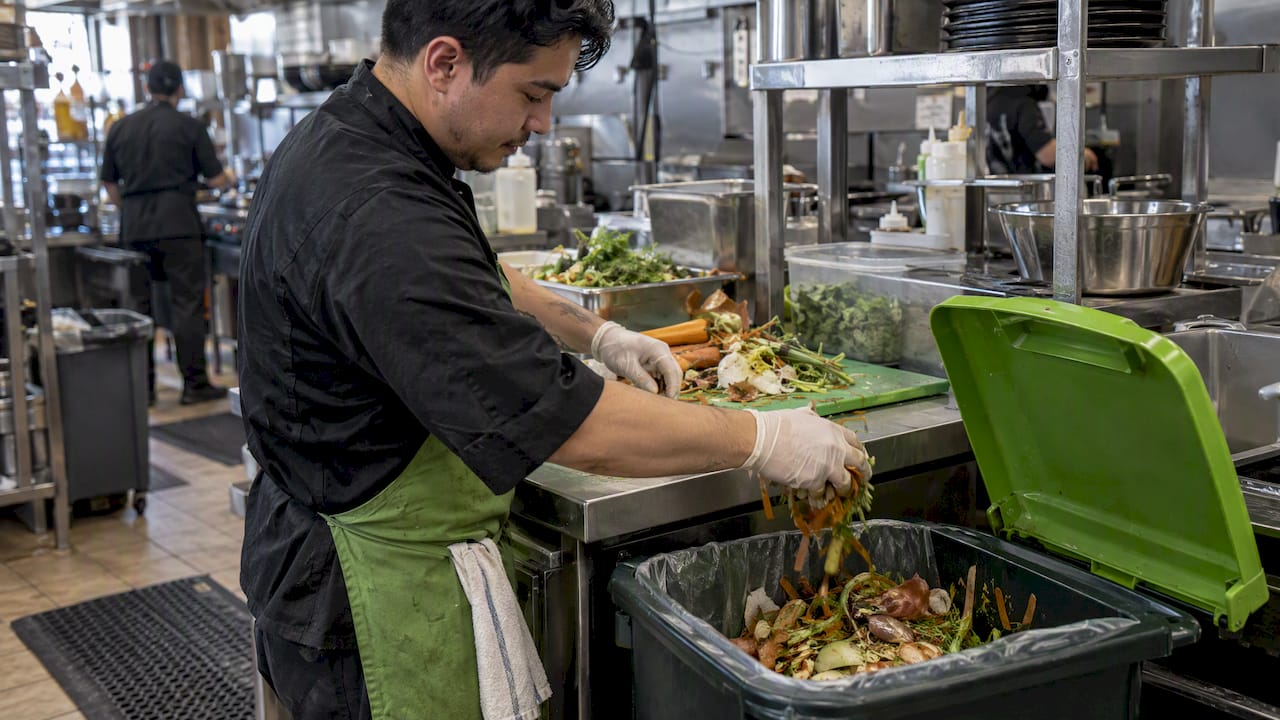
Produce trims, coffee grounds, bread, eggshells and most cooked food scraps are generally accepted, though acceptance for cooked items, meat and dairy depends on the specific processor you use. A balanced mix matters: commercial composting works best with roughly two parts carbon-rich “browns” to one part nitrogen-rich “greens”, and frequent collection keeps odour and pests down.
Plastics, waxed or taped cardboard, and anything soaked in heavy grease usually need to be excluded or handled separately, since they either do not break down or foul the process.
- Accepted: raw and cooked produce trims, coffee grounds and filters, bread, eggshells.
- Conditional: meat, bones and dairy, depending on the processor’s rules.
- Excluded: plastic film, waxed or taped cardboard, heavy grease residue.
Compostable serviceware is a common trap. Many “compostable” cups and containers are only accepted by processors that specifically handle certified packaging, so check with your hauler before promising customers or staff that these items go into the same bin as food scraps.
Regulatory and compliance essentials restaurants must know
Regulations in most jurisdictions oblige commercial food premises to segregate food waste and use a separate collection service where one is available, with catering waste defined explicitly and subject to its own segregation rules.
Processing standards matter as much as segregation. Commercial or thermophilic composting needs to reach and hold specific temperatures to destroy pathogens, and a case study of an on-site composting system found that compost without strict operational controls came out contaminated with E. coli and Salmonella, requiring reprocessing or disposal rather than use. That risk is the main argument for choosing authorised, monitored treatment over an informal setup.
Practical compliance steps are straightforward even if the detail is not:
- Use licensed or authorised haulers and processors for food waste collection.
- Request treatment or processing certificates confirming pathogen control.
- Keep collection records and weights for audits or contract reviews.
- Separate catering waste of animal origin according to your local rules.
Setting up a practical in-restaurant system
A workable system has to survive a busy Friday service, not just a quiet Tuesday morning, so the layout and habits matter more than the hardware.
- Place small capture bins directly at prep stations so scraps go in as they’re trimmed, not carried across the kitchen.
- Line bins with breathable, certified compostable liners rather than standard plastic, and store carbon-rich “browns” such as shredded cardboard or sawdust nearby for layering.
- Empty prep bins into sealed external containers at set points in service, not only at closing.
- Layer greens with browns in the external container to control odour, and schedule frequent emptying rather than letting bins sit full overnight.
- Train staff on what goes in, what stays out, and how to spot contamination, with a quick visual check built into closing duties.
- Set collection frequency to match throughput: smaller kitchens might manage twice weekly, high-volume sites often need daily pickup.
Placement, certified liners and layering with browns measurably reduce odour and pest attraction in commercial kitchens, which is the main operational payoff of getting the setup right the first time.
Pro Tip: Put the compost bin where the busiest prep station can reach it without a detour: convenience, not conscience, is what keeps contamination low.
Costs, savings and potential revenue from composting
Diverting food waste out of general refuse lowers the weight your hauler bills for, and in some cases reduces how often that bin needs collecting at all.
The main cost buckets to compare are collection or service fees, any equipment capital if you go on-site, and the staff time needed for separation and monitoring. Weigh these against what you currently pay for mixed waste disposal, since food waste is often the heaviest fraction in a restaurant’s bin.
- Lower refuse tonnage can mean reduced landfill-bound disposal fees.
- Some providers offer rebates or buyback arrangements for other recyclable material, such as cardboard bales.
- On-site processed compost can sometimes be reused locally, cutting input costs elsewhere.
- Firm figures depend on your current contract terms and local service options.
Outcomes vary by site and by the terms in your existing waste contract, which is why a proper audit, rather than a rule of thumb, is the only reliable way to put numbers on your own kitchen.
When to use a professional provider and how Compact helps
On-site processing carries a technical risk that’s easy to underestimate: without strict control of temperature and process, compost can come out contaminated rather than safe to use, which means reprocessing or disposal instead of the savings you were aiming for.
A professional provider typically handles the audit, supplies or services the equipment, arranges collection, and produces the compliance documentation you need to show pathogen control and authorised treatment.
- An audit establishes your actual waste composition and volumes before you commit to equipment or a contract.
- Supplied equipment, from smaller units like the COMPACT-OC-50 to higher-capacity systems like the COMPACT-OC-5000, matches machine scale to kitchen throughput.
- Ongoing collection and documentation keep a programme compliant without adding to kitchen staff workload.
The general rule: choose a professional route once your volume, regulatory exposure or available floor space makes an informal setup risky rather than simple.
Pro Tip: If you are unsure whether your kitchen has the throughput to justify on-site equipment, a waste audit will answer that question with your own numbers rather than a guess.
Implementation checklist and the first 90 days
Getting started does not need to be complicated, but it does need a sequence.
- Week one: measure baseline waste, order bins, liners and signage, and book a waste audit or hauler consultation.
- Week two: begin separation at prep stations and set an initial collection schedule.
- Day 30: check contamination rates, adjust bin placement or signage, and tweak collection frequency if bins overflow or sit too empty.
- Day 90: review weight reductions and cost impact, then decide whether to scale up, invest in on-site equipment, or formalise a provider partnership.
Composting as one part of a diversion-first strategy
Composting sits below prevention and redistribution on the waste hierarchy, not at the top of it, and EPA guidance places both of those options ahead of composting for good reason: scraps you never create or that go to someone who can eat them beat scraps you process, every time.
What decides whether a composting programme actually works isn’t the equipment, it’s whether staff bother to use the right bin on a Friday night. Culture and training outlast any machine purchase.
— Graham
Compact’s offer: a free audit and composting equipment
Most restaurants lose money on waste contracts they’ve never actually examined, and that’s where a straight answer beats another sales call. Compact offers a Free Waste Audit to establish your baseline waste volumes and identify savings before you commit to anything. For kitchens ready to process food waste on site, Compact supplies organic waste composting machines sized from smaller kitchens to high-volume operations, alongside a bale buyback scheme that turns separated cardboard and plastic into a direct payment rather than a disposal cost.
- Free Waste Audit: establishes current volumes and realistic savings.
- Organic waste composting machines: equipment sized to kitchen throughput.
- We Buyback Bales: direct payment for separated recyclable material.
Request your free waste audit to see where your kitchen stands.
Primary sources and further reading
- EPA composting approaches: the browns-to-greens ratio behind effective commercial composting.
- On-site composting case study: why strict process control prevents pathogen contamination.
FAQ
What do restaurants do with their food waste?
Most restaurants either separate scraps for contracted collection to a commercial composting or treatment facility, or process them on site with dedicated equipment. The choice depends on kitchen volume, available space and local collection options.
What food scraps should not be composted?
Plastic film, waxed or taped cardboard, and heavily greased material are generally excluded because they either resist breakdown or disrupt the composting process. Meat, bones and dairy are conditional and depend on what your specific processor accepts.
How often should I check on compost moisture and turning?
Commercial composting relies on maintaining the right balance of carbon-rich browns to nitrogen-rich greens, commonly around two parts browns to one part greens, with frequent collection reducing odour and pests. On-site systems need regular monitoring against documented process controls rather than any fixed routine based on guesswork.
Can I use food waste as compost?
Yes, but only reliably through a managed process: informal setups risk producing compost contaminated with pathogens if temperature and process controls aren’t maintained. A licensed composting service or properly operated commercial equipment is the safer route for restaurant volumes.
Sources
- EPA — Approaches to composting
- Toward a Circular Bioeconomy within Food Waste Valorization: A Case Study of an On-Site Composting System