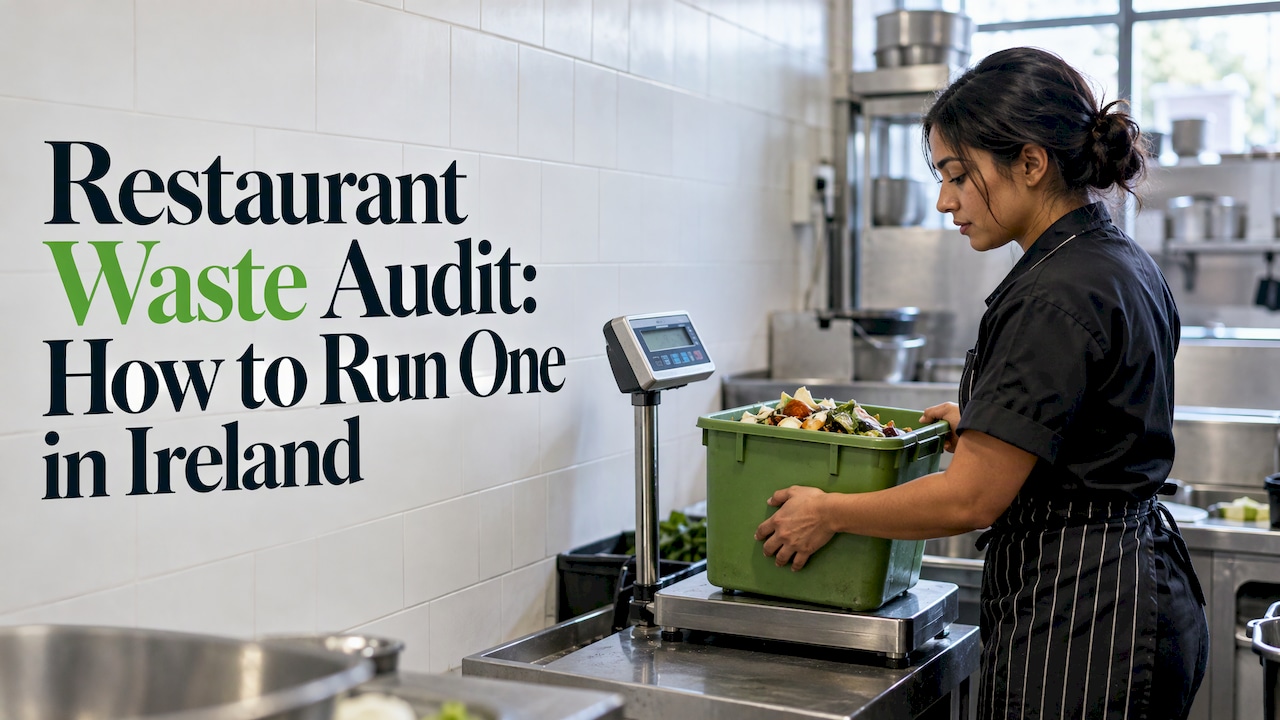
A restaurant waste audit is a week or two of weighing and recording what leaves your kitchen and dining room, bin by bin, so you know how much food, packaging and general waste you produce, where it comes from and what it costs. In Ireland you can start with your existing waste bills, add a simple weekly weighing routine, and put a euro figure on the avoidable part. This guide shows how, step by step, and what Irish rules to check the results against.
TL;DR
- An audit has three jobs: measure each waste stream, find the source of avoidable waste, and put a cost on it.
- Start with the last 12 months of waste bills, then weigh a representative week and multiply by 52 for an annual figure.
- The EPA suggests €3,000 per tonne as an indicative purchase cost of avoidable food waste.
- Since 1 July 2024 every commercial premises where food waste arises must segregate it at source, so your audit should confirm the brown bin is used properly.
- We run free waste audits for Irish businesses and can turn clean cardboard and plastic into rebate income.
Table of Contents
- What a restaurant waste audit tells you
- Know what you are checking against
- Step 1: Start with the paperwork
- Step 2: Choose the categories to track
- Step 3: Weigh a representative week
- Step 4: Turn weights into euros
- Step 5: Act on what you find
- The dry waste side of the audit
- Our perspective
- Get a free audit from our team
- FAQ
- Sources
What a restaurant waste audit tells you
The EPA’s food service pathway for Irish hospitality businesses describes the purpose plainly: estimate food waste in a consistent way, track performance and identify ways to reduce it. It can give you an annual estimate of food waste by bin type, show food ending up in the wrong bins, and estimate what the avoidable food cost you paid for.
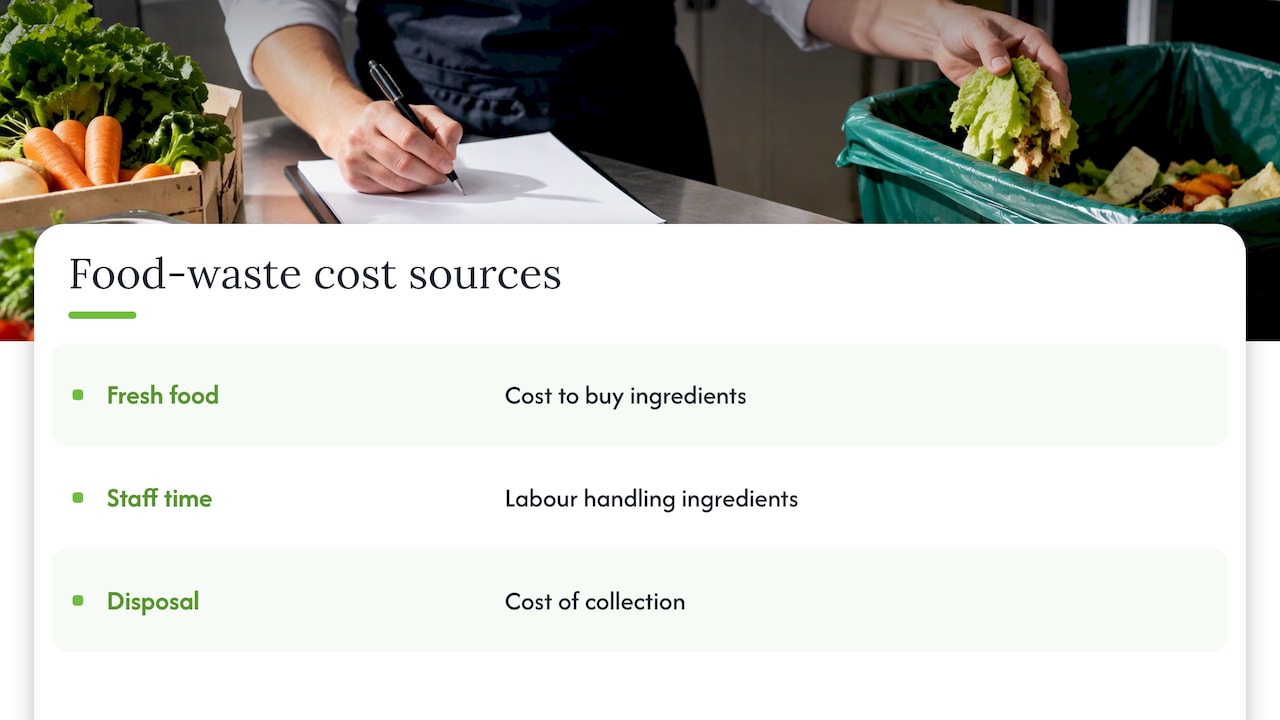
That last point is where an audit earns its time. Waste is a cost you pay three times: once to buy the ingredients, once for the labour that handled them, and once more to have them collected. Wicklow County Council’s prevention guide breaks catering waste cost into exactly those parts: disposal, fresh food and staff time.
An audit also covers more than food. Cardboard from deliveries, glass, plastic wrap and general waste all show up in your bills. A full audit looks at all of them, because the cheapest tonne to deal with is often the one you were paying to send to the wrong bin.
Know what you are checking against
Before you weigh anything, be clear on the legal baseline. Your audit should end with a yes or no on each of these.
- Food waste segregation. The Waste Management (Food Waste) Regulations 2009 require food waste on a producer’s premises to be source segregated and kept apart from other waste and contaminants. The rules cover restaurants, cafés, bistros, wine bars and similar premises where food is prepared on site.
- The 2024 change. The 2024 amendment, effective from 1 July 2024, removed the old exemption for businesses producing under 50 kg of food waste a week. Segregated food waste goes in a dedicated brown bin for an authorised collector, and must go to authorised treatment such as composting or anaerobic digestion.
- Packaging. Under the Waste Management (Packaging) Regulations 2007, packaging waste on your premises, including back-door waste, must be separated at source by material type and collected for recovery or other treatment.
- Weighed collections. From 1 July 2023, collectors must weigh each separate collection and report the weight at least monthly, subject to stated exceptions. That means your contractor should be able to give you weight-based data.
For a fuller walk-through of the obligations, see our guide to food waste regulations in Ireland and packaging waste compliance.
Step 1: Start with the paperwork
You do not need to bin-dive on day one. The EPA pathway starts with what you already have. Collect the waste bills for the last year, check whether you are billed by lift or by weight, and ask your contractor for weight-based data. If you only have lift records, estimate a typical weight per lift for each bin type.
Build a simple sheet with one row per bin type:
| Bin type | Collections per month | Weight per collection | Monthly cost |
|---|---|---|---|
| Brown bin (food waste) | |||
| Mixed general waste | |||
| Dry mixed recycling | |||
| Cardboard | |||
| Glass |
Two things often surface straight away. Bins that are collected more often than they are full, and mixed waste bins that clearly contain food. Both are cost you can act on before you weigh a single bag.
If your building has shared or centralised waste services, the EPA notes that data may not be available at first. The ideal is a separate collection with dedicated reporting for your food service. Ask your landlord or managing agent about it early.
Step 2: Choose the categories to track
The EPA pathway points to three main bin groups: food waste (brown) bins, mixed general waste and recycling bins. Within food waste, the EPA’s research on full-service restaurants identifies three types: unserved waste, plate waste and preparation waste.
- Preparation waste: trimmings, peelings, spoiled stock. Some is unavoidable, but the EPA notes that better preparation practice can reduce it, and that it tends to be high where most food is prepared on site.
- Unserved waste: cooked but never sold. It is often low in made-to-order kitchens, but it still carries the full cost of buying, preparing and storing the food with no income.
- Plate waste: what customers leave. Across full-service restaurants it averages 41% of total food waste, the largest share of avoidable food waste in the sector.
Add a reason code to each entry, such as overproduction, trim, spoilage, returned dish or portion size. The reason is what turns a weight into a decision.
Step 3: Weigh a representative week
The Wicklow guide’s method is simple enough for any kitchen: separate organic waste from general waste for a representative week, weigh the bin, subtract the bin’s own weight, then multiply the weekly figure by 52 for an annual estimate.
How to run the week:
- Pick a normal week. Avoid a bank holiday weekend or a private event unless that is your typical trade. If your business is seasonal, repeat the exercise in the other season.
- Set up separate containers. One each for preparation waste, unserved food and plate scrapings, plus the usual recycling and general waste bins. Label them clearly for staff.
- Put scales where the work happens. A platform scale by the pass and another at the bin store. Weigh the empty container once and write the figure on it.
- Log every weighing. Date, shift, container, net weight, reason code. One person owns the log each day.
- Record covers served. Waste per cover is the figure that lets you compare a quiet week with a busy one.
- Weigh the other streams. Cardboard, glass and general waste, so you can see the full picture. Our waste audit checklist lists what to record for each stream.
If you cannot weigh everything, the EPA also accepts visually checking the bins over a few weeks, or using default factors from national studies to assess mixed waste and recycling. Weight-based data remains the ideal.
Cold storage is a quiet source of spoilage. If walk-in and under-counter units drift out of temperature, stock is lost before it reaches the kitchen. Keeping refrigerator temperature records alongside your audit log helps you match spoilage entries to equipment problems.
Step 4: Turn weights into euros
Once you have a weekly total, the maths is short. Here is an illustrative example, not a benchmark for your site:
| Item | Figure |
|---|---|
| Weekly food waste weighed | 85 kg |
| Annual estimate (× 52) | 4,420 kg (4.42 tonnes) |
| Indicative purchase cost at €3,000 per tonne | €13,260 |
The €3,000 per tonne figure is the EPA pathway’s suggested multiplier for the indicative cost of purchasing the avoidable fraction. If you want a more precise figure, follow the Wicklow approach: take the average cost of ingredients from a sample of your invoices, add collection cost per kg times weight, and add an estimate of the staff time spent on food that is thrown out.
Then look at what the data says, in this order:
- Which category is biggest by weight, and which by cost? A kilo of trimmed beef is not a kilo of potato peel.
- Which reason code appears most?
- Does waste per cover rise on particular days or shifts?
- Is food turning up in the general waste bin?
The EPA stresses that you need to know what is coming from the business, where, and why before choosing any action. The audit gives you that.
Step 5: Act on what you find
Match each finding to a fix.
| Finding | Typical response |
|---|---|
| High plate waste | Review portion sizes, offer smaller portions, adjust sides |
| High preparation waste | Review knife skills, trim specifications and supplier formats |
| Unserved food | Adjust batch sizes and prep lists to forecast covers |
| Spoilage in storage | Rotate stock, check refrigeration, tighten ordering |
| Food in general waste | Re-train staff, label bins, move bins closer to prep stations |
| Bins collected half-empty | Reduce collection frequency or bin size |
For the food that cannot be avoided, Irish law needs it in a brown bin collected by an authorised operator. The EPA notes that a dedicated food waste service, used properly, gives accurate food waste information and lets the waste be used in the circular economy. If you are weighing options for treating food waste on site, read our guide to composting food waste in a restaurant and our range of organic waste composting machines. Wet waste is heavy, and our note on reducing wet waste weight explains how that affects cost.
Then track progress. The EPA recommends reviewing food waste quantities over time against business activity and the actions you took. Repeat a one-week audit every quarter, or after any menu change. Ireland’s national roadmap commits to a 50% cut in food waste by 2030, and customers and corporate clients increasingly ask about it. Businesses that want to go further can look at the EPA’s Food Waste Charter, a public commitment to measure and report on target-based actions.
The dry waste side of the audit
Restaurants, and the suppliers and kitchens behind them, produce a steady flow of cardboard and plastic film. Delivery boxes stack up fast, and loose cardboard fills bins, triggers extra lifts and costs money to move. Clean, baled cardboard has a market value instead.

If your audit shows cardboard is a large share of your bins, a cardboard baler or a cardboard compactor can cut the volume leaving your site, and our bale buyback scheme is built to turn that material into rebate income. Larger sites can also look at refurbished compactors and balers.
Our perspective
Most restaurants we visit are not short of effort. They are short of numbers. The kitchen knows it throws things out, but nobody can say how many kilos, from which station, or what it costs per month.
That is why we start every job with a waste audit built around the site’s real requirements, not a template. We look at the bills, the bins, the back door and the compliance position, then we show what can be saved and what can be earned.
Our view is that waste should be handled as one joined-up system. Food waste goes where the regulations require. Cardboard and plastic are baled clean and sold, so what used to be a disposal cost becomes a rebate. One team covers the audit, the equipment and the collection, so you are not coordinating several suppliers to get a single answer.
Do the audit once properly, repeat it each quarter, and let the numbers decide what you buy.
Graham
Get a free audit from our team
If you would rather not run the weighing yourself, we will audit your waste for you. We look at your streams, your compliance position and the options for equipment and recycling income, and tell you what we find.
Book your free waste audit or start from compact.ie to see everything we offer.
FAQ
How long should a restaurant waste audit last?
One representative week is enough to produce a usable annual estimate, since you multiply the weekly figure by 52. Seasonal businesses should repeat it in their other season. Quarterly re-checks show whether your changes are working.
Do I need special equipment?
No. Platform scales, labelled containers and a log sheet are enough. The EPA pathway is designed to use information you already have, such as waste bills and contractor reports, so you can begin before you buy anything.
Is a food waste audit a legal requirement in Ireland?
The law requires you to segregate food waste at source and use an authorised collector, rather than to run a specific audit. An audit is the practical way to confirm you are meeting those requirements and to measure what the waste costs. See our guide to food waste regulations for the detail.
What should I do with the results?
Rank waste by cost, not only weight, then assign an owner and a target for each of the top three causes. Repeat the audit to check progress, and use the figures when deciding on bins, collections or equipment.
Sources
- EPA: Pathway to less food waste and better margins (2022)
- EPA: Food waste in full-service restaurants
- EPA: Food waste
- Wicklow County Council: Less Food Waste More Profit
- S.I. No. 508/2009, Waste Management (Food Waste) Regulations
- Dún Laoghaire-Rathdown County Council: Food waste
- S.I. No. 798/2007, Waste Management (Packaging) Regulations
- S.I. No. 104/2023, Waste Management (Collection Permit) Regulations
- Ireland’s National Food Waste Prevention Roadmap
- National Food Waste Prevention Roadmap 2023-2025 (gov.ie)