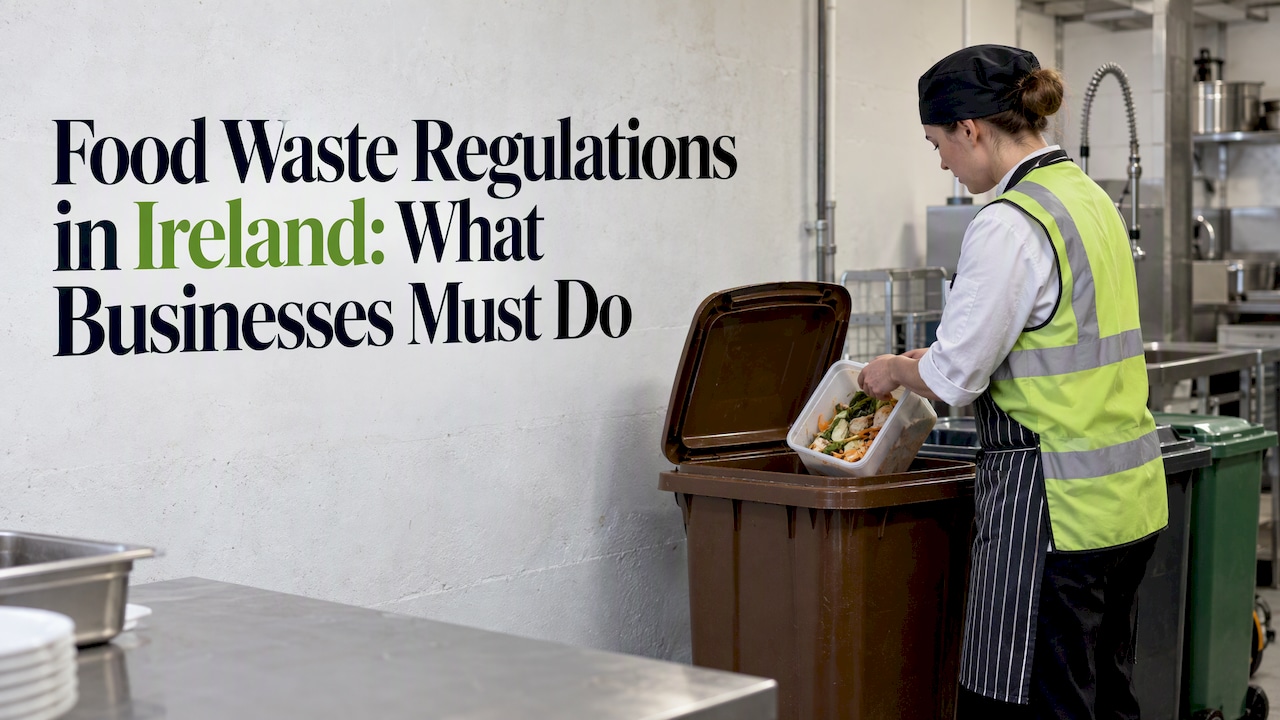
If your business prepares, serves, supplies or even just consumes food on its premises, Irish law requires you to keep food waste separate from other waste. Since 1 July 2024 there is no size threshold: the Waste Management (Food Waste) (Amendment) Regulations 2024 (S.I. No. 294 of 2024) removed the old exemption for premises producing under 50kg a week. A café, an office with a kitchenette and a warehouse with a staff canteen are all covered. This guide explains what that means in practice, what you can do about it, and how to prove you are compliant.
TL;DR
- All commercial premises in Ireland where food is prepared, consumed or supplied must segregate food waste at source. The 50kg-a-week exemption no longer applies.
- You have three legal routes: a separate collection by an authorised collector, authorised on-site treatment, or transfer to an authorised treatment facility with documents to prove it.
- Collectors must offer a three-bin service, and food waste collection is meant to be priced below residual waste, so compliance can lower your bill.
- Both the food business operator and the building occupier can be held liable, and local authorities carry out inspections every year.
- Keep your collection records and permits on file. They are your evidence if an inspector calls.
Table of Contents
- Who the regulations apply to
- Your three legal options
- The three-bin rule and what it does to your bill
- Enforcement: how likely is an inspection?
- Proving compliance: records to keep
- Why this is also a cost question
- Our perspective: compliance is the easy part
- Practical steps by type of premises
- How Compact can help
- FAQ
- Sources
Who the regulations apply to
The rules sit in the Waste Management (Food Waste) Regulations 2009, as amended. MyWaste, the guide run by Ireland’s waste regulators, states that the regulations oblige all commercial premises to segregate food waste so it is collected separately and not mixed with other waste types.
The 2024 amendment widened this. According to the statutory instrument, premises where food is prepared, consumed or supplied are in scope, including offices, warehouses and logistics centres without an on-site kitchen, provided food is supplied or consumed there. In practice that covers:
- Restaurants, cafés, takeaways, pubs and hotels
- Canteens in schools, hospitals, State buildings and workplaces
- Retail units with a staff room or food counter
- Offices where staff eat lunch, make tea or coffee
- Industrial units and logistics sites with staff catering or vending
The most common mistake is assuming a small volume means an exemption. According to the Department’s information note on commercial premises, even tea bags and lunch leftovers mean you need a food waste service. If your waste is a few scraps a day, you still need a brown bin or another authorised route.
Your three legal options
According to MyWaste’s summary guide, you must manage food waste in one of three ways:
- Separate collection by an authorised waste collector. This is the route most businesses take.
- Authorised on-site treatment, such as commercial composting.
- Direct transfer to an authorised treatment facility, with documentary evidence kept for inspection.
| Route | Best suited to | What you need to hold |
|---|---|---|
| Brown bin collection | Most offices, shops, restaurants, hotels | Contract or collection records from your collector |
| On-site treatment | Sites with steady, larger volumes of food waste and space for equipment | Evidence that the treatment is authorised, plus operating records |
| Direct transfer | Producers able to haul their own waste to a facility | Dockets or records from the authorised facility |
The first route needs the least effort. The second is worth a hard look if your site produces food waste daily and your collection costs are rising. Check authorisation requirements for any on-site system with your local authority before you buy, because the legal route depends on the treatment being authorised.
The three-bin rule and what it does to your bill
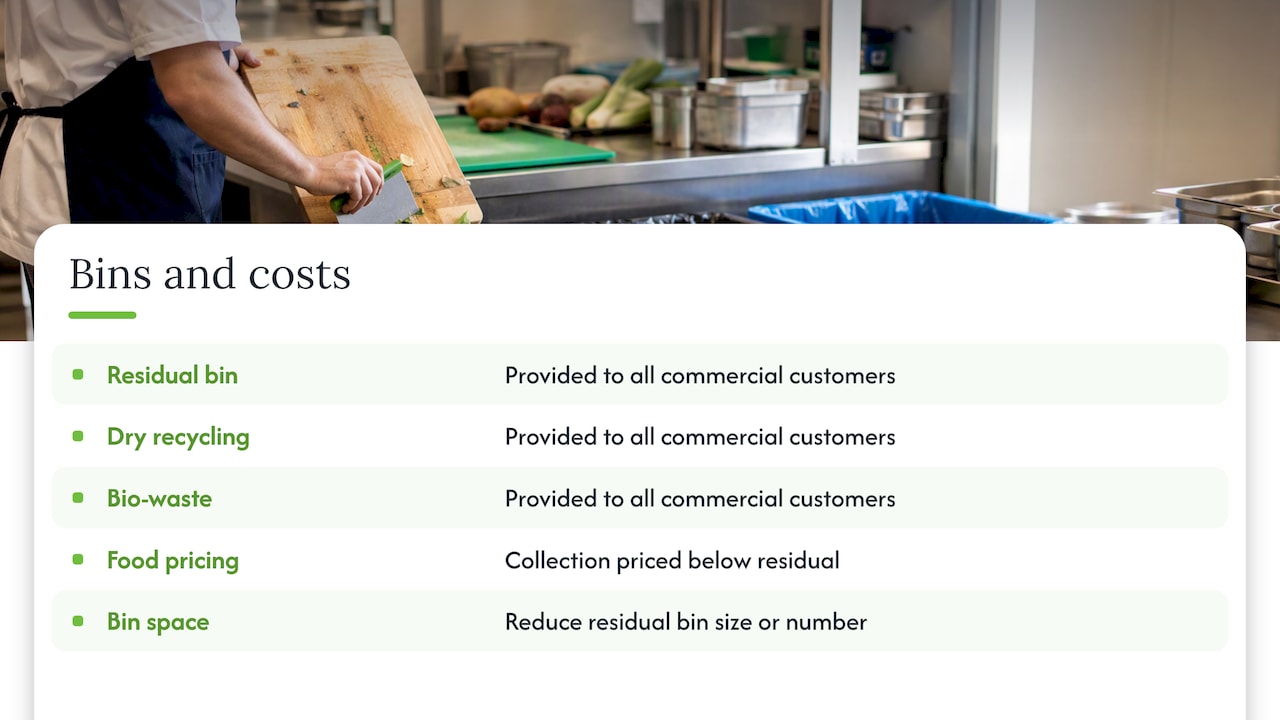
Commercial customers should no longer have to ask for a food waste service. Under rules announced by the Department of the Environment in 2023, every waste collection company must provide a residual, mixed dry recyclable and bio-waste bin to all its commercial customers.
The information note adds the commercial point: collectors are expected to price food waste collection below residual waste. Moving food from the black bin to the brown bin can therefore cut cost, not add it. Food is heavy and wet, so taking it out of general waste often reduces what you pay by weight or lift.
If you think you have no room for another bin, the note advises talking to your collector. You can often reduce the size or number of residual bins to make space.
What goes in the brown bin
The MyWaste guide says the service accepts more than raw food: cooked meat and fish, plate scrapings, coffee grounds and tea bags are all fine. Staff often assume otherwise, so say so on your bin signage.
Compostable packaging is allowed only if it is certified to the European standard EN 13432, shown by the seedling logo. Ordinary plastic liners and “biodegradable” claims without that certification are not acceptable. Check your collector’s own contamination rules too, as they can be stricter.
Enforcement: how likely is an inspection?
Local authorities enforce the regulations. EPA data on local authority inspections shows around 1,282 dedicated commercial food waste inspections in 2025, up from 1,250 in 2024. That is steady, not occasional.
The consequences, per the MyWaste guide, can include enforcement notices, fixed payment notices or prosecution. Inspections are aimed at premises suspected of having no segregated service.
Two further points deserve attention:
- Shared liability. The information note says the operator of the food business and the building occupier can both be held jointly and severally liable. If you are a commercial landlord or property manager, you cannot assume the tenant will deal with it.
- Collector cameras. The same note reports that collectors increasingly use AI cameras on their trucks to spot contamination, such as food in the black bin. That makes it easier for them to identify and report non-compliant premises.
Proving compliance: records to keep
If an authorised officer asks, you need to show how your food waste leaves the building. Build a simple file now:
- Your contract or service agreement with an authorised collector, and the collector’s permit details
- Collection dockets or invoices showing a brown bin lift
- For on-site treatment, evidence of authorisation and regular operating logs
- For direct transfer, dockets from the receiving facility
- A note of where bins are, who empties the internal caddies and how staff are trained
Food businesses already keep temperature and maintenance logs for hygiene inspections. If you want a model for orderly, inspection-ready paperwork, this guide to refrigerator record keeping and maintenance templates shows the discipline. Apply the same habit to your waste file: dated, complete and easy to hand over.
Why this is also a cost question
Ireland has a food waste problem that regulation is trying to tackle. The EPA estimated that the country generated 750,000 tonnes of food waste in 2022, about 145kg per person, above the EU average of 130kg.
For a business, the money is in the detail. Food waste is heavy, so every kilo left in the residual bin is a kilo you pay residual rates on. A sensible order of work looks like this:
- Measure. Weigh what you bin for a week, by stream. Most sites find the split surprising.
- Segregate. Set up the brown bin service and put caddies where food waste actually arises: kitchen, staff room, serving area.
- Right-size. Ask your collector to reduce residual capacity once food is out of it.
- Reduce. Track what is thrown away unserved and adjust ordering and portions.
- Review the economics of on-site treatment if volumes are high and constant.
Our own guidance on cutting waste disposal costs within one or two billing cycles walks through the same logic for the whole waste bill, not only food.
Our perspective: compliance is the easy part
We spend our days looking at what businesses actually put in their bins, and the pattern is consistent. Food waste compliance is rarely a technical problem. It is a visibility problem. Nobody has weighed the streams, nobody knows what the residual bin really contains, and the collection contract has not been read since it was signed.
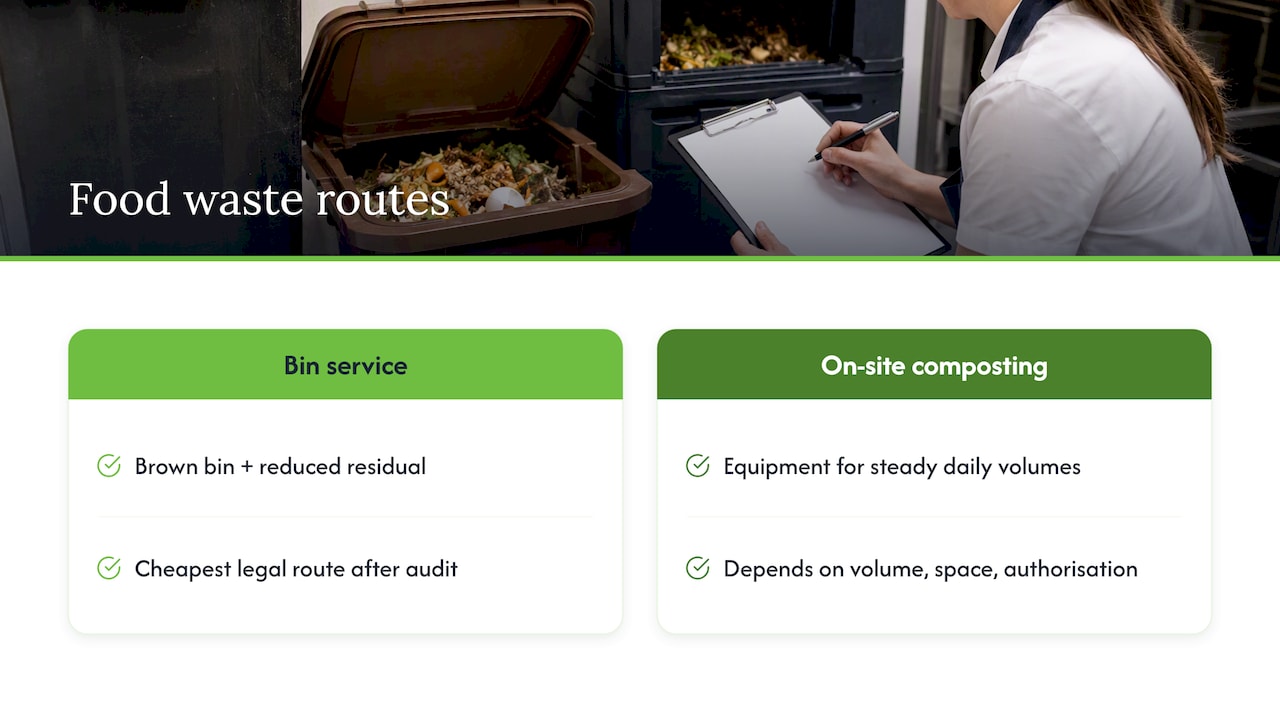
That is why we start with an audit rather than a machine. A site that has measured its waste can choose the cheapest legal route with confidence. Sometimes that is simply a brown bin and a reduced residual bin. For a restaurant, hotel or food producer with steady daily volumes, it can mean looking at on-site organic waste composting equipment. We say “looking at” deliberately: whether on-site treatment makes sense depends on volume, space and the authorisation position, and we would rather you reached that decision with numbers.
The other half of the picture is the dry side. Once food leaves the general bin, cardboard and plastic become the next big lines on your invoice. They are also the ones with resale value, which is where a baler and a buyback arrangement can turn a cost into income. Compliance and cost reduction are the same project if you approach them together.
— Graham
Practical steps by type of premises
Offices and workplaces
You are covered even if there is no canteen. Ask your collector for a brown bin and a small-format caddy for the kitchenette. Tell staff what is accepted, tea bags included. If your office waste is generally unmeasured, an office waste audit shows what each stream costs.
Restaurants, cafés and takeaways
Volumes are higher and contamination risk is greater, especially from packaging. Use only EN 13432 certified compostable items in the food stream. Our article on four ways restaurants can compost food waste and meet regulations covers the options in more detail.
Landlords and property managers
Because liability can be joint, put food waste provisions in tenancy documents and check that multi-tenant bin stores can accommodate three streams. Agree who holds the collection records.
Warehouses, logistics and manufacturing sites
Staff catering and vending make you subject to the rules. Treat the canteen like any food premises and keep the dockets with your other environmental records.
How Compact can help
We offer a free waste audit that reviews what your site produces, what it costs and what is the most practical route to compliance. We supply cardboard balers and compactors, and we run a bale buyback scheme so the dry recyclables you separate can earn money. If you want one point of contact from audit to equipment to collection and payment, start with the audit.
FAQ
Is it illegal to put food waste in the general waste bin at work?
Yes, for commercial premises where food is prepared, consumed or supplied. The regulations require food waste to be segregated and kept out of other waste. Penalties can range from enforcement notices to fixed payment notices or prosecution, according to MyWaste.
Does a small business or office with very little food waste need a brown bin?
Yes. The 50kg-a-week exemption was removed from 1 July 2024, so size no longer matters. If food is consumed on the premises, you need a segregated route, such as a brown bin service.
What can’t go in a commercial food waste bin?
Ordinary plastic bags and packaging do not belong there. Compostable packaging is accepted only when certified to EN 13432, the seedling logo standard. Cooked food, plate scrapings, coffee grounds and tea bags are accepted, but check your own collector’s contamination rules as well.
What if I have no space for another bin?
Talk to your collector. The Department’s information note says you can often reduce the size or number of residual bins to make room for a brown bin. If space is a real constraint, ask about smaller bin formats or collection frequency.
Who is responsible if a tenant does not comply?
Both the food business operator and the building occupier can be held jointly and severally liable, according to the information note. Landlords and managers should therefore check arrangements, not assume them. For a specific situation, take advice from your local authority’s waste enforcement team or a solicitor.
Sources
- S.I. No. 294/2024, Waste Management (Food Waste) (Amendment) Regulations 2024
- MyWaste: Workplace food waste summary guide
- Information Note: Commercial Premises Regulatory Requirements for Segregated Food Waste Management
- Department press release on incentivised waste collection charges
- EPA: Local Authority Environmental Inspections and Enforcement Data 2024 and 2025
- EPA: Circular Economy Waste Statistics Highlights Report 2022