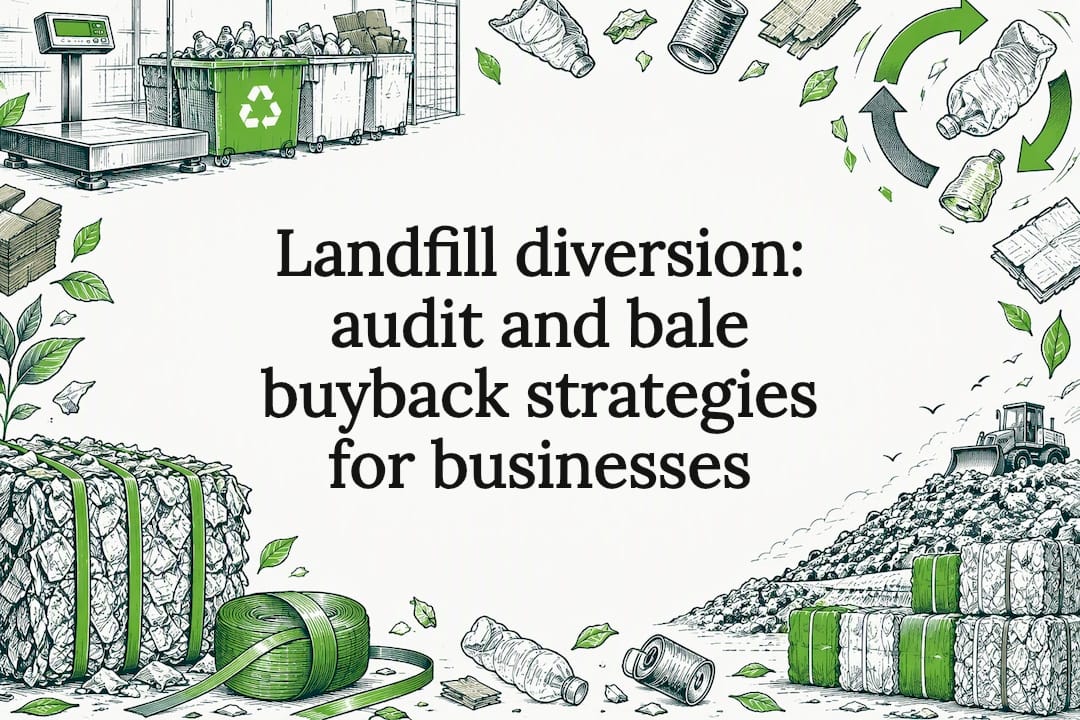
The strategies that cut landfill waste fastest for businesses are prevention, source separation, organics management and high-quality material capture through baling or compaction, applied together rather than piecemeal. EPA data shows Ireland still sends a meaningful share of municipal waste to landfill, against a 2035 target of 10%, so the gap is real and closeable with the right mix of operational changes.
TL;DR:
- Reusing and recycling materials like cardboard, organics, and plastics through source separation and baling can significantly cut landfill waste.
- Organic waste diversion through composting or anaerobic digestion has the biggest potential impact on reducing methane emissions that contribute to climate change.
- Conducting a waste audit first is essential to identify contamination issues and accurately measure diversion rates before investing in equipment.
- Monitoring key indicators such as diversion and contamination rates, along with tonne-by-stream data, ensures better compliance and financial returns from rebates.
- Equipment like balers, compactors, and sensors amplifies diversion efforts by improving material quality, reducing haulage costs, and providing measurable results.
Table of Contents
- What landfill diversion means and the waste hierarchy
- Why diversion matters: climate, cost and compliance
- Which materials and streams businesses can divert
- How to measure diversion: rates, KPIs and reporting
- Practical strategies businesses can adopt
- Technology and innovation that scale diversion
- Policy, regulation and procurement considerations
- Implementation checklist: audit to continuous improvement
- Practitioner perspective: what a tailored audit and bale buyback model delivers
- The gap between good intentions and good data
- Our approach: a free waste audit and the equipment to back it up
- FAQ
- Sources
What landfill diversion means and the waste hierarchy
Landfill diversion is any action that keeps waste out of landfill, whether through prevention, reuse, recycling or recovery. The terminology matters: “diversion” is the broad outcome, “recovery” covers processes like energy recovery or composting, and “backfilling” refers to using waste material to replace non-waste materials in applications such as land reclamation, which EU law only permits when strictly necessary.
Policy treats these options as a strict priority order, not a menu of equals:
- Prevention comes first: generating less waste in the first place.
- Preparing for reuse follows: checking, cleaning or repairing items so they stay in circulation.
- Recycling processes materials into new products.
- Recovery extracts value, often through energy recovery.
- Disposal, including landfill, is the last resort.
A business that redesigns packaging to use less cardboard is acting higher up this hierarchy than one that simply recycles more cardboard, even though both reduce landfill volume.
Why diversion matters: climate, cost and compliance
Landfilled waste, particularly organic material, generates methane as it decomposes, a far more potent greenhouse gas than carbon dioxide over the short term. Diverting organics and recyclables away from landfill is one of the more direct levers a business has over its own emissions’ footprint, and policy now treats it as a compliance matter as much as an environmental one.
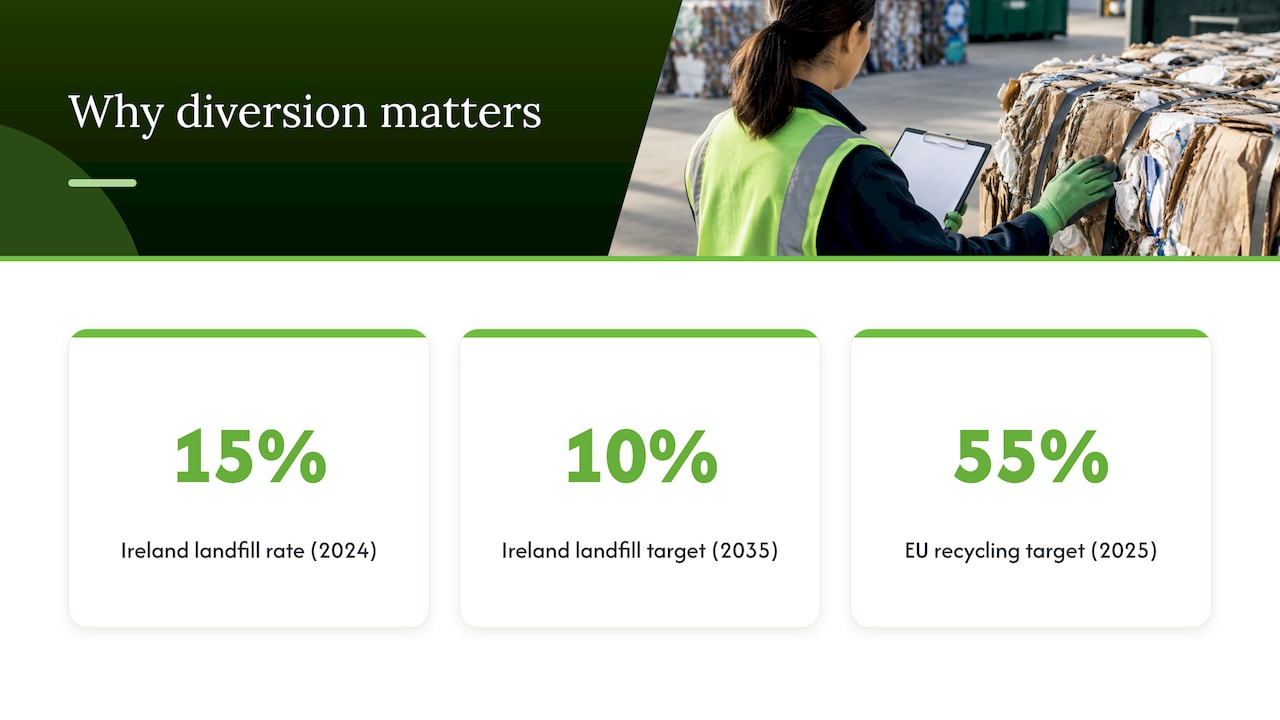
Ireland generated municipal waste in 2024, with around 15% sent to landfill, against a national target of cutting that figure to 10% by 2035. Ireland’s municipal recycling rate sits below the 55% EU target set for 2025, which leaves a measurable gap that better business-level segregation and material recovery can help close.
Beyond compliance, the financial case is direct: landfill gate fees and haulage costs rise as volumes grow, while well-prepared recyclable material can generate rebates instead of costs. For many facility managers, the diversion decision is as much about the balance sheet as the compliance file.
Which materials and streams businesses can divert
Most commercial waste falls into a short list of streams, each with its own best route out of landfill:
- Food and organic waste: composting or anaerobic digestion, often via an authorised collector.
- Cardboard and paper: baling for recycling, typically the highest-value stream for many commercial sites.
- Plastics, including film and EPS: segregation and specialist recycling or compaction, since mixed plastics lose value fast.
- Metals: straightforward recycling with strong rebate potential when kept clean.
- Glass: recycling through dedicated collection, as it contaminates other streams if mixed in.
- Construction and demolition (C&D) waste: selective demolition and material-specific recycling rather than mixed skips.
- WEEE (waste electrical and electronic equipment): specialist take-back schemes.
Plastics and organics are the streams most prone to contamination. A single damp cardboard load or a film stream mixed with food residue can collapse the rebate value of an entire bale, which is why on-site controls at the point of generation matter more than downstream sorting ever can.
How to measure diversion: rates, KPIs and reporting
Diversion rate is the proportion of total waste generated that avoids landfill, expressed as a percentage.
Facility managers tracking performance should monitor a short set of indicators:
- Diversion rate, calculated monthly against the same baseline each time.
- Contamination rate per stream, since a rising figure signals a training or bin-labelling problem.
- Tonnes by stream, to spot which materials are growing or shrinking.
- Revenue recovered from rebates or buyback payments, as a direct financial KPI.
These business-level figures feed the same logic national bodies use for EPA and Eurostat reporting, where diversion is tracked against set national and EU targets. A business that measures consistently can show auditors and regulators exactly where its waste goes, not just how much of it there is.
Practical strategies businesses can adopt
The highest-impact actions sit in a rough order of priority, though most sites need several running at once:
- Prevention: procurement rules that favour less packaging, bulk ordering and product substitution to cut waste before it exists.
- Source separation: clearly labelled, stream-specific bins placed where waste is generated, backed by staff training and spot-checks on contamination.
- Reuse and repair loops: internal take-back arrangements for pallets, containers and durable equipment instead of default disposal.
- Material capture: balers and compactors that turn loose cardboard and film into dense, saleable bales rather than low-value mixed waste, as covered in more detail on our page about cardboard balers and waste compactors.
- Organics management: on-site composting or in-vessel digestion where volumes justify it, or a contract with an authorised collector where they do not.
- Contract management: choosing collectors who can show where material actually ends up, rather than ones who simply move it off-site.
Pro Tip: Audit your bin contents for one week before changing anything: the contamination you find tells you exactly which training or labelling gap to fix first.
The sequencing matters. A business that installs a baler before fixing contamination at the bin simply bales low-grade material faster. Fixing separation first, then investing in equipment, tends to produce a cleaner and more valuable output stream.
Technology and innovation that scale diversion
Equipment choice depends on volume and material mix rather than ambition alone:
- Balers compress cardboard and plastic into dense bales that command better rebates and cost less to haul.
- Compactors suit high-volume mixed waste or cardboard where space and collection frequency are the main constraints.
- EPS compactors handle polystyrene, which is bulky and otherwise expensive to transport in loose form.
- Industrial shredders and dewatering systems reduce the volume and weight of bulky or wet waste streams before collection.
On the monitoring side, bin sensors and route optimisation tools can cut collection frequency and flag contamination before it reaches a bale. Reverse vending systems for drinks containers and anaerobic digestion for food waste extend diversion into streams that bins alone cannot handle well.
Working out return on investment does not require complex modelling: compare the haulage cost reduction from fewer, denser loads, the rebate uplift from cleaner material, and the labour time saved against the equipment’s running cost, using tonnage figures from a proper waste audit rather than estimates.
Policy, regulation and procurement considerations
Compliance obligations now shape diversion decisions as much as cost does. Under Irish food waste regulations, commercial producers must source-segregate food waste and either use an authorised collector or treat it on-site, with no option to send it to general waste.
National and EU policy reinforces the same direction:
- The waste hierarchy remains the legal priority order underpinning national waste plans and EU directives.
- Recycling and landfill targets set the pace that businesses are, directly or indirectly, expected to help meet.
- C&D waste recycling requires genuine separation by material type, since mixed demolition debris rarely qualifies for high-value recovery; practical guidance on this can be found in our partner’s tips on construction site debris removal.
When negotiating collection contracts, build in clauses covering traceability of where material ends up, recycling or reuse KPIs, and the right to audit the collector’s records.
Implementation checklist: audit to continuous improvement
Most successful diversion programmes follow the same sequence:
- Run a waste audit: sample bins across a representative week, recording weight and composition by stream.
- Set SMART targets: align diversion goals with national benchmarks and any company sustainability commitments.
- Pilot interventions: trial new bins, labelling or a single piece of equipment on one site or shift before wider rollout.
- Measure results: compare diversion rate and contamination rate before and after the pilot.
- Scale what works: negotiate new collection contracts, purchase equipment or formalise service agreements, then track KPIs monthly rather than annually.
Skipping the audit stage is the most common reason diversion programmes underperform: without a baseline, it is impossible to tell whether a new bin system or a new baler actually moved the numbers.
Practitioner perspective: what a tailored audit and bale buyback model delivers
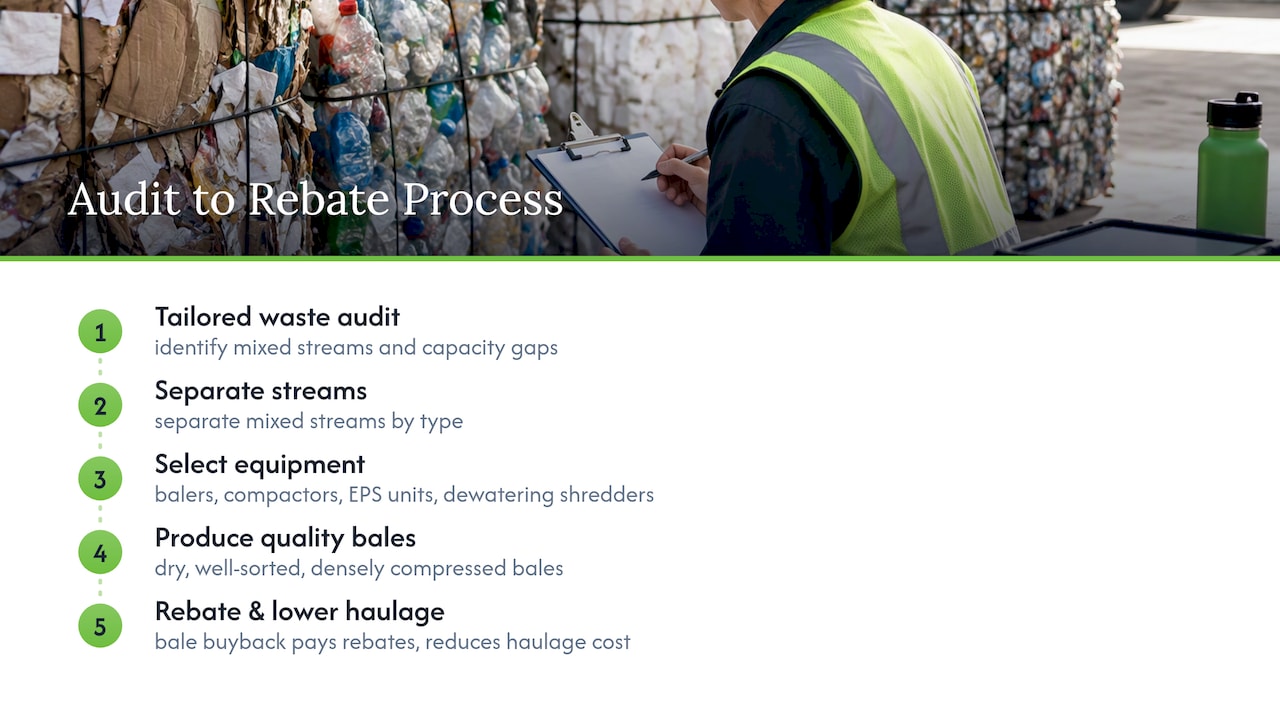
A proper waste audit typically uncovers the same recurring issues: mixed streams that should be separated, under-used recycling capacity and collection frequencies set by habit rather than actual volume. Addressing those three alone often improves diversion rates before any equipment changes hands.
A bale buyback arrangement works by paying businesses for the cardboard and plastic they bale, turning what was previously a disposal cost into a revenue line. The better the bale quality, meaning dry, well-sorted and densely compressed, the stronger the rebate and the lower the haulage cost per tonne. Balers, compactors, EPS recycling units and dewatering shredders each play a role depending on the waste mix a site actually produces, which is why the audit comes first and the equipment decision comes second.
The gap between good intentions and good data
The conventional advice on landfill diversion leans heavily on awareness: better bins, better signage, more enthusiastic recycling campaigns. None of that is wrong, but it treats a measurement problem as a behaviour problem. Most businesses that think they are diverting well have never actually weighed what leaves their site by stream, so they cannot tell whether their programme is improving or just feels better.
What the evidence here actually supports is less glamorous than a sustainability campaign: audit first, fix contamination at the source, then invest in equipment that matches the volumes you have measured, not the volumes you assume. Organics and plastics contamination quietly destroys more diversion potential than any missing bin ever does.
If there is one priority worth taking from this, it is to stop guessing at tonnage and start measuring it. Everything else, from equipment purchase to contract renegotiation, becomes a far easier decision once the numbers are real.
— Graham
Our approach: a free waste audit and the equipment to back it up
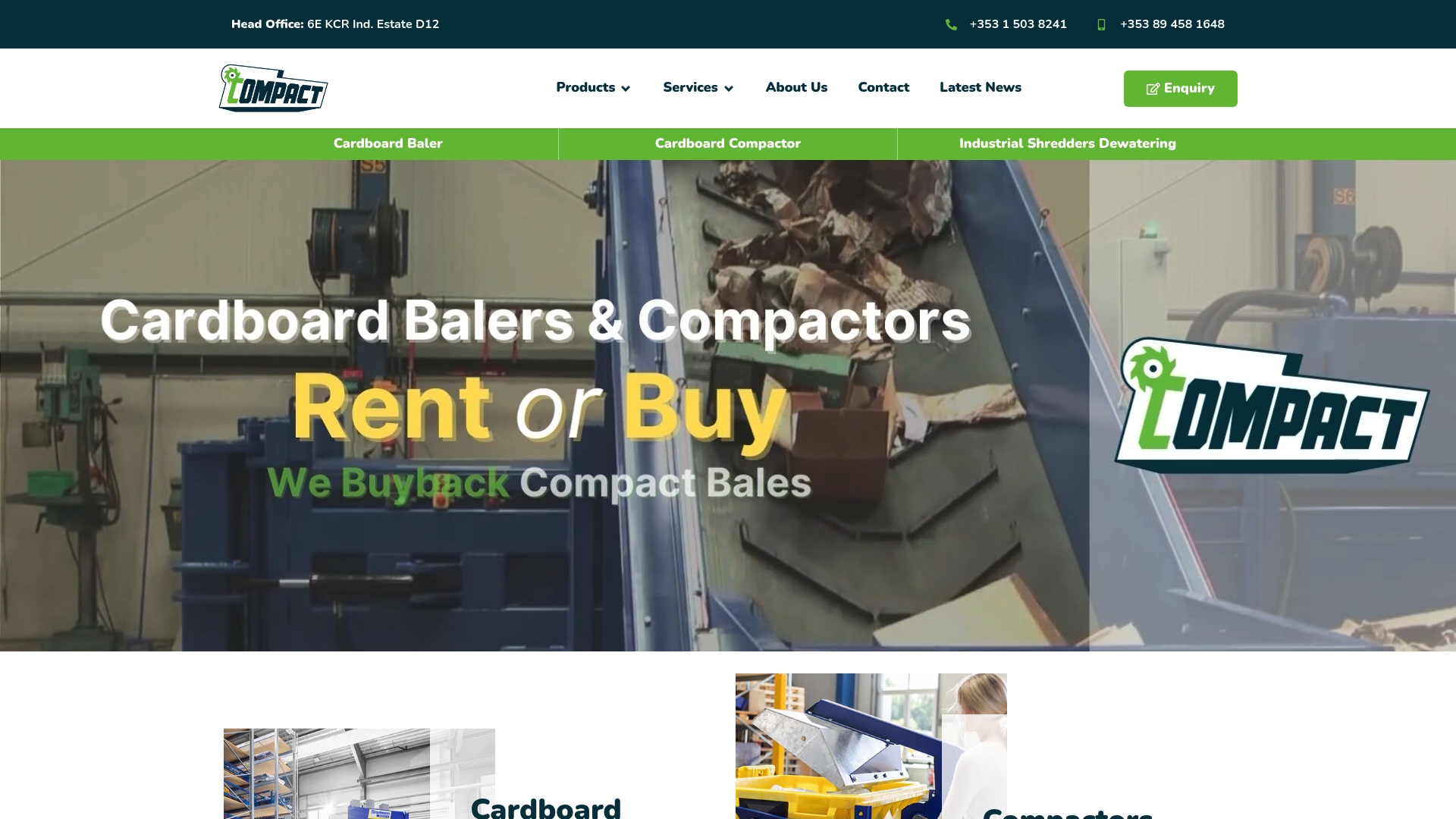
We start every engagement with a free waste audit, because no diversion strategy works without an honest picture of what a site actually throws away. From there, we supply the equipment that matches what the audit finds, whether that is a cardboard baler, a compactor or an EPS unit, and we buy back the resulting bales through our bale buyback programme.
For businesses, the practical outcomes tend to look like this:
- A clearer diversion rate, backed by audit data rather than estimates.
- Easier compliance reporting, since material flows are tracked from bin to buyer.
- A new revenue line from bales that were previously a disposal cost.
If you want to see where your own numbers stand, book a free waste audit and we will tell you honestly what is worth changing first.
FAQ
What are some examples of waste diversion practices?
Common examples include source separation of recyclables at the point of generation, composting or anaerobic digestion of food waste, baling cardboard and plastic for recycling, and reuse schemes for pallets or packaging. Procurement changes that reduce packaging before it enters the waste stream also count as diversion, since prevention sits above recycling in the waste hierarchy.
What is landfill diversion?
Landfill diversion means keeping waste out of landfill through prevention, reuse, recycling or recovery rather than disposal. EPA figures show around 15% of Ireland’s municipal waste still goes to landfill, against a national target of 10% by 2035.
What are 5 waste management strategies?
The five most widely used strategies are prevention, preparing for reuse, recycling, recovery and disposal, listed here in the priority order set by the waste hierarchy. Businesses typically combine prevention and source separation with organics management and material capture through baling or compaction for the fastest results.
What is the best method for reducing landfill waste?
No single method works alone: prevention reduces waste at source, while source separation and organics management stop recyclable and compostable material reaching landfill in the first place. Pairing those behavioural changes with equipment that improves material quality, such as a cardboard baler, tends to produce the largest measurable reduction.
How do businesses measure their landfill diversion rate?
Diversion rate is the share of total waste generated that is recycled, composted or otherwise recovered rather than landfilled, usually tracked monthly against a fixed baseline. Facility managers typically pair this figure with contamination rate and tonnes-by-stream data to spot where a programme is underperforming.
Sources
- Municipal Waste Statistics for Ireland | Environmental Protection Agency
- Waste Management (Food Waste) Regulations 2024 (Ireland) — Irish Statute Book
- Diversion of waste from landfill in Europe | Indicators — EEA